
This is a very interesting (and readable) article about the blending of mathematics and coaching college basketball: http://www.fanragsports.com/cbb/college-basketballs-numbers-game/
Engaging students: Multiplying polynomials
In my capstone class for future secondary math teachers, I ask my students to come up with ideas for engaging their students with different topics in the secondary mathematics curriculum. In other words, the point of the assignment was not to devise a full-blown lesson plan on this topic. Instead, I asked my students to think about three different ways of getting their students interested in the topic in the first place.
I plan to share some of the best of these ideas on this blog (after asking my students’ permission, of course).
This student submission again comes from my former student Daniel Herfeldt. His topic, from Algebra: multiplying polynomials.

How could you as a teacher create an activity or project that involves your topic?
Activities for multiplying polynomials are endless. An activity that I would do with my students is a game called polynomial dice. To do this, you would first is to get several blank dice and write random polynomials on each side of the dice. Then in class, divide the students into groups of no more than three. Each group will get a pair of dice. Have the students roll the dice and they should have two different polynomials. Once they have rolled, have them multiply the polynomials together. This is best done with groups so that the students can share their work with their partners to see if they both got the same answer. If they did not get the same answer, they can go back through each other’s steps to see where they went wrong. If you want to make the game a bit harder, you can add more dice to make them multiply three polynomials, or maybe even more. This is a great game because it can be used for multiplying polynomials, as well as dividing, adding and subtracting. It could be a great review game before a major test to have students remember how to do each individual property. For example, have the students roll the dice, then with the two polynomials they get, they first add the polynomials, followed by the difference, then the product, and finally the quotient.
How can this topic be used in your students’ future courses in mathematics or science?
Multiplying polynomials is used all over mathematics. It is first introduced in Algebra I and Algebra II. Multiplying polynomials can be very difficult for students and make them not want to do the work. This is due to there being so much work for one problem. Since there is so much work, there is a lot of room for mistakes. This topic is used is Algebra I, Algebra II, Algebra III, Pre-Calculus, Calculus and just about every higher math course. If a student is looking to go into an architecture or engineering field, they will have to apply their knowledge of polynomials. Due to this, the topic is one of the most important topics that students need to understand. Knowing how to multiply polynomials also makes it easier to divide polynomials. If a student is struggling with dividing polynomials, you can go back to showing them how to multiply them. Once a student sees the pattern of multiplying polynomials, they are more likely to get the hang of dividing them.
How can technology (YouTube, Khan Academy [khanacademy.org], Vi Hart, Geometers Sketchpad, graphing calculators, etc.) be used to effectively engage students with this topic?
I believe this video would be a great engage for the students when you, as a teacher, are teaching the students how to multiply polynomials for the first time. This video helps students remember what exactly is a polynomial. Although there is only three types of polynomials in the video (monomial, binomial, and trinomial), it uses the three main types that students will be using in a high school level. Another great thing in the video is that it shows how to tell the degree of the polynomial. Although it seems easy to just say the power of x is the same as the degree, students still might forget how to do it. For example, a student might think that a digit by itself and with no variable has a degree of one, but is really a degree of zero. The final point that is key to this video is that it shows students how to line up the terms. Some students might put 6+x^2+3x, and although that is still correct, it will be better written as x^2+3x+6.
Engaging students: Solving systems of linear inequalities
In my capstone class for future secondary math teachers, I ask my students to come up with ideas for engaging their students with different topics in the secondary mathematics curriculum. In other words, the point of the assignment was not to devise a full-blown lesson plan on this topic. Instead, I asked my students to think about three different ways of getting their students interested in the topic in the first place.
I plan to share some of the best of these ideas on this blog (after asking my students’ permission, of course).
This student submission again comes from my former student Heidee Nicoll. Her topic, from Algebra: solving linear systems of inequalities.
How could you as a teacher create an activity or project that involves your topic?
I found a fun activity on a high school math teacher’s blog that makes solving systems of linear inequalities rather exciting.
Link: (https://livelovelaughteach.files.wordpress.com/2013/09/treasure-hunt1.pdf)
The students are given a map of the U.S. with a grid and axes over the top, and their goal is to find where the treasure is hidden. At the bottom of the page there are six possible places the treasure has been buried, marked by points on the map. The students identify the six coordinate points, and then use the given system of inequalities to find the buried treasure. This teacher’s worksheet has six equations, and once the students have graphed all of them, the solution contains only one of the six possible burial points. I think this activity would be very engaging and interesting for the students. Using the map of the U.S. is a good idea, since it gives them a bit of geography as well, but you could also create a map of a fictional island or continent, and use that as well. To make it even more interesting, you could have each student create their own map and system of equations, and then trade with a partner to solve.
How does this topic extend what your students should have learned in previous courses?
If students have a firm understanding of inequalities as well as linear systems of equations, then they have all the pieces they need to understand linear systems of inequalities quite easily and effectively. They know how to write an inequality, how to graph it on the coordinate plane, and how to shade in the correct region. They also know the different processes whereby they can solve linear systems of equations, whether by graphing or by algebra. The main difference they would need to see is that when solving a linear system of equations, their solution is a point, whereas with a linear system of inequalities, it is a region with many, possibly infinitely many, points that fit the parameters of the system. It would be very easy to remind them of what they have learned before, possibly do a little review if need be, and then make the connection to systems of inequalities and show them that it is not something completely different, but is simply an extension of what they have learned before.
How can technology be used effectively to engage students with this topic?
Graphing calculators are sufficiently effective when working with linear systems of equations, but when working with inequalities, they are rather limited in what they can help students visualize. They can only do ≥, not just >, and have the same problem with <. It is also difficult to see the regions if you have multiple inequalities because the screen has no color. This link is an online graphing calculator that has several options for inequalities: https://www.desmos.com/calculator. You can choose any inequality, <, >, ≤, or ≥, type in several equations or inequalities, and the regions show up on the graph in different colors, making it easier to find the solution region. Another feature of the graphing calculator is that the equations or inequalities do not have to be in the form of y=. You can type in something like 3x+2y<7 or solve for y and then type it in. I would use this graphing calculator to help students visualize the systems of inequalities, and see the solution. When working with more than two inequalities, I would add just one region at a time to the graph, which you can do in this graphing calculator by clicking the equation on or off, so the students could keep track of what was going on.
References
Live.Love.Laugh.Teach. Blog by Mrs. Graves. https://livelovelaughteach.wordpress.com/category/linear-inequalities/
Graphing calculator https://www.desmos.com/calculator
Engaging students: Using the point-slope equation of a line
In my capstone class for future secondary math teachers, I ask my students to come up with ideas for engaging their students with different topics in the secondary mathematics curriculum. In other words, the point of the assignment was not to devise a full-blown lesson plan on this topic. Instead, I asked my students to think about three different ways of getting their students interested in the topic in the first place.
I plan to share some of the best of these ideas on this blog (after asking my students’ permission, of course).
This student submission again comes from my former student Brittany Tripp. Her topic, from Algebra: using the point-slope equation of a line.
How can this topic be used in your students’ future courses in mathematics and science?
The point-slope equation of a line can be used in a variety of different ways in mathematics classes that some students may encounter later on. It is used in Calculus when dealing with polynomials. For instance, “key concepts of calculus: limits, continuity, derivatives, and integrals are all relatively trivial for polynomial functions.” It is also seen when dealing with Linear Approximations. “A differentiable function is one for which there is a tangent line at each point on the graph. In an intuitive sense, the tangent to a curve at a point is the line that looks most like the curve at the point of tangency. Assuming that f is differentiable at a, the tangent line to the graph y = f(x) at the point (a,f(a)) is given by the equation.
y – f(a) = f ‘(a)(x – a)
This equation arises from the point-slope formula for the line passing through (a,f(a)) with slope f ‘(a).” In Pre-Calculus with discussing horizontal and vertical shifts you can easily relate back to point-slope equation of a line. You can relate point-slope equation of a line to the definition of derivative where the equation is rewritten with limits to describe the slope as the derivative. This is just a few ways that point-slope pops up in later mathematics courses. It is important to be able to form the point-slope equations of a line, as well as slope-intercept form, and being about to understand it well enough to build off of it when leading into harder concepts.
How has this topic appeared in pop culture (movies, TV, current music, video games, etc.)?
Point-slope equation of a line is used in movies in a huge way that most people probably never even realize. Point-slope equation of a line is used in pinhole cameras. A pinhole camera “is a simple optical imaging device in the shape of a closed box or chamber. In one of its sides is a small hole which, via the rectilinear propagation of light, creates an image of the outside space on the opposite side of the box.” In other words, let’s say we had an object, there is light constantly bouncing off the object. In the case of a pinhole camera, there is a small hole in the nearest wall/barrier which only allows light to pass through the hole. The light that makes it through the hole then hits the far wall, or image plane, creating a projection of the original image. The way point-slope equation of a line is used is first by adding a coordinate plane that has the origin centered at the pinhole. We can imagine that our scene is off to the right of the origin and the image plane is off to the left of the origin. We can choose some point in our scene to be a coordinate point in our coordinate plane. Some of the light bouncing off of that point in our scene will pass through the pinhole and land somewhere on our image plane. One of the ways we can find where it lands in our image plane is by using slope-intercept equation of a line. There is a really cool video on the khan academy website that talks all about the mathematics behind pinhole cameras. There is actually an entire curriculum called Pixar in a Box that goes through a variety of different topics and subject matter that is involved in the making of Pixar movies.
How can technology be used to effectively engage students with this topic?
There are a ton of games online that involve point-slope equation of a line. One website that I found that has a variety of games on it is called Websites for Math. I went and tried out some of these games myself and found them to be fun and entertaining, but somewhat challenging at the same time. The website has links to different games that pertain to slope and equation of a line. You can choose games specifically by what form of an equation of a line you want to practice, among other things. The first game I tried was Algebra Vs. Cockroaches. It pops up with a coordinate plane with a cockroach on it and you have to type in the equation of the line in order to kill the cockroach, but if you take too long the cockroaches start to multiple. I liked this game because it started with just having you identify the y-intercept before leading into harder equations. However, this game focused more on slope-intercept equation of a line than point-slope equation. There were games specifically designed for point-slope equation of a line. One of those games being point-slope jeopardy. If you choose a questions for 300 points you are given a coordinate point and a slope and asked to write the point-slope equation that fits for the given data. If you choose a question for 600 points you are given two coordinate points and asked to write the point-slope equation of the line that fits the given data. Therefore, you must first use the coordinate points to calculate the slope and then plug that into your equation. What I also like about this game is that you can either play by yourself or with a friend. The things I enjoy most about this website is that it has games that don’t only pertain to slope-intercept equation of a line. There are games that focus on slope specifically, graphing equations, slope-intercept form, etc. That way if you are having issues with any of the topics that may have been discussed previously, to point-slope equations of a line, you can find a game that might help refresh your memory.
References:
http://calculuswithjulia.github.io/precalc/polynomial.html
https://www.khanacademy.org/partner-content/pixar/virtual-cameras/depth-of-field/v/optics6-final
http://www.pinhole.cz/en/pinholecameras/whatis.html
https://www2.gcs.k12.in.us/jpeters/slope.htm
http://hotmath.com/hotmath_help/games/kp/kp_hotmath_sound.swf
Engaging students: Finding the slope of a line
In my capstone class for future secondary math teachers, I ask my students to come up with ideas for engaging their students with different topics in the secondary mathematics curriculum. In other words, the point of the assignment was not to devise a full-blown lesson plan on this topic. Instead, I asked my students to think about three different ways of getting their students interested in the topic in the first place.
I plan to share some of the best of these ideas on this blog (after asking my students’ permission, of course).
This student submission again comes from my former student Brianna Horwedel. Her topic, from Algebra: finding the slope of a line.
How can technology (YouTube, Khan Academy [khanacademy.org], Vi Hart, Geometers Sketchpad, graphing calculators, etc.) be used to effectively engage students with this topic?
Algebra vs. the Cockroaches is a great way to get students engaged in learning about slopes. The object of the game is to kill the cockroaches by figuring out what the equation of the line that they are walking on is. It progresses from simple lines such as y=5 to more complicated equations such as y=(-2/3)x+7. It allows the students to quickly recognize y-intercepts and slopes. Once finished, you can print out a “report” that tells you how many the student got correct and how many tries it took them to complete a level. This game could even be used as a formative assessment for the teacher.
http://hotmath.com/hotmath_help/games/kp/kp_hotmath_sound.swf
How could you as a teacher create an activity or project that involves your topic?
Last year, I was placed in an eighth grade classroom that was learning about slope. One of the things that really stuck out to me was that the teacher gave a ski illustration to get the students talking about slope. The illustration starts off with the teacher going skiing. She talks about how when she is going up the ski lift she is really excited and having a “positive” experience which correlates to the slope being positive. Once she gets off of the ski lift, she isn’t going up or down, but in a straight line. She talks about how she doesn’t really feel either excited or nervous because she is on flat ground. This corresponds to lines that have a slope of 0. She then proceeds to talk about how when she starts actually going down the ski slope, she hates it! This relates to the negative slope of a line. She also mentions how she went over the side of a cliff and fell straight down. She was so scared she couldn’t even think or “define” her thoughts. This is tied to slopes that are undefined. I thought that this illustration was a great way of explaining the concept of slope from a real world example. After sharing the illustration, the students could work on problems involving calculating the slope of ski hills.
How can this topic be used in your students’ future courses in mathematics or science?
Understanding how to find the slope of a line is crucial for mathematics courses beyond Algebra I and Algebra II. Particularly, knowing how to find the slope of a line is essential for finding tangent lines of curves. This comes in handy for Calculus when you have to use limits to determine the slope. If a student does not have a strong grasp of what slope means and what its relationship is with the graph and the equation in Algebra I, then they will have a difficult time understanding slopes of lines that are not straight.
The Math Behind Super Mario
Forbes magazine had a great piece that can be shared with students about how mathematics is used when programming video games: http://www.forbes.com/sites/quora/2016/10/21/this-is-the-math-behind-super-mario/#57f7cf532a5c
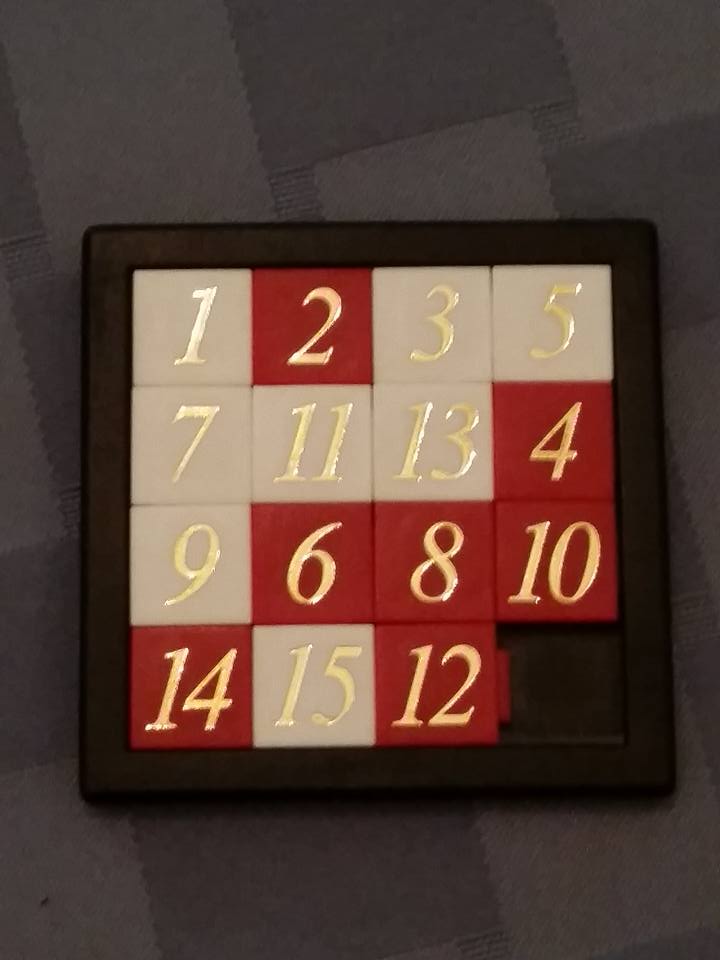
15-square puzzle
From the category “This Is Completely Useless”: here’s what a 15-square puzzle looks like when you arrange the tiles in order of how many factors they have.
The Student-to-Teacher Dictionary
I really enjoyed this thoughtful blogpost from Math With Bad Drawings. A sample:

See the whole thing here: https://mathwithbaddrawings.com/2016/10/26/the-student-to-teacher-dictionary/
My Mathematical Magic Show: Index
I’m doing something that I should have done a long time ago: collecting a series of posts into one single post. The links below show the mathematical magic show that I’ll perform from time to time.
Part 1: Introduction.
Part 2a, Part 2b, and Part 2c: The 1089 trick.
Part 3a, Part 3b, and Part 3c: A geometric magic trick.
Part 4a: Part 4b, Part 4c, and Part 4d: A trick using binary numbers.
Part 5a, Part 5b, Part 5c, and Part 5d: A trick using the rule for checking if a number is a multiple of 9.
Part 7: The Fitch-Cheney card trick, which is perhaps the slickest mathematical card trick ever devised.
Part 8a, Part 8b, and Part 8c: A trick using Pascal’s triangle.
Part 9: Mentally computing 


Part 6: The Grand Finale.
And, for the sake of completeness, here’s a recent picture of me just before I performed an abbreviated version of this show for UNT’s Preview Day for high school students thinking about enrolling at my university.

The Perfect Geometrical Christmas Present
Behold, a three-dimensional calendar on the faces of a rhombic dodecahedron:

Source: https://www.wired.com/2016/10/gorgeous-12-sided-wooden-calendar-geometry-nerd-life/

