Lessons from teaching gifted elementary school students (Part 5a)

Every so often, I’ll informally teach a class of gifted elementary-school students. I greatly enjoy interacting with them, and I especially enjoy the questions they pose. Often these children pose questions that no one else will think about, and answering these questions requires a surprisingly depth of mathematical knowledge.

Here’s a question I once received (though I probably changed the exact wording somewhat):

Exponentiation is to multiplication as multiplication is to addition. In other words,

x^y = x \cdot x \cdot x \dots \cdot x,

x \cdot y = x + x + x \dots + x,

where the operation is repeated y times.

So, multiplication is to addition as addition is to what?

My kneejerk answer was that there was no answer… while exponents can be thought of as repeated multiplication and multiplication can be thought of as repeated addition, addition can’t be thought of as some other thing being repeated.

Which then naturally led to my student’s next question, which I was dreading:

Can you prove that?

This led to another kneejerk reaction, but I kept this one quiet: “Aw, nuts.”

I suggested that x + y can be thought of as starting with x and then adding 1 repeatedly y times, but my bright student wouldn’t hear of this. After all, in the repeated renderings of x^y and x \cdot y, there’s no notion of starting with a number and then doing something with a different number y times.

So I had to put my thinking cap on, and I’m embarrassed to say that it took me a good five minutes before I came up with a logically correct answer that, in my opinion, could be understand by the bright young student who asked the question.

I’ll reveal that answer in tomorrow’s post. In the meantime, I’ll leave a thought bubble if you’d like to think about it on your own.

green_speech_bubble

Is 2i less than 3i? (Part 4: Two other attempted inequalities)

In yesterday’s post, I demonstrated that there is no subset \mathbb{C}^+ \subset \mathbb{C} of the complex numbers which satisfies the following four axioms:

  • If z_1, z_2 \in \mathbb{C}^+, then z_1+z_2 \in \mathbb{C}^+
  • If z_1, z_2 \in \mathbb{C}^+, then z_1 z_2 \in \mathbb{C}^+.
  • For every z \ne 0, either z \in \mathbb{C}^+ or -z \in \mathbb{C}^+, but not both.
  • 0 \notin \mathbb{C}^+

However, it’s instructive (and fun) to try to construct such a set. Yesterday I showed that the following subset satisfies three of the four axioms:

\mathbb{C}^+ = \{x + iy : x > 0 \qquad \hbox{or} \qquad x = 0, y > 0\}

Apostol’s calculus suggests two other subsets to try:

\mathbb{C}^+ = \{x + iy : x^2 + y^2 > 0 \}

and

\mathbb{C}^+ = \{x + iy : x > y\}

Neither of these sets work either, but I won’t spoil the fun for you by giving you the proofs. I leave a thought bubble if you’d like to try to figure out which of the four axioms are satisfied by these two notions of “positive” complex numbers.

green_speech_bubble


Is 2i less than 3i? (Part 3: An inequality that almost works)

In yesterday’s post, I demonstrated that there is no subset \mathbb{C}^+ \subset \mathbb{C} of the complex numbers which satisfies the following four axioms:

  • If z_1, z_2 \in \mathbb{C}^+, then z_1+z_2 \in \mathbb{C}^+
  • If z_1, z_2 \in \mathbb{C}^+, then z_1 z_2 \in \mathbb{C}^+.
  • For every z \ne 0, either z \in \mathbb{C}^+ or -z \in \mathbb{C}^+, but not both.
  • 0 \notin \mathbb{C}^+

However, it’s instructive (and fun) to try to construct such a set. One way of attempting this is defining

\mathbb{C}^+ = \{x + iy : x > 0 \qquad \hbox{or} \qquad x = 0, y > 0\}

This set \mathbb{C}^+ leads to the lexicographic ordering of the complex numbers: if z_1 = a_1 + i b_1 and z_2 = a_2 + i b_2, where a_1, a_2, b_1, b_2 \in \mathbb{R}, we say that z_1 \prec z_2 if

a_1 < a_2 \qquad \hbox{or} \qquad a_1 = a_2, b_1 < b_2

I used the symbol z_1 \prec z_2 because, as we’ll see, \prec satisfies some but not all of the usual properties of an inequality. This ordering is sometimes called the “dictionary” order because the numbers are ordered like the words in a dictionary… the real parts are compared first, and then (if that’s a tie) the imaginary parts are compared. See Wikipedia and Mathworld for more information.

In any case, defining \mathbb{C}^+ in this way satisfies three of the four order axioms.

  • Suppose z_1, z_2 \in \mathbb{C}^+. It’s straightforward to show that z_1 + z_2 \in \mathbb{C}^+. Let z_1 = a_1 + i b_1 and z_2 = a_2 + i b_2, where a_1, a_2, b_1, b_2 \in \mathbb{R}. Then a_1, a_2 \ge 0, and so a_1 + a_2 \ge 0.
    • Case 1: If a_1 + a_2 > 0, then clearly z_1 + z_2 \in \mathbb{C}^+.
    • Case 2: If a_1 + a_2 = 0, that’s only possible if a_1 = 0 and a_2 = 0. But since z_1, z_2 \in \mathbb{C}^+, that means that b_1 > 0 and b_2 > 0. Therefore, b_1 + b_2 > 0. Since a_1 + a_2 = 0, we again conclude that z_1 + z_2 \in \mathbb{C}^+.
  • Suppose z = a + bi \ne 0, where a, b \in \mathbb{R}. Then a \ne 0 or b \ne 0. We now show that, no matter what, z \in \mathbb{C}^+ or -z \in \mathbb{C}^+, but not both.
    • Case 1: If a > 0, then -a < 0, and so z \in \mathbb{C}^+ but -z \notin \mathbb{C}^+.
    • Case 2: If a < 0, then -a > 0, and so -z \in \mathbb{C}^+ but z \notin \mathbb{C}^+.
    • Case 3: If a = 0, then b \ne 0 since z \ne 0. Also, if a = 0, then -a = 0, so that z = bi and -z = -bi.
      • Subcase 3A: If b > 0, then -b < 0, and so z \in \mathbb{C}^+ but -z \notin \mathbb{C}^+.
      • Subcase 3B: If b < 0, then -b > 0, and so -z \in \mathbb{C}^+ but z \notin \mathbb{C}^+.
  • By definition, 0 = 0 + 0i \notin \mathbb{C}^+.

However, the fourth property fails. By definition, i = 0 + 1i \in \mathbb{C}^+. However, i \cdot i = -1 + 0i \notin \mathbb{C}^+.

green line

Because this definition of \mathbb{C}^+ satisfies three of the four order axioms, the relation \prec satisfies some but not all of the theorems stated in the first post of this series. For example, if z_1 \prec z_2 and z_2 \prec z_3, then z_1 \prec z_3. Also, if z_1 \prec z_2 and w_1 \prec w_2, then z_1 + w_1 \prec z_2 + w_2.

I’ll leave it to the interested reader to determine which of the theorems are true, and which are false (and have counterexamples).

Is 2i less than 3i? (Part 2: Proof by contradiction)

Is 2i less than 3i?

That’s a very natural question for a student to ask when first learning about complex numbers. The short answer is, “No… there isn’t a way to define inequality for complex numbers that satisfies all the properties of real numbers.”

I demonstrated this in a roundabout way in yesterday’s post. Today, let’s tackle the issue using a proof by contradiction. (I almost said, “Let’s tackle the issue more directly,” but avoided that phrase because a proof by contradiction is sometimes called an indirect proof, which would lead to the awkward sentence “Let’s tackle the issue more directly with an indirect proof.”)

Suppose that there’s a subset \mathbb{C}^+ \subset \mathbb{C} of the complex numbers which satisfies the following four axioms:

  • If z_1, z_2 \in \mathbb{C}^+, then z_1+z_2 \in \mathbb{C}^+
  • If z_1, z_2 \in \mathbb{C}^+, then z_1 z_2 \in \mathbb{C}^+.
  • For every z \ne 0, either z \in \mathbb{C}^+ or -z \in \mathbb{C}^+, but not both.
  • 0 \notin \mathbb{C}^+

As discussed yesterday, the ordinary properties of inequalities derive from these four order axioms. Assuming these four order axioms are true for the complex numbers, let’s investigate whether i is “positive” or not. According to the third axiom, either i \in \mathbb{C}^+ or -i \in \mathbb{C}^+, but not both.

Case 1. i \in \mathbb{C}^+. Then by the second axiom, i \cdot i \in \mathbb{C}^+, or -1 \in \mathbb{C}^+. Applying the second axiom again, since i \in \mathbb{C}^+ and -1 \in \mathbb{C}^+, we have i \cdot (-1) \in \mathbb{C}^+, or -i \in \mathbb{C}^+. But that’s impossible because we assumed that i \in \mathbb{C}^+.

Case 2. -i \in \mathbb{C}^+. Then by the second axiom, (-i) \cdot (-i) \in \mathbb{C}^+, or -1 \in \mathbb{C}^+. Applying the second axiom again, since -i \in \mathbb{C}^+ and -1 \in \mathbb{C}^+, we have (-i) \cdot (-1) \in \mathbb{C}^+, or i \in \mathbb{C}^+. But that’s impossible because we assumed that -i \in \mathbb{C}^+.

Either way, we obtain a contradiction. Therefore, there is no subset \mathbb{C}^+ of the complex numbers that serves as the “positive” complex numbers, and so there’s no way to define inequalities for complex numbers that satisfies all of the usual properties of inequalities.

Is 2i less than 3i? (Part 1: Order Axioms)

Is 2i less than 3i?

That’s a very natural question for a student to ask when first learning about complex numbers. The short answer is, “No… there isn’t a way to define inequality for complex numbers that satisfies all the properties of real numbers.”

However, for this answer to make sense, we need to talk about how inequalities are defined in the first place.

Following Apostol’s calculus, there are four axioms from which the ordinary notions of inequality follow. We shall assume that there exists a certain subset \mathbb{R}^+ \subset \mathbb{R}, called the set of positive numbers, which satisfies the following four order axioms:

  • If x, y \in \mathbb{R}^+, then x+y \in \mathbb{R}^+
  • If x, y \in \mathbb{R}^+, then xy \in \mathbb{R}^+.
  • For every real x \ne 0, either x \in \mathbb{R}^+ or -x \in \mathbb{R}^+, but not both.
  • 0 \notin \mathbb{R}^+

We then define the symbols <, \le, >, and \ge in the obvious way:

  • x < y means that y-x is positive.
  • x > y means that $y < x$.
  • x \le y means that either x < y or x=y.
  • x \ge y means that y \le x

From only these four axioms, many familiar theorems about inequalities can be proven. For what it’s worth, when I was a student in Algebra I, I had to prove nearly all of these theorems.

  • If a, b \in \mathbb{R}, then exactly one of the following three relations is true: a < b, a > b, a = b.
  • If a < b and b < c, then a < c.
  • If a < b, then a + c < b + c.
  • If a < b and c > 0, then ac < bc.
  • If a \ne 0, then a^2 > 0.
  • 1 > 0.

We interrupt this list with a public-service announcement: Yes, there’s a proof that 1 is greater than 0. When I tell this to students, I can usually see their heads start to spin, as they think, “Of course we know that!” Then I ask them what the definitions of 1 and 0 are. Usually, they have no idea. Then I’ll remind them that 0 is defined to be the additive identity (so that x + 0 = x and 0 + x = x for all real numbers x), while 1 is defined to be the multiplicative identity (so that x \cdot 1 = x and 1 \cdot x = x for all real numbers x). Based on those definitions alone, I then ask my students, is it obvious that the multiplicative identity has to be larger than the additive identity? The answer is no, which is why the above order axioms are needed.

Here are some more familiar theorems about inequalities that derive from the four order axioms.

  • If a < b and c < 0, then ac > bc.
  • If a < b, then -a > -b.
  • If a < 0, then -a > 0.
  • If ab > 0, then a and b are either both positive or both negative.
  • If a < c and b < d, then a + b < c + d.
  • If a < 0 and b < 0, then a + b < 0.
  • If a > 0, then 1/a > 0.
  • If a < 0, then 1/a < 0.
  • If 0 < a < b, then 0 < 1/b < 1/a.
  • If a \le b and b \le c, then a \le c.
  • If a \le b \le c and a = c, then b = c.

These last two theorems are less familiar. They basically state that (1) there is no “biggest” real number and (2) there is no positive number that’s immediately to the right of 0.

  • There is no real number a so that x \le a for all real numbers x.
  • If 0 \le x < h for every positive real number h, then x =0.

green line

Here’s another important theorem that ultimately derives from the four order axioms, proving that a number system including \sqrt{-1} is incompatible with the four order axioms.

  • There is no real number x so that x^2 + 1 = 0.

The proof of this theorem is simple, given the theorems above. If x = 0, then x^2 + 1 = 1, which is greater than 0. If x \ne 0, then x^2 > 0, and so x^2 + 1 > 0 + 1 > 1. Since 1 > 0, it follows by transitivity that x^2 > 0. Either way, x^2 + 1 > 0, and so x^2 + 1 \ne 0.

Proving theorems and special cases (Part 17): Conclusion

In a recent class with my future secondary math teachers, we had a fascinating discussion concerning how a teacher should respond to the following question from a student:

Is it ever possible to prove a statement or theorem by proving a special case of the statement or theorem?

Usually, the answer is no. In this series of posts, we’ve seen that a conjecture could be true for the first 40 cases or even the first 10^{316} cases yet not always be true. We’ve also explored the computational evidence for various unsolved problems in mathematics, noting that even this very strong computational evidence, by itself, does not provide a proof for all possible cases.

Source: http://mathwithbaddrawings.com/2015/06/24/mathemacomics/

However, there are plenty of examples in mathematics where it is possible to prove a theorem by first proving a special case of the theorem. As I’ve hopefully shown through this series, using only examples that could appear in the secondary curriculum, this is a technique that comes up again and again in mathematics, and here’s a story that a like to tell my students to get this idea across.

Here’s a story that I’ll tell my students when, for the first time in a semester, I’m about to use a lemma to make a major step in proving a theorem. (I think I was 13 when I first heard this one, and obviously it’s stuck with me over the years.)

At MIT, there’s a two-part entrance exam to determine who will be the engineers and who will be the mathematicians. For the first part of the exam, students are led one at a time into a kitchen. There’s an empty pot on the floor, a sink, and a stove. The assignment is to boil water. Everyone does exactly the same thing: they fill the pot with water, place it on the stove, and then turn the stove on. Everyone passes.

For the second part of the exam, students are led one at a time again into the kitchen. This time, there’s a pot full of water sitting on the stove. The assignment, once again, is to boil water. Nearly everyone simply turns on the stove. These students are led off to become engineers. The mathematicians are ones who take the pot off the stove, dump the water into the sink, and place the empty pot on the floor… thereby reducing to the original problem, which had already been solved.


Proving theorems and special cases (Part 16): An old homework problem

In a recent class with my future secondary math teachers, we had a fascinating discussion concerning how a teacher should respond to the following question from a student:

Is it ever possible to prove a statement or theorem by proving a special case of the statement or theorem?

Usually, the answer is no. In this series of posts, we’ve seen that a conjecture could be true for the first 40 cases or even the first 10^{316} cases yet not always be true. We’ve also explored the computational evidence for various unsolved problems in mathematics, noting that even this very strong computational evidence, by itself, does not provide a proof for all possible cases.

However, there are plenty of examples in mathematics where it is possible to prove a theorem by first proving a special case of the theorem. For the remainder of this series, I’d like to list, in no particular order, some common theorems used in secondary mathematics which are typically proved by first proving a special case.

The following problem appeared on a homework assignment of mine about 30 years ago when I was taking Honors Calculus out of Apostol’s book. I still remember trying to prove this theorem (at the time, very unsuccessfully) like it was yesterday.

Theorem. If f(x) is a continuous function so that f(x+y) = f(x) + f(y), then f(x) = cx for some constant c.

Proof. The proof mirrors that of the uniqueness of the logarithm function, slowly proving special cases to eventually prove the theorem for all real numbers x.

Case 1. x = 0. If we set x =0 and y = 0, then

f(0+0) = f(0) + f(0)

f(0) = 2 f(0)

0 = f(0)

Case 2. x \in \mathbb{N}. If x is a positive integer, then

f(x) = f(1 + 1 + \dots + 1)

f(x) = f(1) + f(1) + \dots + f(1)

f(x) = xf(1).

(Technically, this should be proven by induction, but I’ll skip that for brevity.) If we let c = f(1), then f(x) = cx.

Case 3. x \in \mathbb{Z}. If x is a negative integer, let x = -n, where n is a positive integer. Then

f(x + (-x)) = f(x) + f(-x)

f(0) = f(x) + f(n)

0 = f(x) + cn

-cn = f(x)

cx = f(x)

Case 4. x \in \mathbb{Q}. If x is a rational number, then write x = p/q, where p and q are integers and q is a positive integer. We’ll use the fact that p = xq = p/q \times q = p/q + p/q + \dots + p/q, where the sum is repeated q times.

f(p/q + p/q + \dots + p/q) = f(p)

f(p/q) + f(p/q) + \dots + f(p/q) = cp

q f(p/q) = cp

f(p/q) = cp/q

f(x) = cx

Case 5. x \in \mathbb{R}. If x is a real number, then let \{r_n\} be a sequence of rational numbers that converges to x, so that

\lim_{n \to \infty} r_n = x

Then, since f is continuous,

f(x) = f \left( \displaystyle \lim_{n \to \infty} r_n \right)

f(x) =\displaystyle \lim_{n \to \infty} f(r_n)

f(x) = \displaystyle \lim_{n \to \infty} c r_n

f(x) = cx

QED

green line

Random Thought #1: The continuity of the function f was only used in Case 5 of the above proof. I’m nearly certain that there’s a pathological discontinuous function that satisfies f(x+y) = f(x) + f(y) which is not the function f(x) = cx. However, I don’t know what that function might be.

Random Thought #2: For what it’s worth, this same idea can be used to solve the following problem that was posed during UNT’s Problem of the Month competition in January 2015. I won’t solve the problem here so that my readers can have the fun of trying to solve it for themselves.


Problem. Determine all nonnegative continuous functions that satisfy

f(x+t) = f(x) + f(t) + 2 \sqrt{f(x)} \sqrt{f(t)}.


Proving theorems and special cases (Part 15): The Mean Value Theorem

In a recent class with my future secondary math teachers, we had a fascinating discussion concerning how a teacher should respond to the following question from a student:

Is it ever possible to prove a statement or theorem by proving a special case of the statement or theorem?

Usually, the answer is no. In this series of posts, we’ve seen that a conjecture could be true for the first 40 cases or even the first 10^{316} cases yet not always be true. We’ve also explored the computational evidence for various unsolved problems in mathematics, noting that even this very strong computational evidence, by itself, does not provide a proof for all possible cases.

However, there are plenty of examples in mathematics where it is possible to prove a theorem by first proving a special case of the theorem. For the remainder of this series, I’d like to list, in no particular order, some common theorems used in secondary mathematics which are typically proved by first proving a special case.

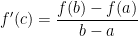
6. Theorem (Mean Value Theorem). If f is a continuous function on the interval [a,b] which is differentiable on the interior (a,b), then there is a point c \in (a,b) so that

f'(c) = \displaystyle \frac{f(b)-f(a)}{b-a}

In other words, there is a point c in (a,b) so that the slope of the tangent line at c is the same as the slope of the line segment connecting the endpoints.

This is a consequence of the following lemma.

Lemma (Rolle’s Theorem). If f is a continuous function on the interval [a,b] which is differentiable on the interior (a,b) so that f(a) = 0 and f(b) = 0, then there is a point c \in (a,b) so that f'(c) = 0.

Notice that Rolle’s Theorem is really a special case of the Mean Value Theorem: if f(a) = 0 and f(b) = 0, then the right-hand side of the conclusion of the Mean Value Theorem becomes

\displaystyle \frac{f(b)-f(a)}{b-a} = \displaystyle \frac{0-0}{b-a} = 0,

thus matching the conclusion of Rolle’s Theorem.

I won’t type out the proofs of Rolle’s Theorem and the Mean Value Theorem here, since Wikipedia has already done that very well. Suffice it to say that Rolle’s Theorem logically comes first, and then the Mean Value Theorem can be proven using Rolle’s Theorem. The main idea is to assume that the function f satisfies the hypotheses of the Mean Value Theorem and then define

g(x) = f(x) - f(a) - \displaystyle \frac{f(b)-f(a)}{b-a} (x-a)

It’s straightforward to show that g satisfies the hypotheses of Rolle’s Theorem and conclude that there must be a point so that g'(c) = 0, from which we obtain the conclusion of the Mean Value Theorem.

Proving theorems and special cases (Part 14): The Power Law of differentiation

In a recent class with my future secondary math teachers, we had a fascinating discussion concerning how a teacher should respond to the following question from a student:

Is it ever possible to prove a statement or theorem by proving a special case of the statement or theorem?

Usually, the answer is no. In this series of posts, we’ve seen that a conjecture could be true for the first 40 cases or even the first 10^{316} cases yet not always be true. We’ve also explored the computational evidence for various unsolved problems in mathematics, noting that even this very strong computational evidence, by itself, does not provide a proof for all possible cases.

However, there are plenty of examples in mathematics where it is possible to prove a theorem by first proving a special case of the theorem. For the remainder of this series, I’d like to list, in no particular order, some common theorems used in secondary mathematics which are typically proved by first proving a special case.

5. Theorem. For any rational number r, we have \displaystyle \frac{d}{dx} x^r = r x^{r-1}.

This theorem is typically proven using the Chain Rule (in the guise of implicit differentiation) and the following lemma:

Lemma. For any integer n, we have \displaystyle \frac{d}{dx} x^n = n x^{n-1}.

Clearly, the lemma is a special case of the main theorem. However, the lemma can be proven without using the main theorem:

Proof of Lemma (Case 1). If n is a positive integer, then

\displaystyle \frac{d}{dx} x^n = \displaystyle \lim_{h \to 0} \frac{(x+h)^n - x^n}{h}

= \displaystyle \lim_{h \to 0} \frac{x^n + n x^{n-1} h + \frac{1}{2} n(n-1) x^{n-2} + \dots + h^n - x^n}{h}

= \displaystyle \lim_{h \to 0} \left[ n x^{n-1} + \frac{1}{2} n(n-1) x^{n-2} h + \dots + h^{n-1} \right]

= n x^{n-1} + 0 + \dots + 0

= n x^{n-1}

Case 1 can also be proven using the Product Rule and mathematical induction.

Proof of Lemma (Case 2). If n = 0, then the theorem is trivially true since x^0 = 1, and the derivative of a constant is zero.

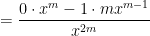
Proof of Lemma (Case 3). If n is a negative integer, then write n = -m, where m is a positive integer. Then, using the Quotient Rule,

\displaystyle \frac{d}{dx} x^n = \displaystyle \frac{d}{dx} \left( x^{-m} \right)

= \displaystyle \frac{d}{dx} \left( \frac{1}{x^m} \right)

= \displaystyle \frac{0 \cdot x^m - 1 \cdot m x^{m-1}}{x^{2m}}

= -m x^{-m - 1}

= n x^{n-1}

QED

Now that the lemma has been proven, the main theorem can be proven using the lemma.

Proof of Theorem. Suppose that r = p/q, where p and q are integers. Suppose that y = x^r = x^{p/q}. Then:

y = x^{p/q}

y^q = \displaystyle \left[ x^{p/q} \right]^q

y^q = x^p

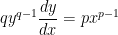
Let’s now differentiate with respect to x:

q y^{q-1} \displaystyle \frac{dy}{dx} = p x^{p-1}

\displaystyle \frac{dy}{dx} = \displaystyle \frac{p x^{p-1}}{q y^{q-1}}

\displaystyle \frac{dy}{dx} = \displaystyle \frac{p}{q} \frac{x^{p-1}}{[x^{p/q}]^{q-1}}

\displaystyle \frac{dy}{dx} = \displaystyle \frac{p}{q} \frac{x^{p-1}}{x^{p - p/q}}

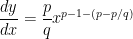
\displaystyle \frac{dy}{dx} = \displaystyle \frac{p}{q} x^{p-1 - (p-p/q)}

\displaystyle \frac{dy}{dx} = \displaystyle \frac{p}{q} x^{p - 1 - p + p/q}

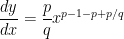
\displaystyle \frac{dy}{dx} = \displaystyle \frac{p}{q} x^{p/q - 1}

\displaystyle \frac{dy}{dx} = r x^{r-1}


QED

Proving theorems and special cases (Part 13): Uniqueness of logarithms

In a recent class with my future secondary math teachers, we had a fascinating discussion concerning how a teacher should respond to the following question from a student:

Is it ever possible to prove a statement or theorem by proving a special case of the statement or theorem?

Usually, the answer is no. In this series of posts, we’ve seen that a conjecture could be true for the first 40 cases or even the first 10^{316} cases yet not always be true. We’ve also explored the computational evidence for various unsolved problems in mathematics, noting that even this very strong computational evidence, by itself, does not provide a proof for all possible cases.

However, there are plenty of examples in mathematics where it is possible to prove a theorem by first proving a special case of the theorem. For the remainder of this series, I’d like to list, in no particular order, some common theorems used in secondary mathematics which are typically proved by first proving a special case.

The next theorem is needed in calculus to show that \ln x = \displaystyle \int_1^x \frac{dt}{t}.

4. Theorem. Let a \in \mathbb{R}^+ \setminus \{1\}. Suppose that f: \mathbb{R}^+ \rightarrow \mathbb{R} has the following four properties:

  1. f(1) = 0
  2. f(a) = 1
  3. f(xy) = f(x) + f(y) for all x, y \in \mathbb{R}^+
  4. f is continuous

Then f(x) = \log_a x for all x \in \mathbb{R}^+.

In other blog posts, I went through the full proof of this theorem, which is divided — actually, scaffolded — into cases:

Case 1. f(x) = \log_a x if x is a positive integer.

Case 2. f(x) = \log_a x if x is a positive rational number.

Case 3. f(x) = \log_a x if x is a negative rational number.

Case 4. f(x) = \log_a x if x is a real number.

Clearly, Case 1 is a subset of Case 2, and Case 3 is a subset of Case 4. Once again, a special case of a theorem is used to prove the full theorem.