My Favorite One-Liners: Part 107

In this series, I’m compiling some of the quips and one-liners that I’ll use with my students to hopefully make my lessons more memorable for them.

When students ask me how long it will take me to grade their exam, I’ll describe my tongue-in-cheek process for grading… I’ll go home, pop on the TV, and watch some movie that gets me in the proper mood for grading exams… perhaps Braveheart… or Gladiator… or The Godfather

My Favorite One-Liners: Part 106

In this series, I’m compiling some of the quips and one-liners that I’ll use with my students to hopefully make my lessons more memorable for them.

Years ago, when I first taught Precalculus at the college level, I was starting a section on trigonometry by reminding my students of the acronym SOHCAHTOA for keeping the trig functions straight:

\sin \theta = \displaystyle \frac{\hbox{Opposite}}{\hbox{Hypotenuse}},

\cos \theta = \displaystyle \frac{\hbox{Adjacent}}{\hbox{Hypotenuse}},

\tan \theta = \displaystyle \frac{\hbox{Opposite}}{\hbox{Adjacent}}.

At this point, one of my students volunteered that a previous math teacher had taught her an acrostic to keep these straight: Some Old Hippie Caught Another Hippie Tripping On Acid.

Needless to say, I’ve been passing this pearl of wisdom on to my students ever since.

My Favorite One-Liners: Part 104

In this series, I’m compiling some of the quips and one-liners that I’ll use with my students to hopefully make my lessons more memorable for them.

I use today’s quip when discussing the Taylor series expansions for sine and/or cosine:

\sin x = x - \displaystyle \frac{x^3}{3!} + \frac{x^5}{5!} - \frac{x^7}{7!} \dots

\cos x = 1 - \displaystyle \frac{x^2}{2!} + \frac{x^4}{4!} - \frac{x^6}{6!} \dots

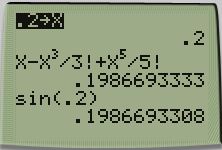
To try to convince students that these intimidating formulas are indeed correct, I’ll ask them to pull out their calculators and compute the first three terms of the above expansion for $x=0.2$, and then compute \sin 0.2. The results:

This generates a pretty predictable reaction, “Whoa; it actually works!” Of course, this shouldn’t be a surprise; calculators actually use the Taylor series expansion (and a few trig identity tricks) when calculating sines and cosines. So, I’ll tell my class,

It’s not like your calculator draws a right triangle, takes out a ruler to measure the lengths of the opposite side and the hypotenuse, and divides to find the sine of an angle.


My Favorite One-Liners: Part 103

In this series, I’m compiling some of the quips and one-liners that I’ll use with my students to hopefully make my lessons more memorable for them.

I’ll use today’s one-liner to give students my expectations about simplifying incredibly complicated answers. For example,

Find f'(x) if f(x) = \displaystyle \frac{\sqrt{x} \csc^5 (\sqrt{x} )}{x^2+1}.

Using the rules for differentiation,

f(x) = \displaystyle \frac{[\sqrt{x} \csc^5 (\sqrt{x} )]'(x^2+1) -[\sqrt{x} \csc^5 (\sqrt{x} )](x^2+1)' }{(x^2+1)^2}

= \displaystyle \frac{[(\sqrt{x})' \csc^5 (\sqrt{x} ) + \sqrt{x} (\csc^5(\sqrt{x}))'](x^2+1) - \sqrt{x} \csc^5 (\sqrt{x} )](2x) }{(x^2+1)^2}

= \displaystyle \frac{[\frac{1}{2\sqrt{x}} \csc^5 (\sqrt{x} ) + 5 \sqrt{x}  \csc^4(\sqrt{x}) [-\csc(\sqrt{x})\cot(\sqrt{x})]\frac{1}{2\sqrt{x}}(x^2+1) - \sqrt{x} \csc^5 (\sqrt{x} )](2x) }{(x^2+1)^2}

With some effort, this simplifies somewhat:

f'(x) = -\displaystyle \frac{\left(5 x^{5/2} \cot \left(\sqrt{x}\right)+3 x^2+5 \sqrt{x} \cot \left(\sqrt{x}\right)-1\right) \csc ^5\left(\sqrt{x}\right)}{2 \sqrt{x} \left(x^2+1\right)^2}

Still, the answer is undeniably ugly, and students have been well-trained by their previous mathematical education to think the final answers are never that messy. So, if they want to try to simplify it further, I’ll give them this piece of wisdom:

You can lipstick on a pig, but it remains a pig.

My Favorite One-Liners: Part 102

In this series, I’m compiling some of the quips and one-liners that I’ll use with my students to hopefully make my lessons more memorable for them.

I’ll use today’s one-liner when the final answer is a hideous mess. For example,

Find f'(x) if f(x) = \displaystyle \frac{\sqrt{x} \csc^5 (\sqrt{x} )}{x^2+1}.

The answer isn’t pretty:

f'(x) = -\displaystyle \frac{\left(5 x^{5/2} \cot \left(\sqrt{x}\right)+3 x^2+5 \sqrt{x} \cot \left(\sqrt{x}\right)-1\right) \csc ^5\left(\sqrt{x}\right)}{2 \sqrt{x} \left(x^2+1\right)^2}

This leads to the only possible response:

As all the King’s horses and all the King’s men said when discovering Humpty Dumpty… yuck.

My Favorite One-Liners: Part 101

In this series, I’m compiling some of the quips and one-liners that I’ll use with my students to hopefully make my lessons more memorable for them.

I’ll use today’s one-liner when a choice has to be made between two different techniques of approximately equal difficulty. For example:

Calculate \displaystyle \iint_R e^{-x-2y}, where R is the region \{(x,y): 0 \le x \le y < \infty \}

There are two reasonable options for calculating this double integral.

  • Option #1: Integrate with respect to x first:

\int_0^\infty \int_0^y e^{-x-2y} dx dy

  • Option #2: Integrate with respect to y first:

\int_0^\infty \int_x^\infty e^{-x-2y} dy dx

Both techniques require about the same amount of effort before getting the final answer. So which technique should we choose? Well, as the instructor, I realize that it really doesn’t matter, so I’ll throw it open for a student vote by asking my class:

Anyone ever read the Choose Your Own Adventure books when you were kids?

After the class decides which technique to use, then we’ll set off on the adventure of computing the double integral.

This quip also works well when finding the volume of a solid of revolution. We teach our students two different techniques for finding such volumes: disks/washers and cylindrical shells. If it’s a toss-up as to which technique is best, I’ll let the class vote as to which technique to use before computing the volume.

My Favorite One-Liners: Part 100

In this series, I’m compiling some of the quips and one-liners that I’ll use with my students to hopefully make my lessons more memorable for them.

Today’s quip is one that I’ll use surprisingly often:

If you ever meet a mathematician at a bar, ask him or her, “What is your favorite application of the Cauchy-Schwartz inequality?”

The point is that the Cauchy-Schwartz inequality arises surprisingly often in the undergraduate mathematics curriculum, and so I make a point to highlight it when I use it. For example, off the top of my head:

1. In trigonometry, the Cauchy-Schwartz inequality states that

|{\bf u} \cdot {\bf v}| \le \; \parallel \!\! {\bf u} \!\! \parallel \cdot \parallel \!\! {\bf v} \!\! \parallel

for all vectors {\bf u} and {\bf v}. Consequently,

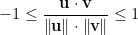
-1 \le \displaystyle \frac{ {\bf u} \cdot {\bf v} } {\parallel \!\! {\bf u} \!\! \parallel \cdot \parallel \!\! {\bf v} \!\! \parallel} \le 1,

which means that the angle

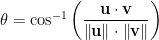
\theta = \cos^{-1} \left( \displaystyle \frac{ {\bf u} \cdot {\bf v} } {\parallel \!\! {\bf u} \!\! \parallel \cdot \parallel \!\! {\bf v} \!\! \parallel} \right)

is defined. This is the measure of the angle between the two vectors {\bf u} and {\bf v}.

2. In probability and statistics, the standard deviation of a random variable X is defined as

\hbox{SD}(X) = \sqrt{E(X^2) - [E(X)]^2}.

The Cauchy-Schwartz inequality assures that the quantity under the square root is nonnegative, so that the standard deviation is actually defined. Also, the Cauchy-Schwartz inequality can be used to show that \hbox{SD}(X) = 0 implies that X is a constant almost surely.

3. Also in probability and statistics, the correlation between two random variables X and Y must satisfy

-1 \le \hbox{Corr}(X,Y) \le 1.

Furthermore, if \hbox{Corr}(X,Y)=1, then Y= aX +b for some constants a and b, where a > 0. On the other hand, if \hbox{Corr}(X,Y)=-1, if \hbox{Corr}(X,Y)=1, then Y= aX +b for some constants a and b, where a < 0.

Since I’m a mathematician, I guess my favorite application of the Cauchy-Schwartz inequality appears in my first professional article, where the inequality was used to confirm some new bounds that I derived with my graduate adviser.

My Favorite One-Liners: Part 99

In this series, I’m compiling some of the quips and one-liners that I’ll use with my students to hopefully make my lessons more memorable for them.

Today’s quip is a light-hearted one-liner that I’ll use to lighten the mood when in the middle of a complex calculation, like the following limit problem from calculus:

Let f(x) = 11-4x. Find \delta so that |f(x) - 3| < \epsilon whenever $|x-2| < \delta$.

The solution of this problem requires isolating x in the above inequality:

|(11-4x) - 3| < \epsilon

|8-4x| < \epsilon

-\epsilon < 8 - 4x < \epsilon

-8-\epsilon < -4x < -8 + \epsilon

At this point, the next step is dividing by -4. So, I’ll ask my class,

When we divide by -4, what happens to the crocodiles?

This usually gets the desired laugh out of the middle-school rule about how the insatiable “crocodiles” of an inequality always point to the larger quantity, leading to the next step:

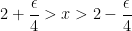
2 + \displaystyle \frac{\epsilon}{4} > x > 2 - \displaystyle \frac{\epsilon}{4},

so that

\delta = \min \left( \left[ 2 + \displaystyle \frac{\epsilon}{4} \right] - 2, 2 - \left[2 - \displaystyle \frac{\epsilon}{4} \right] \right) = \displaystyle \frac{\epsilon}{4}.

Formally completing the proof requires starting with |x-2| < \displaystyle \frac{\epsilon}{4} and ending with |f(x) - 3| < \epsilon.