Engaging students: Adding and subtracting a mixture of positive and negative integers

In my capstone class for future secondary math teachers, I ask my students to come up with ideas for engaging their students with different topics in the secondary mathematics curriculum. In other words, the point of the assignment was not to devise a full-blown lesson plan on this topic. Instead, I asked my students to think about three different ways of getting their students interested in the topic in the first place.

I plan to share some of the best of these ideas on this blog (after asking my students’ permission, of course).

This student submission again comes from my former student Marissa Arevalo. Her topic, from Algebra: adding and subtracting a mixture of positive and negative integers.

green line

How could you as a teacher create an activity or project that involves your topic?

An activity written by Kim Claryon The National Council of Teachers of Mathematics involves students understanding what it means when adding a negative integer, subtracting a positive integer, etc. This activity is called Zip, Zilch, Zero. Students are set in a group of 3 to 4 and dealt seven cards each, where the rest of the cards are left as a draw pile with a single card in the discard pile. Red cards are negative values and black cards are positive where Ace is equal to one, Jack is equal to eleven, Queen is equal to twelve, and King is equal to thirteen. Each student must draw a card from the top of the draw/discard pile. The point of the game is to add cards together to make a “Zip” or equal zero. the object of the game is that when a player plays the last card in their hand, all of the hands are scored by subtracting the absolute value of the sum of the cards in the hands from the absolute value of the cards played in a “Zip”. The winner has the highest score. Do note that the rules may be very tricky to understand as first and should be read aloud in class to help the games to go smoothly. Rules can be found on the website given below.


green line

How has this topic appeared in high culture (art, classical music, theatre, etc.)?


In a lot of idealizations of math by students, they do not associate STEM subjects with that of art. However, as a student who likes to paint and draw, I know that the arts involve a lot of mathematical logic in its creation, so one way to get the students involved, is to show that math is in everything. Therefore, I found a website with a video that discusses positive and negative space in a picture. In the video there is a black and white image of a tree on a flat landscape without anything in the background. The white space of the photo is referred to as the negative space and the black is the positive space as it is the subject and area of interest. In the video, the narrator describes that as the image is made smaller and larger that the value of the negative and positive space increases or decreases.

This can be a great engage as far as to asking the students to observe what happens when you make the subject area smaller or larger and whether or not that means if the negative space has decreased or increased. This could lead to a discussion as to how this relates to numbers and how the values of an integer change based on adding or subtracting from it.


green line

How can technology (YouTube, Khan Academy [khanacademy.org], Vi Hart, Geometers Sketchpad, graphing calculators, etc.) be used to effectively engage students with this topic?


A video I found on a blog “Embrace the Drawing Board” when I was looking through Pinterest had a very entertaining video that demonstrates what happens when adding or subtracting positive and negative integers. On the video the positive integers were green army men and the negative integers were red army men that were fighting in a “War of the Integers”. For example, in each battle, an equal amount of red and green army men will die on both sides when combining, or adding, the red and green men onto the battle field.


This is a great beginning to a sort of game between the students in which two students can play with one as the negative army and the other as the positive army. They can take turns to roll a pair of die where that number is the number of army they are brining to battle. Both students take turns deciding whose value goes first in the equation and then constructs the equations on a sheet of paper to figure out which side won the battle. Then, after about five to ten minutes of addition, the operation switches to subtraction, and the students continue to switch in whose number goes where in the equations.


_____   +  ______ = ________


_____   —  ______ = ________


Afterwards the teacher allow a student lead discussion by asking them what happened when subtracting a negative, adding a negative, etc. Then students can create their own theories and develop their own theories as to why they happened before the teacher can address any misconceptions.


References:


Click to access ZZZ-AS-RulesandRecord.pdf

http://thevirtualinstructor.com/positive-and-negative-space.html

http://mrpiccmath.weebly.com/blog/category/lesson%20ideas


Engaging students: Solving one-step algebra problems

In my capstone class for future secondary math teachers, I ask my students to come up with ideas for engaging their students with different topics in the secondary mathematics curriculum. In other words, the point of the assignment was not to devise a full-blown lesson plan on this topic. Instead, I asked my students to think about three different ways of getting their students interested in the topic in the first place.

I plan to share some of the best of these ideas on this blog (after asking my students’ permission, of course).

This student submission again comes from my former student Anna Park. Her topic, from Algebra: solving one-step algebra problems.

green line

How could you as a teacher create an activity or project that involves your topic?

Bingo game:

The teacher will create a bingo sheet with a free space in the middle, and integers in the other spaces. These integers represent the answers to the word problems that the teacher will be putting on the board or projector screen. Each word problem will either be a one-step equation or a two-step equation. A one step equation involves only one step to solve for the variable, this means only one operation will be done on the equation. The goal is to have the variable by itself on the left side of the equal sign and the numbers on the right side of the equal sign. A two-step equation is similar to a one step equation. A two-step equation is where it takes only two steps to solve for the variable in the equation that has more than one operation. The goal is the same as a one-step equation.
green line

How can this topic be used in your students’ future courses in mathematics or science?

  1. In future courses students will need to know how to isolate a variable in an equation to receive its value. They will need to know how to graph equations and inequalities in future mathematics courses. From Algebra and on students will need to know how to solve for the value of a variable.
  2. Students will also need to know how to create an equation given to them in word problems. Some of the classes that this will be needed for is Physics, geometry, algebra II, Pre-Calculus, Calculus, college courses..etc. Algebra is a tool for problem solving, and critical thinking. Word problems give real life examples of algebra and students will be able to apply this knowledge to real life situations and understand the problems given to them in future classes.


green line

How can technology (YouTube, Khan Academy [khanacademy.org], Vi Hart, Geometers Sketchpad, graphing calculators, etc.) be used to effectively engage students with this topic?

  1. Kolumath is a great youtube math channel that explains how to do certain math operations with great visual examples and clear explanations. The speaker talks clearly and is easy to understand, and the examples he uses ties in information the students have learned in previous courses. His visual examples allow students who struggle with picturing math functions to connect to the lesson.
  2. This channel also gives definitions over the topic and any definition relatable to the operations done in the video.
  3. Listed below are examples he uses on how to solve one-step and two-step equations. (References)

Solving one step equations:  https://www.youtube.com/watch?v=Ot-KSERw8Gc

Solving two step equations: https://www.youtube.com/watch?v=m7acIUcQ-7E


Statistics and percussion

I recently had a flash of insight when teaching statistics. I have completed my lectures of finding confidence intervals and conducting hypothesis testing for one-sample problems (both for averages and for proportions), and I was about to start my lectures on two-sample problems (liek the difference of two means or the difference of two proportions).

On the one hand, this section of the course is considerably more complicated because the formulas are considerably longer and hence harder to remember (and more conducive to careless mistakes when using a calculator). The formula for the standard error is longer, and (in the case of small samples) the Welch-Satterthwaite formula is especially cumbersome to use.

On the other hand, students who have mastered statistical techniques for one sample can easily extend this knowledge to the two-sample case. The test statistic (either z or t) can be found by using the formula (Observed – Expected)/(Standard Error), where the standard error formula has changed, and the critical values of the normal or t distribution is used as before.

I hadn’t prepared this ahead of time, but while I was lecturing to my students I remembered a story that I heard a music professor say about students learning how to play percussion instruments. As opposed to other musicians, the budding percussionist only has a few basic techniques to learn and master. The trick for the percussionist is not memorizing hundreds of different techniques but correctly applying a few techniques to dozens of different kinds of instruments (drums, xylophones, bells, cymbals, etc.)

It hit me that this was an apt analogy for the student of statistics. Once the techniques of the one-sample case are learned, these same techniques are applied, with slight modifications, to the two-sample case.

I’ve been using this analogy ever since, and it seems to resonate (pun intended) with my students as they learn and practice the avalanche of formulas for two-sample statistics problems.

Engaging students: Negative and zero exponents

In my capstone class for future secondary math teachers, I ask my students to come up with ideas for engaging their students with different topics in the secondary mathematics curriculum. In other words, the point of the assignment was not to devise a full-blown lesson plan on this topic. Instead, I asked my students to think about three different ways of getting their students interested in the topic in the first place.

I plan to share some of the best of these ideas on this blog (after asking my students’ permission, of course).

This student submission again comes from my former student Jennifer Elliott. Her topic, from Algebra: negative and zero exponents.

green line

  • Technology Engage
    • I found the website, https://www.mangahigh.com/en-us/math_games/number/exponents/negative_exponents. It is an interactive game that gives a brief explanation of what negative and zero exponents are. Then you can select the difficulty level and the number or questions you wish the children to try. If this a new topic introduced, then the student may miss several. That is ok. As a teacher, you are setting a ground level for the direction of your teach. At the end of the lesson, you can utilize the same game to check the students’ new level of understanding for the topic.

green line

  • Activity Engage
    • The students will engage in prior knowledge that might be needed to understand the idea behind negative and zero exponents. First I will make different notecards, some with definitions such as negative number, fractions, number line, and reciprocals and others. Then I will have some index cards with different exponents including positive, negative, and zero. The cards will have different values such as one might say 10^-1 and one might say 1/10. Every student will have a note card. I will have different sections set up in the room. Example would be definitions, 1, <1, and >1 and have students find which section they belong in. I could also have them find their card partner (different way of writing the same number) and the word matching the definition. Then maybe from there, that group find their counter-partner (I would maybe not use definitions for this part) such that the group with 10^-2 would find the group with 10^2. This would set up groups for them to explore the idea of negative and zero exponents.
      • This activity came from myself but I had some ideas from different pictures on Pinterest, but nothing in particular to source.)

green line

  • Curriculum Engage
    • To show how this might be used later in class, I will work on the idea of decay. The idea of decay can be introduced in science and history off the top of my head. Although the students might be years away from the idea of physics and decay value, this will be a fun way to engage students and hopefully recall the information when a lesson on decay comes in the future. The idea is found on several different websites and has to do with the idea of exponential decay using M&M’s. The idea is to create (or use one of the several choices) of a table to record the data from the trials. The group(s) count the total number of M&M’s. The total is the starting number for trial 0. Trial number would be the first column. The second column would be the number of M&M’s. For trial one, you would dump the bag/cup of candy and the student would remove all the M&M’s that do not have the M showing. Shake the candy up again, and dumb out. Continue with trials until you do not have any M&M’s left. Then the third column will be what percentage of the bag they have left (example maybe ½ of the M&M’s remain.) This activity will lead to the discovery of decay and how it uses zero and negative exponents. The starting point of trial 0 has us with “1” bag/cup of candy and then it will decrease from there. Just like x^0=1 which is great than x^-2=1/2 and so on. At the end, of the complete lesson the idea of using negative exponents in sports, sound, radioactive waste, and scientific notation will be a start of what that students will learn in other subjects in the future.


On Cheating

Here’s an article on cheating that I read recently: http://alumni.stanford.edu/get/page/magazine/article/?article_id=80757

A couple of quotes:

It was once a common schoolyard taunt, delivered with a snarling, singsong cadence: “Cheaters never PROSper! Cheaters never PROSper!” The perp, having been caught in the act of copying from a neighbor’s paper, would reflexively hiss: “I am not a cheater!”

A rash of cheating scandals at leading universities has again aimed a spotlight on the issue and renewed interest in understanding what motivates people to flout the rules. Researchers have found that even excellent students can be tempted to cheat when certain conditions line up. When we’re feeling tired or overwhelmed; when the likelihood of getting away with it is high; and when there is a perception that others are cheating, too, it can be easy to rationalize taking the low road.

Monin says two conditions clearly can motivate cheating among high-achieving students: first, the perception that “everybody else is cheating, so it can’t be that bad;” second, the worry that “I’ll fall behind unless I cheat.” (The same reasoning was used to explain steroid use by baseball players and blood doping by professional cyclists.) The psychological underpinnings of cheating are important, but administrators, researchers and ethicists are trying to understand whether other factors—technology, parenting styles and pressure-cooker environments on campuses—are driving more cheating today.

And:

Duke University researcher Dan Ariely is a professor of behavioral economics who wrote the 2012 book The (Honest) Truth About Dishonesty. Ariely notes that for many years the dominant school of thought about cheating followed the theories of Nobel Prize-winning economist Gary Becker. Becker argued that people rationally analyze their decisions, weigh the pros and cons, assess the risks and penalties, and land on a choice that produces the best outcome for the lowest cost.

Ariely decided to test that. He created experiments involving math problems in which subjects were tempted by greater or lesser rewards, and higher and lower chances of getting caught, and in which the behavior of others around them informed their mindset. Based on his results in one experiment, 70 percent were tempted to cheat at least a little. But it turns out the value of the reward plays a lesser role than Becker would have predicted. Instead, people seemed to calculate the largest benefit they could get for a transgression that would still allow them to tell themselves they weren’t a cheater. “Essentially, we cheat up to the level that allows us to retain our self-image as reasonably honest individuals,” Ariely says.

I recommend reading the whole article.

SOHCAHTOA

Years ago, when I first taught Precalculus at the college level, I was starting a section on trigonometry by reminding my students of the acronym SOHCAHTOA for keeping the trig functions straight:

\sin \theta = \displaystyle \frac{\hbox{Opposite}}{\hbox{Hypotenuse}},

\cos \theta = \displaystyle \frac{\hbox{Adjacent}}{\hbox{Hypotenuse}},

\tan \theta = \displaystyle \frac{\hbox{Opposite}}{\hbox{Adjacent}}.

At this point, one of my students volunteered that a previous math teacher had taught her an acrostic to keep these straight: Some Old Hippie Caught Another Hippie Tripping On Acid.

Needless to say, I’ve been passing this pearl of wisdom on to my students ever since.

Error involving countable numbers in Glencoe Algebra 2 (2014)

Errors in textbooks happened when Pebbles Flintstone and Bamm-Bamm Rubble attended Flintstone Elementary, and they still happen on occasion today. But even with that historical perspective, this howler is a doozy.

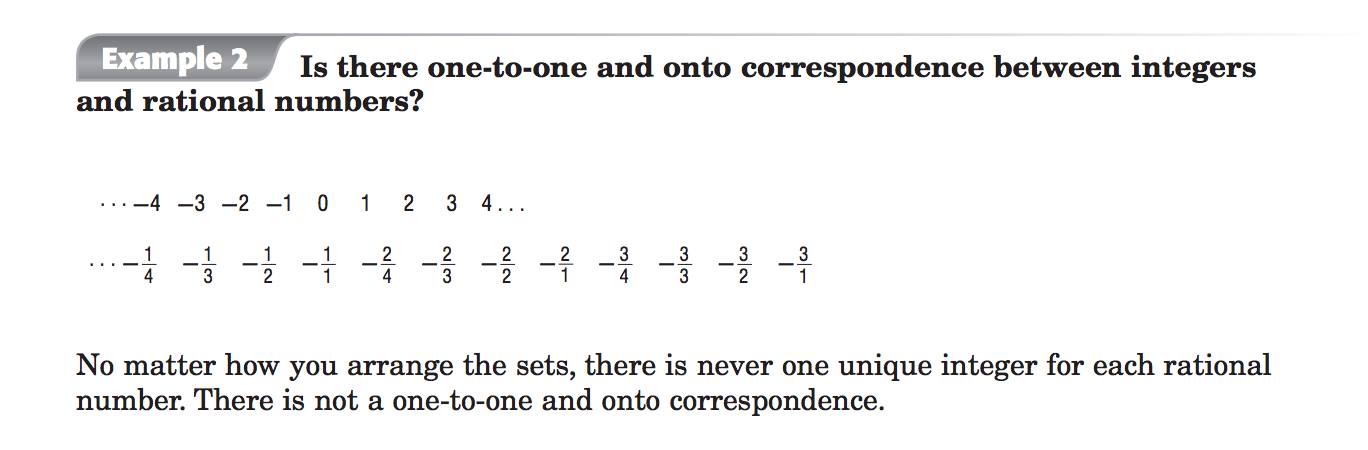
This was sent to me by a former student of mine. It appears in the chapter study guide for Section 2.1 of Glencoe’s Algebra 2 textbook (published in 2014), presumably as an enrichment activity for students learning about the definitions of “one to one functions” and “onto functions.”

countable infinityJust how bad is this mistake?

  • The above “proof” is only a blatant assertion, without any justification, either formal or informal, for why the authors think that the statement is false.
  • The ordering of the rational numbers in the way listed above is actually reasonably close to the listing that actually does produce the one-to-one correspondence between \mathbb{Q} and \mathbb{Z}.
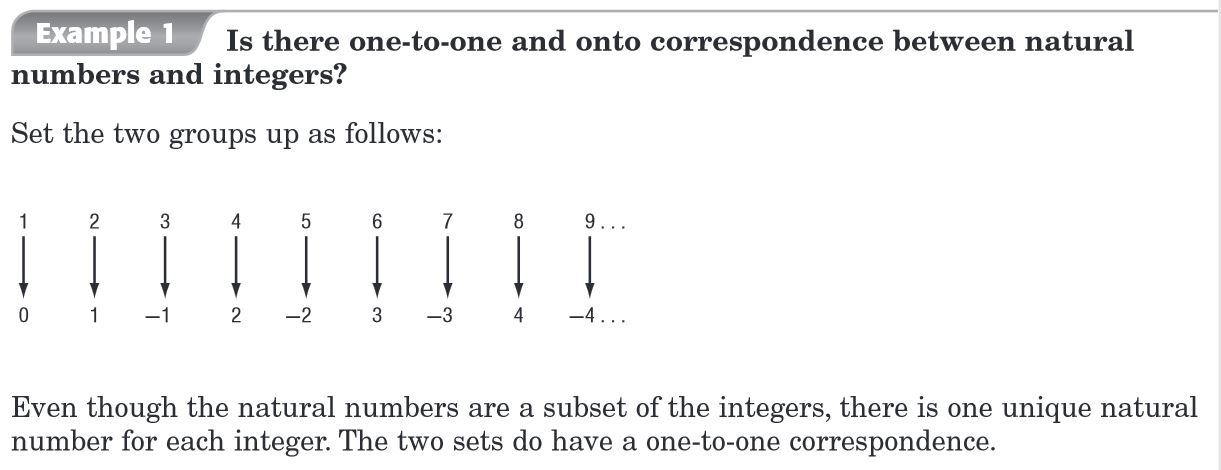
  • Just above Example 2 was Example 1, which gives the correct proof that there’s a one-to-one correspondence between \mathbb{Z} and \mathbb{N}. If the authors had double-checked this proof in any reputable book, they should have also been able to double-check that their Example 2 was completely false.
countable infinity 2

green line

The full chapter study guide can be found here (it’s on the last page): http://nseuntj.weebly.com/uploads/1/8/2/0/18201983/2.1relations_and_functions.pdf

Reactions can be found here: https://www.reddit.com/r/math/comments/3k1qe6/this_is_in_a_high_school_math_textbook_in_texas/

Reference to this can be seen on page 10 of the teacher’s manual here: http://msastete.com/yahoo_site_admin1/assets/docs/Chpte2-1.25882808.pdf


Engaging students: Using the point-slope equation of a line

In my capstone class for future secondary math teachers, I ask my students to come up with ideas for engaging their students with different topics in the secondary mathematics curriculum. In other words, the point of the assignment was not to devise a full-blown lesson plan on this topic. Instead, I asked my students to think about three different ways of getting their students interested in the topic in the first place.

I plan to share some of the best of these ideas on this blog (after asking my students’ permission, of course).

This student submission again comes from my former student Tiffany Jones. Her topic, from Algebra: using the point-slope equation of a line.

green line


B1. How can this topic be used in your students’ future courses in mathematics or science?


The topic of using the point-slope equation of a line comes up in some of the early topics of Calculus 1 such as, how to find the equation of the tangent line of a curve at a given point. The slope, ­, of the tangent line of a curve at a given point, , is equal to the instantaneous rate of change or slope of the curve at that given point. The slope is calculated by evaluating the following limit:

\displaystyle m = \lim_{h \to 0} \frac{f(x_0+h)-f(x_0)}{h}

If the difference quotient has a limit as h approaches zero, then that limit is called the derivative of the function at . Then, values of  and  are substituted into the point-slope equation of a line to determine the equation of the tangent line of a curve at a given point.

y-y_0 = m(x-x_0)

green line

C1. How has this topic appeared in pop culture?

On December 31st 1965, Chuck Jones’ released an animated short titled “The Dot and The Line: A Romance in Low Mathematics”. This ten minute, Oscar-winning film explores the complex relationship between lines, dots, and disorganization. The Line as desperately in love with the Dot. Yet, the Dot is currently involved with a chaotic Squiggle. The Dot ignores the Line, disregarding him as boring and predictable. He lacks complexity. Through a montage following this rejection, the line teaches himself to create angles, form curves, and produce close-ended shapes as well. With this new confidence, he then reveals his newfound self to the Dot. The Dot sees that there is no method to the Squiggles madness.

While the topic of using the point slope equation of a line is not an explicit topic of the short, I feel that this video as an engage activity can be great conversation starter about the relationship between a point and a line. From there the lesson can go on to talk about the point-slope equation. Furthermore, this video can open discussions about the slope-intercept and the point-point forms of a line.

green line

E1. How can technology be used to effectively engage students with this topic?

Explore Learning offers a Gizmo and worksheet on the point-slope form of a line. The Gizmo is an interactive simulator that allows the student to physically move the point around the Cartesian plane or use the sliders to adjust the point values and the slope value. The Gizmo shows the resulting line. I think that the use of such a tool can reinforce the relationship of a particular slope and a particular point to give an equation of a line.

The Gizmo offers to the slope-intercept form of the equation. So this simulator can also be used for a lesson on the slope-intercept form. Also, the Gizmo can place a right triangle along the line with leg lengths to show how the rise and run values change with the overall slope value.

Additionally, I think that this simulator can be used to allow the students to explore the equation. For instance, the students can see why when the graph is shifted to the left 2 units, the resulting equation has (x+2).


References:

http://www.imdb.com/title/tt0059122/?ref_=ttawd_awd_tt

https://www.youtube.com/watch?v=OmSbdvzbOzY

https://www.explorelearning.com/index.cfm?ResourceID=16*4&method=cResource.dspDetail

https://s3.amazonaws.com/el-gizmos/materials/PointSlopeSE.pdf


Engaging students: Approximating data by a straight line

In my capstone class for future secondary math teachers, I ask my students to come up with ideas for engaging their students with different topics in the secondary mathematics curriculum. In other words, the point of the assignment was not to devise a full-blown lesson plan on this topic. Instead, I asked my students to think about three different ways of getting their students interested in the topic in the first place.

I plan to share some of the best of these ideas on this blog (after asking my students’ permission, of course).

This student submission again comes from my former student Esmerelda Sheran. Her topic, from Algebra: approximating data by a straight line.

green line

A.2) How could you as a teacher create an activity or project that involves your topic?


If I created an activity for my class over approximating data by using a straight line I would make sure the type of data, they use is something that is relevant or interesting in the student’s lives. I would have the students work in pairs and choose the data they would work with out of three sets of data I have chosen. Examples of the choices of data would be the relationships between interceptions and wins for NFL teams, car accidents and age, or attendance and GPA (in college/universities). Using the data they chose the students would first take an educated guess of how the graph would look like, draw the scatter plot associated with the data, and compare their guess to the actual graph. At that point the students would try to identify the parent function (xb+c, mx+b, ab, ln(x) etc.) that the data is most similar to or if the data even has correlation. They would then draw what they believed the best fit line would look like on the scatterplot which they would compare to the linear regression once they calculated it on a graphing calculator. I would hope that this activity would be interesting due to the data being real and relatable as well as it being a way to connect parent functions and statistical data.

green line

D.1) What interesting things can you say about the people who contributed to the discovery and/or the development of this topic?

Two of the main collaborators of linear regression are Sir Francis Galton and Karl Pearson. Galton was the discoverer of the linear regression and Pearson further elaborated on Galton’s ideas. Linear regression actually came to be because of sweet peas, Galton was studying heredity in sweet peas and formulated linear regression to aid him in studying the relations he found in his studies. Galton was much more than a hereditist, he was a geologist, meteorologist, tropical explorer, founder of differential psychology, inventor of fingerprint identifications, and an author. A few more interesting things about Galton is that he was knighted, he was accused of promoting eugenics, he was British and he was a half cousin of Charles Darwin. If you were wondering what “eugenics” is, it is the idea of planned breeding of humans through selectively breeding and sterilization. Galton once said, “… I object to pretensions of natural equality.” Being that Galton studied heredity it is no wonder that he felt that some physical/mental/emotional attributes where superior and that humans would benefit from having the “best” genes. Unfortunately for Galton eugenics was frowned upon and he was attacked for promoting it. I think that students would find Galton extremely interesting because of his wide variety of interests.

Karl Pearson, although not as complex as Galton had a few attributes that I feel would interest students. Pearson did not have a childhood that would be considered normal in modern day. Pearson was homeschooled up until he turned nine, and then he went to London alone to study at the University of College School. After he received his degrees and studied physics, metaphysics and Darwinism, Pearson developed his own view in social Darwinism. The social beliefs, he developed led him to changing his name from Carl to Karl.


green line

E.1) How can technology be used to effectively engage students with this topic?


Technology in the classroom has and always will be an effective way to engage students if used correctly. To engage my students to learn how to approximated data with a straight line I would use excel, a smartboard, or the khan academy website. Excel is a useful piece of technology that is underappreciated by the average Joe. With a set of data you can record the relationships and then use the tools to create a scatterplot and then find the linear regression line on the graph.

Using a smartboard in the classroom is effective because it is new technology that is very special and kind of rare. Using smartboard to graph the points of data and then drawing an approximated regression line is highly kinesthetic and gives hands-on experiences instead of just typing in number and getting a calculated result that required almost no brain power. Kinesthetically moving their arms up, down, or side to side helps the students get a feel for the variation and relations between the data and drawing a best fit line themselves help the student understand the data on a different level. The Khan Academy website is a great resource for being introduced and even mastering the concept of linear regression because of the different activities available. For visual and auditory learners, there are a series of videos that explain approximating data by linear regression as well as how to be the most accurate when approximating. Similarly, there is an activity for kinesthetic learners in which they can move a line around to see which line seems most like the best fit line. It is beneficial from an instructor to use this website to help students of all learning types.


References

http://www.mirror.co.uk/news/uk-news/elderly-priest-found-dead-after-5099110

https://www.dartmouth.edu/~matc/math5.geometry/unit2/unit2.html

http://geomhistory.com/home.html

http://www.americanegypt.com/feature/cities/chichenitza/castillo_shadow.htm

https://explorable.com/greek-geometry


Engaging students: Completing the square

In my capstone class for future secondary math teachers, I ask my students to come up with ideas for engaging their students with different topics in the secondary mathematics curriculum. In other words, the point of the assignment was not to devise a full-blown lesson plan on this topic. Instead, I asked my students to think about three different ways of getting their students interested in the topic in the first place.

I plan to share some of the best of these ideas on this blog (after asking my students’ permission, of course).

This student submission again comes from my former student Diana A’Lyssa Rodriguez. Her topic, from Algebra: completing the square.

green line

A2. How could you as a teacher create an activity or project that involves your topic?

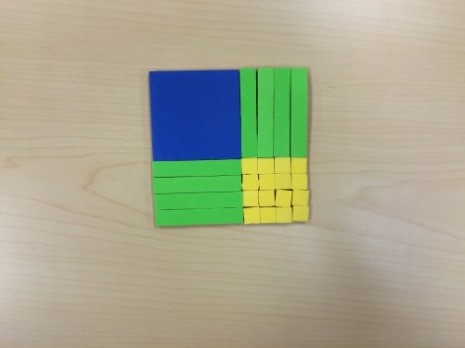
Using Algebra tiles is a great visual way for students to understand completing the square. The students start with the tiles that correspond to the given problem. The unit tiles are then flipped and moved to the other side of the equal sign. The remaining tiles are positioned into a square shape. The corner piece that appears to be missing will be filled unit tiles. What you do to one side, must be done to the other. Therefore the amount of unit tiles added to the square will also be added to the other side of the equation. Find the zero pairs and take them away. Then, find the corresponding tiles that will outline the square, so when multiplied together equals the equation.

Step 1:

square1

Step 2:

square2

Step 3:

square3

Step 4:

square4

Step 5:

square5

Step 6:

square6

Step 7:

square7

Step 8:

square8

green line

D1. What interesting things can you say about the people who contributed to the discovery and/or the development of this topic?

Around 815 – 850 AD, a mathematician Muhammad ibn Musa al-Khwarizmi was hard at work discovering algebra. He was actually the first person to write a text about algebra. His focus for a lot of the text was the dimensions of a square. At the time it was not called completing the square, but Muhammad was the one who came up with it because it is exactly what he did in order to solve the different equations he had at the time. Very similar to the process described using algebra tiles, Muhammad also saw the equations in terms of actual shapes. One of the original problems he tried to solve was x2+10x=39. He looked at x2 as a square with length x and width x. He then created a rectangle with length 10 and width x. The area would equal 10x. To make his theory work he broke up the 10x rectangle into two squares with length x and width 5. Muhammad combined the x2 square and the two 5x pieces into an L shape. This partial square must equal some square with the value of 39. So he came to the conclusion that he had to fill in what was left of the L shape to make it a square. But in order to do that he had to add that same value to the other side. In this case he added 25 (which is 5×5). Muhammad’s final answer was (x+5)2=64, x=3. This was his method but at the time he couldn’t prove that it always worked. So if and when students participate in the algebra tiles activity, they are partaking in a small piece of history.


green line

E1. How can technology be used to effectively engage students with this topic?

This video from Khan Academy is a great tool for completing the square. This video explains why we have to take half of the b value and square it (when looking at ax2+bx+c) to obtain the c value. When the students understand why we do something in math, they are more likely to be interested in the topic. The different colors that are used to write out the process allows the students to organize and understand completing the squares better. This particular video is also just long enough to capture the attention of the students but not so long as to lose it. Also, after hearing the same person explain math all the time, students may not understand it as well as they possibly could. So what is said in this video can easily be explained by the teacher but students sometimes need to hear a different voice explain a concept so they can gain a new perspective on the topic.

https://www.khanacademy.org/math/algebra/quadratics/completing_the_square/v/ex1-completing-the-square


Resources