Engaging students: Factoring polynomials

In my capstone class for future secondary math teachers, I ask my students to come up with ideas for engaging their students with different topics in the secondary mathematics curriculum. In other words, the point of the assignment was not to devise a full-blown lesson plan on this topic. Instead, I asked my students to think about three different ways of getting their students interested in the topic in the first place.

I plan to share some of the best of these ideas on this blog (after asking my students’ permission, of course).

This student submission again comes from my former student Irene Ogeto. Her topic, from probability: Venn diagrams.

green line

A2. How could you as a teacher create an activity or project that involves your topic?


As a warm up activity to a lesson on Venn diagrams, I could set up a model Venn diagram made out of tape on the classroom floor or in the hallway outside of the class. The topic for the activity would be comparing the number of students who prefer to play indoor sports versus the number of students who prefer to play outdoor sports. I would ask the students who prefer to play outdoor sports such as soccer, baseball, football or field hockey to stand in the circle that represents outdoor sports. Then I would ask the students who prefer to play indoor sports such as bowling or table tennis to stand in the other circle. Next, I would ask the students who prefer to play both indoor and outdoor sports such as basketball, volleyball or badminton to stand where the circles intersect. Lastly, I would ask the students who don’t prefer to play any sports to stand outside the two circles.


With this activity we can explore these questions:

  • How many students prefer to play indoor sports?
  • What is the percentage of students in our class prefer to play indoor sports?
  • How many students prefer to play both indoor and outdoor sports?
  • What percentage of students in our class prefer play both indoor and outdoor sports?
  • What percentage of the students in our class prefer to play sports?

green line

C1. How has this topic appeared in pop culture (movies, TV, current music, video games, etc.)?


Venn diagrams have appeared in children’s TV shows such as Cyberspace. In this episode of Cyberspace which is was aired on PBS in Season 1, the Cyberspace squad uses a Venn diagram to rescue the Lucky Charms. The squad uses the terms “or” and “and” with respect to sets to find the Lucky Charms. Motherboard tells them that the Lucky Charms is both blue and tall. One circle represents the blue bunnies and the other circle represents the bunnies of another color. The area where the two circles intersect represents the area where the tall and blue bunnies are. The squad works together to find the Lucky Charms using applications of Venn diagrams. Venn diagrams can be used to explore possibilities and combinations of things. This video can serve as an introduction to a lesson on Venn diagrams. It enables students to see how math is part of culture, as it is found in television shows.


Episode 112: “Of All the Luck” http://www.pbs.org/parents/cyberchase/episodes/season-1/


green line

D1. What interesting things can you say about the people who contributed to the discovery and/or the development of this topic?


John Venn (1834-1923) the famous mathematician, devised a way to picture sets by creating what is now known as Venn diagrams in 1881. John Venn was born in Hull, New England, United Kingdom. He was a lecturer, president of a college, and a priest for some of the years in his life. Venn wanted to show how different groups of things could be represented visually. John Venn called Venn diagrams Eulerian circles because they were similar to the Euler circles created by Leonhard Euler. While they share similarities, Euler circles and Venn diagrams are different. Venn diagrams are more sophisticated and are used to represent all possible combinations of classes. Euler circles differ in the sense that the circles do not always have to intersect and do not always represent all possible combinations. Some people still refer to Venn diagrams as Eulerian circles to this day and often some people use the two terms interchangeably. Despite the differences, both diagrams are used in math every day.


References:

http://www.venndiagram.net/the-history-behind-the-venn-diagram.html

http://www.mathresources.com/products/mathresource/maa/venn_diagram.html

http://www.pbs.org/parents/cyberchase/episodes/season-1/



New England Patriots Cheat At the Pre-Game Coin Flip? Not Really.

Last November, CBS Sports caused a tempest in a teapot with an article with the sensational headline “Patriots have no need for probability, win coin flip at impossible rate.” From the opening paragraphs:

Bill Belichick is never unprepared. Or at least that’s the perception. When other coaches struggle with when to use timeouts or how to manage the clock, the Patriots coach, almost effortlessly, always seems to make the right decision.

Belichick has also been extremely lucky. The Pats have won the coin toss 19 of the last 25 times, according to the Boston Globe‘s Jim McBride.

For some perspective: Assuming the coin toss is a 50/50 proposition, the probability of winning it at least 19 times in 25 tries is 0.0073. That’s less than three-quarters of one percent.

As far as the math goes, the calculation is correct. Using the binomial distribution,

\displaystyle \sum_{n=19}^{25} {25 \choose n} (0.5)^n (0.5)^{25-n} \approx 0.0073.

Unfortunately, this is far too simplistic an analysis to accuse someone of “winning the coin flip at an impossible rate.” Rather than re-do the calculations myself, I’ll just quote from the following article from the Harvard Sports Analysis Collective. The article begins by noting that while the Patriots may have been lucky the last 25 games, it’s not surprising that some team in the NFL was lucky (and the lucky team just happened to be the Patriots).

But how impossible is it? Really, we are interested in not only the probability of getting 19 or more heads but also a result as extreme in the other direction – i.e. 6 or fewer. That probability is just 2*0.0073, or 0.0146.

That is still very low, however given that there 32 teams in the NFL, the probability of any one team doing this is much higher. To do an easy calculation we can assume that all tosses are independent, which isn’t entirely true as when one team wins the coin flip the other team loses. The proper way to do this would be via simulation, but assuming independence is much easier and should yield pretty similar results. The probability of any one team having a result that extreme, as shown before, is 0.0146. The probability of a team NOT having a result that extreme is 1-0.0146 = 0.9854. The probability that, with 32 teams, there is not one of them with a result this extreme is 0.985432 = 0.6245998. Therefore, with 32 teams, we would expect at least one team to have a result as extreme as the Patriots have had over the past 25 games 1- 0.6245998 = 0.3754002, or 37.5% of the time. That is hardly significant. Even if you restricted it to not all results as extreme in either direction but just results of 19 or greater, the probability of one or more teams achieving that is still nearly 20%.

The article goes on to note the obvious cherry-picking used in selecting the data… in other words, picking the 25 consecutive games that would make the Patriots look like they were somehow cheating on the coin flip.

In addition the selection of looking at only the last 25 games is surely a selection made on purpose to make Belichick look bad. Why not look throughout his career? Did he suddenly discover a talent for predicting the future? Furthermore, given the length of Belichick’s career, we would almost expect him to go through a period where he wins 19 of 25 coin flips by random chance alone. We actually simulate this probability. Given that he has coached 247 games with the Patriots, we can randomly generate a string of zeroes and ones corresponding to lost and won con flips respectively. We can then check the string for a sequence of 25 games where there was 19 or more heads. I did this 10,000 times – in 38.71% of these simulations there was at least one sequence with 19 or more heads out of 25.

The author makes the following pithy conclusion:

To be fair, the author of this article did not seem to insinuate that the Patriots were cheating, rather he was just remarking that it was a rare event (although, in reality, it shouldn’t be as unexpected as he makes it out to be). The fault seems to rather lie with who made the headline and pubbed it, although their job is probably just to get pageviews in which case I guess they succeeded.

At any rate, the Patriots lost the coin flip in the 26th game.

Guns on university campuses

Here in Texas, public universities are trying to figure out how they’re going to comply with a recently enacted state campus-carry law so that licensed handgun owners can bring their firearms to campus. A small sampling of local news articles and websites on this topic:

And in the midst of this debate, I found the opportunity for a mathematical wisecrack.

handgun

I’ve used this wisecrack in my probability class to great effect, as the joke pedagogically illustrates the important difference between P(A \mid B) and P(A \cap B).

green line

For what it’s worth, here’s the version of the joke as I first saw it (in the book Absolute Zero Gravity):

Then there was the statistician who hated to fly because he had nightmares about terrorists with bombs. Yes, he knew that it was a million to one chance, but that wasn’t good enough. So he took a lot of trains until he realized what he had to do.

Now, whenever he flies, he packs a bomb in his own suitcase. Hey, do you know what the odds are against an airplane carrying two bombs?

green line

Two final notes:

  1. For the humor-impaired, I’m not referring to all gun owners as idiots. The only people I’m calling idiots are me and those that would slaughter innocent people (and these two sets are disjoint).
  2. Though it’s certainly an important issue, I have no interest in debating the wisdom of the campus-carry law on this blog. Rather, the point of this post was using current events to memorably illustrate mathematical ideas.

Preparation for Industrial Careers in the Mathematical Sciences: Building a Better Filter

The Mathematical Association of America recently published a number of promotional videos showing various mathematics can be used in “the real world.” Here’s the third pair of videos describing how mathematics is used for certain problems in materials science. From the YouTube descriptions:

Dr. Sumanth Swaminathan of W. L. Gore & Associates talks about his career path and the research questions about filtration that he considers. He works to understand the different waste capture mechanisms of filtration devices and to mathematically optimize the microstructure to create better filters.

Prof. Louis Rossi of the Department of Mathematical Sciences of the University of Delaware presents two introductory mathematical models that one can use to understand and characterize filters and the filtration processes.


Lessons from teaching gifted elementary school students: Index (updated)

I’m doing something that I should have done a long time ago: collect past series of posts into a single, easy-to-reference post. The following posts formed my series on various lessons I’ve learned while trying to answer the questions posed by gifted elementary school students. (This is updated from my previous index.)

Part 1: A surprising pattern in some consecutive perfect squares.

Part 2: Calculating 2 to a very large exponent.

Part 3a: Calculating 2 to an even larger exponent.

Part 3b: An analysis of just how large this number actually is.

Part 4a: The chance of winning at BINGO in only four turns.

Part 4b: Pedagogical thoughts on one step of the calculation.

Part 4c: A complicated follow-up question.

Part 5a: Exponentiation is multiplication as multiplication is to addition. So, multiplication is to addition as addition is to what? (I offered the answer of incrementation, but it was rejected: addition requires two inputs, while incrementation only requires one.)

Part 5b: Why there is no binary operation that completes the above analogy.

Part 5c: Knuth’s up-arrow notation for writing very big numbers.

Part 5d: Graham’s number, reputed to be the largest number ever to appear in a mathematical proof.

Preparation for Industrial Careers in the Mathematical Sciences: Improving Market Strategies

The Mathematical Association of America recently published a number of promotional videos showing various mathematics can be used in “the real world.” Here’s the fourth pair of videos describing how mathematics is used in the world of finance. From the YouTube descriptions:

Dr. Jonathan Adler (winner of King of the Nerds Season 3) talks about his career path and about a specific research problem that he has worked on. Using text analytics he was able to help an online company distinguish between its business customers and its private consumers from gift card messages.

Prof. Talithia Williams of Harvey Mudd College explains the statistical techniques that can be used to classify customers of a company using the messages on their gift cards.

Lessons from teaching gifted elementary school students: Index

I’m doing something that I should have done a long time ago: collect past series of posts into a single, easy-to-reference post. The following posts formed my series on various lessons I’ve learned while trying to answer the questions posed by gifted elementary school students.

Part 1: A surprising pattern in some consecutive perfect squares.

Part 2: Calculating 2 to a very large exponent.

Part 3a: Calculating 2 to an even larger exponent.

Part 3b: An analysis of just how large this number actually is.

Part 4a: The chance of winning at BINGO in only four turns.

Part 4b: Pedagogical thoughts on one step of the calculation.

Part 4c: A complicated follow-up question.

Story about Notah Begay III

This is a story that I like to tell my probability and statistics students when we cover the law of averages.

One of my favorite sports is golf, and one spring afternoon in my senior year I went out to play a round. I was assigned a tee time with two other students (that I didn’t know), and off we went.

Unfortunately, the group in front of us were, as I like to say, getting their money’s worth out of the round. Somebody would be stuck in a sand trap and then blast the ball into the sand trap on the other side of the green. Then he’d go to blast the ball out of that sand trap, and the ball would go back to the original one.

Golf etiquette dictates that slow-playing groups should let faster groups play through. However, this group never offered to let us pass them. And so, hole after hole, we would wait and wait and wait.

On hole #9, a player walking by himself came up from behind us. I’m not sure how that happened — perhaps the foursome that had been immediately behind us was even slower than the foursome in front of us — and he courteously asked if he could play through. I told him that we’d be happy to let him play through, but that the group in front of us hadn’t let us through, and so we were all stuck.

As a compromise, he asked if he could join our group. Naturally, we agreed.

This solo golfer did not introduce himself, but I recognized him because his picture had been in the student newspaper a few weeks earlier. He was Notah Begay III, then a hot-shot freshman on the Stanford men’s golf team. Though I didn’t know it then, he would later become a three-time All-American and, with Tiger Woods as a teammate, would win the NCAA championship. As a professional, he would win on the PGA Tour four times and was a member of the 2000 President’s Cup team.

Of course, all that lay in the future. At the time, all I knew was that I was about to play with someone who was really, really good.

We ended up playing five holes together… numbers 10 through 14. After playing 14, it started to get dark and I decided to call it quits (as the 14th green was fairly close to the course’s entrance).

So Notah tees off on #10. BOOM! I had never been so close to anyone who hit a golf ball so far. The guys I was paired with started talking about which body parts they would willingly sever if only they could hit a tee shot like that.

And I thought to myself, Game on.

I quietly kept score of how I did versus how Notah did. And for five holes, I shot 1-over par, while he shot 2-over par. And for five holes, I beat a guy who would eventually earn over $5 million on the PGA Tour.

green lineHow did the 9-handicap amateur beat the future professional? Simple: we only played five holes.

Back then, if I shot 1-over par over a stretch of five holes, I would be pretty pleased with my play, but it wouldn’t be as if I had never done it before. And I’m sure Notah was annoyed that he was 2-over par for those five holes (he chili-dipped a couple of chip shots; I imagine that he was experimenting with a new chipping technique), but even the best golfers in the world will occasionally have a five-hole stretch where they go 2-over par or more.

Of course, a golf course doesn’t have just five holes; it has 18.

My all-time best score for a round of golf was a four-over par 76.; I can count on one hand the number of times that I’ve broken 80. That would be a lousy score for a Division I golfer. So, to beat Notah for a complete round of golf, it would take one of my absolute best days happening simultaneously with one of his worst.

Furthermore, a stroke-play golf tournament is not typically decided in only one round of golf. A typical professional golf tournament, for those who make the cut, lasts four rounds. So, to beat Notah at a real golf tournament, I would have to have my absolute best day four days in a row at the same time that Notah had four of worst days.

That’s simply not going to happen.

So I share this anecdote with my students to illustrate the law of averages. (I also use a spreadsheet simulating flipping a coin thousands of times to make the same point.) If you do something enough times, what ought to happen does happen. However, if instead you do something only a few times, then unexpected results can happen. A 9-handicap golfer can beat a much better player if they only play 5 holes.

To give a more conventional illustration, a gambler can make a few dozen bets at a casino and still come out ahead. However, if the gambler stays at the casino long enough, he is guaranteed to lose money.

Engaging students: Probability and odds

In my capstone class for future secondary math teachers, I ask my students to come up with ideas for engaging their students with different topics in the secondary mathematics curriculum. In other words, the point of the assignment was not to devise a full-blown lesson plan on this topic. Instead, I asked my students to think about three different ways of getting their students interested in the topic in the first place.

I plan to share some of the best of these ideas on this blog (after asking my students’ permission, of course).

This student submission comes from my former student Tiffany Wilhoit. Her topic: probability and odds.

green line

How could you as a teacher create an activity or project that involves your topic?

A fun project to be used with the topic would be to fake a disaster and have the students determine their chance of surviving. This could even be tied in with a history class lesson. For example, if the students were discussing the Titanic (or any other disaster) you could have the students determine their chance of surviving the shipwreck. The students could be given data (Bonus points if they have to find the data themselves!), and from the data apply the information to the class. The students could then solve to find out the chances of each student surviving the disaster.


Another project is to set up a series of races or competitions. There could be separate heats which lead to a final race. The students could then see who wins, and calculate the probability of that person winning. They could also use the information to discover the chances of coming in the top three or top half. This would allow the students to have a “hands on” engagement before applying the knowledge they learned.


green line

How can this topic be used in your students’ future courses in mathematics or science?


Probability and odds is a very relevant topic when discussing genetics. In the students’ future biology class they will discuss Punnett squares. The Punnett square shows the possible combinations of genes an offspring will inherit from its parents. Through using Punnett squares, the students will need to discover the odds or probability of a certain trait being shown in the offspring. By already mastering this topic, the students will have a greater understanding of the information given by the Punnett squares. This will also allow the students to determine how likely certain diseases will be passed on from generation to generation. Once they master the Punnett square involving one trait, the students will then be able to use their knowledge of permutations, combinations, and compound events to find the probability of multiple traits showing up at the same time.


green line

How has this topic appeared in pop culture?


March Madness has become wildly popular since the contest for the Million Dollar Bracket began. While some fill the bracket out randomly, the use of odds and probability can help you choose the best team to pick. Also, we constantly hear about how the chances of winning are so low. Using probability and odds, the exact chance can be determined. The odds of choosing the winning team can also be determined. The students can use similar techniques to determine the chances of the school team winning a game or tournament. This knowledge is applicable in other areas too. We see it predominantly in gambling. You must determine your chances of winning to make a smart bet in a variety of games such as blackjack, poker, roulette, or even horse races such as the Kentucky Derby.


References:

http://pages.uoregon.edu/aarong/teaching/G4075_Outline/node15.html


Engaging students: Independent and dependent events

In my capstone class for future secondary math teachers, I ask my students to come up with ideas for engaging their students with different topics in the secondary mathematics curriculum. In other words, the point of the assignment was not to devise a full-blown lesson plan on this topic. Instead, I asked my students to think about three different ways of getting their students interested in the topic in the first place.

I plan to share some of the best of these ideas on this blog (after asking my students’ permission, of course).

This student submission comes from my former student Emily Bruce. Her topic, from Probability: independent and dependent events.

green line

How can this topic be used in your students’ future courses in mathematics or science?

The concept of probability can be used in a variety of different courses and professions. In sciences classes, the students might want to calculate the probability that the universe was created from the big bang, or they might want to use probability to predict phenotypes. This can later be used by biologists and doctors to determine the chances that a certain disease or genetic mutation will be passed on to a child. Probability and statistics are also commonly used in meteorology to predict weather patterns. In reality, we use the concepts of probability every day when we determine the best choice to make or a reasonable risk to take. Since it correlates with statistics and data analysis well, one could argue that every future course has the potential to expand on this topic.


green line

What interesting things can you say about the people who contributed to the discovery and/or the development of this topic?

Probability has been around for several hundred years. The first time we see probability address was in the fifteenth century. Italian mathematicians published two works on the subject, but the calculations of probabilities were not commonly known. It wasn’t until the seventeenth century that probability really came to light and became a branch of mathematics. It all started with gambling! A man named Chevalier de Méré was a big gambler. He bet that if he rolled a dice four times he could roll at least one 6. He won a lot of money using this bet. Then he wanted to go a step further and started betting that if he rolled two dice twenty four times, he would get two sixes at least once. Similarly, he won the bet more often than not. Eventually he wanted to know why this was happening, so he called on some mathematician friends to research it. That was the start of hundreds of years of researching and developing what we know today as probability.


References:


Brief History of Probability. (2000). Retrieved September 4, 2014. http://www.teacherlink.org/content/math/interactive/probability/history/briefhistory/home.html.


green line

A2. How could you as a teacher create an activity or project that involves your topic?

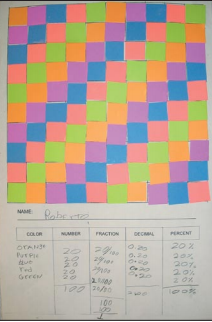
One way I, as a teacher, can create an activity that involves decimals, fractions and percents is to incorporate it with art. I found inspiration from an article titled, “Masterpieces to Mathematics: Using Art to Teach Fraction, Decimal, and Percent Equivalents.” Each student would receive a 100 square grid and a large amount of colored squares (red, green, blue, purple, orange) to create and glue on their square grid paper in a design of their choosing:

As seen on the image above, when the students were done with their masterpiece, they would have another sheet consisting of columns: color, number, fraction, decimal, and percent. They would list the colors they used under the color column, and then count the amount of squares of each color and record it in the number column. They would then convert the number of each color used compared to the total amount of squares (100) to a fraction, decimal, and percent. To further their understanding, I could ask the students to block out the outer squares and ask to calculate the new number of each color, fraction, decimal, and percent from the new total (64).

Percent

References: http://www.17centurymaths.com/contents/napier/jimsnewstuff/Napiers%20Bones/NapiersBones.html

http://www.decodeunicode.org/u+0025

< http://mason.gmu.edu/~jsuh4/math%20masterpiece.pdf>

< http://english.stackexchange.com/questions/177757/why-are-decimals-read-as-fractions-by-some-cultures>

< http://www.princeton.edu/~achaney/tmve/wiki100k/docs/Decimal_separator.html&gt;