In this series, I’m compiling some of the quips and one-liners that I’ll use with my students to hopefully make my lessons more memorable for them.
In some classes, the Greek letter or naturally appears. Sometimes, it’s an angle in a triangle or a displacement when graphing a sinusoidal function. Other times, it represents the cumulative distribution function of a standard normal distribution.
Which begs the question, how should a student pronounce this symbol?
I tell my students that this is the Greek letter “phi,” pronounced “fee”. However, other mathematicians may pronounce it as “fie,” rhyming with “high”. Continuing,
Other mathematicians pronounce it as “foe.” Others, as “fum.”
In this series, I’m compiling some of the quips and one-liners that I’ll use with my students to hopefully make my lessons more memorable for them.
Perhaps one of the more difficult things that I try to instill in my students is numeracy, or a sense of feeling if an answer to a calculation is plausible. As a initial step toward this goal, I’ll try to teach my students some basic pointers about whether an answer is even possible.
For example, when calculating a standard deviation, students have to compute and :
After these are computed — which could take some time — the variance is then calculated:
.
Finally, the standard deviation is found by taking the square root of the variance.
So, I’ll ask my students, what do you do if you calculate the variance and it’s negative, so that it’s impossible to take the square root? After a minute to students hemming and hawing, I’ll tell them emphatically what they should do:
It’s wrong… do it again.
The same principle applies when computing probabilities, which always have to be between 0 and 1. So, if ever a student computes a probability that’s either negative or else greater than 1, they can be assured that the answer is wrong and that there’s a mistake someplace in their computation that needs to be found.
In this series, I’m compiling some of the quips and one-liners that I’ll use with my students to hopefully make my lessons more memorable for them.
Here’s the closing example that I’ll use when presenting the binomial and hypergeometric distributions to my probability/statistics students.
A lonely bachelor decides to play the field, deciding that a lifetime of watching “Leave It To Beaver” reruns doesn’t sound all that pleasant. On 250 consecutive days, he calls a different woman for a date. Unfortunately, through the school of hard knocks, he knows that the probability that a given woman will accept his gracious invitation is only 1%. What is the chance that he will land at least three dates?
You can probably imagine the stretch I was enduring when I first developed this example many years ago. Nevertheless, I make a point to add the following disclaimer before we start finding the solution, which always gets a laugh:
The events of this exercise are purely fictitious. Any resemblance to any actual persons — living, or dead, or currently speaking — is purely coincidental.
In this series, I’m compiling some of the quips and one-liners that I’ll use with my students to hopefully make my lessons more memorable for them. Today’s quip is a follow-up to yesterday’s post and is one that I’ll use when I need my students to remember something that I taught them earlier in the semester — perhaps even the previous day.
For example, in my applied statistics class, one day I’ll show students how to compute the expected value and the standard deviation of a random variable:
Then, the next time I meet them, I start working on a seemingly new topic, the derivation of the binomial distribution:
.
This derivation takes some time because I want my students to understand not only how to use the formula but also where the formula comes from. Eventually, I’ll work out that if and ,
Then, I announce to my class, I next want to compute and . We had just done this the previous class period; however, I know full well that they haven’t yet committed those formulas to memory. So here’s the one-liner that I use: “If you had a good professor, you’d remember how to do this.”
Eventually, when the awkward silence has lasted long enough because no one can remember the formula (without looking back at the previous day’s notes), I plunge an imaginary knife into my heart and turn the imaginary dagger, getting the point across: You really need to remember this stuff.
In this series, I’m compiling some of the quips and one-liners that I’ll use with my students to hopefully make my lessons more memorable for them. Today’s quip is one that I’ll use when I need my students to remember something from a previous course — especially when it’s a difficult concept from a previous course — that somebody else taught them in a previous semester.
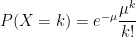
For example, in my probability class, I’ll introduce the Poisson distribution
,
where and the permissible values of are non-negative integers.
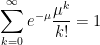
In particular, since these are probabilities and one and only one of these values can be taken, this means that
.
At this point, I want students to remember that they’ve actually seen this before, so I replace by and then multiply both sides by :
.
Of course, this is the Taylor series expansion for . However, my experience is that most students have decidedly mixed feelings about Taylor series; often, it’s the last thing that they learn in Calculus II, which means it’s the first thing that they forget when the semester is over. Also, most students have a really hard time with Taylor series when they first learn about them.
So here’s my one-liner that I’ll say at this point: “Does this bring back any bad memories for anyone? Perhaps like an old Spice Girls song?” And this never fails to get an understanding laugh before I remind them about Taylor series.
In this series, I’m compiling some of the quips and one-liners that I’ll use with my students to hopefully make my lessons more memorable for them.
Here’s a problem that could appear early in a probability class:
Let , , and . Find .
The standard technique for solving this problem involves first finding using the Addition Rule:
From here, the Multiplication Rule can be used (or, equivalently, the definition of a conditional probability):
So far, so good.
Now let me add a small twist to the original problem that creates a small difficulty when solving:
Let , , and . Find .
Proceeding as before, we obtain
The value of $P(A \cup B)$ is obvious. But how do we evaluate the left side?
If I’m teaching an advanced probability class, I might expect them to use DeMorgan’s Laws. However, it’s a whole lot easier to reason out the left hand side: I’m looking for the probability that both and happen or else at least one of and happen. Well, that’s clearly redundant: if both and happen, then certainly at least one of and happen.
Here’s my one-liner, which I say, if possible, using only one breath of air:
Clearly, this is redundant. It’s like saying Dr. Q is my professor and he’s a total stud. It’s redundant. It’s obvious. There’s no need to actually say it.
After the laughter settles from this bit of braggadocio, the can be safely dropped from the left side:
However, I need to emphasize that dropping the term on the left side is a special feature of this particular problem since one set was a subset of the other, and that students shouldn’t expect to always be able to do this when computing conditional probabilities.
In this series, I’m compiling some of the quips and one-liners that I’ll use with my students to hopefully make my lessons more memorable for them.
Here’s a problem that could appear in my class in probability or statistics:
Let be a probability density function for . Find , the cumulative distribution function of .
A student’s first reaction might be to set up the integral as
The problem with this set-up, of course, is that the letter has already been reserved as the right endpoint for this definite integral. Therefore, inside the integral, we should choose any other letter — just not — as the dummy variable.
Which sets up my one-liner: “In the words of the great philosopher Jean-Luc Picard: Plenty of letters left in the alphabet.”
In this series, I’m compiling some of the quips and one-liners that I’ll use with my students to hopefully make my lessons more memorable for them.
Here’s a story that I’ll tell my students when, for the first time in a semester, I’m about to use a previous theorem to make a major step in proving a theorem. For example, I may have just finished the proof of
,
where and are independent random variables, and I’m about to prove that
.
While this can be done by starting from scratch and using the definition of variance, the easiest thing to do is to write
,
thus using the result of the first theorem to prove the next theorem.
And so I have a little story that I tell students about this principle. I think I was 13 when I first heard this one, and obviously it’s stuck with me over the years.
At MIT, there’s a two-part entrance exam to determine who will be the engineers and who will be the mathematicians. For the first part of the exam, students are led one at a time into a kitchen. There’s an empty pot on the floor, a sink, and a stove. The assignment is to boil water. Everyone does exactly the same thing: they fill the pot with water, place it on the stove, and then turn the stove on. Everyone passes.
For the second part of the exam, students are led one at a time again into the kitchen. This time, there’s a pot full of water sitting on the stove. The assignment, once again, is to boil water. Nearly everyone simply turns on the stove. These students are led off to become engineers. The mathematicians are ones who take the pot off the stove, dump the water into the sink, and place the empty pot on the floor… thereby reducing to the original problem, which had already been solved.
In this series, I’m compiling some of the quips and one-liners that I’ll use with my students to hopefully make my lessons more memorable for them.
One of my favorite one-liners is simply stated: “Mathematicians are lazy.” I’ll use this whenever I introduce my students a new piece of mathematical notation or lingo.
For example, in probability, a common notion is a sequence of independent and identically distributed random variables (say, rolling a die repeatedly). However, mathematicians will typically write “i.i.d.” instead of “independent and identically distributed.” Why? That’s when I break out the mantra: “Mathematicians are lazy.” It’s my quick way of saying, “Hey, this is new notation that you’re about to learn, but the whole point of new notation is to make writing mathematical ideas a little quicker.”
Mathematical notation like can appear very intimidating when students first encounter them. Hopefully repeating this mantra a few dozen times each semester makes the introduction of new notation a little more palatable for my students.
In my capstone class for future secondary math teachers, I ask my students to come up with ideas for engaging their students with different topics in the secondary mathematics curriculum. In other words, the point of the assignment was not to devise a full-blown lesson plan on this topic. Instead, I asked my students to think about three different ways of getting their students interested in the topic in the first place.
I plan to share some of the best of these ideas on this blog (after asking my students’ permission, of course).
This student submission again comes from my former student Heidee Nicoll. Her topic, from probability: combinations.
How could you as a teacher create an activity or project that involves your topic?
As a teacher, I would give my students an activity where, with a partner, they would be in charge of creating an ice cream shop. Each ice cream shop has large cones, which can hold two scoops of ice cream, and six different flavors of ice cream. Each shop would be required to make a list of all the different cone options available. (Note: cones with two scoops of the same flavor are not allowed.) The groups would calculate the total number of combinations, and try to find any patterns in their work. I would ask them how to calculate the number of options for 7 flavors of ice cream, and then ask them to find a general rule or pattern for calculating the total for n flavors, and have them try their formula a few times to see if it gives them the correct answer. As a bonus, I would also ask them how many flavors of ice cream they would need to be able to advertise at least 100 different cone combinations.
What interesting things can you say about the people who contributed to the discovery and/or the development of this topic?
Historia Mathematica, a scientific journal, has an article called “The roots of combinatorics,” which describes records of ancient civilizations’ work in combinations and permutations. I would share with my students the first part of this description of the medical treatise of Susruta, without reading the last sentence that gives the answers:
“It seems that, from a very early time, the Hindus became accustomed to considering questions involving permutations and combinations. A typical example occurs in the medical treatise of Susruta, which may be as old as the 6th century B.C., although it is difficult to date with any certainty. In Chapter LX111 of an English translation [Bishnagratna 19631] we find a discussion of the various kinds of taste which can be made by combining six basic qualities: sweet, acid, saline, pungent, bitter, and astringent. There is a systematic list of combinations: six taken separately, fifteen in twos, twenty in threes, fifteen in fours, six in fives, and one taken all together” (Biggs 114).
I would ask them to estimate the number of combinations of any size group within those “six basic qualities” without doing any actual calculations. Once they had all made their estimates, as a class we would do the calculations and comment on the accuracy of our earlier estimates.
How has this topic appeared in pop culture (movies, TV, current music, video games, etc.)?
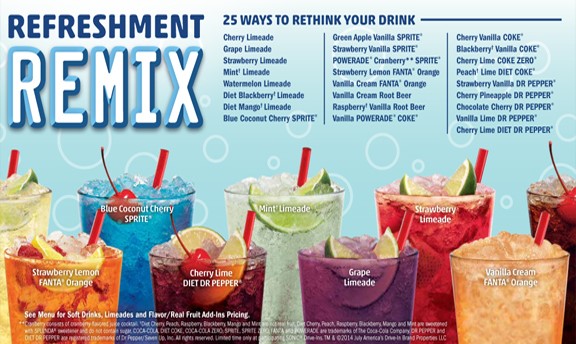
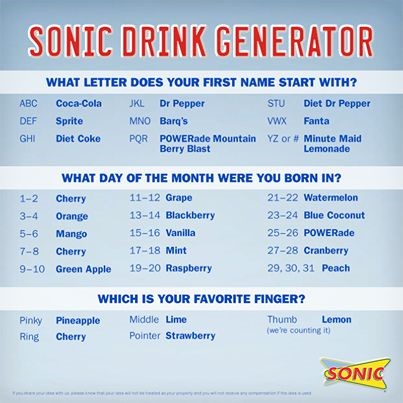
Sonic commercials boast that their fast food restaurant offers more than 168,000 drink combinations. This commercial shows a man trying to calculate the total number of options after buying a drink:
I would show my students the commercial, as well as images of Sonic menus and advertisements for their drinks, such as the following:
The Wall Street Journal also has an article about the accuracy of the company’s claim to 168,000 drink options, found at http://blogs.wsj.com/numbers/counting-the-drink-combos-at-a-sonic-drive-in-230/. The author talks about the number of base soft drinks and additional flavorings available, and says that according to the math, Sonic’s number should be well over 168,000 and closer to 700,000. He describes the claim of a publicist who works for Sonic that 168,000 was the number of options available for no more than 6 add-ins, which the company deemed a reasonable number. The article also notes the difference between reasonable combinations and literally all combinations, which could spur a good discussion in the classroom about context and its importance in real world problems.
References
Biggs, N.l. “The Roots of Combinatorics.” Historia Mathematica 6.2 (1979): 109-36. Web. 08 Sept. 2016.
Carl Bialik. “Counting the Drink Combos at a Sonic Drive-In.” The Wall Street Journal. N.p., 27 Nov. 2007. Web. 08 Sept. 2016.


 and
and  :
:

![\hbox{Var}(X) = E(X^2) - [E(X)]^2](https://s0.wp.com/latex.php?latex=%5Chbox%7BVar%7D%28X%29+%3D+E%28X%5E2%29+-+%5BE%28X%29%5D%5E2&bg=ffffff&fg=000000&s=0&c=20201002) .
.

![\hbox{SD}(X) = \sqrt{ E(X^2) - [E(X)]^2 }](https://s0.wp.com/latex.php?latex=%5Chbox%7BSD%7D%28X%29+%3D+%5Csqrt%7B+E%28X%5E2%29+-+%5BE%28X%29%5D%5E2+%7D&bg=ffffff&fg=000000&s=0&c=20201002)
 .
. and
and  ,
,



 . We had just done this the previous class period; however, I know full well that they haven’t yet committed those formulas to memory. So here’s the one-liner that I use: “If you had a good professor, you’d remember how to do this.”
 ,
, and the permissible values of
  are non-negative integers.
 .
. by
by  and then multiply both sides by
  :
: .
. ,
,  , and
, and  . Find
  .
. using the Addition Rule:





 .
.![P( [A \cap B] \cup [A \cup B] ) = P(A \cup B) \cdot P(A \cap B \mid A \cup B)](https://s0.wp.com/latex.php?latex=P%28+%5BA+%5Ccap+B%5D+%5Ccup+%5BA+%5Ccup+B%5D+%29+%3D+P%28A+%5Ccup+B%29+%5Ccdot+P%28A+%5Ccap+B+%5Cmid+A+%5Ccup+B%29&bg=ffffff&fg=000000&s=0&c=20201002)
 and
and  happen or else at least one of
  can be safely dropped from the left side:


 be a probability density function for
  . Find
  , the cumulative distribution function of
  .
.

 .
. ,
, are independent random variables, and I’m about to prove that
 .
.![\hbox{Var}(X-Y) = \hbox{Var}(X+[-Y]) = \hbox{Var}(X) + \hbox{Var}(-Y)](https://s0.wp.com/latex.php?latex=%5Chbox%7BVar%7D%28X-Y%29+%3D+%5Chbox%7BVar%7D%28X%2B%5B-Y%5D%29+%3D+%5Chbox%7BVar%7D%28X%29+%2B+%5Chbox%7BVar%7D%28-Y%29&bg=ffffff&fg=000000&s=0&c=20201002) ,
, can appear very intimidating when students first encounter them. Hopefully repeating this mantra a few dozen times each semester makes the introduction of new notation a little more palatable for my students.


 Mean Green Math