Engaging students: Venn diagrams

In my capstone class for future secondary math teachers, I ask my students to come up with ideas for engaging their students with different topics in the secondary mathematics curriculum. In other words, the point of the assignment was not to devise a full-blown lesson plan on this topic. Instead, I asked my students to think about three different ways of getting their students interested in the topic in the first place.

I plan to share some of the best of these ideas on this blog (after asking my students’ permission, of course).

This student submission comes from my former student Michelle McKay. Her topic, from Probability: Venn diagrams.

green line

A. What interesting word problems using this topic can your students do now?

In my opinion, you can create a word problem with Venn diagrams on just about anything. To make a word problem more interesting, you can relate the problem to an upcoming event or holiday, make a cultural reference, or even discuss students’ hobbies (i.e. video games, books, etc.).

On Valentine’s Day, a survey of what gifts a women received from their significant other yielded surprising results.

76% of the women surveyed received a card.

72% received chocolate.

49% received flowers.

21% received chocolate and a card.

5% received a card and flowers.

7% received chocolate and flowers.

33% received chocolate, a card, and flowers.

If a woman from the survey was selected at random, what would the probability of her having not received a Valentine’s Day gift be? What is the probability that she received any combination of two gifts? What is the probability that she received a card and flowers, but not chocolate?

green line

B.     How can this topic be used in your students’ future courses in mathematics or science?

Venn diagrams are an excellent way to organize information. They can organize and be a visual representation of gathered statistics (like in the above section). They can also organize general ideas and concepts, distinguishing them as unique or shared amongst other ideas/concepts. A student can use Venn diagrams in either of these manners for both math and science classes of any difficulty.


green line

B. How does this topic extend what your students should have learned in previous courses?

When using Venn diagrams to represent statistics, it reinforces the idea that parts cannot be larger than the whole. We know when using Venn diagrams for statistical data that the decimals must add up to 1 to represent 100%. Students should realize that adding the decimals and getting a number that is larger than or smaller than 1 means they miscalculated or there is “missing” data. By “missing” data, I mean to say that they did not enter in all the given information correctly.


Mathematics and College Football

For years, various algorithms (derisively called “the computers” by sports commentators) have been used to rank college football teams. The source of derision is usually quite simple to explain: most of these algorithms are too hard to explain in layman’s terms, and therefore they are mocked.

For both its simplicity and its ability to provide reasonable rankings, my favorite algorithm is “Random Walker Rankings,” published at http://rwrankings.blogspot.com. Here is a concise description of this ranking system (quoted from http://rwrankings.blogspot.com/2003_12_01_archive.html):

We’ve all experienced befuddlement upon perusing the NCAA Division I-A college football
Bowl Championship Series (BCS) standings, because of the seemingly divine inspiration that must have been incorporated into their determination. The relatively small numbers of games between a large number of teams makes any ranking immediately suspect because of the dearth of head-to-head information. Perhaps you’ve even wondered if a bunch of monkeys could have ranked the football teams as well as the expert coaches and sportswriters polls and the complicated statistical ranking algorithms.

We had these thoughts, so we set out to test this hypothesis, although with simulated monkeys (random walkers) rather than real ones.

Each of our simulated “monkeys” gets a single vote to cast for the “best” team in the nation, making their decisions based on only one simple guideline: They periodically look up the win-loss outcome of a single game played by their favorite team, and flip a weighted coin to determine whether to change their allegiance to the other team. In order to make this process even modestly reasonable, this random decision is made so that there is higher probability that the monkey’s allegiance and vote will go with the team that won the head-to-head contest. For instance, the weighting of the coin might be chosen so that 75% (say) of the time the monkey changes his vote to go with the winner of the game, meaning only a 25% chance of voting for the loser.

The monkey starts by voting for a randomly chosen team. Each monkey then meanders around a network which describes the collection of teams, randomly changing allegiance from one team to another along connections representing games played between the two teams that year. This network is graphically depicted in the figure here, with the monkeys—okay, technically one is a gorilla—not so happily lent to us by Ben Mucha (inset). It’s a simple process: if the outcome of the weighted coin flip indicates that he should be casting his vote for the opposing team, the monkey stops cheerleading for the old team and moves to the site in the network representing his new favorite team. While we let the monkeys change their minds over and over again—indeed, a single monkey voter will forever be changing his vote in this scheme—the percentage of votes cast for each football team quickly stabilizes. We thereby obtain rankings each week of the season and at the end of the season, based on the games played to that point of the season, by looking at the fraction of monkeys that vote for each team…

The virtue of this ranking system lies in its relative ease of explanation. Its performance is arguably on par with the expert polls and (typically more complicated) computer algorithms employed by the BCS. Can a bunch of monkeys rank football teams as well as the systems in use now? Perhaps they can.

Using this algorithm, here’s the current ranking of college football teams as of today. (With great pride, I note that Stanford is ranked #4.) These rankings certainly don’t exactly match the latest AP poll or BCS rankings, but they’re also still reasonable and defensible.

RWFL2011

A surprising appearance of e

Here’s a simple probability problem that should be accessible to high school students who have learned the Multiplication Rule:

Suppose that you play the lottery every day for about 20 years. Each time you play, the chance that you win is 1 chance in 1000. What is the probability that, after playing  1000 times, you never win?

This is a straightforward application of the Multiplication Rule from probability. The chance of not winning on any one play is 0.999. Therefore, the chance of not winning 1000 consecutive times is (0.999)^{1000}, which we can approximate with a calculator.
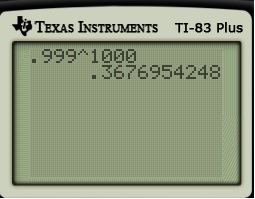
TIlottery1

Well, that was easy enough. Now, just for the fun of it, let’s find the reciprocal of this answer.

TIlottery2

Hmmm. Two point seven one. Where have I seen that before? Hmmm… Nah, it couldn’t be that.

What if we changed the number 1000 in the above problem to 1,000,000? Then the probability would be (0.999999)^{1000000}.

TIlottery3

There’s no denying it now… it looks like the reciprocal is approximately e, so that the probability of never winning for both problems is approximately 1/e.

Why is this happening? I offer a thought bubble if you’d like to think about this before proceeding to the answer.

green_speech_bubbleThe above calculations are numerical examples that demonstrate the limit

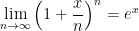
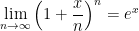
\displaystyle \lim_{n \to \infty} \left(1 + \frac{x}{n}\right)^n = e^x

In particular, for the special case when n = -1, we find

\displaystyle \lim_{n \to \infty} \left(1 - \frac{1}{n}\right)^n = e^{-1} = \displaystyle \frac{1}{e}

The first limit can be proved using L’Hopital’s Rule. By continuity of the function f(x) = \ln x, we have

\ln \left[ \displaystyle \lim_{n \to \infty} \left(1 + \frac{x}{n}\right)^n \right] = \displaystyle \lim_{n \to \infty} \ln \left[ \left(1 + \frac{x}{n}\right)^n \right]

\ln \left[ \displaystyle \lim_{n \to \infty} \left(1 + \frac{x}{n}\right)^n \right] = \displaystyle \lim_{n \to \infty} n \ln \left(1 + \frac{x}{n}\right)

\ln \left[ \displaystyle \lim_{n \to \infty} \left(1 + \frac{x}{n}\right)^n \right] = \displaystyle \lim_{n \to \infty} \frac{ \displaystyle \ln \left(1 + \frac{x}{n}\right)}{\displaystyle \frac{1}{n}}

The right-hand side has the form \infty/\infty as n \to \infty, and so we may use L’Hopital’s rule, differentiating both the numerator and the denominator with respect to n.

\ln \left[ \displaystyle \lim_{n \to \infty} \left(1 + \frac{x}{n}\right)^n \right] = \displaystyle \lim_{n \to \infty} \frac{ \displaystyle \frac{1}{1 + \frac{x}{n}} \cdot \frac{-x}{n^2} }{\displaystyle \frac{-1}{n^2}}

\ln \left[ \displaystyle \lim_{n \to \infty} \left(1 + \frac{x}{n}\right)^n \right] = \displaystyle \lim_{n \to \infty} \displaystyle \frac{x}{1 + \frac{x}{n}}

\ln \left[ \displaystyle \lim_{n \to \infty} \left(1 + \frac{x}{n}\right)^n \right] = \displaystyle \frac{x}{1 + 0}

\ln \left[ \displaystyle \lim_{n \to \infty} \left(1 + \frac{x}{n}\right)^n \right] = x

Applying the exponential function to both sides, we conclude that

\displaystyle \lim_{n \to \infty} \left(1 + \frac{x}{n}\right)^n= e^x

green lineIn an undergraduate probability class, the problem can be viewed as a special case of a Poisson distribution approximating a binomial distribution if there’s a large number of trials and a small probability of success.

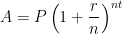
The above calculation also justifies (in Algebra II and Precalculus) how the formula for continuous compound interest A = Pe^{rt} can be derived from the formula for discrete compound interest A = P \displaystyle \left( 1 + \frac{r}{n} \right)^{nt}
All this to say, Euler knew what he was doing when he decided that e was so important that it deserved to be named.

Formula for an infinite geometric series (Part 11)

Many math majors don’t have immediate recall of the formula for an infinite geometric series. They often can remember that there is a formula, but they can’t recollect the details. While it’s I think it’s OK that they don’t have the formula memorized, I think is a real shame that they’re also unaware of where the formula comes from and hence are unable to rederive the formula if they’ve forgotten it.

In this post, I’d like to give some thoughts about why the formula for an infinite geometric series is important for other areas of mathematics besides Precalculus. (There may be others, but here’s what I can think of in one sitting.)

1. An infinite geometric series is actually a special case of a Taylor series. (See https://meangreenmath.com/2013/07/05/reminding-students-about-taylor-series-part-5/ for details.) Therefore, it would be wonderful if students learning Taylor series in Calculus II could be able to relate the new topic (Taylor series) to their previous knowledge (infinite geometric series) which they had already seen in Precalculus.

2. An infinite geometric series is also a special case of the binomial series (1+x)^n, when n does not have to be a positive integer and hence Pascal’s triangle cannot be used to find the expansion.

3. Infinite geometric series is a rare case when an infinite sum can be found exactly. In Calculus II, a whole battery of tests (e.g., the Root Test, the Ratio Test, the Limit Comparison Test) are introduced to determine whether a series converges or not. In other words, these tests only determine if an answer exists, without determining what the answer actually is.

Throughout the entire undergraduate curriculum, I’m aware of only four types of series that can actually be evaluated exactly.

  • An infinite geometric series with -1 < r < 1
  • The Taylor series of a real analytic function. (Of course, an infinite geometric series is a special case of a Taylor series.)
  • A telescoping series. For example, using partial fractions and cancelling a bunch of terms, we find that

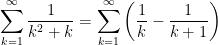
\displaystyle \sum_{k=1}^\infty \frac{1}{k^2+k} = \displaystyle \sum_{k=1}^\infty \left( \frac{1}{k} - \frac{1}{k+1} \right)

\displaystyle \sum_{k=1}^\infty \frac{1}{k^2+k} = \displaystyle \left( 1 - \frac{1}{2} \right) + \left( \frac{1}{2} - \frac{1}{3} \right) \dots

\displaystyle \sum_{k=1}^\infty \frac{1}{k^2+k} = 1

4. Infinite geometric series are essential for proving basic facts about decimal representations that we often take for granted.

5. Properties of an infinite geometric series are needed to find the mean and standard deviation of a geometric random variable, which is used to predict the number of independent trials needed before an event happens. This is used for analyzing the coupon collector’s problem, among other applications.

Multiple choice

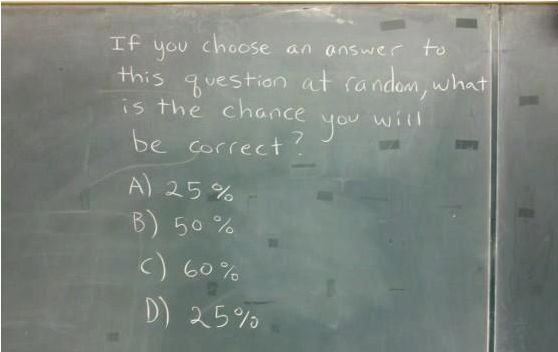
I had a good chuckle at the following photo.


4132012165940iwsmt

Here’s a thought bubble if you’d like to think about it before I reveal the answer.

green_speech_bubble

You’d think that, since there are four possible answers, that you should answer 25%. However, there are two choices for 25%, so the chance of picking 25% as your answer is 2/4, or 50%. But there’s only one way to answer 50%, so the answer should be 1/4, or 25%. To quote “The King and I,” et cetera, et cetera, et cetera.

The correct answer, of course, is adding a fifth option: E) 20%.

Infinite number of monkeys

From Wikipedia:

The infinite monkey theorem states that a monkey hitting keys at random on a typewriter keyboard for an infinite amount of time will almost surely type a given text, such as the complete works of William Shakespeare.

This can be formally proven using the second Borel-Cantelli Lemma, a topic which requires measure-theoretic probability. Thus leading me to one of the driest observations that I’ve ever read in a graduate-level textbook, following the proofs of the Borel-Cantelli Lemmas:

The record of a prolonged coin-tossing game is bound to contain every conceivable book in the Morse code [using heads for dot and tails for dash], from Hamlet to eight-place logarithmic tables. It has been suggested that an army of monkeys might be trained to pound typewriters at random in the hope that ultimately great works of literature would be produced. Using a coin for the same purpose may save feeding and training expenses and free the monkeys for other monkey business.

W. Feller, An Introduction to Probability Theory and Its Applications, Volume 1 (Chapter 8.3), page 202.