I’m doing something that I should have done a long time ago: collecting a series of posts into one single post. The links below show my series on solving problems submitted to the journals of the Mathematical Association of America.
Part 2a: Suppose that and are independent, uniform random variables over . Now define the random variable by
.
Prove that is uniform over . Here, is the indicator function that is equal to 1 if is true and 0 otherwise.
Part 2b: Suppose that and are independent, uniform random variables over . Define , , , and as follows:
is uniform over ,
is uniform over ,
with and , and
.
Prove that is uniform over .
Part 3: Define, for every non-negative integer , the th Catalan number by
.
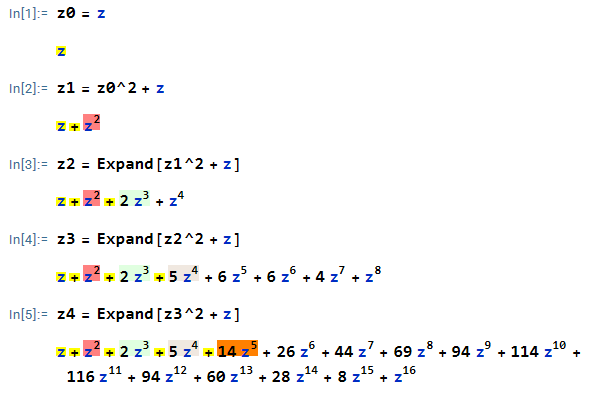
Consider the sequence of complex polynomials in defined by for every non-negative integer , where . It is clear that has degree and thus has the representation
,
where each is a positive integer. Prove that for .
Part 4: Let be arbitrary events in a probability field. Denote by the event that at least of occur. Prove that .
Parts 5a, 5b, 5c, 5d, and 5e: Evaluate the following sums in closed form:
and
.
Parts 6a, 6b, 6c, 6d, and 6e: Two points and are chosen at random (uniformly) from the interior of a unit circle. What is the probability that the circle whose diameter is segment lies entirely in the interior of the unit circle?
Parts 7a, 7b, 7c, 7d, 7e, 7f, 7g, 7h, and 7i: Let and be independent normally distributed random variables, each with its own mean and variance. Show that the variance of conditioned on the event is smaller than the variance of alone.
A brief clip from Megan Moroney’s video “I’m Not Pretty” correctly uses polynomial long division to establish that is a factor of . Even more amazingly, the fact that the remainder is actually fits artistically with the video.
And while I have her music on my mind, I can’t resist sharing her masterpiece “Tennessee Orange” and its playful commentary on the passion of college football fans.
I’m doing something that I should have done a long time ago: collecting a series of posts into one single post. The links below show my series on Lagrange points.
The following problem appeared in Volume 97, Issue 3 (2024) of Mathematics Magazine.
Two points and are chosen at random (uniformly) from the interior of a unit circle. What is the probability that the circle whose diameter is segment lies entirely in the interior of the unit circle?
As discussed in a previous post, I guessed from simulation that the answer is . Naturally, simulation is not a proof, and so I started thinking about how to prove this.
My first thought was to make the problem simpler by letting only one point be chosen at random instead of two. Suppose that the point is fixed at a distance from the origin. What is the probability that the point , chosen at random, uniformly, from the interior of the unit circle, has the desired property?
My second thought is that, by radial symmetry, I could rotate the figure so that the point is located at . In this way, the probability in question is ultimately going to be a function of .
There is a very nice way to compute such probabilities since is chosen at uniformly from the unit circle. Let be the set of all points within the unit circle that have the desired property. Since the area of the unit circle is , the probability of desired property happening is
.
Based on the simulations discussed in the previous post, my guess was that was the interior of an ellipse centered at the origin with a semimajor axis of length and a semiminor axis of length . Now I had to think about how to prove this.
As noted earlier in this series, the circle with diameter will lie within the unit circle exactly when , where is the midpoint of . So suppose that has coordinates , where is known, and let the coordinates of be . Then the coordinates of will be
,
so that
and
.
Therefore, the condition (again, equivalent to the condition that the circle with diameter lies within the unit circle) becomes
,
which simplifies to
.
When I saw this, light finally dawned. Given two points and , called the foci, an ellipse is defined to be the set of all points so that , where is a constant. If the coordinates of , , and are , , and , then this becomes
.
Therefore, the set is the interior of an ellipse centered at the origin with and . Furthermore, is the semimajor axis of the ellipse, while the semiminor axis is equal to .
At last, I could now return to the original question. Suppose that the point is fixed at a distance from the origin. What is the probability that the point , chosen at random, uniformly, from the interior of the unit circle, has the property that the circle with diameter lies within the unit circle? Since is a subset of the interior of the unit circle, we see that this probability is equal to
.
In the next post, I’ll use this intermediate step to solve the original question.
The following problem appeared in Volume 96, Issue 3 (2023) of Mathematics Magazine.
Evaluate the following sums in closed form:
and
.
By using the Taylor series expansions of and and flipping the order of a double sum, I was able to show that
.
I immediately got to thinking: there’s nothing particularly special about and for this analysis. Is there a way of generalizing this result to all functions with a Taylor series expansion?
Suppose
,
and let’s use the same technique to evaluate
.
To see why this matches our above results, let’s start with and write out the full Taylor series expansion, including zero coefficients:
,
so that
or
After dropping the zero terms and collecting, we obtain
.
A similar calculation would apply to any even function .
The following problem appeared in Volume 96, Issue 3 (2023) of Mathematics Magazine.
Evaluate the following sums in closed form:
and
.
In the previous post, we showed that by writing the series as a double sum and then reversing the order of summation. We proceed with very similar logic to evaluate . Since
is the Taylor series expansion of , we may write as
As before, we employ one of my favorite techniques from the bag of tricks: reversing the order of summation. Also as before, the inner sum is inner sum is independent of , and so the inner sum is simply equal to the summand times the number of terms. We see that
.
At this point, the solution for diverges from the previous solution for . I want to cancel the factor of in the summand; however, the denominator is
,
and doesn’t cancel cleanly with . Hypothetically, I could cancel as follows:
,
but that introduces an extra in the denominator that I’d rather avoid.
So, instead, I’ll write as and then distribute and split into two different sums:
.
At this point, I factored out a power of from the first sum. In this way, the two sums are the Taylor series expansions of and :
.
This was sufficiently complicated that I was unable to guess this solution by experimenting with Mathematica; nevertheless, Mathematica can give graphical confirmation of the solution since the graphs of the two expressions overlap perfectly.
The following problem appeared in Volume 96, Issue 3 (2023) of Mathematics Magazine.
Evaluate the following sums in closed form:
and
.
We start with and the Taylor series
.
With this, can be written as
.
At this point, my immediate thought was one of my favorite techniques from the bag of tricks: reversing the order of summation. (Two or three chapters of my Ph.D. theses derived from knowing when to apply this technique.) We see that
.
At this point, the inner sum is independent of , and so the inner sum is simply equal to the summand times the number of terms. Since there are terms for the inner sum (), we see
.
To simplify, we multiply top and bottom by 2 so that the first term of cancels:
At this point, I factored out a and a power of to make the sum match the Taylor series for :
.
I was unsurprised but comforted that this matched the guess I had made by experimenting with Mathematica.
The following problem appeared in Volume 96, Issue 3 (2023) of Mathematics Magazine.
Evaluate the following sums in closed form:
and
.
When I first read this problem, I immediately noticed that
is a Taylor polynomial of and
is a Taylor polynomial of . In other words, the given expressions are the sums of the tail-sums of the Taylor series for and .
As usual when stumped, I used technology to guide me. Here’s the graph of the first sum, adding the first 50 terms.
I immediately notice that the function oscillates, which makes me suspect that the answer involves either or . I also notice that the sizes of oscillations increase as increases, so that the answer should have the form or , where is an increasing function. I also notice that the graph is symmetric about the origin, so that the function is even. I also notice that the graph passes through the origin.
So, taking all of that in, one of my first guesses was , which is satisfies all of the above criteria.
That’s not it, but it’s not far off. The oscillations of my guess in orange are too big and they’re inverted from the actual graph in blue. After some guessing, I eventually landed on .
That was a very good sign… the two graphs were pretty much on top of each other. That’s not a proof that is the answer, of course, but it’s certainly a good indicator.
I didn’t have the same luck with the other sum; I could graph it but wasn’t able to just guess what the curve could be.
The following problem appeared in Volume 53, Issue 4 (2022) of The College Mathematics Journal.
Define, for every non-negative integer , the th Catalan number by
.
Consider the sequence of complex polynomials in defined by for every non-negative integer , where . It is clear that has degree and thus has the representation
,
where each is a positive integer. Prove that for .
This problem appeared in the same issue as the probability problem considered in the previous two posts. Looking back, I think that the confidence that I gained by solving that problem gave me the persistence to solve this problem as well.
My first thought when reading this problem was something like “This involves sums, polynomials, and binomial coefficients. And since the sequence is recursively defined, it’s probably going to involve a proof by mathematical induction. I can do this.”
My second thought was to use Mathematica to develop my own intuition and to confirm that the claimed pattern actually worked for the first few values of .
As claimed in the statement of the problem, each is a polynomial of degree without a nontrivial constant term. Also, for each , the term of degree , for , has a coefficient that is independent of which equal to . For example, for , the coefficient of (in orange above) is equal to
,
and the problem claims that the coefficient of will remain 14 for
Confident that the pattern actually worked, all that remained was pushing through the proof by induction.
We proceed by induction on . The statement clearly holds for :
.
Although not necessary, I’ll add for good measure that
and
This next calculation illustrates what’s coming later. In the previous calculation, the coefficient of is found by multiplying out
.
This is accomplished by examining all pairs, one from the left product and one from the right product, so that the exponent works out to be . In this case, it’s
.
For the inductive step, we assume that, for some , for all , and we define
Our goal is to show that for .
For , the coefficient of in is clearly 1, or .
For , the coefficient of in can be found by expanding the above square. Every product of the form will contribute to the term . Since (since ), the values of that will contribute to this term will be . (Ordinarily, the and terms would also contribute; however, there is no term in the expression being squared). Therefore, after using the induction hypothesis and reindexing, we find
.
The last step used a recursive relationship for the Catalan numbers that I vaguely recalled but absolutely had to look up to complete the proof.
This series was motivated by a terrific article that I read in the American Mathematical Monthly about Lagrange points, which are (from Wikipedia) “points of equilibrium for small-mass objects under the gravitational influence of two massive orbiting bodies.” There are five such points in the Sun-Earth system, called , , , , and .
The article points out a delicious historical factoid: Lagrange had a slight careless mistake in his derivation!
From the article:
Equation (d) would be just the tool to use to determine where to locate the JWST [James Webb Space Telescope, which is now in orbit about ], except for one thing: Lagrange got it wrong!… Do you see it? His algebra in converting to common denominator form is incorrect… Fortunately, at some point in the two-and-a-half centuries between Lagrange’s work and the launch of JWST, this error has been recognized and corrected.
This little historical anecdote illustrates that, despite our best efforts, even the best of us are susceptible to careless mistakes. The simplification should have been
.
(Parenthetically, The article also notes a clear but unintended typesetting error, as the correct but smudged exponent of 3 in the first equation became an incorrect exponent of 2 in the second.)


![[0,1]](https://s0.wp.com/latex.php?latex=%5B0%2C1%5D&bg=ffffff&fg=000000&s=0&c=20201002)


![{\bf 1}[S]](https://s0.wp.com/latex.php?latex=%7B%5Cbf+1%7D%5BS%5D&bg=ffffff&fg=000000&s=0&c=20201002)


![[0,X]](https://s0.wp.com/latex.php?latex=%5B0%2CX%5D&bg=ffffff&fg=000000&s=0&c=20201002)
![[X,1]](https://s0.wp.com/latex.php?latex=%5BX%2C1%5D&bg=ffffff&fg=000000&s=0&c=20201002)


 is a factor of
  . Even more amazingly, the fact that the remainder is
  actually fits artistically with the video.


 lies entirely in the interior of the unit circle?
 . Naturally, simulation is not a proof, and so I started thinking about how to prove this.
 from the origin. What is the probability that the point
  . In this way, the probability in question is ultimately going to be a function of
  be the set of all points
  , the probability of desired property happening is
 .
. and a semiminor axis of length
  . Now I had to think about how to prove this.
 , where
  is the midpoint of
  . Then the coordinates of
  ,
,
 .
. ,
,![\displaystyle \sqrt{ \frac{1}{4} \left[ (x+t)^2 + y^2 \right]} + \sqrt{ \frac{1}{4} \left[ (x-t)^2 + y^2 \right]} < 1](https://s0.wp.com/latex.php?latex=%5Cdisplaystyle+%5Csqrt%7B+%5Cfrac%7B1%7D%7B4%7D+%5Cleft%5B+%28x%2Bt%29%5E2+%2B+y%5E2+%5Cright%5D%7D+%2B+%5Csqrt%7B+%5Cfrac%7B1%7D%7B4%7D+%5Cleft%5B+%28x-t%29%5E2+%2B+y%5E2+%5Cright%5D%7D+%3C+1&bg=ffffff&fg=000000&s=0&c=20201002)

 .
. and
and  , called the foci, an ellipse is defined to be the set of all points
  , where
  is a constant. If the coordinates of
  , and
, and  , then this becomes
 .
. and
and  . Furthermore,
  .
. .
.
 .
. and
and  and flipping the order of a double sum, I was able to show that
  .
. ,
,


![= x \displaystyle \left[ (a_0)' + \sum_{k=1}^\infty \left(a_k x^k \right)' \right]](https://s0.wp.com/latex.php?latex=%3D+x+%5Cdisplaystyle+%5Cleft%5B+%28a_0%29%27+%2B++%5Csum_%7Bk%3D1%7D%5E%5Cinfty+%5Cleft%28a_k+x%5Ek+%5Cright%29%27+%5Cright%5D&bg=ffffff&fg=000000&s=0&c=20201002)


 .
.
 and write out the full Taylor series expansion, including zero coefficients:
 ,
,


 .
. .
. ,
,

 ,
,

 .
. by writing the series as a double sum and then reversing the order of summation. We proceed with very similar logic to evaluate
  . Since


 .
. . I want to cancel the factor of
  in the summand; however, the denominator is
 ,
, . Hypothetically, I could cancel as follows:
 ,
, and then distribute and split into two different sums:

![= \displaystyle \frac{1}{2} \sum_{k=1}^\infty \left[ (-1)^k (2k+1) \frac{x^{2k+1}}{(2k+1)!} - (-1)^k \cdot 1 \frac{x^{2k+1}}{(2k+1)!} \right]](https://s0.wp.com/latex.php?latex=%3D+%5Cdisplaystyle+%5Cfrac%7B1%7D%7B2%7D+%5Csum_%7Bk%3D1%7D%5E%5Cinfty+%5Cleft%5B+%28-1%29%5Ek+%282k%2B1%29+%5Cfrac%7Bx%5E%7B2k%2B1%7D%7D%7B%282k%2B1%29%21%7D+-+%28-1%29%5Ek+%5Ccdot+1+%5Cfrac%7Bx%5E%7B2k%2B1%7D%7D%7B%282k%2B1%29%21%7D+%5Cright%5D&bg=ffffff&fg=000000&s=0&c=20201002)


 .
. from the first sum. In this way, the two sums are the Taylor series expansions of

 .
.

 .
.
 .
. .
. ), we see
 .
. cancels:

 and a power of
  .
.


 increases, so that the answer should have the form
  or
or  , where
  is an increasing function. I also notice that the graph is symmetric about the origin, so that the function is even. I also notice that the graph passes through the origin.
 , which is satisfies all of the above criteria.
 .
.
 is the answer, of course, but it’s certainly a good indicator.
 . For example, for
  , the coefficient of
  (in orange above) is equal to
 ,
,
 :
:  .
.


 is found by multiplying out
 .
. .
. ,
, 
 for
for  .
. , the coefficient
  of
of  is clearly 1, or
  .
.  , the coefficient
  of
of  in
in  will contribute to the term
  . Since
  (since
  that will contribute to this term will be
  . (Ordinarily, the
  and
and 


 .
.  ,
,  , and
, and  .
.

 to common denominator form is incorrect… Fortunately, at some point in the two-and-a-half centuries between Lagrange’s work and the launch of JWST, this error has been recognized and corrected.
 ![q' = \displaystyle \left[ 1 - \frac{1}{(m-1)^3} \right] \cdot \frac{1}{r^3}](https://s0.wp.com/latex.php?latex=q%27+%3D+%5Cdisplaystyle+%5Cleft%5B+1+-+%5Cfrac%7B1%7D%7B%28m-1%29%5E3%7D+%5Cright%5D+%5Ccdot+%5Cfrac%7B1%7D%7Br%5E3%7D&bg=ffffff&fg=000000&s=0&c=20201002)


 .
. Mean Green Math