Predicate Logic and Popular Culture (Part 62): George Strait

Let X(x) be the proposition “x is my ex,” and let T(x) be the proposition “x lives in Texas.” Translate the logical statement

\forall x (X(x) \Rightarrow T(x)),

where the domain is all people.

Naturally, this one of the great hits in the storied career of George Strait.

green line

Context: This semester, I taught discrete mathematics for the first time. Part of the discrete mathematics course includes an introduction to predicate and propositional logic for our math majors. As you can probably guess from their names, students tend to think these concepts are dry and uninteresting even though they’re very important for their development as math majors.

In an effort to making these topics more appealing, I spent a few days mining the depths of popular culture in a (likely futile) attempt to make these ideas more interesting to my students. In this series, I’d like to share what I found. Naturally, the sources that I found have varying levels of complexity, which is appropriate for students who are first learning prepositional and predicate logic.

When I actually presented these in class, I either presented the logical statement and had my class guess the statement in actual English, or I gave my students the famous quote and them translate it into predicate logic. However, for the purposes of this series, I’ll just present the statement in predicate logic first.

Tennis and best 2-out-of-3 vs. best 3-out-of-5

I recently read a very interesting article on FiveThirtyEight.com regarding men’s and women’s tennis that reminded me of the following standard problem in probability.

Player X and Player Y play a series of at most n games, and a winner is declared when either Player X or Player Y wins at least n/2 games. Suppose that the chance that Player X wins is p, and suppose that the outcomes of the games are independent. Find the probability that Player Y wins if (a) n = 3, (b) n = 5.

The easiest way to solve this is to assume that all n games are played, even if that doesn’t actually happen in real life. Then, for part (a), we can use the binomial distribution to find

  • P(X = 0) = P(Y = 3) = (1-p)^3
  • P(X = 1) = P(Y = 2) = 3p(1-p)^2
  • P(X = 2) = P(Y = 1) = 3p^2(1-p)
  • P(X = 3) = P(Y = 0) = p^3

Adding the first two probabilities, the chance that Player Y wins is (1-p)^3 + 3p(1-p)^2 = (1-p)^2 (1+2p).

Similarly, for part (b),

  • P(X = 0) = P(Y = 5) = (1-p)^5
  • P(X = 1) = P(Y = 4) = 5 p (1-p)^4
  • P(X = 2) = P(Y = 3) = 10p^2 (1-p)^3
  • P(X = 3) = P(Y = 2) = 10 p^3 (1-p)^2
  • P(X = 4) = P(Y = 1) = 5 p^4 (1-p)
  • P(X = 5) = P(Y = 0) = p^5

Adding the first three probabilities, the chance that Player Y wins is (1-p)^5 + 5p(1-p)^4 + 10p^2(1-p)^3 = (1-p)^3 (1+3p+6p^2).

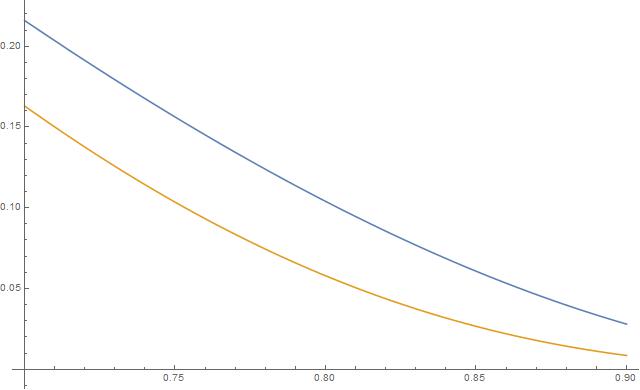
The graphs of (1-p)^2 (1+2p) and (1-p)^3 (1+3p+6p^2) on the interval 0.7 \le p \le 0.9 are shown below in blue and orange, respectively. The lesson is clear: if p > 0.5, then clearly the chance that Player Y wins is less than 50%. However, Player Y’s chances of upsetting Player X are greater if they play a best 2-out-of-3 series instead of a best 3-out-of-5 series.
best2outof3Remarkably, this above curve has been observed in real-life sports: namely, women’s tennis (which plays best 2 sets out of 3 — marked WTA below) and men’s tennis (which plays best 3 sets out of 5 in Grand Slams — marked ATP below). The chart indicates that when two men’s players ranked 20 places apart play each other in Grand Slams, an upset occurs about 13% of the time. However, the upset percentage is only 5% in women’s tennis. (This approximately matches the above curve near p = 0.8.)

However, in tennis tournaments that are not Grand Slams, men’s tennis players also play a matches with a maximum of 3 sets. In those tournaments, the chances of an upset are approximately equal in both men’s tennis and women’s tennis.

However, since the casual tennis fan (like me) only tunes into the Grand Slams but not other tennis matches, this fact is not widely known — which gives the misleading impression that top women’s tennis players are not as tough, skilled, etc. as men’s tennis players.

The FiveThirtyEight article argues that top women’s tennis players don’t make it to the latter stages of Grand Slam tournaments than top men’s players because of the two tournaments are held under these different rules, and that women’s tennis would be better served if their matches were also played in a best-3-out-of-5 format.


Predicate Logic and Popular Culture (Part 61): Taylor Swift

Let S(t) be the proposition “We are in style at time t,” let C(t) be the proposition “We crash down at time t,” and let B(t) be the proposition “We come back at time t.” Translate the logical statement

\forall t (\lnot S(t)) \Rightarrow (\forall t(C(t) \Rightarrow \exists u>t(B(u))).

The straightforward way of translating this into English is, “If we never go out of style, then whenever we crash down we come back at a later time. This approximately matches the second half of the chorus of one of Taylor Swift’s hit songs.

green line

Context: This semester, I taught discrete mathematics for the first time. Part of the discrete mathematics course includes an introduction to predicate and propositional logic for our math majors. As you can probably guess from their names, students tend to think these concepts are dry and uninteresting even though they’re very important for their development as math majors.

In an effort to making these topics more appealing, I spent a few days mining the depths of popular culture in a (likely futile) attempt to make these ideas more interesting to my students. In this series, I’d like to share what I found. Naturally, the sources that I found have varying levels of complexity, which is appropriate for students who are first learning prepositional and predicate logic.

When I actually presented these in class, I either presented the logical statement and had my class guess the statement in actual English, or I gave my students the famous quote and them translate it into predicate logic. However, for the purposes of this series, I’ll just present the statement in predicate logic first.

Predicate Logic and Popular Culture (Part 60): Heartland

Let L(x,t) be the proposition “x loves her at time t.” Translate the logical statement

\exists t<0(L(\hbox{I},t) \land \forall x \forall s < t (\lnot L(x,t))),

where t = 0 is now.

The clunky translation is “There was a time that I loved her, and nobody loved her before that time.” More succinctly, this is the title of the song that’s been played for countless father-daughter dances at wedding receptions since 2006. (I cannot tell a lie: I always turn into a sobbing and amorphous pile of mush whenever I hear this song.)

green line

Context: This semester, I taught discrete mathematics for the first time. Part of the discrete mathematics course includes an introduction to predicate and propositional logic for our math majors. As you can probably guess from their names, students tend to think these concepts are dry and uninteresting even though they’re very important for their development as math majors.

In an effort to making these topics more appealing, I spent a few days mining the depths of popular culture in a (likely futile) attempt to make these ideas more interesting to my students. In this series, I’d like to share what I found. Naturally, the sources that I found have varying levels of complexity, which is appropriate for students who are first learning prepositional and predicate logic.

When I actually presented these in class, I either presented the logical statement and had my class guess the statement in actual English, or I gave my students the famous quote and them translate it into predicate logic. However, for the purposes of this series, I’ll just present the statement in predicate logic first.

Predicate Logic and Popular Culture (Part 59): Taylor Swift

Let T(x) be the proposition “You go talk to x,” and let G(x) be the proposition “We are getting back together at time t.” Translate the logical statement

T(\hbox{your friends}) \land T(\hbox{my friends}) \land T(\hbox{me}) \land \forall t\ge 0 (\lnot G(t)),

where time 0 is now.

Of course, this is the ending part of the chorus to “We Are Never Ever Getting Back Together.”

green line

Context: This semester, I taught discrete mathematics for the first time. Part of the discrete mathematics course includes an introduction to predicate and propositional logic for our math majors. As you can probably guess from their names, students tend to think these concepts are dry and uninteresting even though they’re very important for their development as math majors.

In an effort to making these topics more appealing, I spent a few days mining the depths of popular culture in a (likely futile) attempt to make these ideas more interesting to my students. In this series, I’d like to share what I found. Naturally, the sources that I found have varying levels of complexity, which is appropriate for students who are first learning prepositional and predicate logic.

When I actually presented these in class, I either presented the logical statement and had my class guess the statement in actual English, or I gave my students the famous quote and them translate it into predicate logic. However, for the purposes of this series, I’ll just present the statement in predicate logic first.

Predicate Logic and Popular Culture (Part 58): Taylor Swift

Let Y(x) be the proposition “You are x years old,” and let L(x) be the proposition “x tell you that x loves you,” and let B(x) be the proposition “You believe x.” Translate the logical statement

(Y(15) \land \exists x(L(x))) \Rightarrow B(x),

where the domain is all people.

The straightforward way of translating this into English is, “If you are 15 years old and there exists someone who says that he/she loves you, then you believe him/her.” This approximately matches the chorus of one of Taylor Swift’s earliest hits.

green line

Context: This semester, I taught discrete mathematics for the first time. Part of the discrete mathematics course includes an introduction to predicate and propositional logic for our math majors. As you can probably guess from their names, students tend to think these concepts are dry and uninteresting even though they’re very important for their development as math majors.

In an effort to making these topics more appealing, I spent a few days mining the depths of popular culture in a (likely futile) attempt to make these ideas more interesting to my students. In this series, I’d like to share what I found. Naturally, the sources that I found have varying levels of complexity, which is appropriate for students who are first learning prepositional and predicate logic.

When I actually presented these in class, I either presented the logical statement and had my class guess the statement in actual English, or I gave my students the famous quote and them translate it into predicate logic. However, for the purposes of this series, I’ll just present the statement in predicate logic first.

Predicate Logic and Popular Culture (Part 57): Frozen

Let C(t) be the proposition “The cold bothers me at time t.” Translate the logical statement

\lnot(\exists t\le 0 (C(t))),

where the domain is all times and t=0 is now.

The straightforward way of translating this into English is, “It is false that there exists a time in the past that the cold bothered me.” Also, DeMorgan’s Laws could be applied:

\forall t\le 0(\lnot C(t)),

which can be read “For all times in the past, the cold did not bother me.” Of course, this is the closing line of the chorus of the signature tune from Frozen.

Of course, I can’t mention Frozen without mentioning its parodies; this is the best one that I’ve seen.

green line

Context: This semester, I taught discrete mathematics for the first time. Part of the discrete mathematics course includes an introduction to predicate and propositional logic for our math majors. As you can probably guess from their names, students tend to think these concepts are dry and uninteresting even though they’re very important for their development as math majors.

In an effort to making these topics more appealing, I spent a few days mining the depths of popular culture in a (likely futile) attempt to make these ideas more interesting to my students. In this series, I’d like to share what I found. Naturally, the sources that I found have varying levels of complexity, which is appropriate for students who are first learning prepositional and predicate logic.

When I actually presented these in class, I either presented the logical statement and had my class guess the statement in actual English, or I gave my students the famous quote and them translate it into predicate logic. However, for the purposes of this series, I’ll just present the statement in predicate logic first.

Predicate Logic and Popular Culture (Part 56): The Byrds

Let S(x,t) be the proposition “t is the season for x.” Translate the logical statement

\forall x \exists t (S(x,t)).

This pretty much matches the opening line of the 1960s hit song by The Byrds from Ecclesiastes 3.

green line

Context: This semester, I taught discrete mathematics for the first time. Part of the discrete mathematics course includes an introduction to predicate and propositional logic for our math majors. As you can probably guess from their names, students tend to think these concepts are dry and uninteresting even though they’re very important for their development as math majors.

In an effort to making these topics more appealing, I spent a few days mining the depths of popular culture in a (likely futile) attempt to make these ideas more interesting to my students. In this series, I’d like to share what I found. Naturally, the sources that I found have varying levels of complexity, which is appropriate for students who are first learning prepositional and predicate logic.

When I actually presented these in class, I either presented the logical statement and had my class guess the statement in actual English, or I gave my students the famous quote and them translate it into predicate logic. However, for the purposes of this series, I’ll just present the statement in predicate logic first.

Predicate Logic and Popular Culture (Part 55): The Quiet Man

Let L(x) be the proposition “x is a lock,” let B(x) be the proposition “x is a bolt,” and let H(x) be the proposition “x is in your own mercenary little heart.” Translate the logical statement

\forall x ( (L(x) \lor B(x)) \Rightarrow H(x)),

where the domain is all people.

The straightforward way of translating this into English is, “If it’s a lock or a bolt, then it’s in your own mercenary little heart.” With a little more emphasis, this is one of the great lines uttered by John Wayne in the 1952 film The Quiet Man (a wonderful movie which really needs to be digitized and restored to its original brilliance).

green line

Context: This semester, I taught discrete mathematics for the first time. Part of the discrete mathematics course includes an introduction to predicate and propositional logic for our math majors. As you can probably guess from their names, students tend to think these concepts are dry and uninteresting even though they’re very important for their development as math majors.

In an effort to making these topics more appealing, I spent a few days mining the depths of popular culture in a (likely futile) attempt to make these ideas more interesting to my students. In this series, I’d like to share what I found. Naturally, the sources that I found have varying levels of complexity, which is appropriate for students who are first learning prepositional and predicate logic.

When I actually presented these in class, I either presented the logical statement and had my class guess the statement in actual English, or I gave my students the famous quote and them translate it into predicate logic. However, for the purposes of this series, I’ll just present the statement in predicate logic first.

Predicate Logic and Popular Culture (Part 54): Michael Jackson

Let p be the proposition “Billie Jean is my lover,” let q be the proposition “Billie Jean is a girl,” let r be the proposition “Billie Jean claims I am the one,” and let s be the proposition “The kid is my son.” Translate the logical statement \lnot p \land q \land r \land \lnot s.

Naturally, the translation is the chorus of one of Michael Jackson’s iconic hits.

See also the following rendition with bottles:

green line

Context: This semester, I taught discrete mathematics for the first time. Part of the discrete mathematics course includes an introduction to predicate and propositional logic for our math majors. As you can probably guess from their names, students tend to think these concepts are dry and uninteresting even though they’re very important for their development as math majors.

In an effort to making these topics more appealing, I spent a few days mining the depths of popular culture in a (likely futile) attempt to make these ideas more interesting to my students. In this series, I’d like to share what I found. Naturally, the sources that I found have varying levels of complexity, which is appropriate for students who are first learning prepositional and predicate logic.

When I actually presented these in class, I either presented the logical statement and had my class guess the statement in actual English, or I gave my students the famous quote and them translate it into predicate logic. However, for the purposes of this series, I’ll just present the statement in predicate logic first.









