My Favorite One-Liners: Part 89

In this series, I’m compiling some of the quips and one-liners that I’ll use with my students to hopefully make my lessons more memorable for them.

Here’s a problem that might arise in my discrete mathematics class:

Find the negation of p \Rightarrow q.

This requires a couple of reasonably complex steps. First, we use the fact that p \Rightarrow q is logically equivalent to $\lnot p \lor q$:

\lnot(p \Rightarrow q) \equiv \lnot (\lnot p \lor q).

Next, we have to apply DeMorgan’s Law to find the negation:

\lnot (p \Rightarrow q) \equiv \lnot(\lnot p \lor q) \equiv \lnot(\lnot p) \land \lnot q

Finally, we arrive at the final step: simplifying \lnot(\lnot p). At this point, I tell my class, it’s a bit of joke, especially after the previous, more complicated steps. “Not not p,” of course, is the same as p. So this step is a bit of a joke. Which steps up the following cringe-worthy pun:

In fact, you might even call this a not-not joke.

After the groans settle down, we finish the derivation:

\lnot(p \Rightarrow q) \equiv \lnot(\lnot p \lor q) \equiv \lnot(\lnot p) \land \lnot q \equiv p \land \lnot q.

My Favorite One-Liners: Part 86

In this series, I’m compiling some of the quips and one-liners that I’ll use with my students to hopefully make my lessons more memorable for them.

To get students comfortable with i = \sqrt{-1}, I’ll often work through a quick exercise on the powers of i:

i^1 = i

i^2 = -1

i^3 = -i

i^4 = 1

i^5 = i

Students quickly see that the powers of i are a cycle of length 4, so that i^5 = i \cdot i \cdot i \cdot i \cdot i is the same thing as just i. So I tell my students:

There’s a technical term for this phenomenon: aye-yai-yai-yai-yai.

See also http://mentalfloss.com/article/52790/where-did-phrase-aye-yai-yai-come for more on the etymology of this phrase.

My Favorite One-Liners: Part 85

In this series, I’m compiling some of the quips and one-liners that I’ll use with my students to hopefully make my lessons more memorable for them.

Today’s one-liner is one that I’ll use when I want to discourage students from using a logically correct and laboriously cumbersome method. For example:

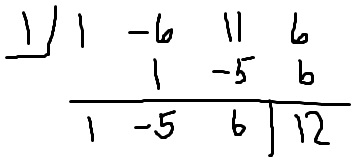
Find a polynomial q(x) and a constant r so that x^3 - 6x^2 + 11x + 6 = (x-1)q(x) + r.

Hypothetically, this can be done by long division:

However, this takes a lot of time and space, and there are ample opportunities to make a careless mistake along the way (particularly when subtracting negative numbers). Since there’s an alternative method that could be used (we’re dividing by something of the form x-c or x+c, I’ll tell my students:

Yes, you could use long division. You could also stick thumbtacks in your eyes; I don’t recommend it.

Instead, when possible, I guide students toward the quicker method of synthetic division:

My Favorite One-Liners: Part 84

In this series, I’m compiling some of the quips and one-liners that I’ll use with my students to hopefully make my lessons more memorable for them.

Every once in a while, I’ll show my students that there’s a difficult way to do a problem that I don’t want them to do for homework. For example, here’s the direct derivation of the mean of the binomial distribution using only Precalculus; this would make an excellent homework problem for the Precalculus teacher who wants to torture his/her students:

E(X) = \displaystyle \sum_{k=0}^n k {n \choose k} p^k q^{n-k}

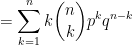
= \displaystyle \sum_{k=1}^n k  {n \choose k} p^k q^{n-k}

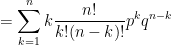
= \displaystyle \sum_{k=1}^n k  \frac{n!}{k!(n-k)!} p^k q^{n-k}

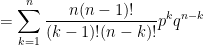
= \displaystyle \sum_{k=1}^n \frac{n!}{(k-1)!(n-k)!} p^k q^{n-k}

= \displaystyle \sum_{k=1}^n \frac{n (n-1)!}{(k-1)!(n-k)!} p^k q^{n-k}

= \displaystyle \sum_{i=0}^{n-1} \frac{n (n-1)!}{i!(n-1-i)!} p^{i+1} q^{n-1-i}

= \displaystyle np \sum_{i=0}^{n-1} \frac{(n-1)!}{i!(n-1-i)!} p^i q^{n-1-i}

= \displaystyle np(p+q)^{n-1}

= np \cdot 1^{n-1}

=np.

However, that’s a lot of work, and the way that I really want my students to do this, which is a lot easier (and which will be used throughout the semester), is by writing the binomial random variable as the sum of indicator random variables:

E(X) = E(I_1 + \dots + I_n) = E(I_1) + \dots + E(I_n) = p + \dots + p = np.

So, to reassure my students that they’re going to be asked to reproduce the above lengthy calculation, I’ll tell them that I wrote all that down for my own machismo, just to prove to them that I really could do it.

Since my physical presence exudes next to no machismo, this almost always gets a laugh.

My Favorite One-Liners: Part 83

In this series, I’m compiling some of the quips and one-liners that I’ll use with my students to hopefully make my lessons more memorable for them.

Here’s a problem from calculus:

Let f(x) = x^2 e^{3x}. Find f''(x).

We begin by finding the first derivative using the Product Rule:

f'(x) = 2x e^{3x} + 3x^2 e^{3x}.

Next, we apply the Product Rule again to find the second derivative:

f''(x) = (2 e^{3x} + 6x e^{3x}) + (6x e^{3x} + 9x^2 e^{3x}).

At this point, before simplifying to get the final answer, I’ll ask my students why the 6x e^{3x} term appears twice. After a moment, somebody will usually volunteer the answer: the first term came from differentiating x^2 first and then e^{3x} second, while the other term came from differentiating e^{3x} first and then x^2 second. Either way, we end up with the same term.

I then tell my class that there’s a technical term for this: Oops, I did it again.

While on the topic, I can’t resist also sharing this (a few years ago, this was shown on the JumboTron of Dallas Mavericks games during timeouts):

My Favorite One-Liners: Part 81

In this series, I’m compiling some of the quips and one-liners that I’ll use with my students to hopefully make my lessons more memorable for them.

Here’s a problem that hypothetically could appear in Algebra II or Precalculus:

Find the solutions of x^4 + 2x^3 + 10 x^2 - 6x + 65 = 0.

While there is a formula for solving quartic equations, it’s extremely long and hence is not typically taught to high school students. Instead, the techniques that are typically taught are the Rational Root Test and (sometimes, depending on the textbook) Descartes’ Rule of Signs. The Rational Root Test constructs a list of possible rational roots (in this case \pm 1, \pm 5, \pm 13, \pm 65) to test… usually with synthetic division to accomplish this as quickly as possible.

The only problem is that there’s no guarantee that any of these possible rational roots will actually work. Indeed, for this particular example, none of them work because all of the solutions are complex (1 \pm 2i and 2 \pm 3i). So the Rational Root Test is of no help for this example — and students have to somehow try to find the complex roots.

So here’s the wisecrack that I use. This wisecrack really only works in Texas and other states in which the state legislature has seen the wisdom of allowing anyone to bring a handgun to class:

What do you do if a problem like this appears on the test? [Murmurs and various suggestions]

Shoot the professor. [Nervous laughter]

It’s OK; campus carry is now in effect. [Full-throated laughter.]


My Favorite One-Liners: Part 79

In this series, I’m compiling some of the quips and one-liners that I’ll use with my students to hopefully make my lessons more memorable for them.

I’ll use today’s quip when there are multiple reasonable ways of solving a problem. For example,

Two fair dice are rolled. Find the probability that at least one of the rolls is a six.

This can be done by directly listing all of the possibilities:

11 \qquad 12 \qquad 13 \qquad 14 \qquad 15 \qquad 16

21 \qquad 22 \qquad 23 \qquad 24 \qquad 25 \qquad 26

31 \qquad 32 \qquad 33 \qquad 34 \qquad 35 \qquad 36

41 \qquad 42 \qquad 43 \qquad 44 \qquad 45 \qquad 46

51 \qquad 52 \qquad 53 \qquad 54 \qquad 55 \qquad 56

61 \qquad 62 \qquad 63 \qquad 64 \qquad 65 \qquad 66

Of these 36 possibilities, 11 have at least one six, so the answer is 11/36.

Alternatively, we could use the addition rule:

P(\hbox{first a six or second a six}) = P(\hbox{first a six}) + P(\hbox{second a six}) - P(\hbox{first a six and second a six})

= P(\hbox{first a six}) + P(\hbox{second a six}) - P(\hbox{first a six}) P(\hbox{second a six})

= \displaystyle \frac{1}{6} + \frac{1}{6} - \frac{1}{6} \times \frac{1}{6}

= \displaystyle \frac{11}{36}.

Another possibility is using the complement:

P(\hbox{at least one six}) = 1 - P(\hbox{no sixes})

= 1 - P(\hbox{first is not a six})P(\hbox{second is not a six})

= 1 - \displaystyle \frac{5}{6} \times \frac{5}{6}

= \displaystyle \frac{11}{36}

To emphasize that there are multiple ways of solving the problem, I’ll use this one-liner:

There are plenty of ways to skin a cat… for those of you who like skinning cats.

When I was a boy, I remember seeing some juvenile book of jokes titled “1001 Ways To Skin a Cat.” A recent search for this book on Amazon came up empty, but I did find this:

My Favorite One-Liners: Part 75

In this series, I’m compiling some of the quips and one-liners that I’ll use with my students to hopefully make my lessons more memorable for them.

The \delta-\epsilon definition of a limit is often really hard for students to swallow:

\forall \epsilon > 0 \exists \delta > 0 \forall x (0 < |x - c| < \delta \Rightarrow |f(x) - L| < \epsilon)

To make this a little more palatable, I’ll choose a simple specific example, like \lim_{x \to 2} x^2 = 4, or

\forall \epsilon > 0 \exists \delta > 0 \forall x (0 < |x - 2| < \delta \Rightarrow |x^2 - 4| < \epsilon)

I’ll use one of the famous lines from “Annie Get Your Gun”:

Anything you can do, I can do better.

In other words, no matter how small a \delta they give me, I can find an \epsilon that meets the requirements of this limit.


My Favorite One-Liners: Part 74

In this series, I’m compiling some of the quips and one-liners that I’ll use with my students to hopefully make my lessons more memorable for them.

After presenting the Fundamental Theorem of Calculus to my calculus students, I make a point of doing the following example in class:

\displaystyle \int_0^4 \frac{1}{4} x^2 \, dx

Hopefully my students are able to produce the correct answer:

\displaystyle \int_0^4 \frac{1}{4} x^2 \, dx = \displaystyle \left[ \frac{x^3}{12} \right]^4_0

= \displaystyle \frac{(4)^3}{12} - \frac{(0)^3}{12}

= \displaystyle \frac{64}{12}

= \displaystyle \frac{16}{3}

Then I tell my students that they’ve probably known the solution of this one since they were kids… and I show them the classic video “Unpack Your Adjectives” from Schoolhouse Rock. They’ll watch this video with no small amount of confusion (“How is this possibly connected to calculus?”)… until I reach the 1:15 mark of the video below, when I’ll pause and discuss this children’s cartoon. This never fails to get an enthusiastic response from my students.

If you have no idea what I’m talking about, be sure to watch the first 75 seconds of the video below. I think you’ll be amused.

My Favorite One-Liners: Part 73

In this series, I’m compiling some of the quips and one-liners that I’ll use with my students to hopefully make my lessons more memorable for them.

Today’s entry is courtesy of Season 1 of The Simpsons. I’ll tell this joke just after introducing derivatives to my calculus students. Here is some dialogue from the episode “Bart The Genius”:

Teacher:  So y = r cubed over 3. And if you determine the rate of change in this curve correctly, I think you’ll be pleasantly surprised.
[The class laughs except for Bart who appears confused.]
Teacher:  Don’t you get it, Bart? Derivative dy = 3 r squared dr over 3, or r squared dr, or r dr r. Har-de-har-har!  Get it?

For a more detailed listing of mathematical references, I highly recommend http://www.simpsonsmath.com (or http://mathsci2.appstate.edu/~sjg/simpsonsmath/), maintained by Dr. Sarah J. Greenwald of Appalachian State University and Dr. Andrew Nestler of Santa Monica College.