In my capstone class for future secondary math teachers, I ask my students to come up with ideas for engaging their students with different topics in the secondary mathematics curriculum. In other words, the point of the assignment was not to devise a full-blown lesson plan on this topic. Instead, I asked my students to think about three different ways of getting their students interested in the topic in the first place.
I plan to share some of the best of these ideas on this blog (after asking my students’ permission, of course).
This student submission again comes from my former student Angelica Albarracin. Her topic, from Algebra: solving linear systems of inequalities.
What interesting (i.e., uncontrived) word problems using this topic can your students do now?
One example of an interesting word problem students can do using this topic is based on a technique astronomers use to learn about celestial bodies. Being able to assess the number of craters a body has on its surface can reveal information about the body’s age, as well as its history of impacts. In comparing the number of craters two bodies have experienced over time, astronomers are able to compare their lifetimes and hypothesize reasons for differences and/or similarities.
Taken from https://spacemath.gsfc.nasa.gov/algebra2.html
Another example of an interesting word problem pertains to determining whether a specific phone plan is best for you. When choosing between certain plans, individuals may have to decide between a higher flat fee and a lower rate per minute or a lower flat fee and a higher rate per minute. In many cases, the answer may not be so obvious so to be able to figure out which is the best deal can prove to be a very helpful money saver. Of course, the answer to this question depends on how many minutes an individual plans to use a month, but we can use linear systems of equations to find out at which point do the plans differ, and thus finding a starting point to the solution.
Taken from https://students.ga.desire2learn.com/d2l/lor/viewer/viewFile.d2lfile/1798/12938/Algebra_ReasoningwithEquationsandInequalities12.htmlHow does this topic extend what your students should have learned in previous courses?
In previous courses, students should have learned about x and y intercepts and solving linear equations. Solving linear systems of equations is and extension of x and y intercepts because one of the major components in this topic is finding the exact point at which two different linear functions meet. We can think of a typical problem of finding the x or y intercept of a linear function in terms of a system. For example, we can let our first equation be y = 3x + 2 and the second be y = 0. From this we can clearly see that our second equation is the x-axis, and as we are trying to find the point of intersection between a linear function, we end up calculating the x-intercept of our first function.
It is also not difficult to see that solving linear systems of equations serves as an extension to solving linear equations. When employing the method of substitution, you must solve for one variable, in terms of the other. This process requires the student to know how to solve singular linear equations, and to apply their solutions through substitution. We can also see an extension regarding graphing linear equations. When solving linear systems of equations by graphing, one must graph each individual linear equation. Once the two individual equations are graphed, the solution can be found by observing the point at which the two equations intersect if at all.
How can technology be used to effectively engage students with this topic?
Desmos is widely regarded for its creative lessons that integrate mathematical topics in fun and engaging ways. For the topic of solving systems of linear equations with graphing and substitution, one such Desmos activity is titled Playing Catch-Up. The first two slides set up an engaging premise where a video compares the running speed of an average person and a professional runner. Further along the activity, the student can see a graphical representation of their speeds and is able to make a prediction as to whether they think one person will pass the other. Aside from being able to see an animated graph that corresponds to the information given in the video, there is also an interesting short answer feature on the first slide. This feature allows the student to ask a question regarding the situation they are presented with in the video. The most helpful part of this feature is that not only can the teacher view the student responses, but also the students can see each other’s responses. This allows for students to communicate with each other in a controlled environment and lead the way for further elaboration on some of the most asked questions.
This specific Desmos activity places much of its emphasis on solving systems of linear equations through graphing, however substitution can still have a place in technology. Typically, when students are introduced to this concept, they are taught the graphing method first as its visual component aids in understanding. Graphing isn’t always reasonable however as it is time consuming and you may be faced with equations that are difficult to graph. By using technology such as the Desmos graphing calculator, the teacher can show the student of an example of a linear system of equations that would be unreasonable to solve by graphing. This gives the students reasoning as to why learning another method such as substitution is necessary while also making them consider a possibility that they might not have thought of before.
References:
https://spacemath.gsfc.nasa.gov/algebra2.htmlhttps://students.ga.desire2learn.com/d2l/lor/viewer/viewFile.d2lfile/1798/12938/Algebra_ReasoningwithEquationsandInequalities12.htmlhttps://teacher.desmos.com/activitybuilder/custom/5818fb314e762b653c3bf0f3
In my capstone class for future secondary math teachers, I ask my students to come up with ideas for engaging their students with different topics in the secondary mathematics curriculum. In other words, the point of the assignment was not to devise a full-blown lesson plan on this topic. Instead, I asked my students to think about three different ways of getting their students interested in the topic in the first place.
I plan to share some of the best of these ideas on this blog (after asking my students’ permission, of course).
This student submission again comes from my former student Jesus Alanis. His topic, from Algebra: solving one- or two-step inequalities.
How could you as a teacher create an activity or project that involves your topic?
As a teacher, the activity I would make so that this topic is more fun is by using the game battleship. When I was in school, learning this lesson for the first time, we did a gallery walk that you would solve for the solutions and would go searching for that solution. Well, you can use the same problems used in a gallery walk. All you would have to do is put it on a worksheet that could be half the solutions of the enemy’s problems and the student’s problems to work on. The student will place(draw) their “ship” on the enemy’s solution. With this activity, you can pair up students and make them go one by one, or since time may be an issue you can make it a race between the two students to see who sinks the opponent’s ships first.
What interesting things can you say about the people who contributed to the discovery and/or the development of this topic?
A brief history of inequalities is that the less than or greater than signs were introduced in 1631 in a book titled “Artis Analyticae Praxis ad Aequationes Algebraicas Resolvendas” created by a British mathematician named Thomas Harriot. An interesting fact is that the creator’s work and the book was published 10 years after his death. A shocking fact is that the actual symbols were created by the book’s editor. At first, the symbols were just triangular symbols that were created by Harriot which was later changed by the editor to what we now know as < and >. A fun fact is that Harriot used parallel lines to symbolized equality, but the parallel lines were vertical, not horizontal as we now know as the equal sign. In the year 1734, a French mathematician named Pierre Bouguer used the less than or equal to and greater than or equal to. Also, there was also another mathematician that use the greater than/ less than symbols but with a horizontal line above them. During these times, the symbols were not yet set in stone and were still being changed. The symbols were actually just triangles and parallel lines to symbolized greater than, less than, greater than or equal to, less than or equal to, and equal to.
How can technology be used to effectively engage students with this topic?
By using technology effectively with this topic, is that I found an online game that has the same idea of the battleship. The website is this: https://www.quia.com/ba/368655.html. The game is online so this is really good resource especially since we are in a pandemic but also an extra resource if the student needs more practice that they can do on their own. This is a good activity for students because I know that there are schools that have in-person classes so each student can use their own computer to prevent any more spreading of the virus while being in the classroom. There are also schools that have classes through Zoom and Google Classroom so they can add this online game as an assignment and make the students have them write down their questions and answers with their work to see the way they work the problems out.
Seehorn, Ashley. “The History of Equality Symbols in Math.” Sciencing, Leaf Group Media, 2 Mar. 2019, sciencing.com/history-equality-symbols-math-8143072.html.
In my capstone class for future secondary math teachers, I ask my students to come up with ideas for engaging their students with different topics in the secondary mathematics curriculum. In other words, the point of the assignment was not to devise a full-blown lesson plan on this topic. Instead, I asked my students to think about three different ways of getting their students interested in the topic in the first place.
I plan to share some of the best of these ideas on this blog (after asking my students’ permission, of course).
This student submission again comes from my former student Trenton Hicks. His topic, from Pre-Algebra: rational and irrational numbers.
The big history associated with irrational numbers involves a Greek philosopher, Hippasus, and his peers, the Pythagorean Theorem, and a square. Hippasus had a square with side lengths of 1 unit, raising the question: what is the distance from corner to corner across the square? The pythagorean theorem tells us that it should be the square root of two. After searching for two numbers to represent the square root of two as a ratio, Hippasus sought out something else: proving that it wasn’t rational. He did so by contradiction, assuming that the square root of two was rational, and that said ratio was in simplest terms. By manipulating the equation, he found that one of the integers in the ratio was even. By further manipulation, he found that the other integer was even as well, reaching a paradox. The ratio couldn’t be in simplest terms if both numbers were even. With this, he had proven that there were no two numbers that could represent the square root of two as a ratio. Thus, the concept of an irrational number was born. It is rumored that once he went to present his findings, his peers disapproved. This new idea contradicted their original beliefs, and was even considered blasphemy. Some rumors even suggest he was murdered for this.
Given the history above, the students could know what it was like for Hippasus and his peers by designing a humorous hypothetical to get them interested in the history. “Imagine you’re in a fellowship of people just like yourselves. You love pizza. You love the toppings, the taste, the artistry. You and your fellow pizza enthusiasts believe that pizza is the language of the universe, and worship it accordingly. One day, you are tasked with cracking a new subcategory of pizza: vegetable pizza. You test vegetables far and wide, and nothing seems to be just what you’re looking for. One day, you see a pineapple sitting on the counter, and you resort to trying it on pizza, since you’re out of ideas. You try it, and it works perfectly. You rush to tell the other pizza enthusiasts and you are shunned for pizza blasphemy. They get so furious with you, that they take you on a boat, and throw you overboard. Your story is very similar to another man’s story, but this man was thrown off a boat for discovering a new set of numbers, not a new flavor of pizza.” Then, to wrap up, the instructor could hand out rulers and squares and tell students to calculate and measure the square’s diagonal corners, to simulate the problem that Hippasus was confronted with.
By this point, the students should have already seen concepts related to fractions, pythagorean theorem, square roots, and they may have even heard of pi or the square root of 2. This concept introduces new terminology to describe fractions as “ratios” or “rational” and introduces a new concept of irrational numbers. The most common example, referenced above, uses a square to construct a 45-45-90 triangle, which is also potentially something they have seen before. Ratios in general are a topic directly related to similar triangles. Lastly, in order to compute areas of circles and related geometries, students have had to use the irrational number pi. When first introduced to this number, students may have been told that this number is irrational without any context of what that means. This lesson and curriculum would be a perfect opportunity to fill in those gaps, while addressing any misconceptions about what irrational numbers are. For instance, many students believe that ⅓ is irrational because it cannot be expressed as a finite decimal.
In my capstone class for future secondary math teachers, I ask my students to come up with ideas for engaging their students with different topics in the secondary mathematics curriculum. In other words, the point of the assignment was not to devise a full-blown lesson plan on this topic. Instead, I asked my students to think about three different ways of getting their students interested in the topic in the first place.
I plan to share some of the best of these ideas on this blog (after asking my students’ permission, of course).
This student submission again comes from my former student Gary Sin. His topic, from Algebra: negative and zero exponents.
How could you as a teacher create an activity or project that involves your topic?
The idea behind negative and zero exponents is to basically go backwards in our method of obtaining answers to positive exponents. I can create an activity where the students will begin by applying their knowledge on positive exponents represented on a number line and how every exponent increase in 1 multiplies the previous number by the base. I can then ask the students to point out a pattern they notice between the answers as the exponents increase. The students will realize that the answer is always the previous answer multiplied by the base.
Now I will ask the students what will happen if we went backwards down the number line instead. The students will then realize that going backwards meant dividing the next answer by the base. With this realization, I will guide the students all the way back to the first power and ask them what will happen now if we kept dividing by the base. The students will figure out that the zero exponent of a base would be 1. I will continue by asking the students what will happen now if we kept going and dividing by the base. The students will finally realize that negative exponents will meant dividing the answers repeatedly by the base. I will conclude by asking the students to go forward down the number line so that they will conclude that this logical way of thinking works with how exponents work.
How can this topic be used in your students’ future courses in mathematics or science?
Exponents are easier ways of representing the multiplication of a base by itself. The students will grasp the concept of exponents once they realize zero and negative exponents are obtained the same way positive ones are obtained, except going backwards.
Therefore, the grasp of exponents is important as they progress towards algebra 1 and 2 where variables are represented with exponents. This is very important as it represents a leap from linear equations to quadratic equations and subsequently cubic equations. Polynomials also greatly utilize exponents and learning how exponents work will allow the students to simplify complicated polynomials by combining like terms. Students learning negative exponents will also allow them to represent polynomials in fraction form which is sometimes easier to manipulate.
The knowledge of exponents is very important once they reach advanced math courses like pre-calculus, calculus and future college math courses. Differentiation and integration both heavily involves exponents.
How does this topic extend what your students should have learned in previous courses?
Understanding how negative and zero exponents work depends on basic knowledge of arithmetic and manipulating fractions. Also the students must have prior knowledge on how positive exponents work.
Exponents is the next level after arithmetic. Arithmetic begins with understanding counting, then learning how to add. Multiplication is derived from addition and it is basically the simplification of adding large groups of the same number. We can see that exponents is the next step after multiplication. The simplification of multiplying large groups of the same number.
However, discovering how zero and negative exponents are obtained requires the use of division. Students will apply their knowledge on how to divide and how to represent division as fractions. E.g. 1 divide by 2 can represented as ½.
Of course this requires the basic knowledge on how exponents themselves work and understanding how the exponent depends on the number of times we multiply the base.
In my capstone class for future secondary math teachers, I ask my students to come up with ideas for engaging their students with different topics in the secondary mathematics curriculum. In other words, the point of the assignment was not to devise a full-blown lesson plan on this topic. Instead, I asked my students to think about three different ways of getting their students interested in the topic in the first place.
I plan to share some of the best of these ideas on this blog (after asking my students’ permission, of course).
This student submission comes from my former student Brendan Gunnoe. His topic, from Pre-Algebra: finding prime factorizations.
How can prime factorization be used in curriculum?
The teacher starts the class by asking students how they would find the least common multiple and greatest common divisor for two numbers. For the LCM, the most basic answer is listing the multiples of both denominators until they share a common multiple. For GCD, the most basic answer is listing out the factors of both numerator and denominator and finding the largest one in common.
Both processes can be made faster when using prime factorization, especially for larger numbers. First, do the process of prime factorization for both numbers. Then, for each prime, take the highest power on the lists and multiply everything together.
For example, take 12 and 45.
The process for finding the GCF is similar. Start off by doing the prime factorization for both numbers. Then, for each shared prime factor, take the smallest power and multiply everything together.
For example, take 12 and 30.
This process generalizes very easily for any amount of input numbers.
GCF and LCM are incredibly important when working with fractions and are used when reducing and adding fractions. Because fractions have loads of misconceptions associated with them, giving students another way to understand fractions can be very beneficial.
Technology
Have you ever wondered why we use 60 seconds in a minute and 60 minutes in an hour? Or why there is 24 hours in a day? What about why there is 360 degrees in a circle? One explanation is because these numbers can be divided evenly by loads of smaller numbers that we use often. In other words, these numbers have lots of factors in them. These kinds of numbers are called highly composite numbers.
A great video showcasing highly composite numbers is Numberphile’s video “5040 and other Anti-Prime Numbers,” hosted by Dr. James Grimes. This video is extremely dense with informative as Dr. Grimes explains what a highly composite number is, shows properties of these numbers, explains why they have these properties, and gives examples of how highly composite numbers are used both in math and in real life. Dr. Grimes also gives a few historical uses of highly composite numbers, which answer some of the questions listed above.
Prime factorization is the foundation of highly composite numbers. Highly composite numbers can be an interesting and exciting application of prime factorization.
Application
Semiprime numbers were also used in the making of the Arecibo message. Because the message is composed of 1679 bits, there is only four ways of decomposing the message into a rectangle. All possible decompositions of 1679 into a rectangle are 1×1679, 73×23, 23×73 and 1679×1. If decoded correctly, then the message forms a picture which contains loads of information about the solar system and life on Earth.
For a way to make semiprime numbers into an engaging activity for students, the teacher could have students create their own mini version of the Arecibo message and show them off in class. Students can be made into groups and each group get assigned a certain semiprime. Then, each group gets to decide what information goes in their mini message and draw their message onto a sheet of poster paper with a grid on it. Finally, they present their message to the class, representing the students sending their message off into space for extraterrestrial life to decode.
In my capstone class for future secondary math teachers, I ask my students to come up with ideas for engaging their students with different topics in the secondary mathematics curriculum. In other words, the point of the assignment was not to devise a full-blown lesson plan on this topic. Instead, I asked my students to think about three different ways of getting their students interested in the topic in the first place.
I plan to share some of the best of these ideas on this blog (after asking my students’ permission, of course).
This student submission again comes from my former student Angelica Albarracin. Her topic, from Pre-Algebra: probability and odds.
How can this topic be used in your students’ future courses in mathematics or science?
Probability is a topic that commonly appears in biology in the study of sexual reproduction. Both in freshman and college level biology, students are required to learn how to create and use Punnett squares. Punnett Squares are used to determine the likelihood certain alleles will appear in the offspring of 2 organisms. These alleles can do anything from determining eye color, to determining whether or not an organism will have a hereditary disease such as hemophilia.
Though statistics is not a required mathematics class for high schoolers in the state of Texas, many students will end up encountering this class in high school and/or college as it pertains directly to many fields of study such as math, biology, chemistry, and physics. One of the most important concepts in statistics is the idea of statistical significance. Using the scientific method and other techniques for conducting a survey or experiment, it is easy to analyze, and record data. However, a major component of statistics is being able to interpret the implications of any given data. One of the biggest indicators that an experiment or survey that was conducted holds real implications is its statistical significance, which is essentially a measure of the probability of observing results as extreme as what was observed.
How has this topic appeared in pop culture (movies, TV, current music, video games, etc.)?
Speed running is a category of gaming that has become hugely popular over the years in which highly skilled and knowledgeable players compete amongst each other to complete a game as fast as possible. One of the most popular of these games in this scene is Minecraft and due to Minecraft’s popularity, speed runners of this game often come within seconds of world records, meaning every small optimization could be the difference between 1st and 2nd place on the leaderboards.
Minecraft is a highly open and adventurous game primarily because each “world” is randomly generated, meaning that no two playthroughs are alike. This randomness not only encompasses world generation, but also factors into the availability of resources in the form of animals, enemies, and even ores used for building and crafting items. The most notorious section of the game where random generation plays a huge role in the speed run is in the collection of an essential item known as the ender pearl. In order to reach the final stage of the game, a minimum of 12 ender pearls are required, which can only be obtained from Endermen, a type of enemy in the game. Though ender pearls are considered an essential item for the completion of the game, it is theoretically possible to complete the game in its entirety without ever obtaining a single pearl. This is due to a unique mechanic the game uses to allow the player into its final stages.
Ender pearls are used in combination with a material called Blaze Powder to make a new item known as an Eye of Ender. Eyes of Ender are used to both locate a special portal to allow players into the “End” and to activate said portal. This portal (known as the End Portal) can only be activated with 12 eyes, but this is where the game’s inherent randomness plays an important factor. For each of the 12 slots in the portal dedicated to the placement of the eyes, there is a 10% chance that there will already be one inside, meaning the player would not need to provide one of their own. It is also important to note that while Eyes of Ender are used to locate this portal, it is completely possible to find this portal on your own, it is simply faster to use the Eye of Ender as a guide (and being faster is in the interest of speed runners). With this being said, the probability a player can complete the game without the usage of a single ender pearl is about 1 in 1 trillion!
So, what’s the big deal? Speed runners can simply obtain the required pearls and ignore this possibility, right? Normally this would be the easy answer, but it becomes a bit more complex when we consider the nature of ender pearls. As mentioned earlier, ender pearls can only be obtained from endermen, and while their exact spawn rates are unknown, they are considered to be uncommon. In addition, each endermen has only a 50% chance of dropping an ender pearl upon defeat. If you consider this with the fact that enemies primarily spawn during the night cycle of the game, it is easy to see how obtaining these pearls can take a lot of time, something a speed runner wants to avoid at all costs. Consequently, runners are often put into a scenario in which they must balance their risk and reward. Though the probability a runner will encounter an End portal with all 12 eyes built in is near impossible, the likelihood that 2 or even 3 eyes would be there is not so low. Should a speed runner devote more time to finding ender pearls, though some of their effort maybe be for nothing, or should a runner find most of the pearls, and hope the rest are at the portal waiting? In a category of gaming where every second counts, probability can be used to figure out the most optimal answer to this question, and lead hopefuls to new world records.
How can technology (YouTube, Khan Academy [khanacademy.org], Vi Hart, Geometers Sketchpad, graphing calculators, etc.) be used to effectively engage students with this topic?
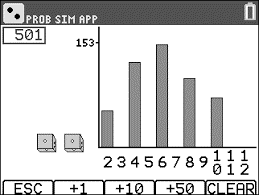
An important concept in probability is the Law of Large Numbers which states that “the relative frequency of an outcome approaches the actual probability of that outcome, as the number of repetitions gets larger” (see link below). This law can be easily observed through repeatedly tossing a coin or rolling a die, however, as the law suggests, this must be done a large amount of times. Tossing a coin 500 times in the classroom, while helpful to demonstrate this law in action, is time consuming and tedious. As a remedy to this, Texas Instruments developed an app for TI-84 graphing calculators called Probability Simulation.
In this free app, students can choose from a variety of actions to simulate such as tossing coins, rolling dice, picking marbles, and drawing cards. In the image above, the calculator is simulating the results of rolling two die. There are many useful features and settings within this app but two of the best ones are the ability to perform an action 50 at a time (indicated by +50) and a graph to keep track of the results of all previous actions. Having the ability to perform each action quickly and in large quantity makes this a much less time consuming and material intensive activity. In addition, having a graph documenting each result from previous actions also helps tremendously in demonstrating the Law of Large Numbers as it acts as a visual aid. In the picture above, the rough formation of a bell curve can be seen after 501 rolls.
References:
https://education.ti.com/en/building-concepts/activities/statistics/sequence1/law-of-large-numbershttps://www.minecraftseeds.co/stronghold-with-end-portal/https://www.speedrun.com/mc/full_game#Any_Glitchless
In my capstone class for future secondary math teachers, I ask my students to come up with ideas for engaging their students with different topics in the secondary mathematics curriculum. In other words, the point of the assignment was not to devise a full-blown lesson plan on this topic. Instead, I asked my students to think about three different ways of getting their students interested in the topic in the first place.
I plan to share some of the best of these ideas on this blog (after asking my students’ permission, of course).
This student submission comes from my former student Jesus Alanis. His topic, from Pre-Algebra: the Laws of Exponents (with integer exponents).
How could you as a teacher create an activity or project that involves your topic?
I would create a project where the students would have to create a “poster”. First, you would give each student a strip that contains one of the laws of the exponent. On the strip, there will be 3 expressions for them to solve that involves one of the laws and have a blank space for the student to create a “rule” for their law. This is where you will let your students find out what law they got. Once they figured out their law they will create a poster that will have the name of the law, the rule of the law (by the rule I mean just using variables, for example, the Product of Powers it would be ), a complete sentence which explains the rule in their own words, and an example of the law which can be one of the expressions from the strip. For the poster, you would want students to use color and decorate the way they want. This will let the student’s inner artist out and creativity shine. You can have your students present their law, or you can have a gallery walk so they can look at all the different laws.
The purpose of the project is for the student to play with the expressions causing them to question which law they received and letting them create a rule that makes them understand how the law works. The sentence on the poster will demonstrate if the student understood the law. This is a project that can be used to let students find out for themselves or this could be a project to help students remember what they learned.
Something extra but you can also make this a relay race by using the strip or the whole paper where the students must at least do one expression from each of the laws of the exponent. In the end, each student in the group has at least done all three laws that were on the page. With the page from TEA, there are only three laws on there, but you could add the rest on there to make the race a little longer. The goal is to have each student have practice with each law that is on the page, they are in a group so they can help each other and familiarize themselves with the laws and peers.
How can this topic be used in your students’ future courses in mathematics or science?
The way students can use the Law of Exponents in the future is that it will help write or type very large numbers towards using fewer numbers. This will not cause the value of the number to change but will be less to write. For example,
.
The law of exponents will also help with loan interest rates that can be used to predict how much you will have to pay in a certain time frame. Exponents are used to determining the pH level of substances, see the growth of bacteria, see the population of a city, and how much has it increased or decreased, and many more.
How has this topic appeared in pop culture?
I did not really find where it appeared in pop culture, but I did find a connection of how you can use the clip of SpongeBob to the Law of Exponents. The way you can connect them is that SpongeBob says all the specific rules to blow a bubble. This is to engage students and make sure to activate their prior knowledge that goes with the rules like the way we do with the area of a rectangle we first have to find the length of the sides and then place them in the formula to be multiplied. The small clip is a demonstration that with the Law of Exponents we must “obey” the math operations so that our results are as perfect as the duck bubbles. Also, we must make the connection between rules and laws which are very similar.
In my capstone class for future secondary math teachers, I ask my students to come up with ideas for engaging their students with different topics in the secondary mathematics curriculum. In other words, the point of the assignment was not to devise a full-blown lesson plan on this topic. Instead, I asked my students to think about three different ways of getting their students interested in the topic in the first place.
I plan to share some of the best of these ideas on this blog (after asking my students’ permission, of course).
This student submission again comes from my former student Alizee Garcia. Her topic, from Algebra: solving one-step algebra problems.
How can this topic be used in your students’ future courses in mathematics or science?
As stated in the topic, one-step algebra problems can also lead up to two-step, three-step, and so on and so forth. Being said, as students’ move on to future courses, the knowledge they have over one-step problems is what will get them through more complex equations. Throughout algebra courses, the basis of problems will be to solve an unknown variable. Without the understanding of the base of algebra, things will not be smooth. Also, solving one-step algebra problems will help students’ even in science classes. For example, chemistry classes contain a lot of variables and unknowns and it is up to the student to solve for them. The amount of solution a student has to put into another solution may need to be figured out by a simple one-step algebra problem and without this knowledge, it can lead to a ruined lab or maybe even an explosion. Solving one-step problems and understanding how to will help students tremendously from the time they learn it to the end of time.
How does this topic extend what your students should have learned in previous courses?
When solving any algebra problem, or solving for an unknown, it allows students to incorporate order of operations. As for just one-step algebra problems, it gives students the opportunity to practice addition, subtraction, multiplication, and division. It also gives them to opportunity to practice setting up an equation when solving for the unknown. There are many things that one-step algebra problems extends for students but as they have more practice, they should not have to think about it much. Furthermore, when solving algebra problems one of the most important things is doing the same application on both sides of the equality. Sometimes students may have done one-step algebra problems in the past but have not set it up in an equation. This also will extend the topic of addition, subtraction, multiplication, and division. Although the students may already have a lot of experience with those applications, it gives them more practice to decide what application to use when solving a one-step algebra problem.
How can technology (YouTube, Khan Academy [khanacademy.org], Vi Hart, Geometers Sketchpad, graphing calculators, etc.) be used to effectively engage students with this topic?
Recently, I have discovered that when appropriate, using websites such as Quizziz, Kahoot, and online games as such helps students engage in the topic. Especially for one-step algebra problems that can be done mentally or quickly on paper, it lets students become more active in the lesson. Students will want to be their peers high score and get the questions right. Using such technology will enable students to have more practice and wanting to do it correctly as well. Making topics a friendly competition for students will make things more exciting for them. Also, these website will allow for an untimed quiz so they do not feel rush and are able to accurately solve problems. Although this can be tricky for some math topics, with simpler things such as one-step algebra problems, it definitely will be a very good opportunity for students to learn material and have fun with it as well.
In my capstone class for future secondary math teachers, I ask my students to come up with ideas for engaging their students with different topics in the secondary mathematics curriculum. In other words, the point of the assignment was not to devise a full-blown lesson plan on this topic. Instead, I asked my students to think about three different ways of getting their students interested in the topic in the first place.
I plan to share some of the best of these ideas on this blog (after asking my students’ permission, of course).
This student submission comes from my former student Haley Higginbotham. Her topic, from Precalculus: computing a dot product.
A1. What interesting (i.e., uncontrived) word problems using this topic can your students do now?
For the dot product of vectors, there are lots of word problems regarding physics that you could do that students would find more interesting than word problems self-contained in math. For example, you could say that “you are trying to hit your teacher with a water balloon. Your first try had a certain velocity and distance in front of the teacher, and your second try had a certain velocity and distance behind the teacher. In order to hit the teacher, you will need half the angle between the vectors to hit the teacher. Figure out what angle and velocity you would need to hit the teacher with a water balloon.” This could also turn into an activity, where the students get to test their guesses to see if they can get close enough. There would be need to be something they could use to accurately catapult their water balloon, but that’s a different problem entirely.
B1. How can this topic be used in your students’ future courses in mathematics or science?
The dot product (and vectors in general) can be seen in physics, calculus 3, linear algebra, vector calculus, numerical analysis, and a bunch of other upper level math and science courses. Of course, not all students are going to be taking upper level math and science courses. However, out of the students going into STEM majors, they most assuredly will see the dot product and by seeing how vectors work earlier in their math careers, they will be more comfortable manipulating something they have already seen before. Also, the dot product and vectors are very useful as a tool to use in upper levels of math and in many different applications of engineering and computer science. In the game design, the dot product can be used to help engineer objects movements in the game work more realistically as a single unit and in relation to other objects.
E1. How can technology be used?
Geogebra is a great site to use since it has a tool https://www.geogebra.org/m/PGHaDjmD that will visually show you how the dot product works. It’s awesome because you get multiple different representations side by side, so that students who understand at different levels can all get something from this visual, interactive program. They can see how changing the position of the vectors changes the dot product and how it relates to the angle between the two vectors. Also, students will most likely be more engaged with this activity than just doing a bunch of examples with no real concept of how all of these pieces relate together which is not good in terms of promoting conceptual understanding. I think you could also use Desmos as an activity builder to make something similar to the above tool if students find the tool confusing to either use or look at.
In my capstone class for future secondary math teachers, I ask my students to come up with ideas for engaging their students with different topics in the secondary mathematics curriculum. In other words, the point of the assignment was not to devise a full-blown lesson plan on this topic. Instead, I asked my students to think about three different ways of getting their students interested in the topic in the first place.
I plan to share some of the best of these ideas on this blog (after asking my students’ permission, of course).
This student submission comes from my former student Andrew Cory. His topic, from Pre-Algebra: powers and exponents.
B1. How can this topic be used in your students’ future courses in mathematics or science?
Exponents are just an easier way to multiply the same number by itself numerous times. They extend on the process of multiplication and allow students to solve expressions such as 2*2*2*2 quicker by writing them as . They are used constantly in future math courses, almost as commonly as addition and multiplication. Exponential functions start becoming more and more common as well. They’re used to calculate things such as compounding interest, or growth and decay. They also become common when finding formulas for sequences and series.
In science courses, exponents are often used for writing very small or very large numbers so that calculations are easier. Large masses such as the mass of the sun are written with scientific notation. This also applies for very small measurements, such as the length of a proton. They are also used in other ways such as bacteria growth or disease spread which apply directly to biology.
C2. How has this topic appeared in pop culture (movies, TV, current music, video games, etc.)?
Any movie or TV show about zombies or disease outbreaks can be referenced when talking about exponents, and exponential growth. The rate at which disease outbreaks spread is exponential, because each person getting infected has a chance to get more people sick and it spreads very quickly. This can be a fun activity to demonstrate with a class to show how quickly something can spread. A teacher can select one student to go tap another student on the shoulder, then that student also gets up and walks around and taps another student. With students getting up and “infecting” others, more and more people stand up with each round, showing how many people can be affected at once when half the class is already up and then the other half gets up in one round.
D1. What interesting things can you say about the people who contributed to the discovery and/or the development of this topic?
Euclid discovered exponents and used them in his geometric equations, he was also the first to use the term power to describe the square of a line. Rene Descartes was the first to use the traditional notation we use for exponents today. His version won out because of conceptual clarity. There isn’t exactly one person credited with creating exponents, it is more of a collaborative thing that got added onto over time. Archimedes discovered and proved the property of powers that states . Robert Recorde, the mathematician who created the equals sign, used some interesting terms to describe higher powers, such as zenzizenzic for the fourth power and zenzizenzizenzic for the eighth power. At a time, some mathematicians, such as Isaac Newton, would only use exponents for powers 3 and greater. Expressing things like polynomials as .
References:
Berlinghoff, W. P., & Gouvêa, F. Q. (2015). Math through the ages: A gentle history for teachers and others.

 What interesting (i.e., uncontrived) word problems using this topic can your students do now?
One example of an interesting word problem students can do using this topic is based on a technique astronomers use to learn about celestial bodies. Being able to assess the number of craters a body has on its surface can reveal information about the body’s age, as well as its history of impacts. In comparing the number of craters two bodies have experienced over time, astronomers are able to compare their lifetimes and hypothesize reasons for differences and/or similarities.
What interesting (i.e., uncontrived) word problems using this topic can your students do now?
One example of an interesting word problem students can do using this topic is based on a technique astronomers use to learn about celestial bodies. Being able to assess the number of craters a body has on its surface can reveal information about the body’s age, as well as its history of impacts. In comparing the number of craters two bodies have experienced over time, astronomers are able to compare their lifetimes and hypothesize reasons for differences and/or similarities.


 Taken from https://students.ga.desire2learn.com/d2l/lor/viewer/viewFile.d2lfile/1798/12938/Algebra_ReasoningwithEquationsandInequalities12.html





 ), a complete sentence which explains the rule in their own words, and an example of the law which can be one of the expressions from the strip. For the poster, you would want students to use color and decorate the way they want. This will let the student’s inner artist out and creativity shine. You can have your students present their law, or you can have a gallery walk so they can look at all the different laws.
 .
. . They are used constantly in future math courses, almost as commonly as addition and multiplication. Exponential functions start becoming more and more common as well. They’re used to calculate things such as compounding interest, or growth and decay. They also become common when finding formulas for sequences and series.
 . Robert Recorde, the mathematician who created the equals sign, used some interesting terms to describe higher powers, such as zenzizenzic for the fourth power and zenzizenzizenzic for the eighth power. At a time, some mathematicians, such as Isaac Newton, would only use exponents for powers 3 and greater. Expressing things like polynomials as
  .
. Mean Green Math