Engaging students: Graphing exponential growth and decay functions

In my capstone class for future secondary math teachers, I ask my students to come up with ideas for engaging their students with different topics in the secondary mathematics curriculum. In other words, the point of the assignment was not to devise a full-blown lesson plan on this topic. Instead, I asked my students to think about three different ways of getting their students interested in the topic in the first place.

I plan to share some of the best of these ideas on this blog (after asking my students’ permission, of course).

This student submission comes from my former student Irene Ogeto. Her topic, from Precalculus: graphing exponential growth and decay functions.

green line

How can technology (YouTube, Khan Academy [khanacademy.org], Vi Hart, Geometers Sketchpad, graphing calculators, etc.) be used to effectively engage students with this topic? Note: It’s not enough to say “such-and-such is a great website”; you need to explain in some detail why it’s a great website.


The Legend of the Chessboard is a famous legend that illustrates exponential growth. A courtier presented a Persian king with the chessboard and as a reward the courtier asked the king for a grain of rice in each square of the chessboard, doubling the amount in each new square. The king agreed and gave the courtier 1 grain of rice in the first square, 2 grains of rice in the second, four grains of rice in the third and so on. The king didn’t realize how rapidly the amount of grain of rice would grow in each square. This video would be a great way to engage the students into the topic at the beginning of the lesson. The Legend of the Chessboard shows how rapidly exponential functions can grow. After watching the video the students can try to guess or calculate the total number of grains of rice the courtier would get in the end. Afterwards, the students can then graph the exponential function.


The students can use this website to check their guess:


http://britton.disted.camosun.bc.ca/jbchessgrain.htm


green line

How could you as a teacher create an activity or project that involves your topic?

In order to explore graphing exponential growth and decay functions, the students could play a card sort matching game. The students will work in groups to play the card sort matching game. Some students will be given the graphs and have to use the points given to derive the equation. Some groups will be given the equations and have to create the graphs of the exponential functions. As a class, we will go over graphing exponential growth and decay functions and analyze the graphs. The students will be expected to identify the domain, range, asymptotes, y-intercepts and whether the graph is exponential growth or exponential decay. Also, we could explore how exponential functions compare to other functions that we previously studied. This is a great activity that can be used as review before an exam.


green line

How can this topic be used in your students’ future courses in mathematics or science?


Exponential functions are used to model different real world scenarios involving population, money, finances, bacteria and much more. Students can use exponential functions in other courses such as Calculus, Biology, Chemistry, Physics, and Economics. In calculus, students explore differentiation and integration of exponential functions. Given the position of an object in exponential form, students can use Calculus to determine if the object will stop moving.  Newton’s Law of Cooling is an example in physics that demonstrates exponential decay. Compound interest is a major application of exponential functions in finances. Exponential population growth, carbon dating, pH and concentrations of drugs are other examples in math and science that can be modeled by exponential growth and decay functions. In addition, students explore logarithmic functions, the inverses of exponential functions. Being able to recognize and graph exponential growth and decay functions is an important concept that can help students’ in their future courses in math or science.

References:

https://www.youtube.com/watch?v=t3d0Y-JpRRg

http://britton.disted.camosun.bc.ca/jbchessgrain.htm

http://www.shsu.edu/kws006/Precalculus/3.2_Applications_of_Exponential_Functions_files/3.2%20Applications%20of%20Exponential%20Functions%20(slides%204%20to%201).pdf

Engaging students: Using Pascal’s triangle

In my capstone class for future secondary math teachers, I ask my students to come up with ideas for engaging their students with different topics in the secondary mathematics curriculum. In other words, the point of the assignment was not to devise a full-blown lesson plan on this topic. Instead, I asked my students to think about three different ways of getting their students interested in the topic in the first place.

I plan to share some of the best of these ideas on this blog (after asking my students’ permission, of course).

This student submission comes from my former student Jason Trejo. His topic, from Precalculus: using Pascal’s triangle.

green line

How could you as a teacher create an activity or project that involves your topic?

After some research and interesting observations I came across while examining Pascal’s Triangle, I feel like I could create some sort of riddle worksheet that involves the Triangle. Once I have taught my students how to create Pascal’s Triangle, I could give my students riddles such as:

  • Once you go and strive in prime, belittling your neighbors isn’t a crime.
    • Students might notice that each number (other than 1) in a prime number row is divisible by that prime number:
      • Row 7= 1, 7, 21, 35, 35, 21, 7, 1
      • Row 11= 1, 11, 55, 165, 330, 462, 462, 330, 165, 55, 11, 1
    • Naturally shallow slides aren’t much fun, but with a fib of raunchy, it is this one.
      • Given that I have gone over the Fibonacci sequence with my students prior to these riddles, I could include this one. The students should eventually see that if you take shallow diagonals on Pascal’s Triangle, the sum of those diagonals are the consecutive numbers in the Fibonacci sequence.
    • In a game on blades, you can’t be a schmuck with a puck. Be nimble and quick to look for the stick.
      • This one is a little more straightforward compared to the last two so hopefully the students will make the connection to notice the hockey stick pattern on the diagonals of Pascal’s Triangle. When adding the numbers down a diagonal, then the number to the side and below will be the sum, thus looking like a hockey stick.
    • What else is there? What else is in store? What patterns can you find when you know who to root four?
      • The “typo” is intentional to give a hint at another pattern the students might notice on Pascal’s Triangle. Now I am challenging the students to find more patterns within the Triangle such as:
        • Sum of rows are the powers of 2
        • Rows relate to the powers of 11 (get murky after the 4th row)
        • Counting numbers, triangular numbers, etc.

The purpose of this activity would extend the use of Pascal’s triangle from what they already know. I could assign this at the beginning of the lesson and if no one understands what the riddles meant, we could come back as a class and figure them out together once the lesson was done. These riddles could be an assignment of their own if I introduce them after they are very familiar with Pascal’s Triangle.


green line

How can this topic be used in students’ future courses in mathematics and science?

I would say the primary use most students will get from Pascal’s Triangle would be to find the coefficients of binomials since it is much easier when working on binomial expansions, but there are also other ways they can use the Triangle as well. For one, it can be of great use in many courses that involve since it is a visual in seeing the number of combinations there are based on the number of items used. For example, say there are 6 different pieces of candy in a bowl and you need to know how many different ways can you choose 3 candies? Using Pascal’s Triangle, we look at the 6th row and the 3rd entry in that row (remembering the top row is Row 0 and the first 1 in each row is Entry 0), we can see that there are 20 possible combinations of 3 different pieces of candy. Other than that, even based on the riddle activity from above, students can use Pascal’s Triangle and its various patterns to help remember such things as triangular numbers, powers of 11, etc.


green line

How has this topic appeared in high culture?

Within the past few years, the Shanghai-based design company, Super Nature Design, created the interactive art piece “Lost in Pascal’s Triangle”. This structure takes inspiration from Pascal’s Triangle and allows people to “explore the concept and magnification of the Pascal’s Triangle mathematics formula.” The following link takes you to the website that gives a bit more information behind the piece and shows how people can interact with the structure through a xylophone-type console: http://www.supernaturedesign.com/work/pascaltriangle#8

Another quick application that can be done through Pascal’s Triangle is by seeing the relationship between the Triangle and Sierpinski’s triangle (as shown below):

pascal1

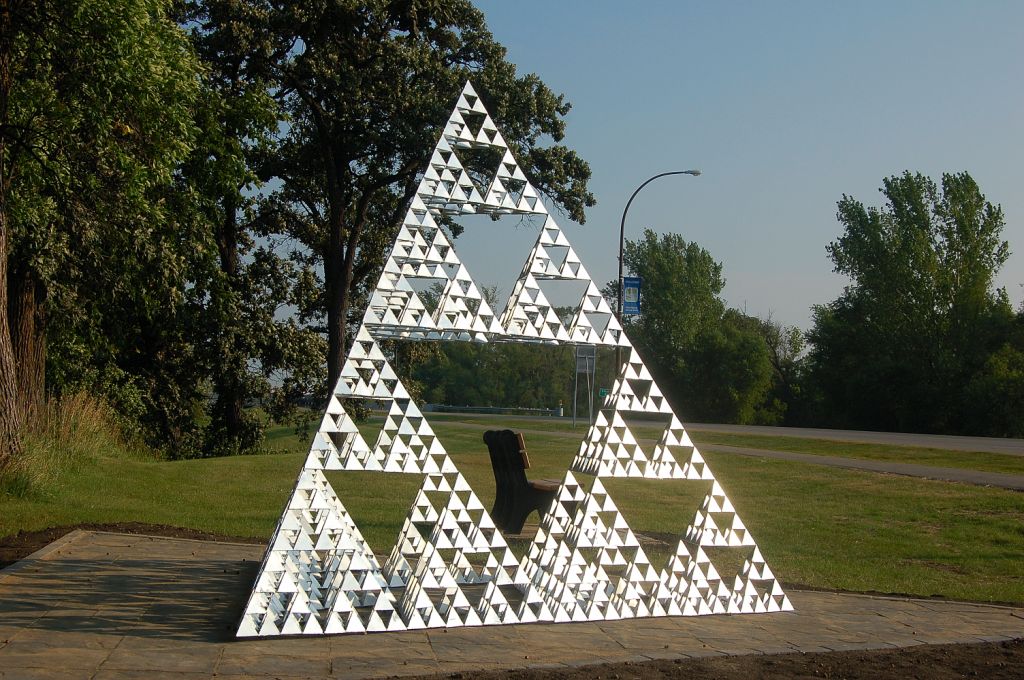
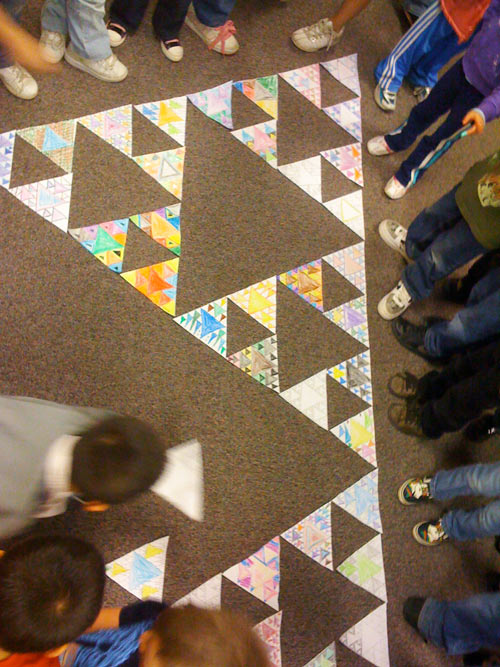
The pattern is by shading in every odd number on Pascal’s Triangle, you start creating Sierpinski’s triangle which is found in many works of art like these:

pascal2


pascal3

It might actually be a small but fun project to have the students create something like this at the beginning of the lesson and then explain the relation of the two special triangles.

References:

Pascal Triangle Information: http://jwilson.coe.uga.edu/EMAT6680Su12/Berryman/6690/BerrymanK-Pascals/BerrymanK-Pascals.html

Image of Pascal’s Triangle: http://mathforum.org/workshops/usi/pascal/images/pascal.hex2.gif

Lost in Pascal’s Triangle: http://www.designboom.com/weblog/images/images_2/andrea/super_nature_design/pascaltriangle01.jpg

Super Nature Design: http://www.supernaturedesign.com/work/pascaltriangle#2

Pascal and Sierpinski Triangle : http://mathforum.org/workshops/usi/pascal/images/sierpinski.pascalfrac.gif

Sierpinski Pyramid: http://www.sierpinskitetrahedron.com/images/sierpinski-tetrahedron-breckenridge.JPG

Sierpinski Art Project: http://fractalfoundation.org/wp-content/uploads/2009/03/sierpkids1.jpg

Engaging students: Graphing Sine and Cosine Functions

In my capstone class for future secondary math teachers, I ask my students to come up with ideas for engaging their students with different topics in the secondary mathematics curriculum. In other words, the point of the assignment was not to devise a full-blown lesson plan on this topic. Instead, I asked my students to think about three different ways of getting their students interested in the topic in the first place.

I plan to share some of the best of these ideas on this blog (after asking my students’ permission, of course).

This student submission comes from my former student Emma Sivado. Her topic, from Precalculus: graphing sine and cosine functions.

green line

D.1: What interesting things can you say about the people who contributed to the discovery and/or the development of this topic?

First, I would pose the question “how did the Egyptians build the pyramids without calculators without measuring tapes and without the advanced mathematics we have today?” After a short discussion I would ask them if we want to build a pyramid that is 250 meters high and the base is 360 meters long how long would we need to make the hypotenuse? Already knowing the Pythagorean Theorem the students would be able to answer the question. Then, I would tell them that historians have found Egyptian scribes asking questions such as these in order to build the pyramids, and systems of ropes with knots were used to measure lengths. These relationships in right triangles created the sine and cosine functions we know today. Sine and cosine date back to 1900 BC where they were used to calculate angles in order to track the motion of the planets and stars. However, the definition of sine and cosine in terms of right triangles was not recorded until 1596 AD by Copernicus.

http://www.math.ucdenver.edu/~jloats/Student%20pdfs/40_Trigonometry_Trenkamp.pdf


green line

A.2: How could you as a teacher create an activity or project that involves your topic?

I found a great activity that encompasses all of the aspects of graphing sine and cosine on the University of Arizona website. Depending on how transformations in the linear and quadratic functions were introduced, this activity could follow the same pattern; allowing the students to explore the ideas themselves and having them put the content into their own words. The activity begins by giving an example of a bug walking on an upright loop. The instructor asks the students what the graph would look like of the bug’s distance from the ground vs. time. I would probably use a different, more concrete example because there are plenty of things the students know that go around in circles. The best example I think is a Ferris wheel. So after the students are able to tell you what the graph would look like you relate that to the unit circle and how the sine and cosine functions follow the same pattern of going around the circle counterclockwise. Next, you let the students plot points from the unit circle onto the Cartesian plane showing them that their prediction was correct; the sine and cosine functions make a wave. Now that they have drawn the parent function you let them explore the functions f(x) = asinx or f(x)= acosx, then f(x) = sin(bx) or f(x) = cos(bx), then finally f(x) = sin(x+c) or f(x) = cos(x+c) to let them discover how a, b, and c change the amplitude, period, frequency, and starting point of the graphs.

This is a great activity because the students use multiple examples to see how a, b, and c affect the parent graph of sine and cosine. The activity promotes inquiry based learning and will help deepen the understanding of the graphs of sine and cosine.

http://ime.math.arizona.edu/g-teams/Profiles/JC/Graphing_Sine_and_Cosine_2013.pdf


green line

E.1: How can technology (YouTube, Khan Academy [khanacademy.org], Vi Hart, Geometers Sketchpad, graphing calculators, etc.) be used to effectively engage students with this topic? Note: It’s not enough to say “such-and-such is a great website”; you need to explain in some detail why it’s a great website.

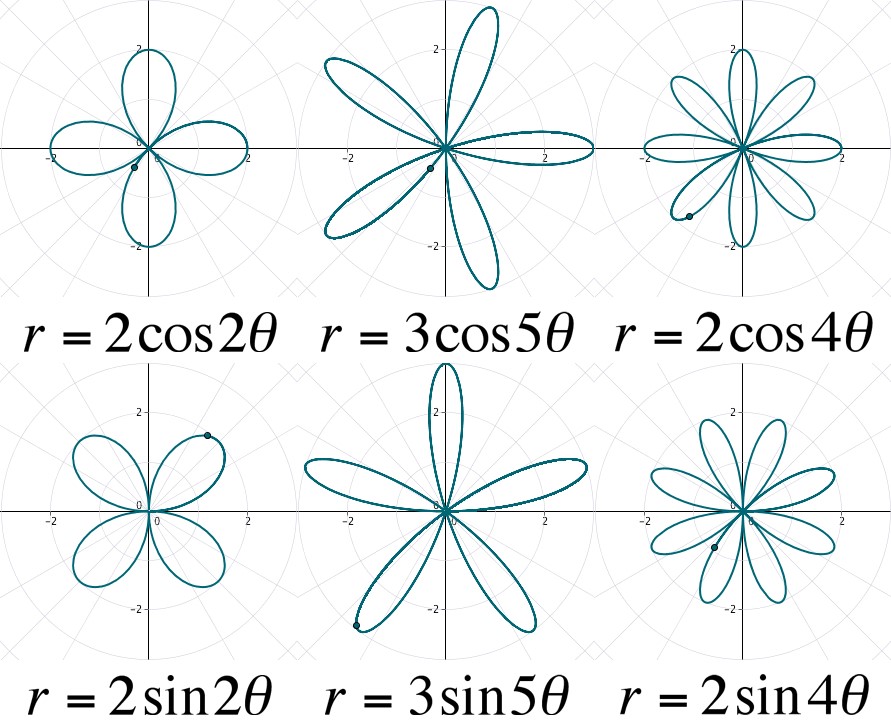
Math can be seen in many forms of art from music to painting. I remember one of my favorite activities from math in high school was creating pictures with sine and cosine functions. We were able to draw flowers, clovers, and hearts simply with only the sine and cosine functions. After the students understand the parent function you can give them an exploration activity on their graphing calculator where they plug in various sine and cosine functions to draw flowers, clovers, and hearts. After that challenge the students to draw their own picture using the patterns they see from the examples. These same ideas can be used in computer graphics and animation to draw similar figures, and a lot of students are interested in computers and especially video games so this should be a fun activity for them.

clovers

ftp://arts.ucsc.edu/pub/ems/DANM%20220-2012/Drawing%20with%20trig.pdf

Engaging students: Using radians to measure angles instead of degrees

In my capstone class for future secondary math teachers, I ask my students to come up with ideas for engaging their students with different topics in the secondary mathematics curriculum. In other words, the point of the assignment was not to devise a full-blown lesson plan on this topic. Instead, I asked my students to think about three different ways of getting their students interested in the topic in the first place.

I plan to share some of the best of these ideas on this blog (after asking my students’ permission, of course).

This student submission comes from my former student A’Lyssa Rodriguez. Her topic, from Precalculus: using radians to measure angles instead of degrees

green line

D1. How did people’s conception of this topic change over time?

Babylonians came up with the degree system. For their number system they liked to use the number 60 and multiples thereof. Therefore they decided on the number 360 and each number represented a degree in a circle. This number was completely arbitrary and was simply a matter of preference by the Babylonians. Although this makes handling circles and angles seem easier, due to it being an arbitrary number, it makes degrees unnatural. So the deeper concepts in math needed a more natural number. Radians are that more natural measurement we needed. Using the length of the radius of any circle and wrapping around the outside of that circle, one can see that it almost completely goes around the entire circle 6 times. To make up for what is left we multiply the radius by 2pi. Thus the equation for the circumference of a circle is C = 2 πr. This is the reason and the change over time for the use of radians instead of degrees.


green line


C2. How has this topic appeared in high culture (art, classical music, theatre, etc.)?
Pure tones are found in music. Regardless of other musical properties such as amplitude or the time relation to other sound waves (phase), these tones will have a consistent sinusoidal sound wave. The sine function used to measure these waves use radians. Although degrees are technically possible, this function is most accurate when using radians. According to Mathematics and Music: Composition, Perception, and Performance by James S. Walker and Gary W. Don, the formula that can be used to determine the oscillation for a tuning fork is y= Asin(θ) where θ is measured in radians and is equal to 2 πvt+ θ0 and θ0 is the initial value of θ when t=0. So y = Asin(2 πvt+ π/2).

green line

B2. How does this topic extend what your students should have learned in previous courses?

In previous courses, students use degrees to measure angles and to refer to circles. Even activities outside of the classroom, such as snowboarding, use degrees. This was easiest and best for learning purposes, up until this point that is. Now that trigonometric functions will be introduced, the circle will be studied more in depth, and more real life situations will be given, it is necessary to use radians instead of degrees. The calculations will become more accurate in some cases, some even easier, and it is essential to use a more natural number. This topic merely adds on to what the students already know about angles but also makes them think about it in a different way. One way their previous knowledge of degrees will be extended is by learning to convert from degrees to radians and back again.


Engaging students: Finding the domain and range of a function

In my capstone class for future secondary math teachers, I ask my students to come up with ideas for engaging their students with different topics in the secondary mathematics curriculum. In other words, the point of the assignment was not to devise a full-blown lesson plan on this topic. Instead, I asked my students to think about three different ways of getting their students interested in the topic in the first place.

I plan to share some of the best of these ideas on this blog (after asking my students’ permission, of course).

This student submission comes from my former student Esmeralda Sheran. Her topic, from Precalculus: finding the domain and range of a function.

green line

I found that Free Math Help and Khan Academy are both interactive websites that help students learn how to find domain and range of functions. If I were to have a lesson on how to find domain and range of functions I would have my students use the Free Math Help website to explore the concept of domain and range. Using the Free Math Help website a student can input any type of function that they come up with to see what the graph looks like, the steps of how to find the domain/range, and how the domain and range correspond with the graph. I could choose to have students come up with their own functions and they could experiment with expression that are not functions just so they can share some findings they came up on their own. Conversely I could make handouts with a variety of functions both continuous and discrete, expression that are not functions so that I could manage their learning in a way that they can see different graphs and their corresponding domain and ranges. Also I could give them a series of functions with different translations based off of one main parent function.

Then using Khan Academy website I could perform an active elaborate in which the students see a graph and then must give the corresponding domain and range intervals. I can walk around to each student to see what they have recorded and ask them to provide a justification for their answer or explain what properties the graph has that gives the domain and range they come up with. However I chose to structure the activities the students will be able to observe and discuss the changes in the domain and range interactively by using either Khan Academy or Free Math Help.


green line

How can this topic be used in your students’ future courses in mathematics or science?

Knowing how to find domain is fundamental to most any mathematical course proceeding and not excluding pre-calculus. Once students are able to understand how to find the domain and range of a function they are able to learn deeper concepts used in calculus, discrete mathematics, and real analysis. Once in calculus students are expected to use domain and range in order to complete derivative problems specifically pertaining to finding critical points like the maximum/minimum and to describe the function as it changes from interval to interval. Understanding domain and range is also important when students must contrive and solve a definite integral from analyzing a graph or data. Then in discrete mathematics students must apply what they have learned from domain and range in the past to understand what preimage and codomain means and how they relate to the domain and how they differ from range. Apart from the regular mathematic courses, physics, differential equations and similar course also have applications of derivatives and integrals that require previous knowledge on how to find the domain and range of a function.


green line

How could you as a teacher create an activity or project that involves your topic?

  • I would have the students create maps such as the ones from The Emperor’s New Groove using colored pencils and paper provided in class.
  • The instructions for the activity would be:
  • Leave an inch of blank space on the bottom of the page and the left edge.
  • Then create your own chase scene
    • Using two different characters
    • Make sure your chase can pass the vertical line test.
  • Then with rulers use the centimeter side to mark your x and y axis
  • Now you must find the length and height of each of your chase scenes
    • instead of writing 7 cm long; 5 cm high use interval notation [2,9];[1,5]

This activity will help students connect domain and range to being the span of the function’s graph and the possible input and output values. It will be engaging because a kid’s movie is tied into the activity. Also the students can work independently and creatively, which is something different than what they are used to doing in the average classroom. After this activity we could move on to a more in depth discussion of the domain of discrete and discontinuous functions.

References:


The Emperor’s New Groove – Disney Movie


Free Math Help interactive website

http://www.freemathhelp.com/domain-range.html

Khan Academy interactive website

https://www.khanacademy.org/math/algebra/algebra-functions/domain-and-range/e/domain_and_range_0.5

Engaging students: Radius, Diameter, and Circumference of a Circle

In my capstone class for future secondary math teachers, I ask my students to come up with ideas for engaging their students with different topics in the secondary mathematics curriculum. In other words, the point of the assignment was not to devise a full-blown lesson plan on this topic. Instead, I asked my students to think about three different ways of getting their students interested in the topic in the first place.

I plan to share some of the best of these ideas on this blog (after asking my students’ permission, of course).

This student submission comes from my former student Zacquiri Rutledge. His topic, from Geometry: radius, diameter, and circumference of a circle.

green line

There are many ideas about how to introduce students and have them study the relationships between the radius, diameter and circumference of a circle. However, one of my favorites has always been the month long project assigned to students at the beginning of class. On the very first day of class, the teacher is to assign the students their project. The instructions of this project are for each of the students to find and measure ten different round or circular objects around their home. The students will need to measure the length around the object (the circumference) using a piece of string and a ruler (the teacher might explain to the students or give an example so they know how to do this), the length from one side of the object to the other side passing through the middle (diameter), and the length from the center of the object to the outside (radius). If the students already know what these terms are called that is okay. However, the teacher should avoid explaining these terms until later.

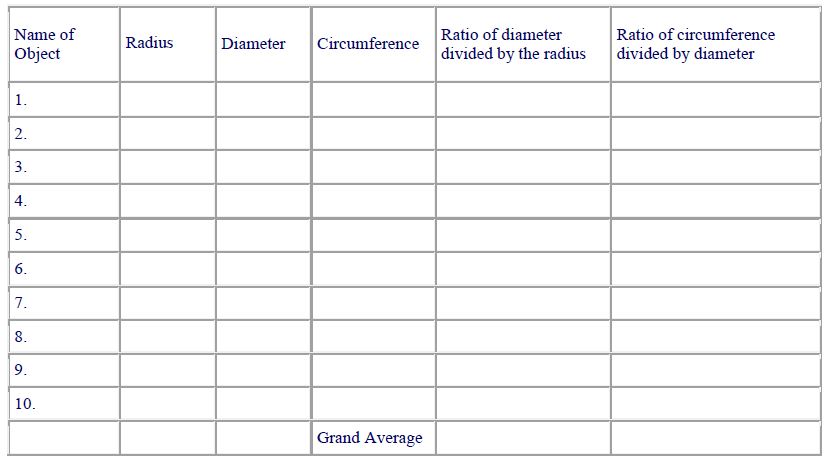
Then a month later, the students are to bring their findings to class. At this point during the class the teacher will have begun her segment of lessons about circles and the various properties of circles. By now the students should have a good idea what the terms radius, diameter, and circumference mean. So the day the students bring in their work, they will be given the following chart, originally designed by the University of Illinois. From here students will slowly begin to fill in their charts with the information they gathered. Once completed students will then begin finding the ratios between diameter-radius and circumference-diameter and recording them. Finally at the bottom, students will find the average of their ratios from the last two columns. Once all of this data is completed, the students should have found that the diameter and radius share a ratio of 2-1 since the diameter is twice the radius. The last column should have produced something close to an average of 3.14159265359 or better known as pi (). Not only will this help students understand that pi is not just a number, but it will also help them to know where it comes from and its importance. From here the teacher would be able to lead into a lesson about some of the other uses of pi and how they all relate back to the relationships between radius, diameter and circumference.

pichart


green line

Radius, diameter, and circumference are very important in many topics beyond their definitions. For instance, later on in the geometry course students will talk about the area of circles. Even though the students might have learned how to find the area of simple polygons such as triangles and quadrilaterals, finding the area of a circle is different because of the use of pi. To find the area of a circle, students have to recall the relationships between the radius, diameter, and circumference in order to understand how the area of a circle uses those relationships. Another example of how they are used is in pre-calculus. In pre-calculus students will talk about the unit circle, a circle with a fixed radius of 1 unit. Using the fixed radius of 1, students will discover that the length around (circumference) the unit circle is 2π. This 2π is important because it can be broken into pieces, called radians, and used to help measure Sine, Cosine, and Tangent at certain radians around the circle. Learning about sine, cosine, and tangent opens up even more things for the students, such as trigonometry and calculus. However, no matter how advanced the mathematics become, they always relate back to the simple concepts of the radius, diameter and circumference of a circle and their relationships.


green line

Radius, diameter, and circumference is a topic that has been talked about and used dating back to 2000 B.C. But, what has it actually been used for all this time? How about architecture? Think about massive constructs such as the Theatre of Ephesus in Rome, Italy. Even though the theatre is not a full circle, look at how each of the seats are evenly placed from the stage. This is because when it was designed, the architect likely used the radius and circumference to accurately plot how far each seat needed to be placed in order to be the same exact distance from the stage as everyone else in their row. Even though only half a circle was used for this theatre, the circumference and radius would have been used to find the ratio pi in order to get the area of how much space was allowed for seating.

Another great example of circumference being used is in the invention of the clock. The clock originated as a sun dial, which would use the sun to cast a shadow, which would tell the time of day. These sun dials date back as early as 3500 B.C. However, in 1583 Galileo found a way to use a pendulum to create a clock that always followed the same length of time (Clock). This is important because not long after the first clock was born, so was the circular face of a clock. The face of a clock has the numbers 1-12 on it, each one evenly spaced around the edge of the clock. By using the circumference of any size of circle, the person building the clock would know just how far to space out each of the numbers, giving each hour the same amount of time between them. If even one of the numbers were off on the clock, the time would be off. Also, it can be seen that on modern clocks, the minute hand always stretches the radius of the clock. By stretching out the minute hand on the clock, the designer of the clock can create evenly spaced notches on the face using the circumference, in order to have the minute hand indicate the minute of the hour.

One final example is the use of radius in war, or more specifically the invention of the radar. Radar was originally being experimented with by German physicist Heinrich Hertz in 1887. He had discovered that certain materials allowed radio waves to pass through them, while others reflected them. In 1890, Nikola Tesla realized that large objects could reflect large enough radio waves to be detected. By harnessing this idea, pulse radar would come to be introduced into United States in 1925, and later used in the British Air Force to defend against German air raids during WWII (Science). The reason radar works, however, is because the system has a set radius in which it can detect radio waves. Once the radar system sends out a radio wave, if it does not reflect back within the radius of the detection system, then the radar will not pick up on anything. The system measures the distance by measuring how long it takes for the radio wave to return to the system after it is sent out and comparing that time to radius of detection. This allowed not only military to defend against air attacks, but it was commonly used during naval combat to defend against submarines as Germany used their U-Boats to attack several American and British naval ships during WWII, as well as WWI before the invention of radar.


References:

“Circumference and Pi.” Circumference and Pi. N.p., n.d. Web. 08 Oct. 2015.

“Clock a History – Timekeepers.” Clock a History – Timekeepers. N.p., n.d. Web. 08 Oct. 2015.

“Science Explorations: Journey Into Space: Radar and Sonar | Scholastic.com.” Science Explorations: Journey Into Space: Radar and Sonar | Scholastic.com. N.p., n.d. Web. 08 Oct. 2015.


Engaging students: Defining the terms acute triangle, right triangle, and obtuse triangle

In my capstone class for future secondary math teachers, I ask my students to come up with ideas for engaging their students with different topics in the secondary mathematics curriculum. In other words, the point of the assignment was not to devise a full-blown lesson plan on this topic. Instead, I asked my students to think about three different ways of getting their students interested in the topic in the first place.

I plan to share some of the best of these ideas on this blog (after asking my students’ permission, of course).

This student submission comes from my former student Taylor Vaughn. Her topic, from Geometry: defining the terms acute triangle, right triangle, and obtuse triangle.

green line

How can this topic be used in your students’ future courses in mathematics or science?

As soon as you think triangles are gone, they are not. In pre-calculus you will address these triangles again, but in a different outlook. In pre-calculus you will notice patterns associated with sin, cos, tan and the different triangles, acute, obtuse, and right. Also there is a cool theorem called Pythagorean Theorem, a2 + b2 =c2, where a and b are the legs and c is the hypotenuse. This theorem you will forever use, no matter how up in math you get. In calculus right triangles are used for trig substitutions.  Trig substitution is instead of using the number, you use sin, cos, tan, sec, to solving different equations. So triangles you want to always remember because in math everything is linked together amd almost everything is a pattern.


green line

How has this topic appeared in pop culture (movies, TV, current music, video games, etc.)?

This semester I have the pleasure of working at the Rec. Being a supervisor for intramurals causes me to a lot of the behind the scenes work that I didn’t know happened. One is turning a patch of grass into a football field. I know you probably thinking what does this have to do with anything, but I actually used 3-4-5 triangles, right triangles, to draw the field.  So when laying down the basics of the field we had to mark of 15 yards from a fence so that participants would hurt themselves. Then I placed the stake at that spot. Then we tied twine around the stake and walked down 100 yards and placed a stake. Then wrapped a new piece of twine to the new stake and measured of 40 yards for the width (measurements comes from NIRSA handbook, which are the rules we go by for flag football). Then did the same for the other side to get a rectangle of a length of 100 yards and with of 40 yards. When I saw this paint can, it then hit me that we had to actually paint this. SO my question was “How am I supposed to get straight line?” Well to my shock, my boss pulls up the measuring tape and said “a 3-4-5 triangle!” Who knew! So for the first corner we measured down the twine 3 yards and then 4 yards going into the field and placed a stake. Then we had to twine the two together measuring to see if it was 5 yards. If it wasn’t we had to keep moving the stakes till they were. Once it was it was for sure that the twine was straight and you could use the paint machine and just push along the line. You do this process and until all the lines are done, even for the yard marking lines , like the 20 yard line, and 40 yard line, that you see on the field. Just as shocked as I was, I bet students will be too. Here is a video to show what I am saying so if it is a little confusing the students will have a visual. Or definitely and visual you could do to show this.


green line

How can technology (YouTube, Khan Academy [khanacademy.org], Vi Hart, Geometers Sketchpad, graphing calculators, etc.) be used to effectively engage students with this topic? Note: It’s not enough to say “such-and-such is a great website”; you need to explain in some detail why it’s a great website.

One cool activity I found was an online game called Triangle Shoot, where you had to classify the triangles. The game has a lot of floating triangles and on the bottom of the cursor it says what triangle you need to click. Before you start the game, it gives definitions and pictures of the triangles before starting. I played it myself and actually found it fun. For me, the timed mode was more fun due to the fact as time got closer to 0 the more pressure I felt trying to beat my previous score. And since the shapes are floating you try to click them before they float away. I also liked that the shapes are not always facing the same way, some are rotated on its side or flipped, which made it a little more difficult. It also calculates a percentage and tells you how many you got wrong and right. The only thing I wish it did was break down the hits and miss according to the triangle that way students know what triangle that understand ad don’t. I really thought this was a fun activity after introducing the vocabulary. The website is actually a good tool for students to practice what each triangle is and how they differ. Even if a school doesn’t have computers that students could actually try this in class, it is something that students could use as a practice. Also the game has a mode where you can do equilateral, isosceles, and scalene triangles. http://www.sheppardsoftware.com/mathgames/geometry/shapeshoot/triangles_shoot.htm


References

Ricalde, Paul. “3-4-5 Method, How to Get a Perfect Right Angle When Building Structures.” YouTube. N.p., 28 Mar. 2013. Web. 7 Oct. 2015.

“Triangle Shoot.” Sheppard Software. N.p., n.d. Web. 7 Oct. 2015.


Engaging students: The distance formula

In my capstone class for future secondary math teachers, I ask my students to come up with ideas for engaging their students with different topics in the secondary mathematics curriculum. In other words, the point of the assignment was not to devise a full-blown lesson plan on this topic. Instead, I asked my students to think about three different ways of getting their students interested in the topic in the first place.

I plan to share some of the best of these ideas on this blog (after asking my students’ permission, of course).

This student submission comes from my former student Samantha Offutt. Her topic, from Geometry: the distance formula.

green line

How could you as a teacher create an activity or project that involves your topic?

https://livelovelaughteach.wordpress.com/2012/01/20/travel-the-us/

I found this awesome idea to help students see the distance formula in a real world view. Students often complain that they will never use math outside of classrooms, or that it’s pointless to learn math because they want to be something completely unrelated to math (i.e. Professional Body Piercer). However, most people will take a trip, at least once in their life. That’s why I find this project to be beneficial. Students have the freedom to create a trip catered to their wants and desires, instead of doing countless problems and worksheets to drill the formula. They get the time to learn about different places and still apply mathematical concepts.


green line

How has this topic appeared in pop culture (movies, TV, current music, video games, etc.)?

Because the distance formula is a variation of Pythagorean Theorem, it was quite funny to come across a scene from The Wizard of Oz. In this scene, the wizard was giving the scarecrow his Th.D, his PHD in Thinkology. Immediately after receiving this, the scarecrow recites his version of the Pythagorean Theorem.

“The sum of the square roots of two sides of an isosceles triangle is equal to the square root of the remaining side.”

This statement works if two sides of the triangle are 1 and the last angle is the sqrt(2). He states it like he’s talking about the distance formula, using square roots, but perhaps, make it a right triangle, and specify the remaining side is opposite the right angle and you can have your brain, Scarecrow! But then again, this is Dorothy’s dream, so perhaps it’s Dorothy who doesn’t know the proper way to state such a theorem!

green line

What interesting things can you say about the people who contributed to the discovery and/or the development of this topic?

The distance formula is motivated by the Pythagorean Theorem, which it’s name alone brings Pythagoras to light. Even though not many people know whether or not Pythagoras actually proved it or whether he gave it it’s definitive form, I know not. But, Pythagoras was a great philosopher and Mathematician (Mastin).

Euclid, did write proofs for the Pythagorean Theorem (I.47). In the books, Geometry: Euclid and Beyond by Robin Hartshorne, and Euclid’s Elements expansion of this concept is given. From the proof of Pythagorean Theorem, to the distance formula used to model axioms (I1)-(I3), (B1)-(B4), and (C1)-(C3) and define congruence for line segments (Hartshorne 87).

Descartes invented the coordinate system, thus his role in contributing to this formula is quite vital. He created a bridge between the worlds of Algebra and Geometry. Watch this Khan Academy Video to gain more insight about Descartes and said bridge: https://www.khanacademy.org/math/algebra/introduction-to-algebra/overview_hist_alg/v/descartes-and-cartesian-coordinates


Resources

Clark, Jeff. “Jeff Clark’s Math in the Movies (Wizard of OZ).” YouTube. YouTube, 26 Jan. 2013. Web. 09 Oct. 2015. <https://www.youtube.com/watch?v=jbvip1Ot6jQ&gt;.


Fields. “Travel the US, with the Distance Formula!” LiveLoveLaughTeach. N.p., 20 Jan. 2012. Web. 09 Oct. 2015. <https://livelovelaughteach.wordpress.com/2012/01/20/travel-the-us/&gt;.


Hartshorne, Robin. Geometry: Euclid and beyond. New York: Springer, 2000. Print.


Khan, Sal. “Introduction to the Coordinate Plane.” Khan Academy. N.p., 12 Feb. 2012. Web. 09 Oct. 2015. <https://www.khanacademy.org/math/algebra/introduction-to-algebra/overview_hist_alg/v/descartes-and-cartesian-coordinates&gt;.


Mastin, Luke. “Pythagoras – Greek Mathematics – The Story of Mathematics.” Pythagoras – Greek Mathematics – The Story of Mathematics. N.p., 2010. Web. 09 Oct. 2015. <http://www.storyofmathematics.com/greek_pythagoras.html&gt;.


“Proposition 47.” Euclid’s Elements, Book I,. N.p., n.d. Web. 09 Oct. 2015. <http://www.clarku.edu/~djoyce/elements/bookI/propI47.html&gt;.


Engaging students: Define the term angle and the measure of an angle

In my capstone class for future secondary math teachers, I ask my students to come up with ideas for engaging their students with different topics in the secondary mathematics curriculum. In other words, the point of the assignment was not to devise a full-blown lesson plan on this topic. Instead, I asked my students to think about three different ways of getting their students interested in the topic in the first place.

I plan to share some of the best of these ideas on this blog (after asking my students’ permission, of course).

This student submission comes from my former student Perla Perez. Her topic, from Geometry: defining the term angle and the measure of an angle.

green line

How could you as a teacher create an activity or project that involves your topic?


On teacherideas.co.uk, there is a very fun activity that helps students understand what an angle is. Karen Westley’s activity, Learning About Angles, involves the students forming a human angle by getting into two lines (Karen uses only one line) that connect at one point. The instructor then asks them to form angles of different degrees: 45º, 90º, 180º, etc. This activity is meant for ages five to eleven, but it can still be helpful for high school students, and can be modified to fit your class. For example, after finishing this activity have the students give a written definition of what an angle is based on their activity and their knowledge of line segments, vertices, rays, etc.

Resources:

http://www.teachingideas.co.uk/maths/learningaboutangles.htm


green line

How can this topic be used in your students’ future courses in mathematics or science?


Angles are a fundamental part of geometry. It is essential that students know how to measure them because when coupled with the right information angles can help determine many different things about a shape, such as area, length of an arc, etc. The students will return to these ideas in more advanced math courses, specifically trigonometry and pre-calculus. For example a problem given in inmath.com says: “Find the area of the sector with radius with 7cm and central angle of 2.5 radians.” In order to answer this question, a student must know the two common types of measurement, degrees and radians. The student will also need to differentiate between the radius and radians since they sound similar and can be easily misinterpreted. When it comes to polar coordinates students will need to convert from the measure of an angle to rectangular coordinates which are in the form (x,y) rather in (r,theta).

Resources:

http://www.intmath.com/trigonometric-functions/8-applications-of-radians.php


green line

What interesting things can you say about the people who contributed to the discovery and/or the development of this topic?


The measure of an angle can be found in two common ways, through radians and through degrees. Dave Joyce from Clark University in his article “Measurements of Angles” says that even before Thomas Muir created the word radians, many mathematicians like Euler were using the idea long before him. That in fact was essential for his famous formula “e = cos θ + i sin θ”, which is true because “[you] measure angles by the length of the arc cut off in the unit circle”. Over time, mathematicians like Thomas Muir began to rediscover the measure of angles in the same way Euler did. An interesting fact about radians is that the angle is equal to the arc length divided by the radius. It was Euclid’s postulates that contributed to the finding the measures of angles without actually stating whether one uses a form of degrees or radians. This information can be found on the website: http://www.storyofmathematics.com/hellenistic_euclid.html and his book Euclid Elements.


Resources:

http://www.clarku.edu/~djoyce/trig/angle.html

http://www.storyofmathematics.com/hellenistic_euclid.html

Euclid’s Elements Book


Engaging students: Recognizing equivalent statements

In my capstone class for future secondary math teachers, I ask my students to come up with ideas for engaging their students with different topics in the secondary mathematics curriculum. In other words, the point of the assignment was not to devise a full-blown lesson plan on this topic. Instead, I asked my students to think about three different ways of getting their students interested in the topic in the first place.

I plan to share some of the best of these ideas on this blog (after asking my students’ permission, of course).

This student submission comes from my former student Tiffany Jones. Her topic, from Geometry: recognizing equivalent statements.

green line

How could you as a teacher create an activity or project that involves your topic?

How has this topic appeared in pop culture?

The topic of recognizing equivalent statements appears in pop culture in Lewis Carroll’s “Alice’s Adventures in Wonderland”.  English mathematician Reverend Charles Lutwidge Dodgson published the work in 1865 under the pseudonym Lewis Carroll.

Reverend Charles Lutwidge Dodgson was a mathematician, so it is not surprising that mathematical concepts appear in his writing. During the tea party scene, examples of logic statements are present. More specifically, how statements and their converse do not have the same meaning or truth-value. The March Hare asks Alice to say what she means, to which she responds with that she means what she says, thinking that to be the same thing. The Hatter disagrees and the conversation continues with three examples to show Alice that the statements are not the same. Here is the text:

Here is the excerpt from the text from chapter seven:

‘Do you mean that you think you can find out the answer to it?’ said the March Hare.

‘Exactly so,’ said Alice.

‘Then you should say what you mean,’ the March Hare went on.

‘I do,’ Alice hastily replied; ‘at least—at least I mean what I say—that’s the same thing, you know.

”Not the same thing a bit!’ said the Hatter. ‘You might just as well say that “I see what I eat” is the same thing as “I eat what I see”!

”You might just as well say,’ added the March Hare, ‘that “I like what I get” is the same thing as “I get what I like”!

”You might just as well say,’ added the Dormouse, who seemed to be talking in his sleep, ‘that “I breathe when I sleep” is the same thing as “I sleep when I breathe”!

”It IS the same thing with you,’ said the Hatter, and here the conversation dropped, and the party sat silent for a minute, while Alice thought over all she could remember about ravens and writing–desks, which wasn’t much.

The lesson on logical statements and truth-values would start with a reading of this section of text or viewing of a clip that keeps the original text.  Take a simple statement and write its converse, inverse, and contrapositive. For example, “I like what I get” becomes “I get what I like”, “I do not like what I do not get”, and “I do not get what I do not like”, respectively.  Discuss the truth-values of each of the statements show that the original and contrapositive are equivalent and that the converse and inverse are equivalent, to help the students see patterns when rewriting a statement.

Then the students will complete a worksheet by MathBits.com to ensure that they understand the process with simple English sentences and to introduce them to the idea with simple mathematical statements. The worksheet includes a portion of the text above for the students’ reference. The worksheet has the students take two simple sentence and write them in the form of “if…, then..”, then the students are to  write their  converse, inverse, and contrapositive. Next, the students compare the truth-values of each statement. Finally, the students are given two mathematical statements and are asked to determine the truth-values.

green line

How can this topic be used in your students’ future courses in mathematics or science?

Recognizing equivalent statements appears in analysis courses and courses which proofs are often used. Being able to recognize equivalent statements adds another tool to the the tool box of proof writing.  With Proof writing, sometimes the contrapositive form of the statement is easier to prove than the original statement itself.

For example, in Math 4050 Advanced Study of Secondary Mathematics Curriculum, the proof of the following theorem is easier to prove by contrapositive than just straight on.

If a prime p divides m*n with m and n composite, then p divides m or        p divides n.

The contrapositive, if p does not divide m and p does not divide n with p, m, and n the same as before, then p does not divide m*n, follows easily (with a little clairvoyance) from another theorem for the class.


green line

Carroll, Lewis. Alice’s Adventures in Wonderland. Lit2Go Edition. 1865. Web. <http://etc.usf.edu/lit2go/1/alices-adventures-in-wonderland/&gt;. October 1, 2015.

Carroll, Lewis. “Chapter VII: A Mad Tea-Party.” Alice’s Adventures in Wonderland. Lit2Go Edition. 1865. Web. <http://etc.usf.edu/lit2go/1/alices-adventures-in-wonderland/17/chapter-vii-a-mad-tea-party/&gt;. October 1, 2015.

Roberts, Frederick, and MathBits.com. Alice in Wonderland Worksheet. S.l.: Commission of the European Communities, 1993. Mathbits. Commission of the European Communities. Web. 1 Oct. 2015

University of North Texas course math 4950 Advanced Study of Secondary Mathematics Curriculum lecture Fall 2015 taught Dr. John Quintanilla