Engaging students: Finding points on the coordinate plane

In my capstone class for future secondary math teachers, I ask my students to come up with ideas for engaging their students with different topics in the secondary mathematics curriculum. In other words, the point of the assignment was not to devise a full-blown lesson plan on this topic. Instead, I asked my students to think about three different ways of getting their students interested in the topic in the first place.

I plan to share some of the best of these ideas on this blog (after asking my students’ permission, of course).

This student submission comes from my former student Tiger Hersh. His topic, from Pre-Algebra: finding points on the coordinate plane.

green line

A2 : How could you as a teacher create an activity or project that involves your topic?

To find a point on a 2-D coordinate plane we would need to have an x-axis and y-axis. Many things in the real world could act as a coordinate plane and that could also be used to create an activity or project. One of those things could be where the students could use a Nerf gun and fire it at a wall with a coordinate plane. This activity would not only be engaging for students but also help them understand how to plot the points on a coordinate plane, but also show students how to find the point on the coordinate plane.

Students will group up and take turns firing darts at a wall that would have a coordinate plane on it. Each group will have different color darts to indicate where each group has plotted their point. Each student in each group will fire two darts at the coordinate plane; After each student has finished plotting their points they will approximate the point and record it down on their worksheet.

green line

Curr1 : How can this topic be used in your students’ future courses in mathematics or science?

Plotting points on a 2-D coordinate plane is used in almost every future course in mathematics. You can observe the usage of 2-D coordinate planes in Geometry, Algebra 1, Algebra 2, Pre-Cal, and so on.
In Geometry you can plot the points of a triangle on the coordinate plane to then find the distance between them with the distance formula or you could find the midpoint between each point using the midpoint formula. These are only some examples that plot points on the 2-D coordinate plane.

In Algebra 1/2 you can see that you can find the slope between two points using the slope equation. You can also use this concept to plot points for equations that involve the slope-intercept form, polynomials, the unit circle, shapes, etc. The points that are plotted could also show what is happening over a period of time and also give us an idea what the equation is trying to tell us.

In Pre-cal you plot points on a coordinate plane in the equation x^2+y^2=1 to form the unit circle and also plot points when you have to rotate or transform a shape or equation.


green line

Cul1 : How has this topic appeared in pop culture (movies, TV, current music, video games, etc.)?

The game Starcraft 2 is a real-time strategy (RTS) game where you have to build an economy to fuel an army and beat the opponent by destroying their infrastructure, economy, or army. Interestingly when you build your building you notice that you are building on a 2-D coordinate plane.

The game itself is in its own 2-D coordinate plane where you have to plan where to move at certain points and also place your buildings at certain points to either block off a ramp or create a concave for your units so that they are able to deal more damage towards the opponent. There are also times in the game where you have to keep in mind about key parts in the map where your opponent is, where your next bases are, where proxies are, and where to set up counter attacks on your opponent.


Engaging students: The field axioms

In my capstone class for future secondary math teachers, I ask my students to come up with ideas for engaging their students with different topics in the secondary mathematics curriculum. In other words, the point of the assignment was not to devise a full-blown lesson plan on this topic. Instead, I asked my students to think about three different ways of getting their students interested in the topic in the first place.

I plan to share some of the best of these ideas on this blog (after asking my students’ permission, of course).

This student submission again comes from my former student Andrew Sansom. His topic, from Pre-Algebra: the field axioms of arithmetic (the distributive law, the commutativity and associativity of addition and multiplication, etc.).

green line

Algebra, from one perspective, is the use of numbers’ and operations’ properties to manipulate expressions. Some of these properties, called the field axioms, are crucial to being able to easily solve equations. These properties include associativity, commutativity, distributivity, identity, and inverse. To better appreciate how these properties are so helpful in algebra, it is useful to explore some examples of operations that do not obey these laws.

A1. What interesting (i.e., uncontrived) word problems using this topic can your students do now?

Example 1: The Average (Mean) is Not Associative

Part 1
A math teacher Mrs. Taylor instructs a class of three students: Alice, Bob, and Charlie. The class took an exam last week, but Charlie was sick and missed the test, so he took it today. Mrs. Taylor promised the class that if the class average on the exam was high enough, she would give them all candy. If Alice scored a 96 and Bob scored an 83, what was the class average (the average of those two students) after the first day of the exam?

mean(A,B)= \frac{(A+B}{2}=

Part 2
After Charlie took the exam (he scored an 89), Mrs. Taylor wanted to know if she had to calculate the average from scratch (i.e. add all three scores and divide by three), or if she could just average the previous mean and Charlie’s score (i.e. add your answer from part 1 and Charlie’s score and divide by 2), since she already had done some arithmetic and didn’t want to waste time. Would she find the same answer if she tried both methods? If not, which one is correct? Why?
mean(mean(A,B),C)= \frac{ \frac{A+B}{2} +C}{2} =

mean(A,B)= \frac{A+B+C}{3}=

Part 3
After her discovery in Part 2, Mrs. Taylor is curious if she first found the mean of Bob and Charlie’s grades, then averaged it with Alice’s grade, if it would be the same as an answer above. Is it? Why or why not?

mean(A,mean(B,C))=\frac{A+ \frac{B+C}{2} }{2}=

Part 4
What does it mean for an operation to be associative? How does this activity show that the average (mean) is not associative? Why does this mean you have to be extra careful when solving problems with averages?

Example 2: Subtraction is Not Commutative

Part 1
Mrs. Taylor likes to visit Alaska during the summer. When she arrived in Anchorage, it was 10F, but a snowstorm caused the temperature to drop by 21F. Write an equation with subtraction to find the new temperature the next day.

The next summer, when Mrs. Taylor arrives in Anchorage, it is 21F but the temperature drops 10F. Write an equation with subtraction to find the new temperature the next day.

Part 2
What does it mean for an operation to be commutative? Based on what you found in Part 1, is subtraction commutative? Why or why not? Why does that mean you need to be extra careful when solving problems with subtraction?


green line

B2. How does this topic extend what your students should have learned in previous courses?

Prior to pre-algebra, students should be proficient in arithmetic. In that study, they should have been exposed to fact families, which are simple examples of the inverse elements of addition and multiplication. The field axioms generalize these ideas to other objects. Students also should have realized that subtraction and division do not commute, though they likely never used that name. They also likely realized that addition by 0 or multiplication by 1 do not affect the value of the other element. By learning the names of these different properties, students build upon their prior experience to be able to label and acknowledge when these properties appear in other contexts.


green line

B1. How can this topic be used in your students’ future courses in mathematics or science?

Although high school students will spend most of their time working in fields, instead of other algebraic structures such as non-Abelian groups or noncommutative rings, an appreciation and awareness of the field axioms while studying pre-algebra will prepare them for solving equations involving exponents (for example, intuitively questioning whether 2^x=x^2, which are trivially different, but not obvious to the novice). Furthermore, most Algebra II classes do briefly study Matrix Algebra, which is noncommutative (i.e. matrix multiplication does not commute), which causes many interesting conundrums for the uninitiated student while trying to solve problems. This appreciation of the field axioms prepares them for later study in Linear Algebra and Abstract Algebra. Outside of their math classes, vector fields form a critical part of physics, even at the high school level. Although most high school students do not realize it, they have to use the field axioms all the time to solve physics problems.

References:
Use of the mean as a simple example of a non-associative operation courtesy of StackExchange user “Accumulation” on the thread “Non-Associative Operations” (https://math.stackexchange.com/a/2892589)


Solving a Math Competition Problem: Index

I’m doing something that I should have done a long time ago: collecting a series of posts into one single post. The following links comprised my series on an interesting math competition problem. This series was actually written by my friend Jeff Cagle, department head for mathematics at Chapelgate Christian Academy, as he tried technique after technique to solve this problem. I thought that his resolution to the problem was an excellent example of the process of mathematical problem-solving, and (with his permission) I am posting the process of his solution here. (For the record, I have no doubt that I would not have been able to solve this problem.)

Part 1: Statement of the problem.

Part 2: Initial thoughts on getting a handle on the problem.

Part 3: Initial insight.

Part 4: Geometric insight with a Riemann sphere.

Part 5: Roadblock.

Part 6: Getting past the roadblock.

Part 7: Insight.

Part 8: Proof of insight.

Part 9: Alternate solution (now that we know the answer).


Engaging students: Area of a trapezoid

In my capstone class for future secondary math teachers, I ask my students to come up with ideas for engaging their students with different topics in the secondary mathematics curriculum. In other words, the point of the assignment was not to devise a full-blown lesson plan on this topic. Instead, I asked my students to think about three different ways of getting their students interested in the topic in the first place.

I plan to share some of the best of these ideas on this blog (after asking my students’ permission, of course).

This student submission again comes from my former student Lissette Molina. Her topic, from Geometry: finding the area of a trapezoid.

green line

How could you as a teacher create an activity or project that involves your topic?

I believe most students in America all discovered finding the area of a trapezoid with one very easy and simple activity. Students are to receive a trapezoid of some different sizes. They are then asked to find area by cutting off the triangular sides. The student then finds that all trapezoids are composed of triangles and a rectangle. This is a very quick activity that requires students to come up with a formula that works across all trapezoids. Learning about finding the area of a shape with hands-on discoveries keeps the formula and how it became embedded into students’ memories. This activity may also work with most polygons.


green line

How does this topic extend what your students should have learned in previous courses?

Find the area of a trapezoid does not require much information from previous courses. One major topic the student should be able to have learned before coming into a geometry class should be area. However, very rarely, students do not know what area is already. So, the student should be able to apply what they know about area into finding the area of a trapezoid. This involves finding the area of a rectangle and a triangle. It is important that a student understands exactly where a formula is derived, so it is also important that students know that the trapezoid contains two shapes and that finding the area of those two shapes will help them find the area of the resultant trapezoid.

green lineHow can technology (YouTube, Khan Academy [khanacademy.org], Vi Hart, Geometers Sketchpad, graphing calculators, etc.) be used to effectively engage students with this topic?

One helpful website or program is Desmos (desmos.com). There are usually modules made for students often made by teachers. I have not yet come across one already made, but here is what I have in mind. Desmos is primarily made for graphing, but there are so many functions in this website that it can be manipulated to perform other things such as the unit circle. One very helpful idea would be to make a shape of a trapezoid by combining two triangles of different sizes off each of a rectangle’s sides. Since these shapes are placed on top of a graph, students would be able to calculate the area by counting the square units. WIth triangles, students can count the number of half, quarter, etc. square units. This way, students can find the area of a trapezoid by counting the squares, and realize that it would be easiest to find the area of those two triangles and one rectangle and combine them.

Engaging students: Geometric sequences

In my capstone class for future secondary math teachers, I ask my students to come up with ideas for engaging their students with different topics in the secondary mathematics curriculum. In other words, the point of the assignment was not to devise a full-blown lesson plan on this topic. Instead, I asked my students to think about three different ways of getting their students interested in the topic in the first place.

I plan to share some of the best of these ideas on this blog (after asking my students’ permission, of course).

This student submission comes from my former student Victor Acevedo. His topic, from Precalculus: geometric sequences.

green line

How has this topic appeared in pop culture (movies, TV, current music, video games, etc.)?

2048 is a fun game on mobile phones and online that can help introduce the concept of geometric sequences to students. The game is based on the powers of 2 and trying to reach 2^11 (or 2048). Each time two matching tiles are combined it creates the next power of 2. At first glance, it may seem that you are just adding the two tiles, so it doesn’t look like a geometric sequence. The geometric sequence shows up when you look at the terms in the sequence being each new tile that is introduced. For example, the 8 tile comes from two 4 tiles, and each 4 tile comes from two 2 tiles, but the 8 tile is still the third new tile making it the third term in the sequence. There can be a discussion about how many tiles are needed to create the first several terms in the sequence up until 2048.

https://play2048.co/

green line

What interesting (i.e., uncontrived) word problems using this topic can your students do now?

A fun problem that involves geometric sequences is the doubling penny problem. You are asked to decide whether you would rather have lump sum of $1,000,000 given to you upfront or take an offer that involves doubling pennies for the next 30 days. The second offer would involve you taking a single penny on the first day, then doubling that amount each day until the 30th day. At first it seems like a reasonable choice to take the lump sum of $1,000,000, but you have to remember that we are dealing with and exponential or geometric growth in the second offer. On the 30th day you would receive 2^30 pennies which would be $107,374,182.40. That number doesn’t even include the sum of all the other days you were receiving pennies. This would be a great way to explore that difference between linear (or arithmetic) and exponential (or geometric) growth.

green line

How have different cultures throughout time used this topic in their society?

The paradox of Achilles and the tortoise is an example where geometric sequences are applied with philosophical thought. Achilles is racing a tortoise.  Achilles gives the tortoise a lead because he believes that he is much faster than the tortoise. The paradox arises from the fact that Achilles will have to try and close the gap between him and tortoise while the tortoise keeps moving forward. By having to always get to where the tortoise has been, Achilles can’t catch up. A simplified way of seeing this is by imagining the tortoise already being at the finish line and Achilles just having to close the gap in between him and the tortoise. He does so in a way that cuts the distance between him and the tortoise in half every minute. By doing so, Achilles will never actually catch up since there is always more distance to travel. In this case the common ratio for the geometric sequence would ½ and the end goal would be 0 but it could never be attained.

Engaging students: Introducing the number e

In my capstone class for future secondary math teachers, I ask my students to come up with ideas for engaging their students with different topics in the secondary mathematics curriculum. In other words, the point of the assignment was not to devise a full-blown lesson plan on this topic. Instead, I asked my students to think about three different ways of getting their students interested in the topic in the first place.

I plan to share some of the best of these ideas on this blog (after asking my students’ permission, of course).

This student submission comes from my former student Julie Thompson. Her topic, from Precalculus: introducing the number e.

green line

What interesting word problems using this topic can your students do now?


I found a very interesting word problem involving the number e and derangements. A derangement is a permutation of a set in which no element is in its original place. The word problem I found is as follows:

“At the bohemian jazz parties frequented by aficionados of the number e, the espresso flows freely, and at the end of the evening, party-goers are just as likely to go home in someone else’s overcoat as they are in their own. After such a party, what are the chances that at least one person goes home wearing the right coat?”

To start off, we need to find out how many permutations, or how many combinations of ways the coats can be put on at random when guests leave the party. The problem asks us to identify the chance that at least one person IS wearing the right coat. In other words, we need to delete all the combinations in which nobody grabbed the correct coat. These are the derangements. Interestingly, when you divide the number of permutations by the number of derangements, you get a number extremely close to the value of e. And the ratio is always so.

Looking at a numerical example with 10 guests, the number of ways 10 people can pick up 10 coats (permutations) is 3628800, and the number of ways nobody would pick up the right coat is 1334961. Dividing, 3628800/1334961= 2.71828, which is extremely close to e. Therefore, the chance of nobody getting the right coat is about 1 in e. How interesting. I feel like this word problem would really interest students!


green line

How was this topic adopted by the mathematical community?

The number e was not discovered as ‘naturally’ as you may think. Mathematicians came close to discovering e in their calculations many times in the 17th century but thought it was just a random number without any real significance. The first person to calculate e is not documented, but historians believe it to not even be a mathematician, but a banker or trader. Why is this?

The number e is very fundamental to a financial process that took off in the 17th century. “The number e lies at the foundations of one of the most fundamental processes of finance: compound interest.” Mathematicians, including Jacob Bernoulli, would later go on to define:

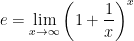
            . e = \displaystyle \lim_{x \to \infty} \left(1 + \frac{1}{x} \right)^x

            “This is why the number e appears so often in modeling the exponential growth or decay of everything from bacteria to radioactivity.” This fact was adopted by the mathematical community and many mathematicians started collaborating and making many more discoveries on the number e, such as Euler, who estimated e correctly to 18 decimal places, gave the continued fraction expansion of e, and made a connection between e and the sine and cosine functions. The number e is one of the most beautiful and powerful number in all of mathematics and the use of it was adopted into mathematics most likely by a banker…how interesting.


green line

How can technology be used to effectively engage students with this topic?


Any graphing technology, such as a TI calculator, Mathematica, MatLab, Desmos, etc., are great tools to use in order to engage students when discovering the number e. For instance, to convince students that the above limit is true,

e = \displaystyle \lim_{x \to \infty} \left(1 + \frac{1}{x} \right)^x,

 I can have them graph the function for themselves and actually see that the function approaches the number e as x gets very large. Similarly, I can simulate numbers of e on a computer program with the expansion  1 + 1/1! + 1/2! + 1/3! + … to show the sum getting closer and closer to the value of e the more terms I add. I believe this will be really engaging because the expansion for the number e and the limit for e look like they have nothing to do with e at first glance. To make the connection between them graphically would be somewhat magical to students and hopefully make them curious for more.


References:

http://wmueller.com/precalculus/e/e6.html (this is word problem from A1)

https://brilliant.org/wiki/the-discovery-of-the-number-e/

http://mathworld.wolfram.com/e.html

http://www-history.mcs.st-and.ac.uk/HistTopics/e.html


Engaging students: Compound interest

In my capstone class for future secondary math teachers, I ask my students to come up with ideas for engaging their students with different topics in the secondary mathematics curriculum. In other words, the point of the assignment was not to devise a full-blown lesson plan on this topic. Instead, I asked my students to think about three different ways of getting their students interested in the topic in the first place.

I plan to share some of the best of these ideas on this blog (after asking my students’ permission, of course).

This student submission comes from my former student J. R. Calvillo. His topic, from Precalculus: compound interest.

green line

How was this topic adopted by the mathematical community?


The mathematical community adopted the concept of compound interest very well. Albert Einstein was one of if not the biggest mathematician who adopted this policy of compound interest very well. His most notable quote on the topic is, “Compound interest is the eighth wonder of the world. He who understand it, earns it… He who doesn’t… pays it.” (Albert Einstein) Compound interest has expanded even from the mathematical community and spread to banks, and how they decide to give out interest on deposits or loans. The concept of compound interest has truly been one of the most well received concepts in the mathematical community, so much so that it even spread outside of that community into the business world. Where it then changed how businesses and banks looked at interest.

green line

How could you as a teacher create an activity or project that involves your topic?


Compound interest is a very important and very relatable topic for teachers to be able to relate real world examples to.  With that, I believe it is very important to make compound interest relatable to the real world uses that students’ will one day see when they get older. To begin the activity, each student will receive $2,000. That $2,000 will be put in the bank and the bank has agreed to add interest. The bank decided to give them the option on how they want that interest compounded; daily, monthly, quarterly or yearly. At the end we will group together the students’ who wanted to compound their interest similarly. Each group will get to explain why they chose how often it will be compounded, then will get the opportunity to solve how much it will grow after 2 years, 4 years and 20 years. This will then allow the students to see the differences and similarities between the different options that the bank provided, and which option will earn you the most money.

green line

How can this topic be used in your students’ future courses in mathematics or science?


Compound interest is a topic that will originally get introduced in a pre-calculus class, however, if any students’ go onto take classes such as statistics or any other business related math, it will contain material on compound interest. It is used as such a big role in the business world that getting a true understanding how it works and the reasoning behind why it works is crucial from the earliest class that we see it in.  In later classes it can be touched on more so, especially reaching the ways that it is beneficial to use it or the ways that it may hurt to use it. Either way it is a concept that will come up again whether you see it in the classroom, or in real life. Compound interest is one of if not the most relatable topic to the outside world with all of its applications to loans and how it is used in banks. Getting the fundamental concepts early is a crucial aspect to understanding its deeper usage in other courses.


Resources:

Compound interest – Albert Einstein. (n.d.). Retrieved from https://quotesonfinance.com/quote/79/albert-einstein-compound-interest


Engaging students: Graphing Sine and Cosine Functions

In my capstone class for future secondary math teachers, I ask my students to come up with ideas for engaging their students with different topics in the secondary mathematics curriculum. In other words, the point of the assignment was not to devise a full-blown lesson plan on this topic. Instead, I asked my students to think about three different ways of getting their students interested in the topic in the first place.

I plan to share some of the best of these ideas on this blog (after asking my students’ permission, of course).

This student submission comes from my former student Christian Oropeza. His topic, from Precalculus: graphing sine and cosine functions.

green line

How could you as a teacher create an activity or project that involves your topic?

An activity for students to understand how to graph sine and cosine could consist the use of website desmos (Reference 1). In this activity students will be in pairs and must complete a worksheet that list different forms of the equation sine and cosine that illustrate some of the transformations for sine and cosine. One student will enter the equation onto desmos and the other student will draw the graph on a separate worksheet. The pair will switch roles after each equation, so both students understand how to interpret and draw a given sine or cosine equation. After all the equations have been graphed and sketched, each pair will move on to the next part of the activity in which they must manipulate the equation asin(bx+c)+d and acos(bx+c)+d on desmos where a,b,c, and d are all  numerical sliders that can be adjusted to help students visually interpret what transformation they represent. Finally, to prove that students understood the material, each pair will come up with a sketch of a transformation of sine or cosine and trade with another pair of students, in which they must figure out the corresponding equation that matches the given graph.


green line

How can this topic be used in your students’ future courses in mathematics or science?

This topic comes up any subject that has sinusoidal waves, such as physics, calculus, and some engineering classes. For example, in calculus graphing the derivative of sine gives the graph of cosine. This shows students that the slope at any point on the sine curve is the cosine and the slope of any point on the cosine curve is the negative of the sine. The topic of sine and cosine is a crucial component  in electrical engineering (EE). For EE, there’s a class called, circuit analysis that has a section named “Euler’s Sine Wave” and “Euler’s Cosine Wave”, which incorporates the use of Euler’s formula (Reference 2). Also, in electrical engineering, there’s a machine called a “signal generator”, which sends different types of signals as inputs to circuit. This machine can alter the frequency and amplitude of the signal, where amplitude represents the amount of voltage inputted into the circuit. In math, there’s a topic called “Fourier Series” that also incorporates sine and cosine (Reference 3).

green line

How can technology (YouTube, Khan Academy [khanacademy.org], Vi Hart, Geometers Sketchpad, graphing calculators, etc.) be used to effectively engage students with this topic? Note: It’s not enough to say “such-and-such is a great website”; you need to explain in some detail why it’s a great website.

Desmos (Reference 1), can be used to show students the different transformations of both functions. This way students can visually understand what each component is and how each component affects the functions y=asin(bx+c)+d and y=acos(bx+c)+d, where a is the amplitude, b is the period, c is the phase shift, and d is the vertical shift. Vision learning (Reference 4), is also a great website for students when they are introduced to the topic of sine and cosine. This website goes over the history of sine by relating it to waves and circles. The website first goes over how Hipparchus calculated the trigonometric ratios and how that led to the sine function. This website gives students a background on how the functions sine and cosine came to be over time. Also, this website talks about how when the Unit Circle is placed on a Cartesian graph, this illustrates how sine and cosine take over a periodic trend, so students can see why the graphs of sine and cosine are infinite if the domain is all real numbers.

References:

  1. https://www.desmos.com/calculator
  2. https://www.khanacademy.org/science/electrical-engineering/ee-circuit-analysis-topic/ee-ac-analysis/v/ee-eulers-sine-wave
  3. https://www.mathsisfun.com/calculus/fourier-series.html
  4. https://www.visionlearning.com/en/library/Math-in-Science/62/Wave-Mathematics/131

Engaging students: Using right-triangle trigonometry

In my capstone class for future secondary math teachers, I ask my students to come up with ideas for engaging their students with different topics in the secondary mathematics curriculum. In other words, the point of the assignment was not to devise a full-blown lesson plan on this topic. Instead, I asked my students to think about three different ways of getting their students interested in the topic in the first place.

I plan to share some of the best of these ideas on this blog (after asking my students’ permission, of course).

This student submission comes from my former student Cameron Story. His topic, from Precalculus: using right-triangle trigonometry.

green line

What interesting (i.e., uncontrived) word problems using this topic can your students do now?

Most right-angle trigonometry word problems involve giving two measurements of a triangle (angle, sides or both) and asking the students to solve for the missing piece. I argue that these problems are fine for practice, but one has to admit these problems encourage “plugging and chugging” along with their formula sheets.

To make things interesting, I would use something along the lines of this word problem from purplemath.com:

“You use a transit to measure the angle of the sun in the sky; the sun fills 34′ of arc. Assuming the sun is 92,919,800 miles away, find the diameter of the sun. Round your answer to the nearest mile,” (Stapel, 2018).

This is incredible! Using trigonometry, students can find out the diameter of the entire sun just by knowing how far away it is and how much of the sky the sun takes up. If you were to use this word problem in a experimental type of project, I strongly recommend using the moon for measurement instead; you can probably guess why measuring the sun in the sky is a BAD idea.


green line

What are the contributions of various cultures to this topic?

One amazing culture to contribute to the study of triangles and trigonometry were the Ancient Babylonians, who lived in what is now Iraq about 4,000 years ago. Archaeologists have found clay tablets from 1800 BC where the Babylonians carved and recorded various formulas and geometric properties. There were several such tablets found to have been lists of Pythagorean triples, which are integer solutions to the famous equation a^2+b^2=c^2.

The Greeks, while going through their own philosophical and mathematical renaissance, gave the namesake for trigonometry. Melanie Palen, writer for the blog Owlcation, makes is very clear why trigonometry “… sounds triangle-y.”  The word trigonometry is derived from two Greek words – ‘trigonon’ which means ‘triangle’ and ‘metron’ meaning ‘measure.’ “Put together, the words mean “triangle measuring”” (Palen, 2018).

green line

How can technology (YouTube) be used to effectively engage students with this topic?

In the YouTube video “Tattoos on Math” by the YouTube channel 3Blue1Brown (link: https://youtu.be/IxNb1WG_Ido), Grant Sanderson offers a unique perspective on the six main trigonometric functions. In the video. Grant explains how his friend Cam has the initials CSC, which is how we notationaly represent the cosecant function. Not only is this engaging because most students wouldn’t even think of seeing tattoos in math class, but also because Grant always backs up the mathematical content in his videos with beautiful animations.

Students know how sine and cosine functions are represented geometrically; these are just the “legs” of a right-angled triangle. Most students, however, only see the other four trigonometric functions as formulas to be solved. However, as Grant cleverly explains and visualizes in this video, all of these functions have geometric representations as well when paired with the unit circle. This video (moreover, this entire YouTube channel) can be helpful to those visual-learning students who need more than a formula to be convinced of something like the cosecant function.


References:

3Blue1Brown YouTube Video: https://youtu.be/IxNb1WG_Ido

Palen, Melanie. “What Is Trigonometry? Description & History of Trig.” Owlcation, Owlcation, 25 July 2018, owlcation.com/stem/What-is-Trigonometry.

Stapel, Elizabeth. “Right-Triangle Word Problems.” Purplemath, 2018, http://www.purplemath.com/modules/rghtprob.html

Engaging students: Proving that the angles of a convex n-gon sum to 180(n-2) degrees

In my capstone class for future secondary math teachers, I ask my students to come up with ideas for engaging their students with different topics in the secondary mathematics curriculum. In other words, the point of the assignment was not to devise a full-blown lesson plan on this topic. Instead, I asked my students to think about three different ways of getting their students interested in the topic in the first place.

I plan to share some of the best of these ideas on this blog (after asking my students’ permission, of course).

This student submission again comes from my former student Victor Acevedo. His topic, from Geometry: Proving that the angles of a convex n-gon sum to 180(n-2) degrees.

green line

How could you as a teacher create an activity or project that involves your topic?


A great activity to try with students would be to look at regular and irregular polygons and the triangles “inside” of them. Using some string and a few tacks, students could “construct” regular polygons on pegboard or foam. They could then measure the angles made by the string using a protractor and find the sum. After doing a the first few regular polygons, the students could do the same with irregular convex polygons and notice that the sum of the angles is the same for regular and irregular polygons with the same number of sides. At this point the students might have established a pattern for the sum of all the interior angles of a polygon as the number of sides (n) increases. The next task would be to go back to the regular polygons and make the triangles inside. This would be done by picking one of the vertices as the starting point and connecting that point to all the other vertices. Since the starting point is already connected to two of the other vertices, we wouldn’t have to make those connections again. The students would then see that inside of the regular polygons there are n-2 triangles. Since the sum of every triangle’s interior angles is 180°, the sum of the regular polygons’ interior angles would be 180(n-2). To further prove our original statement, the students would repeat the process of creating triangles with the irregular convex polygons.


green line

How can technology (YouTube, Khan Academy [khanacademy.org], Vi Hart, Geometers Sketchpad, graphing calculators, etc.) be used to effectively engage students with this topic?

This interactive Desmos program helps students work through proving that the sum of the interior angles of convex n-gons is 180(n-2). The program starts with a review of the sum of the angles in triangles. The students would then look at the diagonals of polygons and count the triangles formed. The students get the opportunity of deriving the formula for the sum of interior angles by continuing patterns as the number of sides increase. This program also encourages students to think about the “limit” to the interior angles of a polygon and why it approaches 180º but will never actually reach it. There is also a link to an extension of this activity to looking at the exterior angles of a polygon as well.

https://teacher.desmos.com/activitybuilder/custom/5b75d8d696a0ad0aefe7f3ff


green line

What interesting things can you say about the people who contributed to the discovery and/or the development of this topic?

René Descartes did not necessarily contribute to the discovery of the sum of the interior angles of convex polygons, but he was able to apply some of the outcomes to philosophy. Descartes uses the regular chiliagon (1,000-sided polygon) to demonstrate the differences between intellection and imagination. While we can clearly picture understand a triangle, a chiliagon is not quite as simple to picture due to the large number of angles and edges. To the naked eye, a chiliagon would look nearly identical to a circle. The only possible way to discern any difference would be to zoom in until you can possibly see different vertices. This application to philosophy is great for students to begin thinking about the limit that the interior angles of regular polygons reach as the number of edges increases.