Engaging students: Area of a triangle

In my capstone class for future secondary math teachers, I ask my students to come up with ideas for engaging their students with different topics in the secondary mathematics curriculum. In other words, the point of the assignment was not to devise a full-blown lesson plan on this topic. Instead, I asked my students to think about three different ways of getting their students interested in the topic in the first place.

I plan to share some of the best of these ideas on this blog (after asking my students’ permission, of course).

This student submission again comes from my former student Lucy Grimmett. Her topic, from Geometry: finding the area of a triangle.

green line

How could you as a teacher create an activity or project that involved your topic?

This topic is perfect for creating a mini 5E lesson plan or a discovery activity. Students can easily discover the area of a triangle after they know what the area of a square is. I would give my students a piece of paper (can also use patty paper) that is cut into a square. The students would be asked to write down the area of a square and from there would derive the formula for a triangle by folding the paper into a triangle. They will see that a triangle can be half of a square. The students will be able to test their formula by finding the area of the square and dividing it by 2 and then using the formula they derived. If the two answers match then the student’s formulas should be correct. The teacher would be floating around the room observing, and asking probing questions to lead students down the correct path.


green line

How can this topic be used in your students’ future courses in mathematics or science?

Finding the area of a triangle is important for many different aspects of mathematics and physics. Students will discuss finding the surface area of a figure, finding volume, or learning further about triangles. When discussing surface area and volume students will have to find the area of a base. In many examples a base can be a triangle. For examples, if a figure is a triangular pyramid and students are finding the surface area they will have to find the area of 4 triangles (3 of which will be the same area if the base is equilateral.) The Pythagorean theorem is also a huge aid when finding areas of non-right triangles. Mathematics consistently builds on itself. In physics triangles are very often used to find the magnitude at which force are being applied to an object. They use vectors to show this relationship and then use trigonometry functions (derived from the area) to find the magnitude of the force.

green line

What interesting things can you say about the people who contributed to the discovery and/or the development of this topic?

Finding the area of a triangle can be performed using different methods. Heron (or Hero) found Heron’s formula for finding the area of a triangle using its side lengths. Heron was considered the greatest experimenter of antiquity. Heron is known for creating the first vending machine. Not the type of vending machines we have today, but a holy water vending machine. A coin would be dropped into the slot and would dispense a set amount of holy water.  The Chinese mathematicians also discovered a formula equivalent to Heron’s. This was independent from his discovery and was published much later. The next mathematician-astronomer who was involved in the area of a triangle was Aryabhata. Aryabhata discovered that the area of a triangle can be expressed at one-half the base times the height. Aryabhata worked on the approximation of pi, it is thought that he may have come to the conclusion that pi is irrational.


Information found from: https://en.wikipedia.org/wiki/Hero_of_Alexandria

https://en.wikipedia.org/wiki/Area#Triangle_area


Engaging students: Defining the words acute, right, and obtuse

In my capstone class for future secondary math teachers, I ask my students to come up with ideas for engaging their students with different topics in the secondary mathematics curriculum. In other words, the point of the assignment was not to devise a full-blown lesson plan on this topic. Instead, I asked my students to think about three different ways of getting their students interested in the topic in the first place.

I plan to share some of the best of these ideas on this blog (after asking my students’ permission, of course).

This student submission again comes from my former student Lisa Sun. Her topic: how to engage geometry students when defining the words acute, right, and obtuse.

green line

How could you as a teacher create an activity or project that involves your topic?

I believe a scavenger hunt will be a great activity for the students to help concrete their knowledge of acute, right, and obtuse angles. It will be a take home activity rather than an activity that they’ll complete in school. I’ve created this scavenger hunt to take place outside of the classroom so students will understand that what we learn in math class takes place in our everyday lives outside of the walls of school.

This scavenger hunt activity requires students to observe their surroundings everywhere they go. I want them to find 10 acute angles, 10 right angles, and 10 obtuse angles. Along with that, they must take a picture or sketch accordingly to which angle the image has. (For example, picture/sketch of a corner of book shelf – right angle). To spark some motivation and interest, I will announce to the students that if they are able to find 15 of each angle instead of 10, I will add 2 points to their next exam grade.


green line

What interesting things can you say about the people who contributed to the discovery and/or the development of this topic?

Archimedes and Euclid are the mathematicians who have discovered and developed the idea of the types of angles that we have today. As a student, when my teachers related the topic with the brilliant minds who made such discoveries, I felt that the topics that I was learning were more relatable and I had gained a deeper understanding of the topic. I hope to do the same for my students with this topic. Here are the following interesting facts about Archimedes and Euclid to keep the students enlightened for geometry.

Interesting facts about Archimedes:

  • 1 of 3 most influential and important mathematician who ever lived (other two are Isaac Newton and Carl Gauss)
  • Rumors that he was considered to be of royalty because he was so respected by the King during his time
  • Invented the odometer

Interesting facts about Euclid:

  • “Father of Geometry”
  • His book “Elements” is one of the most powerful works in history of mathematics
  • His name means “Good Glory” in Greek


green line

How can technology be used to effectively engage students with this topic?

Above is a link that I would present, on replay, as students are walking into my classroom to set the tone of the classroom for the day. Once they are all seated, I will tell them to get out their interactive journal and write at least 5 facts that are new to them as I play the video for them once more. By doing so, we’re keeping the students engaged as they are reinforcing what they just heard in writing. Once students are done with this task, I will select students randomly to state one fact that they had just learned from the video. Guide the students to know and remember the “take home message” which are the following:

  • Definition of Angle: The amount of turn between two rays that have a common end point, the vertex
  • Angles are measured in degrees
  • Angles are seen everywhere
  • Acute angles: 0 – 89 degrees
  • Right angles: 90 degrees
  • Obtuse angles: 91-180


References:

https://www.mathsisfun.com/definitions/angle.html

http://www.yurtopic.com/society/people/archimedes-facts.html

http://www.10-facts-about.com/Euclid/id/382


Engaging students: Deriving the Pythagorean theorem

In my capstone class for future secondary math teachers, I ask my students to come up with ideas for engaging their students with different topics in the secondary mathematics curriculum. In other words, the point of the assignment was not to devise a full-blown lesson plan on this topic. Instead, I asked my students to think about three different ways of getting their students interested in the topic in the first place.

I plan to share some of the best of these ideas on this blog (after asking my students’ permission, of course).

This student submission comes from my former student Jillian Greene. Her topic, from Geometry: deriving the Pythagorean theorem.

green line

How can technology be used to effectively engage students with this topic?


Geometers Sketchpad is a fantastic resource to be able to more intuitively explore aspects of geometry without the approximation that often comes from using a graphing calculator or a pencil and paper. There is an exploratory activity that can either allow students to discover the Pythagorean Theorem in a different way, or just to reinforce the relationships between the sides. Have students create of a line segment AB with a length of one unit, whatever the measurement might be. Then create a right isosceles triangle using AB as the two equal sides. Now the students will build off of this triangle, making more right triangle (not necessarily isosceles) using the hypotenuse as one of the legs of the next triangle, and the other leg having the same length as AB.  Do this 6 times and find the length of final triangle’s hypotenuse. Now explain what the pattern is, and how the relationships work. The final product should look like this:

The final side should be sqrt(7), and the hypotenuses should go sqrt(2), sqrt(3), sqrt(4)…all the way up to x. Hopefully students will be fascinated by the relationship!

green line

What interesting things can you say about the people who contributed to the discovery and/or the development of this topic?


The Pythagorean Theorem was first theorized by Pythagoras, right? Wrong! There’s a very rich history that comes with this theorem that finds a relation in the sides on right triangles. Actually, there were clay tablets indicating an understanding of this theorem found in Babylonian settlements from more than 1000 years before Pythagoras. The Yale tablet, depicted below, has numbers written out in the Babylonian system that give the number “1.414212963” which is very close to √2 = 1.414213562, indicating an understanding of the 1-1-√2 relationship.

Similarly, there are relics from the Chinese and the Egyptian people having either the relationship between the legs figured out, or the existence of 3-4-5 triangles, or a “Pythagorean triple.” The Egyptians made sure their corners on their buildings were 90 degrees by using a rope with 12 evenly spaced notches to make a 3-4-5 triangle. So where does Pythagoras come in? Pythagoras was the first one to formulate a proof in regards to this theorem. So where are his proofs? Well, Pythagoras felt strongly against allowing anyone to record his teachings in any way, so there is no physical proof left behind. However, from what we know about Pythagoras, it is safe to assume that he approached it geometrically.

green line

How could you as a teacher create an activity or project that involves your topic?


Hello Detective, thank you for coming in to help today. Scar Tellub, 24 year old male, brown hair, green eyes, was found shot early this morning. He was shot for an unknown purpose, but is luckily recovering now.  However, we are determined to find this shooter. We know from eye witness testimonies that the gunshot came from overhead, from the top of a nearby building. We know from where the bodies were found, Mr. Tellub was standing perfectly in the center of three buildings, specifically he was 9 feet away from each building. From the entry and exit of the bullet, we can tell the gun was shot from 15 feet away. We have three possible suspects that could be the culprit, but we need your mathematical prowess to help us nail the bad person.


These are the possible shooters:

  1. Madison Bloodi: 19 years old, blonde hair/blue eyes, babysitter. Spotted atop the first building, Trump Tower (20 feet tall), at the time of the shooting.
  2. Hunter Kilt: 34 years old, brown hair/brown eyes, landscaper. Spotted atop the second building, the Eiffel Tower (6 feet tall), at the time of the shooting.
  3. Winston Payne: 26 years old, black hair/green eyes, lawyer. Spotted atop the third building, the Leaning Tower of Pisa (12 feet tall), at the time of the shooting.


Again, thank you for your time, Detective. We know full well that you won’t let us down. Please draw us a photo and show us your work for all three suspects so we can provide them to the judge. Happy mathing!


References:


http://jwilson.coe.uga.edu/emt668/emat6680.f99/challen/pythagorean/lesson4/lesson4.html


http://www.ualr.edu/lasmoller/pythag.html


(I did a similar activity to the murder one with students before, but I cannot find it online again, so I wrote a new one kind of similar to what I remember)


Engaging students: Introducing proportions

In my capstone class for future secondary math teachers, I ask my students to come up with ideas for engaging their students with different topics in the secondary mathematics curriculum. In other words, the point of the assignment was not to devise a full-blown lesson plan on this topic. Instead, I asked my students to think about three different ways of getting their students interested in the topic in the first place.

I plan to share some of the best of these ideas on this blog (after asking my students’ permission, of course).

This student submission again comes from my former student Jessica Martinez. Her topic, from Geometry: introducing proportions.

green line

How has this topic appeared in high culture (art, classical music, theatre, etc.)?

I would show a slideshow of classical artwork and architect such as the Mona Lisa, the Parthenon and the Pyramids in Egypt and then lead an open discussion of what qualities make these popular icons aesthetically appealing. Then I could lead into what makes a specific shape attractive, such as a rectangle, and have my students draw their ‘best looking’ rectangle, which would then lead into a discussion about the Golden Ratio. The Golden Ratio, also known as the “divine proportion”, appears in thousands of artworks and architecture pieces around the world. I would like to show a piece of artwork or architecture divided into the Golden Ratio rectangles and have my students calculate the Golden Ratio to the nearest hundredth -it’s about 1.618. Then I could go back to my original examples of classical artwork and show them with the Golden Ratio proportions drawn. I could also mention how famous painter Leonardo Da Vinci even illustrated a book about the Golden Ratio called De Divina Proportione, which talks about how mathematical and artistic proportions are used to create artwork and design architectural structures.


green line

How could you as a teacher create an activity or project that involves your topic?

Continuing on the idea of C2 above, I would like to create a project that involves my students using the Golden ratio and proportions to create their own architecture. I could have them research some more famous examples to get ideas, and then have them design their project blueprints, explaining what measurements, ratios and proportions they used to develop it (I would also include a requirement of using the Golden Ratio somewhere in their design). Then in teams of 2-3 students, I would have them create a small scale model of their design using materials found at home or at a craft store. To make it more authentic to the students and possibly a longer, more intensive project, I could give them a scenario of designing their own dream homes; by adding a budget and some time to research, my students could use proportions to calculate the cost of materials needed to build their home (here I would most likely exclude materials not needed for the actual building; plumping, electric and air conditioning would make it more complicated but will most likely not fit in the time frame of my teaching).


green line

How have different cultures throughout time used this topic in their society?


In American culture (and many other cultures), society considers beauty and attractiveness of high importance; its valued so much in some industries that people will go to the lengths of paying thousands of dollars altering their faces and body shapes to something more ‘aesthetically pleasing’ through plastic surgery. What is interesting to know is that plastic surgeons use proportions in order to create a more attractive look for their clients. Plastic surgeons will photograph a client’s face from the front and side views and divide their face into sections in the picture.  Then they will make corrections or marks on the photo (and on the client) of where the client wants surgery using specific proportions that create a look that is more symmetrical and ‘pleasing’ to look at. An example of this is shown below in the proportions of the nose to rest of the human face. (I would probably also remind my students that no one’s face is perfectly proportional and it’s a good thing because otherwise we would all look the same, and that’s boring.)

References

Obara, S. (n.d.). Golden Ratio in Art and Architecture. Retrieved October 13, 2016, from http://jwilson.coe.uga.edu/emt668/EMAT6680.2000/Obara/Emat6690/Golden Ratio/golden.html

Zimbler, M. S., & Ham, J. (n.d.). Aesthetic Facial Analysis. In Cummings Otolaryngology. Retrieved October 13, 2016, from http://www.marczimblermd.com/plasticsurgeonnyc/ResearchPublications/CummingsOtolaryngology.pdf


Engaging students: Finding the area of a right triangle

In my capstone class for future secondary math teachers, I ask my students to come up with ideas for engaging their students with different topics in the secondary mathematics curriculum. In other words, the point of the assignment was not to devise a full-blown lesson plan on this topic. Instead, I asked my students to think about three different ways of getting their students interested in the topic in the first place.

I plan to share some of the best of these ideas on this blog (after asking my students’ permission, of course).

This student submission again comes from my former student Jessica Bonney. Her topic, from Geometry: finding the area of a right triangle.

green line

What interesting word problems using this topic can your students do now?


Since students have learned the area of a rectangle, we can use this previously learned knowledge to help students better understand the area of a right triangle. To start off the class you could say that a farmer needs our help developing his pasture into two hay meadows, one for warm-season grass and the other for cool-season grass. The large, rectangular pasture measures 250 yards wide and 600 yards long. Hancock Seed Company sells bahia grass(warm-season grass) seed for $140 per 50-lb bag per acre and ryegrass (cool-season grass) seed for $25 per 50-lb bag per acre. Have the students initially calculate the area of the pasture, then the area of the area of each triangle. From there the students can calculate how many acres are in each triangular section of pasture to determine how many pounds of seed the farmer will need. This activity allows the students to investigate and see the relationship between the area of a triangle compared to the area of a rectangle in a real world setting.

green line

How can technology (YouTube, Khan Academy [khanacademy.org], Vi Hart, Geometers Sketchpad, graphing calculators, etc.) be used to effectively engage students with this topic?


Khan Academy has a great tool for showing students the area of a right triangle (https://www.khanacademy.org/math/geometry-home/geometry-area-perimeter/geometry-area-triangle/a/area-of-triangle). This tool allows students to see how the area of a triangle correlates to the area of a rectangle. By clicking on the dot and dragging it, the user can see why the formula for the area of a triangle works. Students should have previously learned that the area of a rectangle is the base multiplied by the height (A=bh). This interactive tool shows students that the area of a triangle is one half the area of a rectangle (A= ½ bh). Through further interactions on the website the students then can transform the triangles to rectangles and solve to find the area of the triangle. For further explanation of the formula, Khan Academy has a video demonstrating and proving the area of a triangle using methods from Euclid’s Elements, but in a much simpler form so that students will be able to follow along.

References:


Khan Academy: https://www.khanacademy.org/math/geometry-home/geometry-area-perimeter/geometry-area-triangle/a/area-of-triangle


Trigonometry for Physics: http://www.lshsstem.com/uploads/3/9/1/4/39145399/phy_1_trig_for_physics.pdf


Khan Academy: https://www.khanacademy.org/math/trigonometry/trigonometry-right-triangles


Radford University: http://www.radford.edu/rumath-smpdc/Units/src/Poles_Sports.pdf


Hancock Seed Company (Bahia Grass Seed): https://hancockseed.com/hancocks-pensacola-bahia-grass-seed-50-lb-bag-4.html


Hancock Seed Company (Ryegrass Seed): https://hancockseed.com/hancocks-ryegrass-seed-50-lb-bag-14.html


Engaging students: Finding the inverse, converse, and contrapositive

In my capstone class for future secondary math teachers, I ask my students to come up with ideas for engaging their students with different topics in the secondary mathematics curriculum. In other words, the point of the assignment was not to devise a full-blown lesson plan on this topic. Instead, I asked my students to think about three different ways of getting their students interested in the topic in the first place.

I plan to share some of the best of these ideas on this blog (after asking my students’ permission, of course).

This student submission comes from my former student Heidee Nicoll. Her topic, from Geometry: finding the inverse, converse, and contrapositive.

green line

How could you as a teacher create an activity or project that involves your topic?

I would start this lesson with if-then statements that were not math related.  I would use simple examples such as “If it is raining, then my mother will not let me play outside.”  Students will be in groups, and will each group will have a set of cutouts, with each set containing two copies of the word “not”, a card with “if” and a card with “then,” and each “if” statement and each “then” statement on separate cards.  They will also have a worksheet that gives them space to write the sentences that we come up with as a class.  As the teacher, I will have a set of cutouts that will have either magnets or tape on the back that I will have on the board.  I will show them an example, before having them work on their own.  I will have the cards, for example “If” “It is raining” “then” “my mother will not let me play outside” on the board.  Then I will put a “not” card in front of each statement and ask the students what this statement means.  It will say “If” “not” “it is raining” “then” “not” “my mother will not let me play outside,” which translates to “If it is not raining, my mother will let me play outside.”  The students will copy the grammatically correct statement onto their worksheet.  I will ask them if it is a true statement.  Then, I will put the statement back in its original form, and then will switch the “if” and “then” statements, which would result in “If” “my mother will not let me play outside” “then” “it is raining.” The students will copy down this sentence and will discuss whether or not it is true.  Lastly, we will do the contrapositive of the statement, and switch the “if” and “then” statements and add the “not” cards.  The students will then do several sentences on their own, moving around the cards to form the statements, copying the sentences onto their worksheets, and talking as a group about whether or not the statements are true.  This will help the students see the concept behind these different statements before having to learn the names inverse, converse, and contrapositive, and without having to think about them in terms of geometry.


green line

How has this topic appeared in pop culture (movies, TV, current music, video games, etc.)?

This clip from some Star Trek episode shows an example of times in the English language when it might be hard to decode exactly what someone is saying because of the word “not” or the use of double negatives.

I would show the students the clip and ask them what the man meant by “nobody helps nobody but himself” and if that was a true statement.  If they decide that it is not true, then I would ask them what they would change about the sentence to make it true.  Although this clip does not explicitly use the ideas of inverse, converse, or contrapositive, it shows the importance of being able to take a somewhat confusing or ambiguous statement and understand it logically.  In order for students to understand inverse, converse, and contrapositive, they need to understand that the phrase “this is not an odd number” also means “this is an even number,” or that “this polygon does not have an uneven number of sides” means that “this polygon has an even number of sides.”  I would show them examples such as these, and have the students share what they think the statements mean.  We would have a class discussion about how language can be confusing at times, and how we need to be able to decode it.


green line

How can technology (YouTube, Khan Academy [khanacademy.org], Vi Hart, Geometers Sketchpad, graphing calculators, etc.) be used to effectively engage students with this topic?

I would use Kahoot! to create an online quiz.  I would have questions such as “which of these statements is logically true?” and “which of these statements is logically false?” Each answer choice would be a short statement, some math related, such as “if a number ends in 2 it is even” and some not related, such as “if the sun is out today, then it is warm outside.”  I would also include statements that were the inverse, converse, or contrapositive, such as “if it is not warm outside, then the sun is not out today.”  The students would have to read all the answer choices and pick the one that was true or false, depending on what the question was asking.  This would get them thinking about whether or not certain statements are true, and would give them practice logically decoding words and phrases.  Kahoot! keeps track of the students that answer correctly and quickly and keeps points, so it would be a small competition, which students normally enjoy.


Engaging students: Finding the area of a circle

In my capstone class for future secondary math teachers, I ask my students to come up with ideas for engaging their students with different topics in the secondary mathematics curriculum. In other words, the point of the assignment was not to devise a full-blown lesson plan on this topic. Instead, I asked my students to think about three different ways of getting their students interested in the topic in the first place.

I plan to share some of the best of these ideas on this blog (after asking my students’ permission, of course).

This student submission comes from my former student Daniel Herfeldt. His topic, from Geometry: finding the area of a circle.

green line

Learning area of a circle as well as the circumference in geometry is beneficial for anyone who is looking to pursue any career involving math. This includes anything from a math teacher to an architect. This helps with most future courses in mathematics. With this said, it will be very beneficial when going into pre-calculus. This is because in pre-calculus you will deal a lot with trigonometry. This includes such things as the unit circle, which is a great deal to pre-calculus itself. Being familiar with the equations of a circle helps to understand why things work in a unit circle. It can help with simple things such as why x2+y2=r2. Knowing the area of a circle will make the class easier to understand in all. This topic is also very important to future architects. The reason for this is because if an architect doesn’t know the area of a circle or any other shape, it would be very difficult to construct a building. If one cannot figure the dimensions of a pillar to help support the ceiling of a building, the building will have a possibility to collapse. This causes the structure of a building to rely highly on the dimensions, area, and volume of all shapes including the circle. This proves that the importance of the area of a circle to be very high. Most students will not know that everywhere they go, circles are needed. Informing them about these small details could have the students more eager to learn. Giving them great real world examples might also help the students understand and grasp the knowledge that you are trying to teach them because it relates to them.

green line

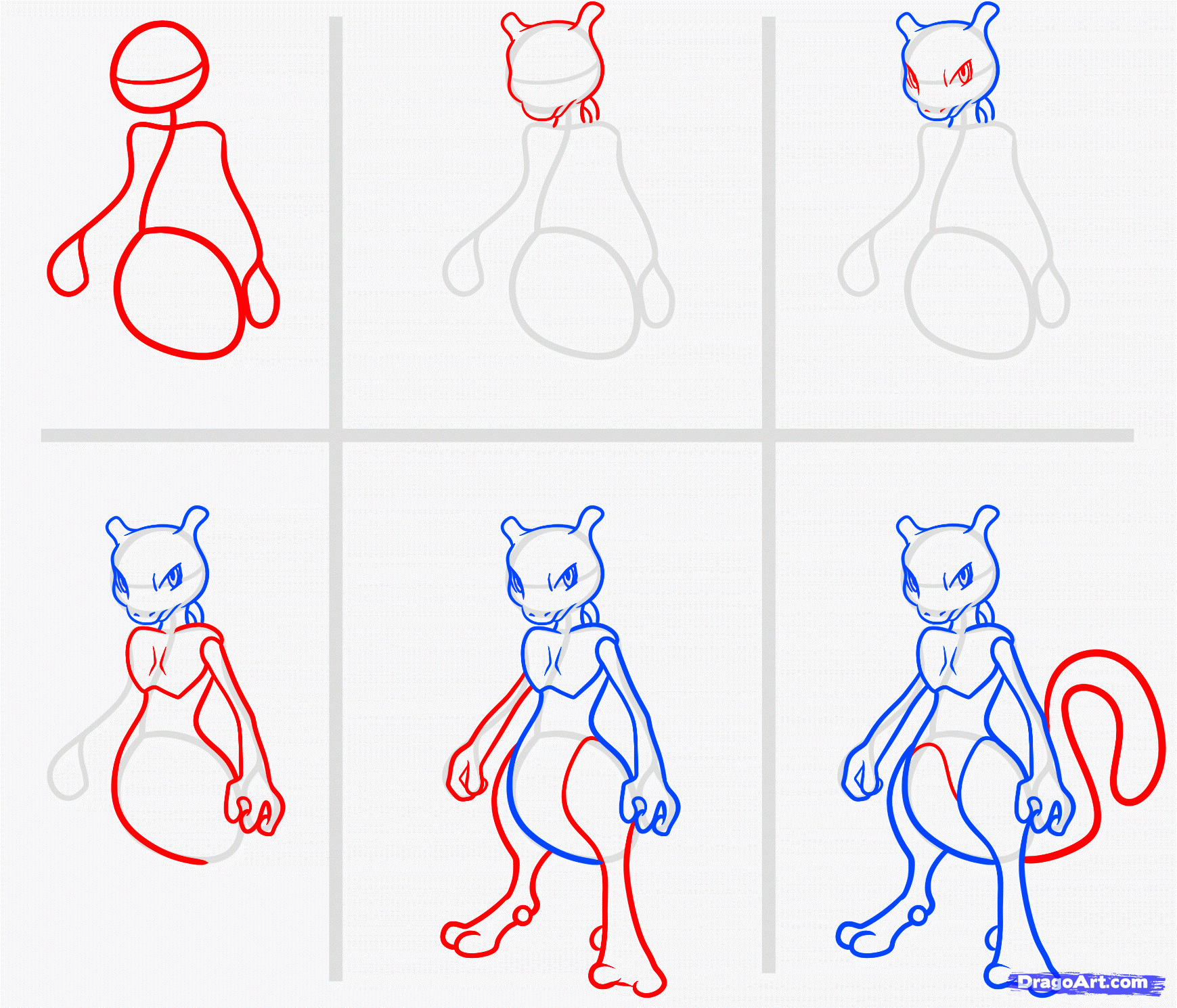
Circles will be anywhere you go. They are in your everyday TV show, video games, and movies. Although at first glance you might not actually see them, they really are there. When creating a character for an animated movie or a popular video game, artist first start to draw with simple circles and lines. They need to figure out a certain area of the character’s face to be able to fit the facial features. For example, they need to be able to fit eyes, a mouth, a nose and a few more features. From this, they will go on to the animation of the character. This also includes circles because in an animation, when you are wanting to move one object, you have to move it all. The same process applies when working on the landscape properties. It will mostly start with simple lines, circles, and boxes. From there, it will progress into more advance steps, putting more and more detail into it. When moving a character, it is also necessary to move the landscape and surroundings as well. This would be great to tell a class because students will be able to relate to the subject. Most kids in the high school level will play video games. Whether the game is on their phone or a gaming console, they still require the beginning steps. If the student doesn’t play video games, they can relate to it due to watching an animated movie. This will be a great way to engage the class in the first few minutes of class. Below is a picture of the progression of drawing a Pokémon.


green line

Many ancient civilizations have been fascinated with circles. Circles can be seen in many ancient structures and buildings from the Roman Coliseum to Stonehenge.

One ancient civilization fascinated with circles were the Greeks. The believed the circle to be a sacred divine shape mostly based on its multiple points of symmetry.  The Greeks also invented a puzzle called squaring the circle, in which the person had to construct a square with the exact area of a circle a compass and a straight edge. This puzzle has been proved mathematically impossible.

Other instances in which circles played an important role in history were the circles that appeared in the crops in different areas of the world. These crop circles have been argued to be a hoax while others indicate it is not possible for the crop circles to be the work of humans.  Regardless, of their origin, these crop circles continue to fascinate us.

Circles continue to have significance today. They are used in logos and other things usually to signify unity and harmony. Even the Olympic symbol is made up of five interlocking colorful rings. The circle is still found today enclosing the all seeing eye over the pyramid in the dollar bill on the US currency.

The significance of presenting this information to students, especially high school students, is to give them background information. I think many high schoolers will be interested to learn how circles have been significant in other cultures throughout history.  Students can be given a short introduction in the subject and asked to look for more instances in which circles played a role in an ancient civilization and then bring that trajectory to modern times.


Website: https://nrich.maths.org/2561


Engaging students: Midpoint

In my capstone class for future secondary math teachers, I ask my students to come up with ideas for engaging their students with different topics in the secondary mathematics curriculum. In other words, the point of the assignment was not to devise a full-blown lesson plan on this topic. Instead, I asked my students to think about three different ways of getting their students interested in the topic in the first place.

I plan to share some of the best of these ideas on this blog (after asking my students’ permission, of course).

This student submission again comes from my former student Christine Gines. Her topic, from Geometry: deriving the term midpoint.

green line

Euclid was an Alexandrian Greek mathematician who created Euclidean geometry, and is also known as the Father of Geometry. He created a book called Elements, becoming one of the most influential works in mathematics’ history. Not much biographical information is known about him so many researchers believe he was not just one man, but rather a fictional character created by a team of mathematicians. This hypothesis however, is not well accepted by todays scholars. Euclid’s book Elements consists of 13 separate books, all bounded together, which is now what many high school math courses are based off of, – especially geometry. In book one proposition 10, the bisection of finite straight line is constructed and proved, which is also the construction of the midpoint of a finite segment. Many of the books works and theories have been taken, molded and manipulated throughout the years by mathematicians in order to form new and innovative ideas and theories. For example, being able to construct a mid point by using only circles. Mathematicians have challenged Euclid and his proofs many times, thus leading to great discoveries and theories, such as the discovery of doing his constructions in less steps (par value) and other types of math, but they still haven’t disproven much.

http://blog.yovisto.com/euclid-the-father-of-geometry/

https://en.wikipedia.org/wiki/Euclidean_geometry

http://math.stackexchange.com/questions/227285/constructing-the-midpoint-of-a-segment-by-compass


green line

Creating a midpoint hands on before seeing a precise definition is a great strategic way for a student to end up with reasonable definition of sed midpoint. According to Euclid, knowing how to create a midpoint with a ruler and compass can lead to the capability of creating other common shapes like circles, triangles, and squares. Common shapes are all around us in each and every material thing, but not many people think like a mathematician does. For example, a mathematician thinks the roof of a house looks like a triangle and not just an every day roof, a hot tub looks like a circle, a door looks like a rectangle and an infinite number of more examples. There is also more in depth use of common shapes like these. Films create their characters according to the correlation of shapes and emotions. For example, a villain is created to cause terror, fear, and intimidation; the type of shapes that portray those emotions are sharp and jagged, a lot like triangles are. The video attached does a great job on putting together a series of popular films and demonstrating how common shapes on characters and scenes manipulate the viewer’s feelings. This will allow the students to see how being able to define a midpoint leads to the creation of other shapes, and also their role in pop culture and how much it impacts them without even noticing.

green line

Defining the midpoint is not only limited to a finite line segment. In algebra two the students will learn and have to find the vertex of a parabola. Finding the midpoint of a quadratic equation is equivalent to finding the vertex, because the value x is the axis of symmetry of the parabola. Being able to derive the axis of symmetry is also a beginning step to writing an equation in vertex form and completing the square. The comprehension of the midpoint formulas, axis of symmetry, and vertex form will form a direct path to the introduction of conics and deriving formulas for them. In addition, students are also taught about area approximation under a curve and how to calculate it. When students are first being introduced to the topic they are taught a technique called Riemann sum. Riemann summation is best approached with partitions of equal size over an interval. There are four methods to calculate such technique left Riemann Sum, Right Riemann Sum, Trapezoidal Rule, and Middle Sum. To calculate Middle Sum method, the student will have to approximate the function at the midpoint of partitions.


Engaging students: Defining the terms complementary angles, supplementary angles, and vertical angles

In my capstone class for future secondary math teachers, I ask my students to come up with ideas for engaging their students with different topics in the secondary mathematics curriculum. In other words, the point of the assignment was not to devise a full-blown lesson plan on this topic. Instead, I asked my students to think about three different ways of getting their students interested in the topic in the first place.

I plan to share some of the best of these ideas on this blog (after asking my students’ permission, of course).

This student submission comes from my former student Brittany Tripp. Her topic, from Geometry: defining the terms complementary angles, supplementary angles, and vertical angles

green line

How could you as a teacher create an activity or project that involves your topic?

I really enjoy getting the students up, out of their seats, moving around, and engaging with one another. One way that you could do this, that would fit for this topic, would be to create different matching cards. You could makes cards that have the names: complementary angles, supplementary angles, and vertical angles. Then to go along with those you could have different cards that have the definitions of the different types of angles and other characteristics about them. You would give each student a card and then turn on some music and have them dance around the room looking for the people that pair with them. I love the idea of music because it gets the students more engaged than just lazily walking around the room. In my opinion, music and dancing your awakens senses and increases student engagement in a way that just walking around doesn’t. After everyone finds the people they pair with you could have each group read off their cards so that everyone else has to opportunity to gain all the information on all of the cards. You could take this one step further and get different angles and measurements and cards ask the students to first find their complementary angle, then supplementary. This would give them the opportunity to actually practice the different types of angles and put definitions to actually problems.


green line

What interesting things can you say about the people who contributed to the discovery and/or development of this topic?

A variety of people have contributed to the discovery and development of this topic, for instance: Proclus, Eudemus, Euclid, and that is just to name a few. They all have varying definitions of what an angle itself is and while none of them use the terms complementary, supplementary, or vertical angles, they state things that we now know to be those things. Proclus, or Proclus of Athens, is known to have been “the most authoritative philosopher of late antiquity.” “[He] was eager to demonstrate the harmony of the ancient religious revelations and to integrate them in the philosophical tradition of Pythagoras and Plato.” He also wrote commentaries on a variety of other philosophers and mathematicians works including, but not limited to, Euclid, Aristotle, and Plato. In a commentary of Euclid’s first book of elements, Proclus’s idea, of what an angle is, is presented.

There are also two corollaries given by Proclus in association with Book I Proposition 32 of Euclid’s Elements which discusses the three angles of a triangle. Eudemus, or Eudemus of Rhodes, was a Greek philosopher very present before 300 B.C. He worked closely with Aristotle and Theophrastus. “[Eudemus’s] history of geometry, arithmetic, and astronomy completed the Doctrines of the Natural Scientists of Theophrastus.” There are three known works on the history of Mathematics that were contributed by Eudemus, those, as stated in the previous quote, being: History of Arithmetic, History of Geometry, and History of Astronomy. Eudemus’s idea of what an angle is, is also presented in the commentary of Euclid’s first book of elements.

Of course, considering Eudemus is known for one of his works History of Geometry, I think it is safe to say he contributed much more to Geometry than this simply idea of an angle. Now on to maybe one of the most well known mathematicians, who contributed to the understanding and development of angles, Euclid. There is not very much that anyone knows about Euclid besides when and where he was born. He is mostly known for this contribution to geometry in the Elements. In Euclid’s book, Euclid’s Elements, there are propositions outlining a variety of different types of angles such as supplementary angles and vertical angles. For instance, Book I Proposition 13 of Euclid’s Elements is about supplementary angles and Book I Proposition 15 is about vertical angles.


green line

How can technology be used to effectively engage students with this topic?

There is a website that I have used before with students that I have tutored and I have really enjoyed using it and see how much the students enjoy using it! The website is IXL Learning (https://www.ixl.com/). I love this website because it has a huge variety of different mathematics topics ranging from grades Pre-K, counting objects, to Twelfth grade, Pre-Calculus and Calculus. The website alone is super appealing because it is very colorful which instantly helps to catch the attention of whomever is using it. All of the grades levels are presented on the homepage so it makes finding the grade you are looking for extremely easy. When you click on the grade level it takes you to a screen that is broken up into categories and within each category there are subcategories. These make it even easier to find/access the specific topic you are looking for. For instance when looking for complementary, supplementary, and vertical angles you can click on tenth grade geometry. The page it takes you to contains a category called Angles. Under the angles category there are subcategories that include angle vocabulary, angle measures, identify different types of angles, as well as other things.


Engaging students: Classifying polygons

In my capstone class for future secondary math teachers, I ask my students to come up with ideas for engaging their students with different topics in the secondary mathematics curriculum. In other words, the point of the assignment was not to devise a full-blown lesson plan on this topic. Instead, I asked my students to think about three different ways of getting their students interested in the topic in the first place.

I plan to share some of the best of these ideas on this blog (after asking my students’ permission, of course).

This student submission again comes from my former student Brianna Horwedel. Her topic, from Geometry: classifying polygons.

green line

How could you as a teacher create an activity or project that involves your topic?

A great activity for classifying polygons would be a card sort. Give students index cards with different ways to describe polygons on them. For example, the cards could say “has three sides”, “has five sides”, “has 4 equal sides”, “has four sides”, “triangle”, “quadrilateral”, “square”, “pentagon”. Also include cards with a pictorial representation of the polygons that you want them to identify. Have the students work in groups of three or four to match all of the cards. For example, “has three sides”, “triangle”, and the picture of a triangle would all be matched together. After about five to ten minutes of the students working in their groups, I would have a larger set of the index cards (probably on standard printer paper) that one person from each group would come up and place in the correct category/group.


green line

How can technology be used to effectively engage students with this topic?

There are tons of great polygon sorting games online. At the beginning of the unit I would have the students play Polygon Shape Game (http://www.sheppardsoftware.com/mathgames/geometry/shapeshoot/PolygonShapesShoot.htm). It is a great introductory game. It really helps the students understand what it means to be a polygon. The students have to pick out all of the shapes that are polygons on one round; on the next round, they have to pick out all of the shapes that aren’t polygons. Once students have a better understanding of what defines a polygon and different types of polygons, I would have them play Half a Min: Polygon (http://www.math-play.com/types-of-poligons.html). This game makes the students type in a type of polygon based on the hint given. This game is definitely harder than the first one; I would save it for maybe a review before a test.


green line

How has this topic appeared in high culture (art, classical music, theatre, etc.)?

Polygons occur frequently in abstract art, particularly the movement called De Stijl. It was inspired in part by the chaos of war. Dutch artists in 1917 wanted to contrast the messiness of war with art that consisted of balance, harmony, and the absence of individual expression. Piet Mondrian is one of the most famous artists to come from this particular movement. His work is created using grids, which creates various rectangles, and primary colors. Here is one of his paintings titles Broadway Boogie Woogie:

It would be really fun for the students to then create their own artwork in the De Stijl style using only polygons that we have previously discussed.

References:

http://visionandverse.blogspot.com/2014/08/the-art-of-piet-mondrian.html

http://www.abstract-art-framed.com/mondrian.html

http://www.math-play.com/types-of-poligons.html

http://www.sheppardsoftware.com/mathgames/geometry/shapeshoot/PolygonShapesShoot.htm