Teaching for understanding and teaching procedures

Many critics of the current state of mathematics education take issue with asking students to explain their reasoning. They’d rather students just apply an algorithm and get the answer.

The following is quoted from QED: The Strange Theory of Light and Matter, where Richard Feynman describes how he’s going to explain for a lay audience the techniques behind quantum mechanics that earned him a Nobel Prize. (By the way, I highly recommend this book.)

How am I going to explain to you the things I don’t explain to my students until they are third-year graduate students? Let me explain it by analogy.

The Maya Indians were interested in the rising and setting of Venus as a morning “star” and as an evening “star” – they were very interested in when it would appear. After some years of observation, they noted that five cycles of Venus were very nearly equal to eight of their “nominal years” of 365 days (they were aware that the true year of seasons was different and they made calculations of that also). To make calculations, the Maya had invented a system of bars and dots to represent numbers (including zero), and had rules by which to calculate and predict not only the risings and settings of Venus, but other celestial phenomena, such as lunar eclipses.

In those days, only a few Maya priests could do such elaborate calculations. Now, suppose we were to ask one of them how to do just one step in the process of predicting when Venus will next rise as a morning star – subtracting two numbers. And let’s assume that, unlike today, we had not gone to school and did not know how to subtract. How would the priest explain to us what subtraction is?

He could either teach us the numbers represented by the bars and dots and the rules for “subtracting” them, or he could tell us what he was really doing: “Suppose we want to subtract 236 from 584. First, count out 584 beans and put them in a pot. Then take out 236 beans and put them to one side. Finally, count the beans left in the pot. That number is the result of subtracting 236 from 584.”

You might say, “My Quetzalcoatl! What tedium, counting beans, putting them in, taking them out – what a job!”

To which the priest would reply, “That’s why we have the rules for the bars and dots. The rules are tricky, but they are a much more efficient way of getting the answer than by counting beans. The important thing is, it makes no difference as far as the answer is concerned: we can predict the appearance of Venus by counting beans (which is slow, but easy to understand) or by using the tricky rules (which is much faster, but you must spend years in school to learn them).”

To understand how subtraction works – as long as you don’t have to actually carry it out – is really not so difficult.

That’s my position: I’m going to explain to you what the physicists are doing when they are predicting how Nature will behave, but I’m not going to teach you any tricks so you can do it efficiently. You will discover that in order to make any reasonable predictions with this new scheme of quantum electrodynamics, you would have to make an awful lot of little arrows on a piece of paper. It takes seven years – four undergraduate and three graduate to train our physics students to do that in a tricky, efficient way. That’s where we are going to skip seven years of education in physics: By explaining quantum electrodynamics to you in terms of what we are really doing, I hope you will be able to understand it better than do some of the students!

In the same way, I want students in 2nd and 3rd grades to understand what they are really doing when they subtract, and not just mindlessly follow a procedure to get an answer that they do not really understand.

Where I tend to agree with most critics of the Common Core is that students are asked to write miniature essays to explain their reasoning, and that’s probably a bad idea. Even though I want students to understand why subtraction works, 2nd and 3rd graders are still learning how to write complete sentences and can get easily frustrated with explaining their reasoning in paragraph form. I think there are better ways (like drawing pictures) of assessing whether young children really understand subtraction that is more developmentally appropriate.

Reflections by a teacher on the Common Core

The implementation of the Common Core has left a lot to be desired, but it’s heartening to see that some teachers have embraced what the Common Core attempts to accomplish. I saw the following first-person person referenced in the Washington Post; the original post can be found at http://www.youngedprofessionals.org/1/post/2014/03/is-the-common-core-working-in-the-classroom.html.

The Common Core State Standards are a reality now for teachers in Maryland and DC, while Virginia is one of six states to omit the standards from their state education approach. YEP-DC asked local educators how the Common Core is playing out in their classroom. Are the standards increasing student understanding or presenting obstacles? What’s changed in pedagogical approach, and how are students are reacting to the shift? 

Meredith Rosenberg, fourth-grade teacher

Compare 1/4 and 5/6. This seemingly simple problem is a no-brainer for adults. We know right away that 5/6 is greater than 1/4. But where do you begin with a student who has no conceptual understanding of what a fraction is?

One of the most defining features of the Common Core is how it introduces concepts to students through different modes of comprehension. By the end of a six-week Common Core unit on fractions, my students were talking about, writing about, drawing, and playing with fractions. When they encountered the above problem on a quiz, some students drew a picture, while others found common denominators. A few used a strategy called common numerators, which requires a deep understanding of the denominator of a fraction. One student drew the fractions on a number line. The takeaway: The students in my class were able to compare these fractions in no fewer than five different ways.

The Common Core implementation is not without its challenges. Many standards are vague, and there are only small bits of information coming from the Partnership for the Assessment of Readiness in College and Career (PARCC) on how they are to be tested. The inconsistency with which the standards have been implemented result in the need for highly differentiated classrooms. For example, some of my students came into fourth grade with a solid conceptual understanding of fractions, while others from other schools had no idea what a fraction meant.

However, my school has prioritized Common Core implementation and tackled its challenges with consistent professional development, regular refinement of unit plans, daily lessons and assessments, and an intense focus on the Standards for Mathematical Practice. As a result, my students are thinking critically about numbers every day, and they are becoming accustomed to attacking problems with multiple strategies and assessing the validity of those strategies. The Common Core standards choose depth over breadth, and with appropriate teacher development and support, this leads to much more critical thinking and analysis in the classroom.

Thoughts on the Common Core and its implementation

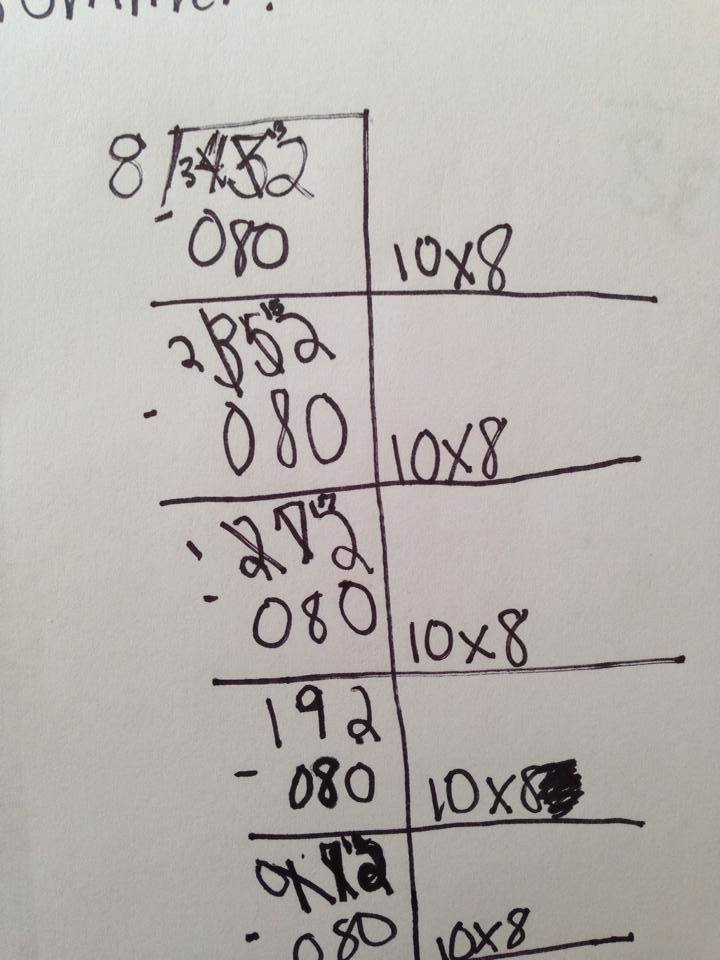
The following picture appeared on the Facebook page of Daniel Bongino, who is running for Congress in Maryland.
Source: https://scontent-a-dfw.xx.fbcdn.net/hphotos-prn1/t1/1184774_620433314716100_343011500_n.jpg

Here was his commentary on this picture:

Like many of you, I am a parent who is passionate about my child’s education in an increasingly competitive and unforgiving global economy.

Having stated that, I cannot condemn the Common Core in strong enough terms. Look at the picture I have attached to this post. I gave my daughter a relatively easy long-division problem to do today, in an attempt to gauge her progress, and this is what she gave back to me.

This is completely unacceptable. How is it that we are replacing a time-tested, efficient method of long-division with an absurd, multi-step process that not only confuses the students, but the parents too?

Compounding the Common Core disaster is the fact that in my daughter’s last school year she was taught the older, more effective method of long-division and is now completely confused.

Friends, all politics are local and it gets no more local than your kitchen table. Fight back against the Common Core, and do it quickly, by calling and emailing your local, state, and federal elected officials.

This is not a partisan issue. Your child’s education is suffering whether you are a Democrat or a Republican. Every second we lose is another second our kids are being exposed to a third-rate curriculum in a first-world economy. Count on me as an ally in this fight.
-Dan

Source: https://www.facebook.com/dan.bongino/photos/a.517057181720381.1073741827.101043269988443/620433314716100/?type=1&theater

green line

Yesterday, I discussed the mathematical logic behind this unorthodox approach to subtraction. Today, I want to briefly talk about the Common Core standards for mathematics and their implementation, as this is a topic that I’ve been following for several years.

  1. To the mindless critics who think that America is headed to communism because of the Common Core: there’s no point having a rational discussion about this. Michael Gerson is one of many conservative commentators who is not ideologically opposed to the Common Core; see http://www.washingtonpost.com/opinions/michael-gerson-gop-fear-of-common-core-education-standards-unfounded/2013/05/20/9db19a94-c177-11e2-8bd8-2788030e6b44_story.html.
  2. Also to the mindless critics: while Texas (where I live) is not a Common Core state, the standards for mathematics that we’ve had for the past 10 years or so align fairly well with the Common Core. And Texas is about as far away from a blue state as any of the 50.
  3. To the thoughtful critics who are worried about the appropriateness of the Common Core standards: as I said, while not in perfect alignment, for the last few years Texas has had content and process standards for mathematics education that are decently close to those stipulated by the Common Core. I’m more than happy to declare that the implementation of the Common Core has been thoroughly botched from sea to shining sea. Still, I believe that a good implementation is possible, and I hope that you don’t throw out the baby with the bath water when critiquing the potential of the Common Core standards.
  4. To the supporters of the Common Core standards: you better read Diane Ravitch’s thoughtful critique of how the standards have been rolled out: http://dianeravitch.net/2013/02/26/why-i-cannot-support-the-common-core-standards/. It seems to me that textbook publishers are driving the rollout of the Common Core, and educators are desperately trying to shift from the previous standards to the new standards while also trying to figure how they are being required to teach because of the textbook… and not because of the standards themselves.
  5. Also to the supporters of the Common Core standards: voters — and, more importantly, parents — will not tolerate these standards if a rationale for these standards are not carefully explained. I do think that most parents do care about the mathematical education of their children and will rationally discuss cutting-edge ways of teaching mathematics, but they have to be convinced that these cutting edge methods actually make sense. The rollout of the Common Core will be studied in public-relation circles for years to come for how *not* to make drastic changes.
  6. And though they are not specifically required by the Common Core, don’t get me started on the hours we’re wasting high-stakes testing, an intellectually lazy and ineffective way of measuring teacher quality.

Thoughts on unorthodox ways of teaching long division

The following picture appeared on the Facebook page of Daniel Bongino, who is running for Congress in Maryland.

Source: https://scontent-a-dfw.xx.fbcdn.net/hphotos-prn1/t1/1184774_620433314716100_343011500_n.jpg

Here was his commentary on this picture:

Like many of you, I am a parent who is passionate about my child’s education in an increasingly competitive and unforgiving global economy.

Having stated that, I cannot condemn the Common Core in strong enough terms. Look at the picture I have attached to this post. I gave my daughter a relatively easy long-division problem to do today, in an attempt to gauge her progress, and this is what she gave back to me.

This is completely unacceptable. How is it that we are replacing a time-tested, efficient method of long-division with an absurd, multi-step process that not only confuses the students, but the parents too?

Compounding the Common Core disaster is the fact that in my daughter’s last school year she was taught the older, more effective method of long-division and is now completely confused.

Friends, all politics are local and it gets no more local than your kitchen table. Fight back against the Common Core, and do it quickly, by calling and emailing your local, state, and federal elected officials.

This is not a partisan issue. Your child’s education is suffering whether you are a Democrat or a Republican. Every second we lose is another second our kids are being exposed to a third-rate curriculum in a first-world economy. Count on me as an ally in this fight.
-Dan

Source: https://www.facebook.com/dan.bongino/photos/a.517057181720381.1073741827.101043269988443/620433314716100/?type=1&theater

This picture was shared by a friend on Facebook; the resulting discussion follows. I’m sharing this because I think the following reactions are typical of parents when their children are taught mathematics using non-traditional methods.

While I don’t think that any of the commentators said anything personally embarrassing, I’m withholding the actual names of the correspondents for the sake of anonymity.

Anonymous #1: What in the world is this?

Me: In the worst case scenario, it’s a waste of time for children who already know how to divide.

In the best case scenario, it’s an effective and pedagogically reasonable first step — for children who don’t yet know how to divide. (FYI, this technique has been used long before the advent of the Common Core.

Here’s the justification: Young children often have a hard time coming up with the “best” first step that 43 divided by 8 is 5 with remainder 3. However, they often can come up with a reasonable first step, whether it’s subtracting off 10 groups of 8 or 40 groups of 8. The important thing is that they’re reducing 432 by a multiple of 80, not necessarily the “best” or “optimal” multiple of 80. With practice, children hopefully get better at guessing the optimal multiple of 80, thus leading to the traditional method of long division.

The idea is that the children can, with time, figure out the reason why long division works, rather than mindlessly following an algorithm that leads them to an answer that they don’t understand.

Anonymous #2: It’s the longest division problem ever. Lol

Anonymous #3: OMG John, that answer was more confusing than the picture!! LOL just kidding! What I want to see from that picture is, did she eventually get the answer right? Did she give up? If the kids learn how to get a right answer, I’m hard pressed to find a valid argument against any teaching method. If it frustrates them to the point that they give up, well then that is a problem. That picture he posted doesn’t give us any real information. It just makes us old farts think “what the hell??” Because it’s so different from what we learned.

Maybe it isn’t pulling up right, but I don’t see an answer in that picture. Is because she couldn’t do it or because he just wanted to post the weird method to promote fear of something new?

My daughter was taught the “lattice” way to do 3 digit multiplication. I wanted to cry trying to figure that out. But it made sense to her and she got the answers right.

But, I will admit that it looks crazy to me, too!

Me: I agree that the person who posted the picture did not (deliberately?) show if the student ultimately got the right answer. I can say that the partial steps that are shown are correct.

I’m for teaching any technique in elementary school that’s (1) logically correct, whether or not it’s the way it’s (mythically) “always been taught,” (2) encourages students to think mathematically, as opposed to mindlessly following a procedure with no real conceptual understanding, and (3) prepares students for algebra in a few years’ time.

I’ll also say this: unorthodox teaching practices usually go over better when both the practices and the rationale for the practices are clearly explained to parents. Sadly, while a lot of thought has gone into improving mathematics education, not much thought has gone into justifying these new practices to parents, and that’s a shame.

Anonymous #2: The problem isn’t teaching the method. I’m all for showing kids multiple ways to do things. The problem is forcing all kids to use this method. We are all different and therefore we all think differently. If it makes sense this way to you great however if it doesn’t make sense then why not let kids use the way that works for them. Yes teaching different methods is great but forcing kids to use methods they don’t understand is foolish.

Me: No argument from me.

Anonymous #4: I am troubled by this and other styles of math that no longer require children to learn and memorize simple mathematical tables of simple addition, subtraction, multiplication, and division. It disappoints me to no end that people allow children to avoid learning thoroughly these tables, as though they are not necessary in life. I am appalled here that kids are encouraged as early as 3rd grade to start using a calculator for basic math!

I appreciate different styles of doing math here, Subtraction and Division are quite different in (European Country) than in America. But sometimes it just seems that so many new methods are obscure attempts to help an overly super small subset of kids which are then exposed to them, and at times, forced on them; much to the chagrin of parents.

Me: (Anonymous #4), I agree about the importance of children memorizing mathematical tables at a young age. I disagree that this particular algorithm — unorthodox long division — necessarily tells children that such memorization isn’t particular useful.

My own daughter struggled with long division when she first learned it. She already knew that 36 divided by 4 was 9 and hence knew the “right” step when computing 368 divided by 4. However, when the problem changed to something like dividing 384 by 4, she had difficult with the first step, as she didn’t have anything memorized for “38 divided by 4.”

My friends who are elementary teachers tell me that this particular conceptual barrier is fairly common when children first learn long division.

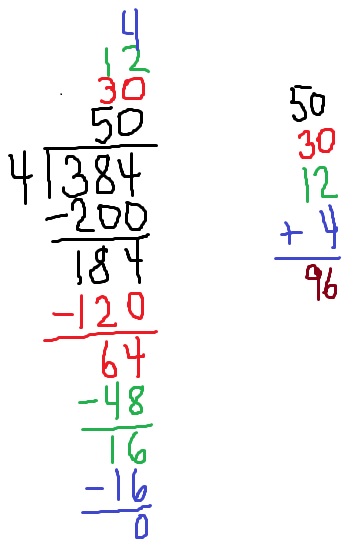
For 384 divided by 4, the best first step is subtracting 90 groups of 4 from 384, but she was having trouble immediately coming up with the largest multiple of 10 that would work. However, subtracting *any* multiple makes progress toward the solution, even if it isn’t necessarily the “best” step for solving the problem as fast as possible.

In those early stages of her learning, she computed 384 divided by 4 using suboptimal steps. I can’t remember exactly how she did it, but a reconstruction from memory is shown in the attached picture. She knew that 50 times 4 was less than 384, so it was “safe” to subtract 200. When she did this, I didn’t correct her by telling her that she should have subtracted 90 groups of 4. Instead, I let her make this step (emphasis, step — and not mistake) and let her proceed.

The step that always surprised me was when she’d occasionally subtract 12 groups of 4… she had memorized her multiplication table up to 12 and instinctively knew that subtracting 12 groups of 4 brought her closer to the correct answer than subtracting 10 groups of 4.

Obviously, as she got better at long division, she made fewer and fewer suboptimal steps when dividing. That’s the beauty of this unorthodox method… children don’t have to stress so much about making the best next move, as any next move will bring them closer to the answer. Hopefully, with practice, children get better at making the best moves quicker, but that’s a skill that they develop as they get used to long-division algorithm.
longdivision

Me: One more thought: (Anonymous #1), I’m sorry if I’ve completely commandeered your original post! 🙂

Anonymous #1: John you crack me up! I have never had such lengthy discussion about anything I have ever posted! I still have NO idea how to do all these extra steps-but I know who I will be asking for help when the time comes for me to deviate from my old school method of math!

Poorly worded homework problems

A personal pet peeve of mine are grade-school homework problems that are extremely poorly worded, thus leading to unnecessary confusion and bewilderment in students who (sadly) are already confused and bewildered more often than they (or we) would like. Here are two examples that I’ve seen recently.

(1) A worksheet gives the numbers 144 and 300 with the instructions “Find all of the ways to multiply to make each product. First, find the ways with two factors, and then find ways to multiply with more than two factors.”

The second half of the instructions can easily be interpreted by a child to mean “Find all of the ways to write 144 and 300 as a product with more than two factors.” This reading of the question (probably not intended by the author) will take even a gifted child a really, really long time to complete. Furthermore, I’m a professional mathematician, and even I have no idea off the top of my head if there’s an easy formula for the number of ways that a number can be expressed with an arbitrary number of factors greater than 1.

(2) A rocket blasts off. At 10.0 seconds after blast off, it is at 10,000 feet, traveling at 3600 mph. Assuming the direction is up, calculate the acceleration.

I assume that the author was trying to be cute by adding the “it is at 10,000 feet” part of the problem. Or the author wants the student to develop skill at weeding out unnecessary information (like the height) and identifying just the important information (the final velocity and the time) to calculate the quantity of interest.

But it’s aggravating that the information in the problem is not consistent, so there is no solution. In other words, it’s impossible for a rocket to travel with constant acceleration at travel 10000 feet at 3600 mph 10 seconds later.

To begin,

3600 \displaystyle \frac{\hbox{mile}}{\hbox{hour}} = 3600 \displaystyle \frac{\hbox{mile}}{\hbox{hour}} \times \displaystyle \frac{\hbox{5280 feet}}{\hbox{1 mile}} \times \displaystyle \frac{\hbox{1 hour}}{\hbox{3600 seconds}} = 5280\displaystyle \frac{\hbox{feet}}{\hbox{second}}.

Therefore, the (presumably constant) acceleration is

\displaystyle \frac{5280 \hbox{~feet/second}}{10 \hbox{~seconds}} = 528 \hbox{~feet/second}^2.

However, using calculus, we can compute the height of the rocket by integrating twice:

v(t) = \int 528 \, dt = 528t + v_0 = 528t

y(t) = \int 528t \, dt = 264t^2 + y_0 = 264t^2

Therefore, the height of the rocket after 10 seconds is y(10) = 26,400, not the 10,000 feet given in the problem.

An analysis of subtraction algorithms from the 18th and 19th centuries

Today I happily link to this wonderful article about how elementary school students “should” subtract two numbers, as it challenges the commonly held notion that there is only one way that subtraction should be implemented.

The common algorithm taught in schools today is the Decomposition Algorithm.

http://www.youtube.com/watch?v=3itmfsP6HoM

But there’s also the Equal Additions Algorithm.

http://www.youtube.com/watch?v=AN8XN_MSucI

And the Complement Algorithm.

http://www.youtube.com/watch?v=krNVuaIwi-o

And the Austrian Algorithm.

The author concludes:

The teaching and learning of subtraction is just as important today as it was in the past. Innovations in technology and mathematics curriculum have certainly occurred since the 1700s and 1800s, but the need for the teaching and learning of subtraction has not changed. Today, in many classrooms, subtraction is often taught through student-invented algorithms. Looking to the past may give teachers insight into invented algorithms or other algorithms students may use. Additionally, many teachers who do not encourage students to invent strategies teach only the “standard subtraction algorithm” presented in nearly every textbook across the United States, the decomposition algorithm. This research and analysis provides the modern teacher with an opportunity to reflect on the algorithms being taught in his or her classroom and allows the teacher to begin to think about why decomposition became the dominant algorithm in the United States. Teachers can ask their students to reflect on whether they agree with this historical turn of events. Incorporating the history of subtraction algorithms into modern elementary school mathematics invites robust mathematical discussion of subtraction and also of how, for many mathematical operations, there isn’t just one algorithm, but rather many algorithms from which to choose.

Exploring the history of subtraction in past school mathematics may provide us with insight into students’ mathematical struggles as they attempt to conceptualize not only subtraction, but also negative numbers and other notoriously challenging mathematical concepts. As educators and researchers, we need to devote more attention to issues in mathematics education such as the development of specific algorithms in elementary mathematics.

Coin problems

Here’s a problem that a friend posed to me a while ago. Apparently this is called the Coin Problem, but I’d never heard of it before.

McNuggets used to come in boxes of 6, 9, or 20. Given that scheme, what is the largest number of nuggets that cannot be ordered exactly?

Here’s a similar problem:

In American football, teams can score points in increments of 3 (field goal) and 7 (touchdown plus extra point). What is the largest number that can’t be a valid football score? (I’ve ignored other possible ways of scoring — 2-point safeties, 6-point touchdowns without the extra point, 8-point touchdowns with a two-point conversion — because the problem is utterly trivial with these extra options.)

I’m not going to give the answers (if you want to cheat, see the above link), but I suggest questions like these as a way of engaging elementary-school students (who have mastered addition and multiplication) with a non-traditional math question.

A Review of WuzzitTrouble: an app for math education

0

Most apps and computer games that claim to assist with the development of mathematical knowledge only focus on rote memorization. There’s certainly a place for rote memorization, but I’ve been very disappointed with the paucity of games that encourage mathematical creativity beyond, say, immediate recall of the times tables.

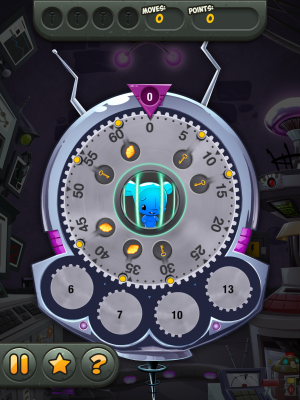
Enter WuzzitTrouble, a new app that was developed by Keith Devlin, a professor of mathematics at Stanford and one of the great popularizers of mathematics today. An introduction to WuzzitTrouble can be seen in this promotional video:

One minor complaint about WuzzitTrouble is that the first few levels are so easy that it’s easy for children to low-ball the game… in much the same way that the first few levels of Angry Birds are utterly easy. (My other complaints is that the game only assume one user, so that a parent can’t play the game without affecting a child’s settings.) However, the level of difficulty does eventually increase. Here’s another promotional video showing how to solve Level 1-25:

Here’s a sampling of some of the higher levels. Remember that the wheel has 65 steps along the circumference, as shown in the above picture and videos.

  • Level 2-5: Using cog wheels of size 5 and 9, pick up keys at 23 and 36 and prizes at 27, 45, and 55.
  • Level 2-15: Using cog wheels of size 5, 7, and 9, pick up keys at 11, 16, and 21 and prizes at 32 and 42.
  • Level 2-25: Using cog wheels of size 5, 9, and 16, pick up keys at 24, 48, and 59; prizes at 11 and 37; and avoid a penalty at 64.
  • Level 3-3: Using cog wheels of size 3, 4, and 5, pick up keys at 7, 17, and 27 and prizes at 12 and 22.

In the words of their promotional materials:

At InnerTube Games, we set out to design and build mobile casual video games and puzzles that can attract and engage a large number of players, yet are built on fundamental mathematical concepts and embed sound mathematics learning principles.

We start with one simple, yet powerful observation. A musical instrument won’t teach you about music. But when you pick up an instrument and start playing – badly at first – you cannot fail to learn about music. And the more you play, the more you learn. In fact, using that one instrument, you can go all the way from stumbling beginner to virtuoso concert performances. It’s the music that changes, not the instrument. In modern parlance, the instrument is a platform. And (well designed) platforms are good for learning because they make the learning meaningful and put the learner in charge.

InnerTube Games does not build video games to “teach mathematics.” Rather, we build instruments which you can play, and we design them so that when you play them, you cannot fail to learn about mathematics. Moreover, each single game can be used to deliver mathematical challenges of increasing sophistication.

Our vision for learning design is to build the game around core mathematical concepts and practice so it looks and plays like the familiar casual games on the market. As a result, you won’t be able to see the difference by playing the first few levels, or by watching someone else play. It’s the educational power under the hood that makes our games different.

We’re not making a secret of the fact that our games are math-based. It’s not “stealth learning;” it’s a form of learning through action that the brain finds natural, having much in common with what educational researchers call embodied learning.

Wuzzit Trouble is our first puzzle to reach the market. It is built around the important mathematical concepts of integer partitions–the expression of a whole number as a sum of other whole numbers–and Diophantine equations. At the easiest levels of the puzzle, these provide engaging practice in basic arithmetic, leading to arithmetical fluency.

But that’s just the start. Integer partitions and Diophantine equations are major areas of mathematics, still being worked on today by leading mathematicians.

Freeing the Wuzzits won’t take you into those dizzy realms—at least in the initial release, which comes loaded with puzzles aimed at the Elementary and Middle School levels. But as you progress, you will face challenges that increasingly require higher-order arithmetical thinking, algebraic thinking, strategy design and modification, optimization, and algorithm design, all crucial abilities in today’s world. Getting three stars can require considerable ingenuity.

As you attempt to free each Wuzzit and maximize your score, you will be developing and applying valuable conceptual, analytic thinking skills that sharpen your mind—all without lifting pencil to paper.

As educators and former educators, all of us at InnerTube are very aware of the importance of learners meeting agreed standards. In its initial release version Wuzzit Trouble provides natural learning in the following areas of the US Common Core Curriculum:

  • *Grade 2, Operations & Algebraic Thinking #2
  • *Grade 2, Number & Operations in Base Ten #2, #8
  • *Grade 3, Operations & Algebraic Thinking #1, #4
  • *Grade 4, Operations & Algebraic Thinking #5
  • *Grade 6, Number System #5, #6

But we don’t want anyone to play our game purely to hit those Common Core markers. We want you to play it because it’s fun and challenging. Improvement in those CC areas comes automatically. Just like learning music by playing a musical instrument!

The analogy that I prefer is playing basketball. When young children are first learning to play basketball, there’s a place for learning how to dribble, how to pass, how to shoot free throws, etc. (These are analogous to learning how to add, subtract, multiply, and divide.) But children don’t just learn skills: they also go out and play. That’s where the WuzzitTrouble app fits in: it offers children a chance to just play with mathematics and enjoy it.

More references:

http://profkeithdevlin.org/2013/09/03/the-wuzzits-free-at-last/

Review: Wuzzit Trouble

Finger trick for multiplying by 9

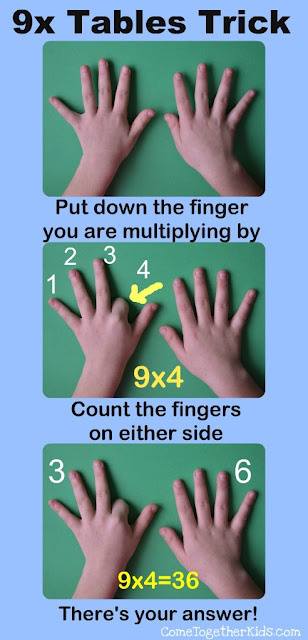
I’m constantly amazed at the number of college students who, through no fault of their own, simply were never taught this simple trick for multiplying by 9 when they were kids.

9x Tables TrickWhy does this trick work? In the picture, if the left pinkie is brought down, there are nine fingers to the right that are up (corresponding to 9 \times 1). If the second finger is lowered and the first is raised, that’s equivalent to adding 10 (since there’s one additional finger in the “tens” part) and subtracting one (since there’s one less finger in the “ones” part). In other words, changing the lowered finger by one digit (pardon the pun) is like successively adding 9, and successively adding 9 is the same as multiplying by 9.

Checking if a number is a multiple of 7

I just read a couple of nice tricks for checking if a number is divisible by 7. There are standard divisibility tests for 2, 3, 4, 5, 6, 8, 9, 10, 11, and 12, but checking a number is divisible by 7 is somewhat more difficult. But these two tricks make the task more manageable. The proofs for these tricks can be found in the given links.

Method #1, from http://www.arscalcula.com/mental_math_divisibility_tests.shtml: Add multiples of 7 to get a multiple of 10, and then lop off the 0.

Here’s how it goes: You want to see whether, say, 11352 is divisible by 7 . To do this, first you either add or subtract a mutiple of 7 until you get a number ending in 0 . So in the case of 11352 , I would add 28 to get 11380 .

Now whack off the last zero, and repeat! So 11380 goes to 1138 . From that I subtract 28 to get 1110 , which goes to 111 . To that I add 49 to get 160 , which goes to 16 .Finally: 16 is not divisible by 7 and thus (this is the statement of the test), neither is 11352.

Method #2, from http://www.arscalcula.com/mental_math_divisibility.shtml: Separate the number into two parts: the ones digit, and everything else but the ones digit. Multiply the ones digit by 5, and add to the the second number.

It’s hard to understand what this means without seeing an example. Let n=434. Then 5 \cdot 4+43=63 . Since 63 is divisible by 7 , so is 434.