
I’m late in sharing this, but this is a good challenge.
Category: Elementary
Collaborative Mathematics: Challenge 10, Part 1
I’m a little late in sharing this, but this is a nice puzzle:
Vans
Whenever I see this logo, I feel compelled to find the answer by squaring.
 (Shamelessly stolen from a friend.)
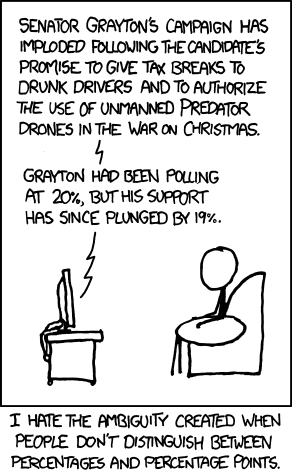
Percentage points
Opting Out of High-Stakes Assessments
In response to the growing movement of parents who have opted out of high-stakes testing, Michelle Rhee wrote a defense of the (commercial) enterprise in the Washington Post. This op-ed piece was brilliantly deconstructed, point by point, at http://curmudgucation.blogspot.com/2014/04/wapo-wastes-space-on-that-woman.html. I encourage you to read the whole thing. A few excerpts:
[Michelle Rhee]: No, tests are not fun — but they’re necessary. Stepping on the bathroom scale can be nerve-racking, but it tells us if that exercise routine is working. Going to the dentist for a checkup every six months might be unpleasant, but it lets us know if there are cavities to address. In education, tests provide an objective measurement of how students are progressing — information that’s critical to improving public schools.
Except that the current crop of Standardized Tests are not like stepping on a scale or going to the dentist. They are like trying to find out a child’s weight by waterboarding him. They are like having your teeth checked by a blind blacksmith. Because, in education, tests NEVER provide an objective measure of anything, because tests are made by people. Yes, tests are useful– but only good tests. And do you know what good tests are useful for? They are useful for providing information critical to helping further the education of students.
I am not a Systems True Devotee. STDs believe that we just have to create a well-oiled precision machine and it will spit out Smarterer Student Products like toasters off an assembly line. I would stop to further develop the point, but we’re only one paragraph in. These woods are dark and deep, but we have miles to go.
From this diving board, That Woman proceeds to register her stunned amazement that in various places, there’s a movement that is convincing parents to pull kids out of these tests! Really!!! These marvelous tests that will tell us how schools are doing!! What in the name of God are they thinking!?!?!!?
[Michelle Rhee:] This makes no sense. All parents want to know how their children are progressing and how good the teachers are in the classroom. Good educators also want an assessment of how well they are serving students, because they want kids to have the skills and knowledge to succeed.
Allow to help you comprehend this, O She. You are correct that parents and educators do want to know these things. Your mistake is in believing that they can only know this by looking at standardized test results.
Yes, the Great and Powerful Woman Who No Longer Has a Curtain To Hide Behind imagines a world where parents sit at home after eight months of school, wringing their hands and saying, “Oh, jehosephat, I wish we knew how Janey was doing in school. But we have no idea.” Meanwhile, at school, teachers sit and the lounge and say, “Yeah, I’ve been with this kid for eight months but I just don’t know how he’s doing. Thank God we’re going to be giving a high stakes high pressure badly written unproven standardized test soon so that I’ll know how it’s going.”
In That Woman’s universe, parents and teachers (sorry– public school parents and teachers) are dumber than dirt. In fact, the list of People Standing in the Way of Educational Excellence gets longer and longer. Parents, teachers, democratically elected school boards– reformy fans have an enemies list that keeps lengthening.
[Michelle Rhee:] We don’t need to opt out of standardized tests; we need better and more rigorous standardized tests in public schools.
Yes!! When you’re doing something stupid and bad and non-productive, do it More Harder!!
[Michelle Rhee:] We also shouldn’t accept the false argument that testing restricts educators too much, stifles innovation in the classroom or takes the joy out of teaching. That line of thought assumes that the test is the be-all and end-all — and if that’s the perspective, the joy is already long gone.Here’s a multiple choice test for you, dear, exhausted reader. Select which statement best reflects the meaning of the above excerpt:
1) Do not assume that the test is the be-all and end-all. It will just be-all the way we decide to end-all teaching careers, school existence, and student futures.
2) You cannot claim that this year’s testing is sucking up all the joy of teaching, because we actually drained that lake long ago and killed the fish flopping in the mud with fire and big pointy sticks.
Common Core, subtraction, and the open number line: Part 4
The following picture has been making the rounds lately.

My bedrock position is simply stated: I’m for teaching any technique in elementary school that’s (1) logically correct, whether or not it’s the way it’s (mythically) “always been taught,” (2) encourages students to think mathematically, as opposed to mindlessly following a procedure with no real conceptual understanding, and (3) prepares students for algebra in a few years’ time.
That said, I have a lot of opinions about this picture, which does not necessarily align with our society’s impatient obsession with 10-second sound bites and 140-character tweets. So be it. I will divide my opinions into several categories of increasing scope.
- The solution of this particular question.
- The pedagogical reasons for using this technique (called an open number line). In other words, do we only want Jack to get the right answer, or do we want Jack to understand something about the logic behind the answer?
- The difficulty of assessing the depth of a student’s knowledge in a way that is developmentally appropriate.
- The importance of engaging parents with unorthodox ways of teaching mathematics.
Some of my opinions will line up nicely with supporters of the Common Core. Other opinions will align with the Common Core’s thoughtful critics.

This is Part 4 of this series of posts: the importance of engaging parents and caregivers when unorthodox techniques of mathematics are taught.
I’ve only witnessed the implementation of the Common Core from afar, but there’s absolutely no doubt that the professional development of teachers who have been asked to teach math in a new way has left a lot to be desired. Ditto for explaining these new approaches to parents and caregivers who want to help their children.
True story: I personally did not know about the open number line until the “Meet the Teachers” night that was held for parents near the start of the school year. The teachers explained that they would be doing math a little differently and did a couple of examples using the open number line. I could feel many eyes in the room looking back at me (people know I’m a math professor) with facial expressions saying “Is this stuff really going to work for our kids?”
As this was my first exposure to the open number line, I was skeptical (I would have preferred using base-10 kits) but I held my tongue and listened carefully to the presentation. After the presentation, I was convinced that this was a completely legitimate way of teaching the subject and that the teachers had the requisite depth of understanding to teach arithmetic using this technique. After the presentation, I told anyone who’d listen that this technique was mathematically sound and pedagogically sound, even if it was different than the way that “it’s always been taught.”
Parents generally bought into the technique that evening. I’m not sure that they would have bought into it if its rationale had not been carefully explained to them.
And, as a reminder, Texas is not a Common Core state.
The failure to explain to parents and caregivers unorthodox but correct ways of teaching mathematics has been perhaps the greatest failure of the roll-out of the Common Core. It’s unacceptable that children are crying over their math homework and parents feel powerless to help (a common theme that I’ve heard over and over again from my friends).
Teachers and parents ought to be natural allies in wanting children to have a greater depth of understanding of arithmetic that will prepare them for algebra later. However, because the strategies of teaching the “why”s of mathematics have generally not been carefully explained to parents, they naturally feel somewhat helpless when trying to help their children with their homework.
My own field of research is not mathematics education. So, at professional conferences, I’ve asked friends and colleagues the same question over the years:
Letting children use their own natural curiosity to get at they “why”s of mathematics is good. Letting children use their own natural curiosity and also having the support of parents at home is better. So what research has been done on strategies on successfully engaging parents with how mathematics is currently taught versus how it was taught a generation ago (or, more accurately, what parents remember of their own experiences from elementary school)?
To my surprise, people that I greatly respect did not have an immediate answer to my question. So I’m guessing that while there’s been a lot of research into successful strategies for teaching mathematics in the classroom, there hasn’t been a lot of research into how these strategies can be supported when children are away from the classroom and asking their parents for help on their homework.
I’ll repeat the close of yesterday’s post: I won’t defend the indefensible way that the Common Core has been rolled out. Voters will be more than justified in voting out anyone who supports the Common Core if its implementation isn’t fixed in the very near future.
Common Core, subtraction, and the open number line: Part 3
The following picture has been making the rounds lately.
My bedrock position is simply stated: I’m for teaching any technique in elementary school that’s (1) logically correct, whether or not it’s the way it’s (mythically) “always been taught,” (2) encourages students to think mathematically, as opposed to mindlessly following a procedure with no real conceptual understanding, and (3) prepares students for algebra in a few years’ time.
That said, I have a lot of opinions about this picture, which does not necessarily align with our society’s impatient obsession with 10-second sound bites and 140-character tweets. So be it. I will divide my opinions into several categories of increasing scope.
- The solution of this particular question.
- The pedagogical reasons for using this technique (called an open number line). In other words, do we only want Jack to get the right answer, or do we want Jack to understand something about the logic behind the answer?
- The difficulty of assessing the depth of a student’s knowledge in a way that is developmentally appropriate.
- The importance of engaging parents with unorthodox ways of teaching mathematics.
Some of my opinions will line up nicely with supporters of the Common Core. Other opinions will align with the Common Core’s thoughtful critics.
This is Part 3 of this series of posts: assessing the depth of a student’s knowledge of mathematics in ways that are developmentally appropriate. To be blunt, this has been one of the great weaknesses of the roll-out of the Common Core in the early years of its implementation.
Where I agree with most critics of the Common Core is that, even though I want students to understand why (for instance) subtraction works, 2nd and 3rd graders are still learning how to write complete sentences. So of course they will get easily frustrated with explaining their reasoning in paragraph form. I think there are better ways of assessing whether young children really understand subtraction that is more developmentally appropriate. (Here in Texas, students in this age group are instead asked to explain their reasoning by drawing pictures.)
I’m happy to defend the standards of the Common Core themselves, but it’s patently obvious that the implementation of the Common Core standards were driven by textbook publishers and not educators. I don’t doubt that much of what’s assigned for homework under the guise of the Common Core is developmentally inappropriate.
I’m perfectly happen to defend the logic behind a specific pedagogical technique like the open number line. But I can still be genuinely annoyed that the first years of the Common Core has been so badly botched. And I’m especially annoyed that most public defenders of the Common Core seem deaf to the legitimate and thoughtful complaints of its critics (as opposed to the braying expressed in the original picture).
Here’s another example that made the rounds in recent months, for which I have a considerable amount of sympathy.
The problem in question that forms the basis of her argument:
Mr. Yumata’s class has 18 students. If the class counts around by a number and ends with 90, what number did they count by?
The “correct” answer requires students to divide 90 tick marks into equal groups of 18, counting the number of tick marks in each group. Again, the textbook publisher missed the mark. The phrasing of the problem asks for just the answer (5). If the problem wants to know a rationale for the answer, then it should have been phrased in a different way.
There absolutely is a place in the curriculum for the method described in the video — dividing 


Flatly, I won’t defend the indefensible way that the Common Core has been rolled out. The textbook publishers have clearly missed the mark on how to assess the depth of a student’s knowledge. Voters will be more than justified in voting out anyone who supports the Common Core if its implementation isn’t fixed in the very near future.
Common Core, subtraction, and the open number line: Part 2
The following picture has been making the rounds lately.
My bedrock position is simply stated: I’m for teaching any technique in elementary school that’s (1) logically correct, whether or not it’s the way it’s (mythically) “always been taught,” (2) encourages students to think mathematically, as opposed to mindlessly following a procedure with no real conceptual understanding, and (3) prepares students for algebra in a few years’ time.
That said, I have a lot of opinions about this picture, which does not necessarily align with our society’s impatient obsession with 10-second sound bites and 140-character tweets. So be it. I will divide my opinions into several categories of increasing scope.
- The solution of this particular question.
- The pedagogical reasons for using this technique (called an open number line). In other words, do we only want Jack to get the right answer, or do we want Jack to understand something about the logic behind the answer?
- The difficulty of assessing the depth of a student’s knowledge in a way that is developmentally appropriate.
- The importance of engaging parents with unorthodox ways of teaching mathematics.
Some of my opinions will line up nicely with supporters of the Common Core. Other opinions will align with the Common Core’s thoughtful critics.
This is Part 2 of this series of posts: the pedagogical reasons for using an open number line.
I firmly reject the premise, implied by the picture, that the only goal of teaching mathematics is just getting the right answer. If that’s the goal, then we can eliminate much of the K-5 curriculum by handing out 19-cent solar calculators to every student. That will pretty much guarantee that the students will solve elementary arithmetic problems like the one shown. It will also fail to develop their higher-order reasoning skills and leave them hopelessly unprepared for algebra.
A great example of a teacher using children’s natural curiosity to foster mathematical thinking can be seen in this video: https://www.teachingchannel.org/videos/common-core-teaching-division.
I absolutely agree with Common Core critics that students in elementary school should, at the end of the day, be able to quickly compute 427-316 using the standard algorithm in 5 seconds or less. I would also argue that it’s also important for students to learn why is algorithm works and not just how to use the algorithm. This deeper level of conceptual understanding begins to lay the foundation for the more abstract thinking required in later years.
The open number line predates the Common Core by about 25 years; for more information, see http://www.k-5mathteachingresources.com/empty-number-line.html. When used properly (a big “if”), it will lead students to the standard algorithms for addition and subtraction. I’ve personally seen the open number line successfully used in the elementary schools where I live in the hands of skilled teachers. Bottom line: the students had no problem with the technique. (By the way, Texas is not a Common Core state.)
So I take great issue with the quote “The process used is ridiculous and would result in termination if used.” Of course the process is ridiculous for people who already know how to subtract. For students who are first learning how to subtract multi-digit numbers, however, it is a completely appropriate way to introduce students to the topic which will lead them to the standard algorithm for subtraction. Once learned, then there will be no need to revert back to the previous method.
I have heard some critics say that teaching the “why”s of mathematics, using the open number line and other techniques, merely favors the stronger math students and the expense of the weaker students. Perhaps this happens in some classrooms. However, this has not been my personal experience. I have supervisory authority over aspiring teachers who have taught math to literally thousands of third, fourth, and fifth graders — all in a non-Common Core state. With careful supervision, they have used the children’s natural curiosity and inductive reasoning (but not deductive logic — that’s an important distinction) to get at the “why”s of mathematics as well as the “how”s. And I’ve not personally witnessed anything like the frustrations that I’ve heard as the Common Core has been implemented. Hence my “don’t throw out the baby with the bathwater” approach when I hear and appreciate legitimate concerns and frustrations with how the Common Core has been rolled out.
One more thing: a great motivation of the Common Core has been to improve student achievement in algebra by fostering mathematical habits of thinking in the lower grade levels. It’s certainly debatable about whether or not this ideal has been achieved. But the motivation for the Common Core and improving conceptual understanding at the lower grade levels is to increase access to higher-level mathematics, not to favor the high achievers.
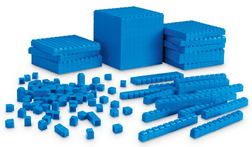
Though I’ve seen it used effectively, I’m personally not an advocate for the open number line. Given the choice, I would use a base-10 kit (shown above) for students who are first learning subtraction. I would start by collecting 4 plates of 100, 2 rods of 10, and 7 cubes of 1. I would then remove 3 plates of 100, 1 rod of 10, and 6 cubes of 1. The remaining pieces (1 plate of 100, 1 rod of 10, 1 cube of 1) represents the answer of 111.(This particular problem didn’t require trading a plate of 100 for 10 rods of 10 or else a rod of 10 for 10 cubes of 1; this would be handled later in the curriculum.)
I do recognize that teaching children multiplication and especially division with a base-10 kit is very cumbersome and is significantly easier using an open number line. So I see the rationale for using an open number line for addition and subtraction if it will be used in later years to teach multiplication and division.
I don’t support requiring children to learn subtraction or any other concept in mathematics by any one specific technique. The big issues are (1) getting the right answer and, of equal importance, (2) understanding why the answer works. I take issue with the original picture because it favors (1) but not also (2), and a surface level of understanding will not serve students well when they hit algebra.
Bottom line: I have absolutely no problem with schools using a technique like the open number line, as it is a mathematically correct way of explaining to students why the answer works.
Common Core, subtraction, and the open number line: Part 1
The following picture has been making the rounds lately.
My bedrock position is simply stated: I’m for teaching any technique in elementary school that’s (1) logically correct, whether or not it’s the way it’s (mythically) “always been taught,” (2) encourages students to think mathematically, as opposed to mindlessly following a procedure with no real conceptual understanding, and (3) prepares students for algebra in a few years’ time.
That said, I have a lot of opinions about this picture, which does not necessarily align with our society’s impatient obsession with 10-second sound bites and 140-character tweets. So be it. I will divide my opinions into several categories of increasing scope.
- The solution of this particular question.
- The pedagogical reasons for using this technique (called an open number line). In other words, do we only want Jack to get the right answer, or do we want Jack to understand something about the logic behind the answer?
- The difficulty of assessing the depth of a student’s knowledge in a way that is developmentally appropriate.
- The importance of engaging parents with unorthodox ways of teaching mathematics.
Some of my opinions will line up nicely with supporters of the Common Core. Other opinions will align with the Common Core’s thoughtful critics.
This is Part 1 of this series of posts: the solution of this particular question. Here it is:
Jack correctly started at 427 on the number line. He then correctly understood that 316 consists of 3 groups of 100, 1 group of 10, and 6 groups of 1. He then correctly subtracted 3 groups of 100 (for an interim answer of 127) and then correctly subtracted 6. However, he forgot to subtract 10. That’s why he got a wrong answer (121) that was 10 more than the correct answer (111).
Just to make sure I wasn’t completely missing the mark on this, I rewrote the problem (without the handwritten commentary) and showed it individually to a few elementary school students. They all saw Jack’s mistake within 15 seconds. They may not have been able to explain what Jack did right and what Jack did wrong in the form of a letter (more on that in a later post), but they certainly identified the core problem quickly.
I understand a parent’s frustration with knowing how to subtraction but seeing a child learning subtraction in a different way. (More on that in a later post). I also understand that some may argue with this technique of teaching children how to subtract. (More on that in a later post.) But there’s no way to sugarcoat this: an engineer who took differential equations and read this problem but couldn’t figure out that Jack forgot to subtract by 10 has little conceptual understanding of mathematics.
So let offer some free advice to critics of the Common Core who want to share this picture to vent their complaints. I am totally sympathetic with frustrations expressed in this picture. Sharing this picture with your fellow critics may feel good, perhaps with the self-justification “If an engineer can’t figure this stuff out, then how can I?!?!” However, sharing this picture is not going to persuade anyone who disagrees with you to your cause. Remember: some children can solve this problem in 15 seconds or less. If anything, sharing this picture only communicates to those who disagree with you that the critics of the Common Core are the people who have little conceptual understanding of elementary school mathematics. Once again, I am sympathetic to the emotions expressed in this picture, but there are better ways of criticizing the Common Core and persuading its unabashed supporters to your cause.
In the posts that follow, I will provide plenty of criticism of how the Common Core has been implemented in its initial years.
New Math, by Tom Lehrer
To add a little levity to the recent posts about the Common Core, here’s the song “New Math” by Tom Lehrer that poked fun at the New Math curriculum of the 1960s.
For some context, here’s a succinct summary of the new math fad by Richard Feynman, who won the Nobel Prize in Physics and served on a commission for choosing math textbooks for California in 1964:
I understood what they were trying to do. Many [Americans] thought we were behind the Russians after Sputnik, and some mathematicians were asked to give advice on how to teach math by using some of the rather interesting modern concepts of mathematics. The purpose was to enhance mathematics for the children who found it dull.
I’ll give you an example: They would talk about different bases of numbers — five, six, and so on — to show the possibilities. That would be interesting for a kid who could understand base ten — something to entertain his mind. But what they turned it into, in these books, was that every child had to learn another base! And then the usual horror would come: “Translate these numbers, which are written in base seven, to base five.” Translating from one base to another is an utterly useless thing. If you can do it, maybe it’s entertaining; if you can’t do it, forget it. There’s no point to it.
From the chapter “Judging Books by their Covers” in Surely You’re Joking, Mr. Feynman!
 Mean Green Math