Texans QB Ryan Fitzpatrick’s Son Shows Off Math Skills During Postgame Press Conference (Part 2)

From Bleacher Report:

Houston Texans quarterback Ryan Fitzpatrick… threw for 358 yards and six touchdowns in a 45-21 victory over the Tennessee Titans on Sunday [November 30, 2014]. However, [his son] Brady was the star of the postgame press conference.

Fitzpatrick put his son on the spot at the end of the press conference. In a matter of seconds, Brady was able to multiply 93 by 97 in his head.

Source: http://bleacherreport.com/articles/2284833-texans-qb-ryan-fitzpatricks-son-shows-off-math-skills-during-postgame-presser

After the thought bubble, I’ll reveal the likely way that young Brady did this.

green_speech_bubble

Here’s a trick for multiplying two numbers in their 90s which is accessible to bright elementary-school students. We begin by multiplying out (100-x)(100-y):

(100-x)(100-y) = 10,000 - 100x - 100y + xy

(100-100y) = 100(100 - [x+y]) + xy

For 93 \times 97, we have x = 7 and y = 3. So x+y = 10, and 100 - [x+y] = 90. So the first two digits of the product is 90.

Also, xy = 21. So the last two digits are 21.

Put them together, and we get the product $100 \times 90 + 21 = 9021$.

I don’t expect that young Brady knew all of this algebra, but I expect that he did the above mental arithmetic to put together the product. Well done, young man.

Texans QB Ryan Fitzpatrick’s Son Shows Off Math Skills During Postgame Press Conference (Part 1)

From Bleacher Report:

Houston Texans quarterback Ryan Fitzpatrick… threw for 358 yards and six touchdowns in a 45-21 victory over the Tennessee Titans on Sunday [November 30, 2014]. However, [his son] Brady was the star of the postgame press conference.

Fitzpatrick put his son on the spot at the end of the press conference. In a matter of seconds, Brady was able to multiply 93 by 97 in his head.

Source: http://bleacherreport.com/articles/2284833-texans-qb-ryan-fitzpatricks-son-shows-off-math-skills-during-postgame-presser

I’ll reveal the (likely) way that young Brady Fitzpatrick pulled this off tomorrow. In the meantime, I’ll leave a thought bubble if you’d like to try to figure it out on your own.

green_speech_bubble

Arithmetic with big numbers (Part 3)

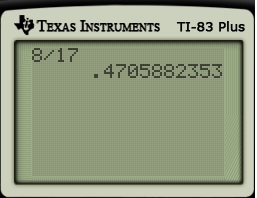
In the previous two posts, we considered the use of base-10^n arithmetic so that a calculator can solve addition and multiplication problems that it ordinarily could not handle. Today, we turn to division. Let’s now consider the decimal representation of \displaystyle \frac{8}{17}.

TI817

There’s no obvious repeating pattern. But we know that, since 17 has neither 2 nor 5 as a factor, that there has to be a repeating decimal pattern.

So… what is it?

When I ask this question to my students, I can see their stomachs churning a slow dance of death. They figure that the calculator didn’t give the answer, and so they have to settle for long division by hand.

That’s partially correct.

However, using the ideas presented below, we can perform the long division extracting multiple digits at once. Through clever use of the calculator, we can quickly obtain the full decimal representation even though the calculator can only give ten digits at a time.

green line

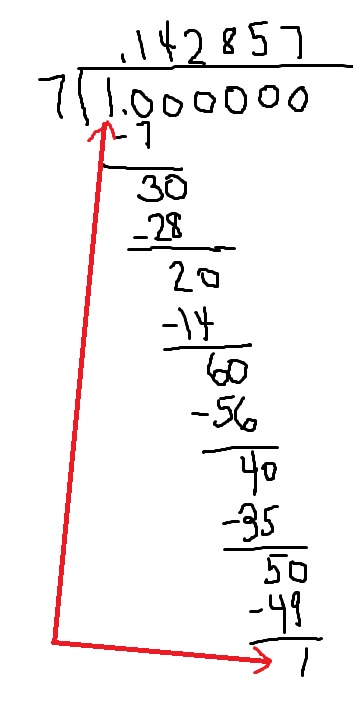
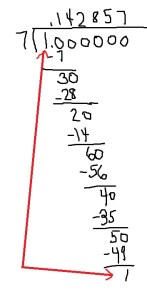
Let’s now return to where this series began… the decimal representation of \displaystyle \frac{1}{7} using long division. As shown below, the repeating block has length 6, which can be found in a few minutes with enough patience. By the end of this post, we’ll consider a modification of ordinary long division that facilitates the computation of really long repeating blocks.
longdivision17

Because we arrived at a repeated remainder, we know that we have found the repeating block. So we can conclude that \displaystyle \frac{1}{7} = 0.\overline{142857}.

Students are taught long division in elementary school and are so familiar with the procedure that not much thought is given to the logic behind the procedure. The underlying theorem behind long division is typically called the division algorithm. From Wikipedia:

Given two integers a and b, with b \ne 0, there exist unique integers q and r such that a = bq+r and $0 \le r < |b|$,  where |b| denotes the absolute value of b.

The number q is typically called the quotient, while the number r is called the remainder.

Repeated application of this theorem is the basis for long division. For the example above:

Step 1.

10 = 1 \times 7 + 3. Dividing by 10, 1 = 0.1 \times 7 + 0.3

Step 2.

30 = 4 \times 7 + 2. Dividing by 100, 0.3 = 0.04 \times 7 + 0.02

Returning to the end of Step 1, we see that

1 = 0.1 \times 7 + 0.3 = 0.1 \times 7 + 0.04 \times 7 + 0.02 = 0.14 \times 7 + 0.02

Step 3.

20 = 2 \times 7 + 6. Dividing by 1000, 0.02 = 0.002 \times 7 + 0.006

Returning to the end of Step 2, we see that

1 = 0.14 \times 7 + 0.02 = 0.14 \times 7 + 0.0002 \times 7 + 0.006 = 0.142 \times 7 + 0.006

And so on.

green line

By adding an extra zero and using the division algorithm, the digits in the decimal representation are found one at a time. That said, it is possible (with a calculator) to find multiple digits in a single step by adding extra zeroes. For example:

Alternate Step 1.

1000 = 142 \times 7 + 6. Dividing by 1000, 1 = 0.142 \times 7 + 0.006

Alternate Step 2.

6000 = 587 \times 7 + 1. Dividing by 100000, 0.006 = 0.000587 \times 7 + 0.000001

Returning to the end of Alternate Step 1, we see that

1 = 0.142 \times 7 + 0.006= 0.142 \times 7 + 0.000587\times 7 + 0.000001 = 0.142857 \times 7 + 0.000001

So, with these two alternate steps, we arrive at a remainder of 1 and have found the length of the repeating block.

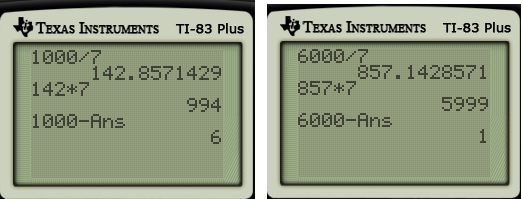
The big catch is that, if a = 1000 or a = 6000 and b = 7, the appropriate values of q and r have to be found. This can be facilitated with a calculator. The integer part of 1000/7 and 6000/7 are the two quotients needed above, and subtraction is used to find the remainders (which must be less than 7, of course).

TI17

At first blush, it seems silly to use a calculator to find these values of q and r when a calculator could have been used to just find the decimal representation of 1/7 in the first place. However, the advantage of this method becomes clear when we consider fractions who repeating blocks are longer than 10 digits.

green lineLet’s now return to the question posed at the top of this post: finding the decimal representation of \displaystyle \frac{8}{17}. As noted in Part 6 of this series, the length of the repeating block must be a factor of \phi(17), where \phi is the Euler toitent function, or the number of integers less than 17 that are relatively prime with 17. Since 17 is prime, we clearly see that \phi(17) = 16. So we can conclude that the length of the repeating block is a factor of 16, or either 1, 2, 4, 8, or 16.

Here’s the result of the calculator again:

TI817

We clearly see from the calculator that the repeating block doesn’t have a length less than or equal to 8. By process of elimination, the repeating block must have a length of 16 digits.

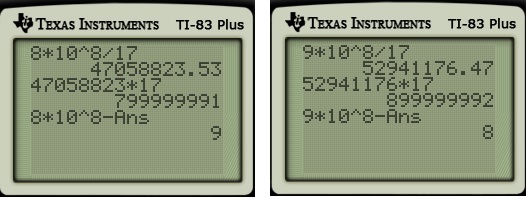
Now we perform the division algorithm to obtain these digits, as before. This can be done in two steps by multiplying by 10^8 = 100,000,000.

TI817b

So, by the same logic used above, we can conclude that

\displaystyle \frac{8}{17} = 0.\overline{4705882352941176}

In other words, through clever use of the calculator, the full decimal representation can be quickly found even if the calculator itself returns only ten digits at a time… and had rounded the final 2941176 of the repeating block up to 3.

(Note: While this post continues exploring the unorthodox use of a calculator to handle arithmetic problems, it also appeared in a previous series on the decimal expansions of rational numbers.)


Arithmetic with big numbers (Part 2)

Ready for an elementary arithmetic problem? Here it is:

bigmult1

Nothing to it… just multiply the two numbers. Of course, we’d rather not multiply them by hand, so let’s use a calculator instead:

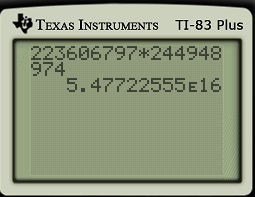
bigmult2

Uh oh… the calculator doesn’t give the complete answer. It does return the first nine significant digits, but it doesn’t return all 16 digits. Indeed, we can’t be sure that the final 5 in the answer is correct because of rounding.

So now what we do (other than buy a more expensive calculator)?

In yesterday’s post, I posed a similar problem involving addition. Adding two big numbers by hand is no big deal. However, multiplying two big numbers, one digit at time, would be tedious!

When I pose this question to students, the knee-jerk reaction is to groan when facing the prospect of multiplying these two big numbers by hand. However, it is possible to use modern technology to make ordinary grade-school multiplication move a lot quicker. Perhaps the fastest way to do this is to split the numbers into block of five digits instead of the usual three:bigmult3

Now we proceed as if each block of five digits was a single digit. We begin with the last block of digits on the second row, which is 48974. First, we multiply 6797 and 48974 using a calculator. Because most modern scientific calculators have a 10-digit display, we can be assured that the complete answer will be shown. (This is why I chose to divide the numbers using block of five digits and not six or more.) The last five digits in the answer are written down; the more significant digits are carried.

Next, we multiply 2236 and 48974 and then add the number that was carried.

bigmult4We then repeat using 2449, the next (and final) block of digits on the second row. First, we multiply 6797 and 2449 using a calculator. The last five digits in the answer are written down; the more significant digits are carried.
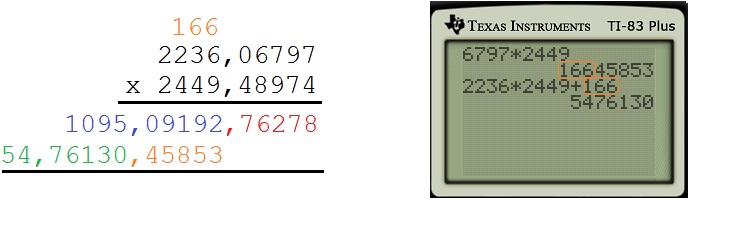
Next, we multiply 2236 and 2449 and then add the number that was carried.

bigmult5

Finally, it remains to add these two partial products to obtain the final product. For this problem, this can be accomplished with only a single addition: the block of digits 76278 simply carry down to the final answer, and so we can start by adding the second and third blocks of digits. As this sum is less than 10^{10}, there is no digit to carry, and so the leading 54 also carries down to the final answer.
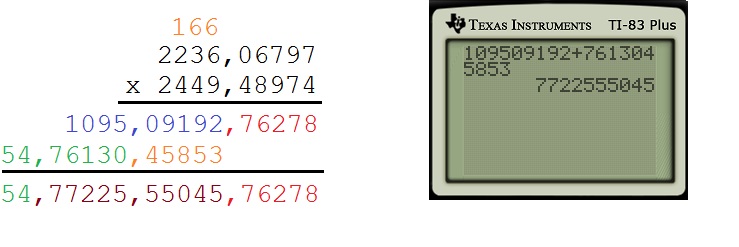
bigmult6The above technique is logically equivalent to using base 100,000 as opposed to the customary use of base 10 arithmetic. So while multiplying two numbers in the billions still takes some time, judiciously using a calculator makes this exercise go a lot quicker than the ordinary grade-school method of multiplying one digit at a time.


Arithmetic with big numbers (Part 1)

Ready for an elementary arithmetic problem? Here it is:

bigadd1

Nothing to it… just add the two numbers. Of course, we’d rather not add them by hand, so let’s use a calculator instead:

bigadd5

Uh oh… the calculator doesn’t give the complete answer. It does return the first nine significant digits, but it doesn’t return all 16 digits. Indeed, we can’t be sure that the final 7 in the answer is correct because of rounding.

So now what we do (other than buy a more expensive calculator)?

When I pose this question to students, the knee-jerk reaction is to just start adding one digit at a time. Though that’s not the worst possible response, it is possible to use modern technology to make ordinary grade-school addition move a lot quicker. One way to do this is to take three digits at a time while using a calculator:


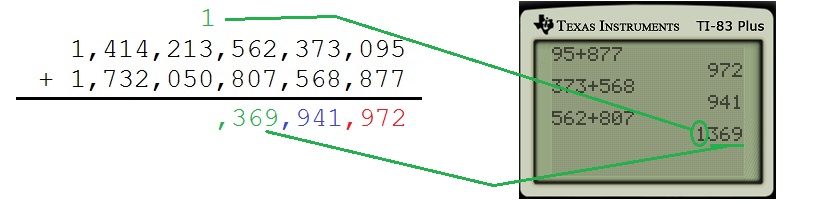
bigadd2

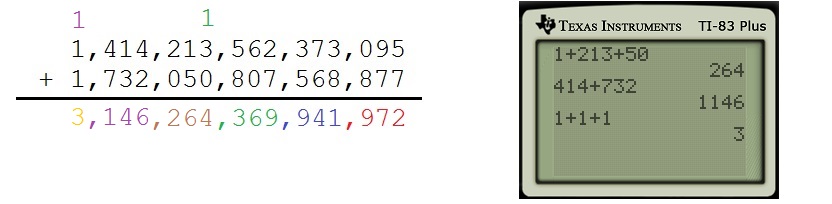
Notice that the 1 in 1369 gets carried over to the next block of three digits in much the same way that a sum greater than 10 has the tens digit carried over to the next digit. Continuing:

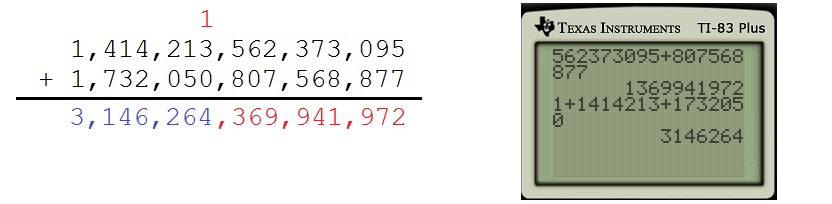
bigadd3This is logically equivalent to using base 1000 to add these two numbers (as opposed to base 10) and is certainly a lot faster than using only one digit at a time. Of course, it’d go even faster if we use up to nine digits a time (which is equivalent to using base one billion).

bigadd4

Another poorly written word problem

Textbooks have included the occasional awful problem ever since Pebbles Flintstone and Bamm-Bamm Rubble chiseled their homework on slate tablets while attending Bedrock Elementary. But even with the understanding that there have been children have been doing awful homework problems since the dawn of time (and long before the advent of the Common Core), this gem that was assigned to Texas 5th graders is a doozy.

Source: https://www.facebook.com/photo.php?fbid=10203673212963557&set=o.121316371311714&type=1&theater

I get what the textbook wants the student to do: rounding to the nearest $10 and developing the skill of approximating a sum without actually laboriously computing the sum exactly. According to this logic, $54.26 gets rounded to $50 and $34.34 gets rounded to $30. So Fran spends about $80, and (according to this logic) so she has about $20 left. So the textbook wants the student to answer B.

But this is wrong on so many levels only destined to confuse parents and children alike.

First, the actual answer, without using approximations, is $11.40. Undeniably, $5 (answer C) is closer to $11.40 than $20 (answer B).

Second, it’s entirely reasonable and appropriate for students to approximate to either the nearest dollar or else the nearest $5. Indeed, nothing in this problem says that the rounding must occur to the nearest $10… I’d imagine that this could only be inferred from the context of other problems on the page. By rounding to the nearest dollar, Fran would have about $12 left. By rounding to the nearest $5, Fran would have about $10 left. And there’s nothing “wrong” with either of these approximations.

Third, in real life, Fran would not say that it would cost about $80 to buy the sneakers and shirt. In real life, Fran would always round up to be sure that she has enough money to complete the transaction. If Fran keeps rounding to the nearest $10, she’ll end up short of money at the cash register sooner or later. So while rounding up or down may be appropriate for some problems, it probably shouldn’t be advocated for the sake of financial literacy.

In short, this problem does little except confuse students and get them to hate math. I do advocate that children should be able to estimate a sum without finding it. This is one of the standards for teaching Texas 5th graders mathematics:

Number, operation, and quantitative reasoning. The student estimates to determine reasonable results. The student is expected to use strategies, including rounding and compatible numbers to estimate solutions to addition, subtraction, multiplication, and division problems. Source: http://ritter.tea.state.tx.us/rules/tac/chapter111/ch111a.html

That said, this particular problem is an exceptionally poor way of determining whether students have acquired that skill. It’s hard to believe that this problem survived the proofreading process before the textbook was published.

See also: https://meangreenmath.com/2013/06/20/acceleration/