Predicate Logic and Popular Culture (Part 70): Spice Girls

Let p be the proposition “You wanna be my lover,” and let F(x) be the proposition “x is my friend,” and let G(x) be the proposition “You have to get with x.” Translate the logical statement

p \Rightarrow \forall x (F(x) \Rightarrow G(x)),

where the domain is all people.

The straightforward way of translating this into English is, “If you wanna be my lover, then you have to get with all of my friends.” This matches the first line of the chorus of one of the biggest hits of the 1990s.

green line

Context: This semester, I taught discrete mathematics for the first time. Part of the discrete mathematics course includes an introduction to predicate and propositional logic for our math majors. As you can probably guess from their names, students tend to think these concepts are dry and uninteresting even though they’re very important for their development as math majors.

In an effort to making these topics more appealing, I spent a few days mining the depths of popular culture in a (likely futile) attempt to make these ideas more interesting to my students. In this series, I’d like to share what I found. Naturally, the sources that I found have varying levels of complexity, which is appropriate for students who are first learning prepositional and predicate logic.

When I actually presented these in class, I either presented the logical statement and had my class guess the statement in actual English, or I gave my students the famous quote and them translate it into predicate logic. However, for the purposes of this series, I’ll just present the statement in predicate logic first.

Predicate Logic and Popular Culture (Part 69): Whitney Houston

Let L(t) be the proposition “I will love you at time t.” Translate the logical statement

\forall t\ge 0 L(t),

where the domain is all times.

Of course, this is the iconic song by Whitney Houston.

green line

Context: This semester, I taught discrete mathematics for the first time. Part of the discrete mathematics course includes an introduction to predicate and propositional logic for our math majors. As you can probably guess from their names, students tend to think these concepts are dry and uninteresting even though they’re very important for their development as math majors.

In an effort to making these topics more appealing, I spent a few days mining the depths of popular culture in a (likely futile) attempt to make these ideas more interesting to my students. In this series, I’d like to share what I found. Naturally, the sources that I found have varying levels of complexity, which is appropriate for students who are first learning prepositional and predicate logic.

When I actually presented these in class, I either presented the logical statement and had my class guess the statement in actual English, or I gave my students the famous quote and them translate it into predicate logic. However, for the purposes of this series, I’ll just present the statement in predicate logic first.

Predicate Logic and Popular Culture (Part 68): Justin Bieber

Let M(x) be the proposition “My momma likes x.” Translate the logical statement

\lnot M(\hbox{you}) \land \forall x M(x),

where the domain is all people.

The straightforward way of translating this into English is, “My momma does not like you, and my momma likes everyone.” (An amusing consequence of this syllogism is the conclusion “You are nobody.”) This almost precisely matches the memorable line of the chorus in Justin Bieber’s recent hit song.

green line

Context: This semester, I taught discrete mathematics for the first time. Part of the discrete mathematics course includes an introduction to predicate and propositional logic for our math majors. As you can probably guess from their names, students tend to think these concepts are dry and uninteresting even though they’re very important for their development as math majors.

In an effort to making these topics more appealing, I spent a few days mining the depths of popular culture in a (likely futile) attempt to make these ideas more interesting to my students. In this series, I’d like to share what I found. Naturally, the sources that I found have varying levels of complexity, which is appropriate for students who are first learning prepositional and predicate logic.

When I actually presented these in class, I either presented the logical statement and had my class guess the statement in actual English, or I gave my students the famous quote and them translate it into predicate logic. However, for the purposes of this series, I’ll just present the statement in predicate logic first.

Predicate Logic and Popular Culture (Part 67): Janet Jackson

Let T(x,t) be the proposition “I think of x at time t,” and let M(x,t) be the proposition “x seems to matter at time t.” Translate the logical statement

\forall t (T(\hbox{you},t) \Rightarrow \forall x \ne \hbox{you}(\not M(x,t))).

The straightforward way of translating this into English is, “If I think of you at a time, then everything else does not matter at that time.” More lyrically, it’s the first line of the chorus to Janet Jackson first #1 single, released in 1986.

green line

Context: This semester, I taught discrete mathematics for the first time. Part of the discrete mathematics course includes an introduction to predicate and propositional logic for our math majors. As you can probably guess from their names, students tend to think these concepts are dry and uninteresting even though they’re very important for their development as math majors.

In an effort to making these topics more appealing, I spent a few days mining the depths of popular culture in a (likely futile) attempt to make these ideas more interesting to my students. In this series, I’d like to share what I found. Naturally, the sources that I found have varying levels of complexity, which is appropriate for students who are first learning prepositional and predicate logic.

When I actually presented these in class, I either presented the logical statement and had my class guess the statement in actual English, or I gave my students the famous quote and them translate it into predicate logic. However, for the purposes of this series, I’ll just present the statement in predicate logic first.

Predicate Logic and Popular Culture (Part 66): West Side Story

Let L(x,t) be the proposition “We find a new way of living at place x and at time t,” and let F(x,t) be the proposition “We find a way of forgiving at place x and t.” Translate the logical statement

\exists x \exists t (L(x,t) \land F(x,t)).

This matches almost perfectly one of the lines from the classic song “Somewhere” from the musical West Side Story.

green line

Context: This semester, I taught discrete mathematics for the first time. Part of the discrete mathematics course includes an introduction to predicate and propositional logic for our math majors. As you can probably guess from their names, students tend to think these concepts are dry and uninteresting even though they’re very important for their development as math majors.

In an effort to making these topics more appealing, I spent a few days mining the depths of popular culture in a (likely futile) attempt to make these ideas more interesting to my students. In this series, I’d like to share what I found. Naturally, the sources that I found have varying levels of complexity, which is appropriate for students who are first learning prepositional and predicate logic.

When I actually presented these in class, I either presented the logical statement and had my class guess the statement in actual English, or I gave my students the famous quote and them translate it into predicate logic. However, for the purposes of this series, I’ll just present the statement in predicate logic first.

Predicate Logic and Popular Culture (Part 65): John Philip Sousa

Let S(t) be the proposition “The Stars and Stripes wave at time t.” Translate the logical statement

\forall t (S(t)).

I tried to think of a fitting example for the Fourth of July, but the best that I could find was the closing line of the chorus of the Stars and Stripes Forever.

Which naturally leads me to this amazing version from the 1970s:

green line

Context: This semester, I taught discrete mathematics for the first time. Part of the discrete mathematics course includes an introduction to predicate and propositional logic for our math majors. As you can probably guess from their names, students tend to think these concepts are dry and uninteresting even though they’re very important for their development as math majors.

In an effort to making these topics more appealing, I spent a few days mining the depths of popular culture in a (likely futile) attempt to make these ideas more interesting to my students. In this series, I’d like to share what I found. Naturally, the sources that I found have varying levels of complexity, which is appropriate for students who are first learning prepositional and predicate logic.

When I actually presented these in class, I either presented the logical statement and had my class guess the statement in actual English, or I gave my students the famous quote and them translate it into predicate logic. However, for the purposes of this series, I’ll just present the statement in predicate logic first.

Predicate Logic and Popular Culture (Part 64): Abraham Lincoln

Let F(x,t) be the proposition “You can fool x at time t.” Translate the logical statement

\exists t_1 \forall x (F(x,t_1)) \land \exists x_1 \forall t(F(x_1,t)) \land \lnot(\forall x \forall t(F(x,t))).

Of course, this is the famous quote commonly attributed to Abraham Lincoln: “You can fool all of the people some of the time, and some of the people all of the time, but you cannot fool all of the people all of the time.”

green line

Context: This semester, I taught discrete mathematics for the first time. Part of the discrete mathematics course includes an introduction to predicate and propositional logic for our math majors. As you can probably guess from their names, students tend to think these concepts are dry and uninteresting even though they’re very important for their development as math majors.

In an effort to making these topics more appealing, I spent a few days mining the depths of popular culture in a (likely futile) attempt to make these ideas more interesting to my students. In this series, I’d like to share what I found. Naturally, the sources that I found have varying levels of complexity, which is appropriate for students who are first learning prepositional and predicate logic.

When I actually presented these in class, I either presented the logical statement and had my class guess the statement in actual English, or I gave my students the famous quote and them translate it into predicate logic. However, for the purposes of this series, I’ll just present the statement in predicate logic first.

Predicate Logic and Popular Culture (Part 63): P. T. Barnum

Let S(x) be the proposition "latex x$ is a sucker,” and let B(x,t) be the proposition “x is born at time t.” Translate the logical statement

\forall t \exists x (S(x) \land B(x,t)).

Naturally, this is the famous quote often attributed to P. T. Barnum: “There’s a sucker born every minute.”

green line

Context: This semester, I taught discrete mathematics for the first time. Part of the discrete mathematics course includes an introduction to predicate and propositional logic for our math majors. As you can probably guess from their names, students tend to think these concepts are dry and uninteresting even though they’re very important for their development as math majors.

In an effort to making these topics more appealing, I spent a few days mining the depths of popular culture in a (likely futile) attempt to make these ideas more interesting to my students. In this series, I’d like to share what I found. Naturally, the sources that I found have varying levels of complexity, which is appropriate for students who are first learning prepositional and predicate logic.

When I actually presented these in class, I either presented the logical statement and had my class guess the statement in actual English, or I gave my students the famous quote and them translate it into predicate logic. However, for the purposes of this series, I’ll just present the statement in predicate logic first.

Predicate Logic and Popular Culture (Part 62): George Strait

Let X(x) be the proposition “x is my ex,” and let T(x) be the proposition “x lives in Texas.” Translate the logical statement

\forall x (X(x) \Rightarrow T(x)),

where the domain is all people.

Naturally, this one of the great hits in the storied career of George Strait.

green line

Context: This semester, I taught discrete mathematics for the first time. Part of the discrete mathematics course includes an introduction to predicate and propositional logic for our math majors. As you can probably guess from their names, students tend to think these concepts are dry and uninteresting even though they’re very important for their development as math majors.

In an effort to making these topics more appealing, I spent a few days mining the depths of popular culture in a (likely futile) attempt to make these ideas more interesting to my students. In this series, I’d like to share what I found. Naturally, the sources that I found have varying levels of complexity, which is appropriate for students who are first learning prepositional and predicate logic.

When I actually presented these in class, I either presented the logical statement and had my class guess the statement in actual English, or I gave my students the famous quote and them translate it into predicate logic. However, for the purposes of this series, I’ll just present the statement in predicate logic first.

Engaging students: Using Pascal’s triangle

In my capstone class for future secondary math teachers, I ask my students to come up with ideas for engaging their students with different topics in the secondary mathematics curriculum. In other words, the point of the assignment was not to devise a full-blown lesson plan on this topic. Instead, I asked my students to think about three different ways of getting their students interested in the topic in the first place.

I plan to share some of the best of these ideas on this blog (after asking my students’ permission, of course).

This student submission comes from my former student Jason Trejo. His topic, from Precalculus: using Pascal’s triangle.

green line

How could you as a teacher create an activity or project that involves your topic?

After some research and interesting observations I came across while examining Pascal’s Triangle, I feel like I could create some sort of riddle worksheet that involves the Triangle. Once I have taught my students how to create Pascal’s Triangle, I could give my students riddles such as:

  • Once you go and strive in prime, belittling your neighbors isn’t a crime.
    • Students might notice that each number (other than 1) in a prime number row is divisible by that prime number:
      • Row 7= 1, 7, 21, 35, 35, 21, 7, 1
      • Row 11= 1, 11, 55, 165, 330, 462, 462, 330, 165, 55, 11, 1
    • Naturally shallow slides aren’t much fun, but with a fib of raunchy, it is this one.
      • Given that I have gone over the Fibonacci sequence with my students prior to these riddles, I could include this one. The students should eventually see that if you take shallow diagonals on Pascal’s Triangle, the sum of those diagonals are the consecutive numbers in the Fibonacci sequence.
    • In a game on blades, you can’t be a schmuck with a puck. Be nimble and quick to look for the stick.
      • This one is a little more straightforward compared to the last two so hopefully the students will make the connection to notice the hockey stick pattern on the diagonals of Pascal’s Triangle. When adding the numbers down a diagonal, then the number to the side and below will be the sum, thus looking like a hockey stick.
    • What else is there? What else is in store? What patterns can you find when you know who to root four?
      • The “typo” is intentional to give a hint at another pattern the students might notice on Pascal’s Triangle. Now I am challenging the students to find more patterns within the Triangle such as:
        • Sum of rows are the powers of 2
        • Rows relate to the powers of 11 (get murky after the 4th row)
        • Counting numbers, triangular numbers, etc.

The purpose of this activity would extend the use of Pascal’s triangle from what they already know. I could assign this at the beginning of the lesson and if no one understands what the riddles meant, we could come back as a class and figure them out together once the lesson was done. These riddles could be an assignment of their own if I introduce them after they are very familiar with Pascal’s Triangle.


green line

How can this topic be used in students’ future courses in mathematics and science?

I would say the primary use most students will get from Pascal’s Triangle would be to find the coefficients of binomials since it is much easier when working on binomial expansions, but there are also other ways they can use the Triangle as well. For one, it can be of great use in many courses that involve since it is a visual in seeing the number of combinations there are based on the number of items used. For example, say there are 6 different pieces of candy in a bowl and you need to know how many different ways can you choose 3 candies? Using Pascal’s Triangle, we look at the 6th row and the 3rd entry in that row (remembering the top row is Row 0 and the first 1 in each row is Entry 0), we can see that there are 20 possible combinations of 3 different pieces of candy. Other than that, even based on the riddle activity from above, students can use Pascal’s Triangle and its various patterns to help remember such things as triangular numbers, powers of 11, etc.


green line

How has this topic appeared in high culture?

Within the past few years, the Shanghai-based design company, Super Nature Design, created the interactive art piece “Lost in Pascal’s Triangle”. This structure takes inspiration from Pascal’s Triangle and allows people to “explore the concept and magnification of the Pascal’s Triangle mathematics formula.” The following link takes you to the website that gives a bit more information behind the piece and shows how people can interact with the structure through a xylophone-type console: http://www.supernaturedesign.com/work/pascaltriangle#8

Another quick application that can be done through Pascal’s Triangle is by seeing the relationship between the Triangle and Sierpinski’s triangle (as shown below):

pascal1

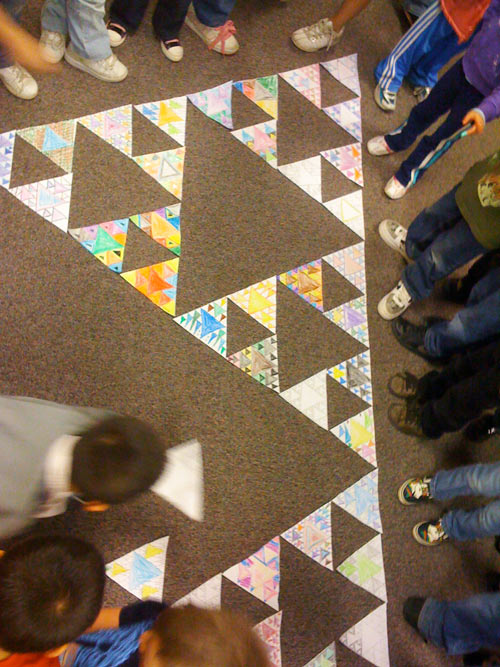
The pattern is by shading in every odd number on Pascal’s Triangle, you start creating Sierpinski’s triangle which is found in many works of art like these:

pascal2


pascal3

It might actually be a small but fun project to have the students create something like this at the beginning of the lesson and then explain the relation of the two special triangles.

References:

Pascal Triangle Information: http://jwilson.coe.uga.edu/EMAT6680Su12/Berryman/6690/BerrymanK-Pascals/BerrymanK-Pascals.html

Image of Pascal’s Triangle: http://mathforum.org/workshops/usi/pascal/images/pascal.hex2.gif

Lost in Pascal’s Triangle: http://www.designboom.com/weblog/images/images_2/andrea/super_nature_design/pascaltriangle01.jpg

Super Nature Design: http://www.supernaturedesign.com/work/pascaltriangle#2

Pascal and Sierpinski Triangle : http://mathforum.org/workshops/usi/pascal/images/sierpinski.pascalfrac.gif

Sierpinski Pyramid: http://www.sierpinskitetrahedron.com/images/sierpinski-tetrahedron-breckenridge.JPG

Sierpinski Art Project: http://fractalfoundation.org/wp-content/uploads/2009/03/sierpkids1.jpg