The following problem appeared in Volume 131, Issue 9 (2024) of The American Mathematical Monthly.
Let  and
and  be independent normally distributed random variables, each with its own mean and variance. Show that the variance of conditioned on the event
  is smaller than the variance of alone.
We suppose that  ,
,  ,
,  , and
, and  . With these definitions, we may write
  and
and  , where
  and
and  are independent standard normal random variables.
The goal is to show that  . In previous posts, we showed that it will be sufficient to show that
  , where
  and
and  . We also showed that
  , where
  and
and

is the cumulative distribution function of the standard normal distribution.
To compute
![\hbox{Var}(Z_1 \mid Z_1 > a + bZ_2) = E(Z_1^2 \mid Z_1 + a bZ_2) - [E(Z_1 \mid Z_1 > a + bZ_2)]^2](https://s0.wp.com/latex.php?latex=%5Chbox%7BVar%7D%28Z_1+%5Cmid+Z_1+%3E+a+%2B+bZ_2%29+%3D+E%28Z_1%5E2+%5Cmid+Z_1+%2B+a+bZ_2%29+-+%5BE%28Z_1+%5Cmid+Z_1+%3E+a+%2B+bZ_2%29%5D%5E2&bg=ffffff&fg=000000&s=0&c=20201002) ,
,
we showed in the previous post that
 .
.
We now turn to the second conditional expectation:
 .
.
The expected value in the numerator is a double integral:
 ,
,
where  is the joint probability density function of and . Since and are independent, is the product of the individual probability density functions:
 .
.
Therefore, we must compute
 ,
,
where I wrote  for the event
  .
.
I’m not above admitting that I first stuck this into Mathematica to make sure that this was doable. To begin, we compute the inner integral:
we begin by using integration by parts on the inner integral:

![=\displaystyle \left[ -z_1 e^{-z_1^2/2} \right]_{a+bz_2}^\infty + \int_{a+bz_2}^\infty e^{-z_1^2/2} \, dz_1](https://s0.wp.com/latex.php?latex=%3D%5Cdisplaystyle+%5Cleft%5B+-z_1+e%5E%7B-z_1%5E2%2F2%7D+%5Cright%5D_%7Ba%2Bbz_2%7D%5E%5Cinfty+%2B+%5Cint_%7Ba%2Bbz_2%7D%5E%5Cinfty+e%5E%7B-z_1%5E2%2F2%7D+%5C%2C+dz_1&bg=ffffff&fg=000000&s=0&c=20201002)
![= (a+bz_2) \displaystyle \exp \left[-\frac{(a+bz_2)^2}{2} \right] + \int_{a+bz_2}^\infty e^{-z_1^2/2} \, dz_1](https://s0.wp.com/latex.php?latex=%3D+%28a%2Bbz_2%29+%5Cdisplaystyle+%5Cexp+%5Cleft%5B-%5Cfrac%7B%28a%2Bbz_2%29%5E2%7D%7B2%7D+%5Cright%5D+%2B+%5Cint_%7Ba%2Bbz_2%7D%5E%5Cinfty+e%5E%7B-z_1%5E2%2F2%7D+%5C%2C+dz_1&bg=ffffff&fg=000000&s=0&c=20201002)
Therefore,
![E(Z_1^2 I_A) = \displaystyle \frac{1}{2\pi} \int_{-\infty}^\infty (a+bz_2) \exp \left[-\frac{(a+bz_2)^2}{2} \right] \exp \left[ -\frac{z_2^2}{2} \right] \, dz_2 + \int_{-\infty}^\infty \int_{a+bz_2}^\infty \frac{1}{2\pi} e^{-z_1^2/2} e^{-z_2^2/2} \, dz_1 dz_2](https://s0.wp.com/latex.php?latex=E%28Z_1%5E2+I_A%29+%3D+%5Cdisplaystyle+%5Cfrac%7B1%7D%7B2%5Cpi%7D+%5Cint_%7B-%5Cinfty%7D%5E%5Cinfty+%28a%2Bbz_2%29+%5Cexp+%5Cleft%5B-%5Cfrac%7B%28a%2Bbz_2%29%5E2%7D%7B2%7D+%5Cright%5D+%5Cexp+%5Cleft%5B+-%5Cfrac%7Bz_2%5E2%7D%7B2%7D+%5Cright%5D+%5C%2C+dz_2+%2B+%5Cint_%7B-%5Cinfty%7D%5E%5Cinfty+%5Cint_%7Ba%2Bbz_2%7D%5E%5Cinfty+%5Cfrac%7B1%7D%7B2%5Cpi%7D+e%5E%7B-z_1%5E2%2F2%7D+e%5E%7B-z_2%5E2%2F2%7D+%5C%2C+dz_1+dz_2&bg=ffffff&fg=000000&s=0&c=20201002) .
.
The second term is equal to  since the double integral is
  . For the first integral, we complete the square as before:
![E(Z_1^2 I_A) = \Phi(c) + \displaystyle \frac{1}{2\pi} \int_{-\infty}^\infty (a+bz_2) \exp \left[-\frac{(b^2+1)z_2^2 + 2abz_2 + a^2}{2} \right] \, dz_2](https://s0.wp.com/latex.php?latex=E%28Z_1%5E2+I_A%29+%3D+%5CPhi%28c%29+%2B+%5Cdisplaystyle+%5Cfrac%7B1%7D%7B2%5Cpi%7D+%5Cint_%7B-%5Cinfty%7D%5E%5Cinfty+%28a%2Bbz_2%29+%5Cexp+%5Cleft%5B-%5Cfrac%7B%28b%5E2%2B1%29z_2%5E2+%2B+2abz_2+%2B+a%5E2%7D%7B2%7D+%5Cright%5D+%5C%2C+dz_2&bg=ffffff&fg=000000&s=0&c=20201002)
![= \Phi(c) + \displaystyle \frac{1}{2\pi} \int_{-\infty}^\infty (a + bz_2) \exp \left[ -\frac{b^2+1}{2} \left( z_2^2 + \frac{2abz_2}{b^2+1} \,\,\,\,\,\,\,\,\,\,\,\,\,\,\,\, \right) \right] \exp \left[ -\frac{1}{2} \left(a^2 \,\,\,\,\,\,\,\,\,\,\,\,\,\,\,\, \right) \right] dz_2](https://s0.wp.com/latex.php?latex=%3D+%5CPhi%28c%29+%2B+%5Cdisplaystyle+%5Cfrac%7B1%7D%7B2%5Cpi%7D+%5Cint_%7B-%5Cinfty%7D%5E%5Cinfty+%28a+%2B+bz_2%29+%5Cexp+%5Cleft%5B+-%5Cfrac%7Bb%5E2%2B1%7D%7B2%7D+%5Cleft%28+z_2%5E2+%2B+%5Cfrac%7B2abz_2%7D%7Bb%5E2%2B1%7D+%5C%2C%5C%2C%5C%2C%5C%2C%5C%2C%5C%2C%5C%2C%5C%2C%5C%2C%5C%2C%5C%2C%5C%2C%5C%2C%5C%2C%5C%2C%5C%2C+%5Cright%29+%5Cright%5D+%5Cexp+%5Cleft%5B+-%5Cfrac%7B1%7D%7B2%7D+%5Cleft%28a%5E2+%5C%2C%5C%2C%5C%2C%5C%2C%5C%2C%5C%2C%5C%2C%5C%2C%5C%2C%5C%2C%5C%2C%5C%2C%5C%2C%5C%2C%5C%2C%5C%2C+%5Cright%29+%5Cright%5D+dz_2&bg=ffffff&fg=000000&s=0&c=20201002)
![= \Phi(c) +\displaystyle \frac{1}{2\pi} \int_{-\infty}^\infty (a + bz_2)\exp \left[ -\frac{b^2+1}{2} \left( z_2^2 + \frac{2abz_2}{b^2+1} + \frac{a^2b^2}{(b^2+1)^2} \right) \right] \exp \left[ -\frac{1}{2} \left(a^2 - \frac{a^2b^2}{b^2+1} \right) \right] dz_2](https://s0.wp.com/latex.php?latex=%3D+%5CPhi%28c%29+%2B%5Cdisplaystyle+%5Cfrac%7B1%7D%7B2%5Cpi%7D+%5Cint_%7B-%5Cinfty%7D%5E%5Cinfty+%28a+%2B+bz_2%29%5Cexp+%5Cleft%5B+-%5Cfrac%7Bb%5E2%2B1%7D%7B2%7D+%5Cleft%28+z_2%5E2+%2B+%5Cfrac%7B2abz_2%7D%7Bb%5E2%2B1%7D+%2B+%5Cfrac%7Ba%5E2b%5E2%7D%7B%28b%5E2%2B1%29%5E2%7D+%5Cright%29+%5Cright%5D+%5Cexp+%5Cleft%5B+-%5Cfrac%7B1%7D%7B2%7D+%5Cleft%28a%5E2+-+%5Cfrac%7Ba%5E2b%5E2%7D%7Bb%5E2%2B1%7D+%5Cright%29+%5Cright%5D+dz_2&bg=ffffff&fg=000000&s=0&c=20201002)
![= \Phi(c) +\displaystyle \frac{1}{2\pi} \int_{-\infty}^\infty (a + bz_2)\exp \left[ -\frac{b^2+1}{2} \left( z_2 + \frac{ab}{b^2+1} \right)^2 \right] \exp \left[ -\frac{1}{2} \left( \frac{a^2}{b^2+1} \right) \right] dz_2](https://s0.wp.com/latex.php?latex=%3D+%5CPhi%28c%29+%2B%5Cdisplaystyle+%5Cfrac%7B1%7D%7B2%5Cpi%7D+%5Cint_%7B-%5Cinfty%7D%5E%5Cinfty+%28a+%2B+bz_2%29%5Cexp+%5Cleft%5B+-%5Cfrac%7Bb%5E2%2B1%7D%7B2%7D+%5Cleft%28+z_2+%2B+%5Cfrac%7Bab%7D%7Bb%5E2%2B1%7D+%5Cright%29%5E2+%5Cright%5D+%5Cexp+%5Cleft%5B+-%5Cfrac%7B1%7D%7B2%7D+%5Cleft%28+%5Cfrac%7Ba%5E2%7D%7Bb%5E2%2B1%7D+%5Cright%29+%5Cright%5D+dz_2&bg=ffffff&fg=000000&s=0&c=20201002)
![= \Phi(c) +\displaystyle \frac{e^{-c^2/2}}{2\pi} \int_{-\infty}^\infty (a + bz_2)\exp \left[ -\frac{b^2+1}{2} \left( z_2 + \frac{ab}{b^2+1} \right)^2 \right] dz_2](https://s0.wp.com/latex.php?latex=%3D+%5CPhi%28c%29+%2B%5Cdisplaystyle+%5Cfrac%7Be%5E%7B-c%5E2%2F2%7D%7D%7B2%5Cpi%7D+%5Cint_%7B-%5Cinfty%7D%5E%5Cinfty+%28a+%2B+bz_2%29%5Cexp+%5Cleft%5B+-%5Cfrac%7Bb%5E2%2B1%7D%7B2%7D+%5Cleft%28+z_2+%2B+%5Cfrac%7Bab%7D%7Bb%5E2%2B1%7D+%5Cright%29%5E2+%5Cright%5D+dz_2&bg=ffffff&fg=000000&s=0&c=20201002) .
.
I now rewrite the integrand so that has the form of the probability density function of a normal distribution, writing  and multiplying and dividing by
  in the denominator:
![E(Z_1^2 I_A) = \Phi(c) + \displaystyle \frac{e^{-c^2/2}}{\sqrt{2\pi}\sqrt{b^2+1}} \int_{-\infty}^\infty (a+bz_2) \frac{1}{\sqrt{2\pi} \sqrt{ \displaystyle \frac{1}{b^2+1}}} \exp \left[ - \frac{\left(z_2 + \displaystyle \frac{ab}{b^2+1} \right)^2}{2 \cdot \displaystyle \frac{1}{b^2+1}} \right] dz_2](https://s0.wp.com/latex.php?latex=E%28Z_1%5E2+I_A%29+%3D+%5CPhi%28c%29+%2B+%5Cdisplaystyle+%5Cfrac%7Be%5E%7B-c%5E2%2F2%7D%7D%7B%5Csqrt%7B2%5Cpi%7D%5Csqrt%7Bb%5E2%2B1%7D%7D+%5Cint_%7B-%5Cinfty%7D%5E%5Cinfty+%28a%2Bbz_2%29+%5Cfrac%7B1%7D%7B%5Csqrt%7B2%5Cpi%7D+%5Csqrt%7B+%5Cdisplaystyle+%5Cfrac%7B1%7D%7Bb%5E2%2B1%7D%7D%7D+%5Cexp+%5Cleft%5B+-+%5Cfrac%7B%5Cleft%28z_2+%2B+%5Cdisplaystyle+%5Cfrac%7Bab%7D%7Bb%5E2%2B1%7D+%5Cright%29%5E2%7D%7B2+%5Ccdot+%5Cdisplaystyle+%5Cfrac%7B1%7D%7Bb%5E2%2B1%7D%7D+%5Cright%5D+dz_2&bg=ffffff&fg=000000&s=0&c=20201002) .
.
This is an example of making a problem easier by apparently making it harder. The integrand has the probability density function of a normally distributed random variable  with
with  and
and  . Therefore, the integral is equal to
  , so that
 ,
,


 .
.
Therefore,
 .
.
We note that this reduces to what we found in the second special case: if  , then
  and
and  , so that
  , matching what we found earlier.
In the next post, we consider the calculation of  .
.


) is qualitatively different from no maggot (
).
 .
.
 , then
  is always positive, where
 must be positive: show that
  . If I could prove both of these claims, then that would prove that
  ,
,  .
. , it’s even easier. If
  .
. , so that
  , thus concluding the solution.
 , then
  is always positive, where
 must be greater than
  .
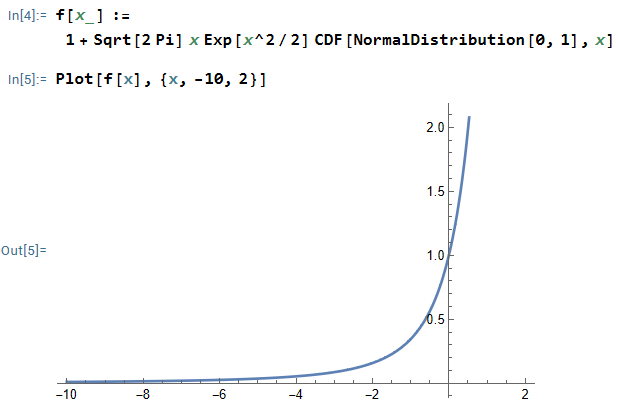
.
 . If I could prove both of these claims, then that would prove that
  .
. , we integrate by parts. (This is permissible: the integrands below are well-behaved if
  is not in the range of integration.)

![= \displaystyle x e^{x^2/2} \left[ -\frac{1}{t} e^{-t^2/2} \right]_{-\infty}^x - x e^{x^2/2} \int_{-\infty}^x \frac{d}{dt} \left(\frac{1}{t} \right) \left( -e^{-t^2/2} \right) \, dt](https://s0.wp.com/latex.php?latex=%3D+%5Cdisplaystyle++x+e%5E%7Bx%5E2%2F2%7D+%5Cleft%5B+-%5Cfrac%7B1%7D%7Bt%7D+e%5E%7B-t%5E2%2F2%7D+%5Cright%5D_%7B-%5Cinfty%7D%5Ex+-+x+e%5E%7Bx%5E2%2F2%7D+%5Cint_%7B-%5Cinfty%7D%5Ex+%5Cfrac%7Bd%7D%7Bdt%7D+%5Cleft%28%5Cfrac%7B1%7D%7Bt%7D+%5Cright%29+%5Cleft%28+-e%5E%7B-t%5E2%2F2%7D+%5Cright%29+%5C%2C+dt&bg=ffffff&fg=000000&s=0&c=20201002)
![= \displaystyle x e^{x^2/2} \left[ -\frac{1}{x} e^{-x^2/2} - 0 \right] + |x| e^{x^2/2} \int_{-\infty}^x \frac{1}{t^2} e^{-t^2/2} \, dt](https://s0.wp.com/latex.php?latex=%3D+%5Cdisplaystyle++x+e%5E%7Bx%5E2%2F2%7D+%5Cleft%5B+-%5Cfrac%7B1%7D%7Bx%7D+e%5E%7B-x%5E2%2F2%7D+-+0+%5Cright%5D+%2B+%7Cx%7C+e%5E%7Bx%5E2%2F2%7D+%5Cint_%7B-%5Cinfty%7D%5Ex+%5Cfrac%7B1%7D%7Bt%5E2%7D+e%5E%7B-t%5E2%2F2%7D+%5C%2C+dt&bg=ffffff&fg=000000&s=0&c=20201002)

 .
. .
. ,
, .
. ,
,
 .
.
![= 1 - \displaystyle\frac{c e^{-c^2/2}}{ \sqrt{2\pi} (b^2+1) \Phi(c)} - \frac{e^{-c^2}}{2\pi (b^2+1) [\Phi(c)]^2}](https://s0.wp.com/latex.php?latex=%3D+1+-++%5Cdisplaystyle%5Cfrac%7Bc+e%5E%7B-c%5E2%2F2%7D%7D%7B+%5Csqrt%7B2%5Cpi%7D+%28b%5E2%2B1%29+%5CPhi%28c%29%7D+-+%5Cfrac%7Be%5E%7B-c%5E2%7D%7D%7B2%5Cpi+%28b%5E2%2B1%29+%5B%5CPhi%28c%29%5D%5E2%7D&bg=ffffff&fg=000000&s=0&c=20201002)
![= 1 - \displaystyle\frac{c}{ \sqrt{2\pi} (b^2+1) \Phi(c) e^{c^2/2}} - \frac{1}{2\pi (b^2+1) [\Phi(c)]^2e^{c^2}}](https://s0.wp.com/latex.php?latex=%3D+1+-++%5Cdisplaystyle%5Cfrac%7Bc%7D%7B+%5Csqrt%7B2%5Cpi%7D+%28b%5E2%2B1%29+%5CPhi%28c%29+e%5E%7Bc%5E2%2F2%7D%7D+-+%5Cfrac%7B1%7D%7B2%5Cpi+%28b%5E2%2B1%29+%5B%5CPhi%28c%29%5D%5E2e%5E%7Bc%5E2%7D%7D&bg=ffffff&fg=000000&s=0&c=20201002)
![= 1 - \displaystyle\frac{\sqrt{2\pi} c e^{c^2/2} \Phi(c) + 1}{2\pi (b^2+1) [\Phi(c)]^2 e^{c^2}}](https://s0.wp.com/latex.php?latex=%3D+1+-++%5Cdisplaystyle%5Cfrac%7B%5Csqrt%7B2%5Cpi%7D+c+e%5E%7Bc%5E2%2F2%7D+%5CPhi%28c%29+%2B+1%7D%7B2%5Cpi+%28b%5E2%2B1%29+%5B%5CPhi%28c%29%5D%5E2+e%5E%7Bc%5E2%7D%7D&bg=ffffff&fg=000000&s=0&c=20201002) .
. , it suffices to show that the second term must be positive. Furthermore, since the denominator of the second term is positive, it suffices to show that
  must also be positive.
 .
. ,
, .
. ,
,![E(Z_1 I_A) = \displaystyle \frac{1}{2\pi} \int_{-\infty}^\infty \left[ - e^{-z_1^2/2} \right]_{a+bz_2}^\infty e^{-z_2^2/2} \, dz_2](https://s0.wp.com/latex.php?latex=E%28Z_1+I_A%29+%3D+%5Cdisplaystyle+%5Cfrac%7B1%7D%7B2%5Cpi%7D+%5Cint_%7B-%5Cinfty%7D%5E%5Cinfty+%5Cleft%5B+-+e%5E%7B-z_1%5E2%2F2%7D+%5Cright%5D_%7Ba%2Bbz_2%7D%5E%5Cinfty+e%5E%7B-z_2%5E2%2F2%7D+%5C%2C+dz_2+&bg=ffffff&fg=000000&s=0&c=20201002)
![= \displaystyle \frac{1}{2\pi} \int_{-\infty}^\infty \exp \left[ -\frac{(a+bz_2)^2}{2} \right] \exp\left[-\frac{z_2^2}{2} \right] dz_2](https://s0.wp.com/latex.php?latex=%3D+%5Cdisplaystyle+%5Cfrac%7B1%7D%7B2%5Cpi%7D+%5Cint_%7B-%5Cinfty%7D%5E%5Cinfty+%5Cexp+%5Cleft%5B+-%5Cfrac%7B%28a%2Bbz_2%29%5E2%7D%7B2%7D+%5Cright%5D+%5Cexp%5Cleft%5B-%5Cfrac%7Bz_2%5E2%7D%7B2%7D+%5Cright%5D+dz_2&bg=ffffff&fg=000000&s=0&c=20201002)
![= \displaystyle \frac{1}{2\pi} \int_{-\infty}^\infty \exp \left[ -\frac{(b^2+1)z_2^2+2abz_2+a^2}{2} \right]](https://s0.wp.com/latex.php?latex=%3D+%5Cdisplaystyle+%5Cfrac%7B1%7D%7B2%5Cpi%7D+%5Cint_%7B-%5Cinfty%7D%5E%5Cinfty+%5Cexp+%5Cleft%5B+-%5Cfrac%7B%28b%5E2%2B1%29z_2%5E2%2B2abz_2%2Ba%5E2%7D%7B2%7D+%5Cright%5D&bg=ffffff&fg=000000&s=0&c=20201002) .
.![E(Z_1 I_A) = \displaystyle \frac{1}{2\pi} \int_{-\infty}^\infty \exp \left[ -\frac{b^2+1}{2} \left( z_2^2 + \frac{2abz_2}{b^2+1} \,\,\,\,\,\,\,\,\,\,\,\,\,\,\,\, \right) \right] \exp \left[ -\frac{1}{2} \left(a^2 \,\,\,\,\,\,\,\,\,\,\,\,\,\,\,\, \right) \right] dz_2](https://s0.wp.com/latex.php?latex=E%28Z_1+I_A%29+%3D+%5Cdisplaystyle+%5Cfrac%7B1%7D%7B2%5Cpi%7D+%5Cint_%7B-%5Cinfty%7D%5E%5Cinfty+%5Cexp+%5Cleft%5B+-%5Cfrac%7Bb%5E2%2B1%7D%7B2%7D+%5Cleft%28+z_2%5E2+%2B+%5Cfrac%7B2abz_2%7D%7Bb%5E2%2B1%7D+%5C%2C%5C%2C%5C%2C%5C%2C%5C%2C%5C%2C%5C%2C%5C%2C%5C%2C%5C%2C%5C%2C%5C%2C%5C%2C%5C%2C%5C%2C%5C%2C+%5Cright%29+%5Cright%5D+%5Cexp+%5Cleft%5B+-%5Cfrac%7B1%7D%7B2%7D+%5Cleft%28a%5E2+%5C%2C%5C%2C%5C%2C%5C%2C%5C%2C%5C%2C%5C%2C%5C%2C%5C%2C%5C%2C%5C%2C%5C%2C%5C%2C%5C%2C%5C%2C%5C%2C+%5Cright%29+%5Cright%5D+dz_2&bg=ffffff&fg=000000&s=0&c=20201002)
![= \displaystyle \frac{1}{2\pi} \int_{-\infty}^\infty \exp \left[ -\frac{b^2+1}{2} \left( z_2^2 + \frac{2abz_2}{b^2+1} + \frac{a^2b^2}{(b^2+1)^2} \right) \right] \exp \left[ -\frac{1}{2} \left(a^2 - \frac{a^2b^2}{b^2+1} \right) \right] dz_2](https://s0.wp.com/latex.php?latex=%3D+%5Cdisplaystyle+%5Cfrac%7B1%7D%7B2%5Cpi%7D+%5Cint_%7B-%5Cinfty%7D%5E%5Cinfty+%5Cexp+%5Cleft%5B+-%5Cfrac%7Bb%5E2%2B1%7D%7B2%7D+%5Cleft%28+z_2%5E2+%2B+%5Cfrac%7B2abz_2%7D%7Bb%5E2%2B1%7D+%2B+%5Cfrac%7Ba%5E2b%5E2%7D%7B%28b%5E2%2B1%29%5E2%7D+%5Cright%29+%5Cright%5D+%5Cexp+%5Cleft%5B+-%5Cfrac%7B1%7D%7B2%7D+%5Cleft%28a%5E2+-+%5Cfrac%7Ba%5E2b%5E2%7D%7Bb%5E2%2B1%7D+%5Cright%29+%5Cright%5D+dz_2&bg=ffffff&fg=000000&s=0&c=20201002)
![= \displaystyle \frac{1}{2\pi} \int_{-\infty}^\infty \exp \left[ -\frac{b^2+1}{2} \left( z_2 + \frac{ab}{b^2+1} \right)^2 \right] \exp \left[ -\frac{1}{2} \left( \frac{a^2}{b^2+1} \right) \right] dz_2](https://s0.wp.com/latex.php?latex=%3D+%5Cdisplaystyle+%5Cfrac%7B1%7D%7B2%5Cpi%7D+%5Cint_%7B-%5Cinfty%7D%5E%5Cinfty+%5Cexp+%5Cleft%5B+-%5Cfrac%7Bb%5E2%2B1%7D%7B2%7D+%5Cleft%28+z_2+%2B+%5Cfrac%7Bab%7D%7Bb%5E2%2B1%7D+%5Cright%29%5E2+%5Cright%5D+%5Cexp+%5Cleft%5B+-%5Cfrac%7B1%7D%7B2%7D+%5Cleft%28+%5Cfrac%7Ba%5E2%7D%7Bb%5E2%2B1%7D+%5Cright%29+%5Cright%5D+dz_2&bg=ffffff&fg=000000&s=0&c=20201002)
![= \displaystyle \frac{e^{-c^2/2}}{2\pi} \int_{-\infty}^\infty \exp \left[ -\frac{b^2+1}{2} \left( z_2 + \frac{ab}{b^2+1} \right)^2 \right] dz_2](https://s0.wp.com/latex.php?latex=%3D+%5Cdisplaystyle+%5Cfrac%7Be%5E%7B-c%5E2%2F2%7D%7D%7B2%5Cpi%7D+%5Cint_%7B-%5Cinfty%7D%5E%5Cinfty+%5Cexp+%5Cleft%5B+-%5Cfrac%7Bb%5E2%2B1%7D%7B2%7D+%5Cleft%28+z_2+%2B+%5Cfrac%7Bab%7D%7Bb%5E2%2B1%7D+%5Cright%29%5E2+%5Cright%5D++dz_2&bg=ffffff&fg=000000&s=0&c=20201002) .
.![E(Z_1 I_A) = \displaystyle \frac{e^{-c^2/2}}{\sqrt{2\pi}\sqrt{b^2+1}} \int_{-\infty}^\infty \frac{1}{\sqrt{2\pi} \sqrt{ \displaystyle \frac{1}{b^2+1}}} \exp \left[ - \frac{\left(z_2 + \displaystyle \frac{ab}{b^2+1} \right)^2}{2 \cdot \displaystyle \frac{1}{b^2+1}} \right] dz_2](https://s0.wp.com/latex.php?latex=E%28Z_1+I_A%29+%3D+%5Cdisplaystyle+%5Cfrac%7Be%5E%7B-c%5E2%2F2%7D%7D%7B%5Csqrt%7B2%5Cpi%7D%5Csqrt%7Bb%5E2%2B1%7D%7D+%5Cint_%7B-%5Cinfty%7D%5E%5Cinfty++%5Cfrac%7B1%7D%7B%5Csqrt%7B2%5Cpi%7D+%5Csqrt%7B+%5Cdisplaystyle+%5Cfrac%7B1%7D%7Bb%5E2%2B1%7D%7D%7D+%5Cexp+%5Cleft%5B+-+%5Cfrac%7B%5Cleft%28z_2+%2B+%5Cdisplaystyle+%5Cfrac%7Bab%7D%7Bb%5E2%2B1%7D+%5Cright%29%5E2%7D%7B2+%5Ccdot+%5Cdisplaystyle+%5Cfrac%7B1%7D%7Bb%5E2%2B1%7D%7D+%5Cright%5D+dz_2&bg=ffffff&fg=000000&s=0&c=20201002) .
. , where
  , we have
 ,
, .
. , and
, and  , then
  , and
, and  , we have
 ,
, .
. . As discussed in the previous post, this can be rewritten as
  , where
  . We begin by using the definition
![\hbox{Var}(X \mid A) = E(X^2 \mid A) - [E(X \mid A)]^2 = \displaystyle \frac{E(X^2 I_A)}{P(A)} - \left[ \frac{E(XI_A)}{P(A)} \right]^2](https://s0.wp.com/latex.php?latex=%5Chbox%7BVar%7D%28X+%5Cmid+A%29+%3D+E%28X%5E2+%5Cmid+A%29+-+%5BE%28X+%5Cmid+A%29%5D%5E2+%3D+%5Cdisplaystyle+%5Cfrac%7BE%28X%5E2+I_A%29%7D%7BP%28A%29%7D+-+%5Cleft%5B+%5Cfrac%7BE%28XI_A%29%7D%7BP%28A%29%7D+%5Cright%5D%5E2&bg=ffffff&fg=000000&s=0&c=20201002) .
. and
and  . First,
![E(XI_A) = E([\mu_1 + \sigma_1 Z_1] I_A) = \mu E(I_A) + E(\sigma_1 Z_1 I_A) = \mu_1 P(A) + \sigma_1 E(Z_1 I_A)](https://s0.wp.com/latex.php?latex=E%28XI_A%29+%3D+E%28%5B%5Cmu_1+%2B+%5Csigma_1+Z_1%5D+I_A%29+%3D+%5Cmu+E%28I_A%29+%2B+E%28%5Csigma_1+Z_1+I_A%29+%3D+%5Cmu_1+P%28A%29+%2B+%5Csigma_1+E%28Z_1+I_A%29&bg=ffffff&fg=000000&s=0&c=20201002) ,
, .
.![E(X^2 I_A) = E([\mu_1 + \sigma_1 Z_1]^2 I_A)](https://s0.wp.com/latex.php?latex=E%28X%5E2+I_A%29+%3D+E%28%5B%5Cmu_1+%2B+%5Csigma_1+Z_1%5D%5E2+I_A%29&bg=ffffff&fg=000000&s=0&c=20201002)
![= E([\mu_1^2 + 2\mu_1 \sigma_1 Z_1+ \sigma_1^2 Z_1^2] I_A)](https://s0.wp.com/latex.php?latex=%3D+E%28%5B%5Cmu_1%5E2+%2B+2%5Cmu_1+%5Csigma_1+Z_1%2B+%5Csigma_1%5E2+Z_1%5E2%5D+I_A%29&bg=ffffff&fg=000000&s=0&c=20201002)
 ,
, .
.![\hbox{Var}(A) = E(X^2 \mid A) - [ E(X \mid A) ]^2](https://s0.wp.com/latex.php?latex=%5Chbox%7BVar%7D%28A%29+%3D++E%28X%5E2+%5Cmid+A%29+-+%5B+E%28X+%5Cmid+A%29+%5D%5E2&bg=ffffff&fg=000000&s=0&c=20201002)
![= \mu_1^2 + 2 \mu_1 \sigma_1 E(Z_1 \mid A) + \sigma_1^2 E(Z_1^2 \mid A) - [\mu_1 + \sigma_1 E(Z_1 \mid A)]^2](https://s0.wp.com/latex.php?latex=%3D+%5Cmu_1%5E2+%2B+2+%5Cmu_1+%5Csigma_1+E%28Z_1+%5Cmid+A%29++%2B+%5Csigma_1%5E2+E%28Z_1%5E2+%5Cmid+A%29+-+%5B%5Cmu_1+%2B+%5Csigma_1+E%28Z_1+%5Cmid+A%29%5D%5E2&bg=ffffff&fg=000000&s=0&c=20201002)
![=\mu_1^2 + 2 \mu_1 \sigma_1 E(Z_1 \mid A) + \sigma_1^2 E(Z_1^2 \mid A) - \mu_1^2 - 2\mu_1 \sigma_1 E(Z_1 \mid A) - \sigma_1^2 [E(Z_1 \mid A)]^2](https://s0.wp.com/latex.php?latex=%3D%5Cmu_1%5E2+%2B+2+%5Cmu_1+%5Csigma_1+E%28Z_1+%5Cmid+A%29++%2B+%5Csigma_1%5E2+E%28Z_1%5E2+%5Cmid+A%29++-+%5Cmu_1%5E2+-+2%5Cmu_1+%5Csigma_1+E%28Z_1+%5Cmid+A%29+-+%5Csigma_1%5E2+%5BE%28Z_1+%5Cmid+A%29%5D%5E2&bg=ffffff&fg=000000&s=0&c=20201002)
![= \sigma_1^2 E(Z_1^2 \mid A) - [E(Z_1 \mid A)]^2](https://s0.wp.com/latex.php?latex=%3D+%5Csigma_1%5E2+E%28Z_1%5E2+%5Cmid+A%29+-+%5BE%28Z_1+%5Cmid+A%29%5D%5E2&bg=ffffff&fg=000000&s=0&c=20201002)
 .
. .
.  , where
  .
. and
and  . After solving this special case, I then made a small generalization by allowing
  to be arbitrary. Solving these two special cases boosted my confidence that I would eventually be able to tackle the general case, which I start to consider with this post.
![\hbox{Var}(X \mid X > Y) = E(X^2 \mid X > Y) - [E(X \mid X > Y)]^2 < \hbox{Var}(X) = \sigma_1^2](https://s0.wp.com/latex.php?latex=%5Chbox%7BVar%7D%28X+%5Cmid+X+%3E+Y%29+%3D+E%28X%5E2+%5Cmid+X+%3E+Y%29+-+%5BE%28X+%5Cmid+X+%3E+Y%29%5D%5E2+%3C+%5Chbox%7BVar%7D%28X%29+%3D+%5Csigma_1%5E2&bg=ffffff&fg=000000&s=0&c=20201002) .
. ,
, . We switch to


 ,
, will also be a normal random variable with
 .
.  ,
, is the cumulative distribution function of the standard normal distribution.
 .
. and
and  .
. Mean Green Math