Computing e to Any Power (Part 3)

In this series, I’m exploring the following ancedote from the book Surely You’re Joking, Mr. Feynman!, which I read and re-read when I was young until I almost had the book memorized.

One day at Princeton I was sitting in the lounge and overheard some mathematicians talking about the series for e^x, which is 1 + x + x^2/2! + x^3/3! Each term you get by multiplying the preceding term by x and dividing by the next number. For example, to get the next term after x^4/4! you multiply that term by x and divide by 5. It’s very simple.

When I was a kid I was excited by series, and had played with this thing. I had computed e using that series, and had seen how quickly the new terms became very small.

I mumbled something about how it was easy to calculate e to any power using that series (you just substitute the power for x).

“Oh yeah?” they said. “Well, then what’s e to the 3.3?” said some joker—I think it was Tukey.

I say, “That’s easy. It’s 27.11.”

Tukey knows it isn’t so easy to compute all that in your head. “Hey! How’d you do that?”

Another guy says, “You know Feynman, he’s just faking it. It’s not really right.”

They go to get a table, and while they’re doing that, I put on a few more figures.: “27.1126,” I say.

They find it in the table. “It’s right! But how’d you do it!”

“I just summed the series.”

“Nobody can sum the series that fast. You must just happen to know that one. How about e to the 3?”

“Look,” I say. “It’s hard work! Only one a day!”

“Hah! It’s a fake!” they say, happily.

“All right,” I say, “It’s 20.085.”

They look in the book as I put a few more figures on. They’re all excited now, because I got another one right.

Here are these great mathematicians of the day, puzzled at how I can compute e to any power! One of them says, “He just can’t be substituting and summing—it’s too hard. There’s some trick. You couldn’t do just any old number like e to the 1.4.”

I say, “It’s hard work, but for you, OK. It’s 4.05.”

As they’re looking it up, I put on a few more digits and say, “And that’s the last one for the day!” and walk out.

What happened was this: I happened to know three numbers—the logarithm of 10 to the base e (needed to convert numbers from base 10 to base e), which is 2.3026 (so I knew that e to the 2.3 is very close to 10), and because of radioactivity (mean-life and half-life), I knew the log of 2 to the base e, which is.69315 (so I also knew that e to the.7 is nearly equal to 2). I also knew e (to the 1), which is 2. 71828.

The first number they gave me was e to the 3.3, which is e to the 2.3—ten—times e, or 27.18. While they were sweating about how I was doing it, I was correcting for the extra.0026—2.3026 is a little high.

I knew I couldn’t do another one; that was sheer luck. But then the guy said e to the 3: that’s e to the 2.3 times e to the.7, or ten times two. So I knew it was 20. something, and while they were worrying how I did it, I adjusted for the .693.

Now I was sure I couldn’t do another one, because the last one was again by sheer luck. But the guy said e to the 1.4, which is e to the.7 times itself. So all I had to do is fix up 4 a little bit!

They never did figure out how I did it.

My students invariably love this story; let’s take a look at the first calculation.

Feynman knew that e^{2.3026} \approx 10 and e^1 \approx 2.71828, so that

e^{3.3026} = e^{2.3026} \times e^1 \approx 10 \times 2.71828 = 27.1828.

That’s all well and good, but how did Feynman give an initial answer of 27.11 in his head? The book doesn’t say, but we can guess that he used the Taylor series approximation:

e^x = 1 + x - \displaystyle \frac{x^2}{2!} + \frac{x^3}{3!} + \dots

e^{-0.0026} \approx 1 - 0.0026

Therefore,

e^{3.3} = e^{3.3026} e^{-0.0026} \approx 27.1828 (1 - 0.0026)

\approx 27.18 - 27 \times 26 \times 0.0001

\approx 27.18 - 700 \times 0.0001

= 27.18 - 0.07

= 27.11.

However, I’m not going to lie… I have no idea (other than his sheer genius with numbers) how he was able to mentally tack on two extra digits. The above calculation, to four decimal places, yields e^{3.3} \approx 27.1121, which is incorrect in the fourth decimal place. Indeed, if we use the more precise value of \ln 10 = 2.3025851\dots, we would obtain

e^{3.3} = e^{3.3025851\dots} e^{-0.0025851\dots} \approx 27.1828 (1 - 0.0025851\dots)

e^{3.3} \approx 27.112548\dots,

which is still incorrect in the fourth decimal place. In other words, Feynman could not have just used the first two terms of the Taylor expansion of e^x to obtain his answer of 27.1126. Therefore, Feynman must have used the next term in the Taylor series expansion as well as at least five decimal places of \ln 10 to make this calculation:

e^{3.3} = e^{3.3025851\dots} e^{-0.0025851\dots} \approx 27.1828  \displaystyle \left(1 - 0.0025851\dots + \frac{(0.0025851\dots)^2}{2!} \right)

And I have no idea how he could possibly have done this in his head in only a minute or two.

Computing e to Any Power (Part 2)

In this series, I’m looking at a wonderful anecdote from Nobel Prize-winning physicist Richard P. Feynman from his book Surely You’re Joking, Mr. Feynman!. This story concerns a time that he computed e^x mentally for a few values of x, much to the astonishment of his companions.

Part of this story directly ties to calculus.

One day at Princeton I was sitting in the lounge and overheard some mathematicians talking about the series for e^x, which is 1 + x + x^2/2! + x^3/3! Each term you get by multiplying the preceding term by x and dividing by the next number. For example, to get the next term after x^4/4! you multiply that term by x and divide by 5. It’s very simple.

When I was a kid I was excited by series, and had played with this thing. I had computed e using that series, and had seen how quickly the new terms became very small.

As noted, this refers to the Taylor series expansion of e^x, which is can be used to compute e to any power. The terms get very small very quickly because of the factorials in the denominator, thus lending itself to the computation of e^x. Indeed, this series is used by modern calculators (with a few tricks to accelerate convergence). In other words, the series from calculus explains how the mysterious “black box” of a graphing calculator actually works.

Continuing the story…

“Oh yeah?” they said. “Well, then what’s e to the 3.3?” said some joker—I think it was Tukey.

I say, “That’s easy. It’s 27.11.”

Tukey knows it isn’t so easy to compute all that in your head. “Hey! How’d you do that?”

Another guy says, “You know Feynman, he’s just faking it. It’s not really right.”

They go to get a table, and while they’re doing that, I put on a few more figures.: “27.1126,” I say.

They find it in the table. “It’s right! But how’d you do it!”

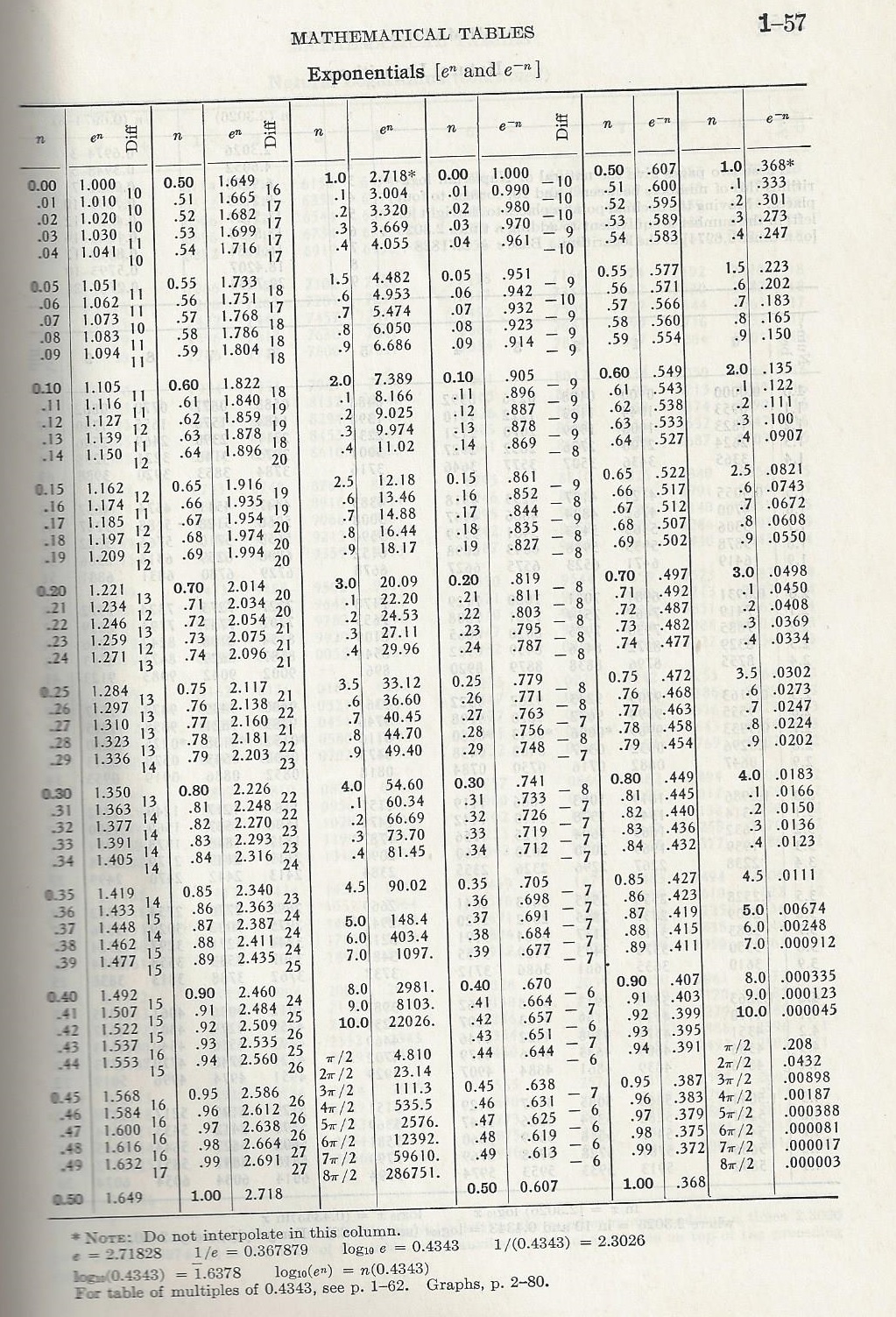
For now, I’m going to ignore how Feynman did this computation in his head and instead discuss “the table.” The setting for this story was approximately 1940, long before the advent of handheld calculators. I’ll often ask my students, “The Brooklyn Bridge got built. So how did people compute e^x before calculators were invented?” The answer is by Taylor series, which were used to produce tables of values of e^x. So, if someone wanted to find e^{3.3}, they just had a book on the shelf.

For example, the following page comes from the book Marks’ Mechanical Engineers’ Handbook, 6th edition, which was published in 1958 and which I happen to keep on my bookshelf at home.

ExponentTable

Look down the fifth and sixth columns of this table, we see that e^{3.3} \approx 27.11. Somebody had computed all of these things (and plenty more) using the Taylor series, and they were compiled into a book and sold to mathematicians, scientists, and engineers.

But what if we needed an approximation better more accurate than four significant digits? Back in those days, there were only two options: do the Taylor series yourself, or buy a bigger book with more accurate tables.

Lessons from teaching gifted elementary students (Part 6b)

Every so often, I’ll informally teach a class of gifted elementary-school students. I greatly enjoy interacting with them, and I especially enjoy the questions they pose. Often these children pose questions that no one else will think about, and answering these questions requires a surprising depth of mathematical knowledge.

Here’s a question I once received:

255/256 to what power is equal to 1/2? And please don’t use a calculator.

Here’s how I answered this question without using a calculator… in fact, I answered it without writing anything down at all. I thought of the question as

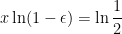
\displaystyle \left( 1 - \epsilon \right)^x = \displaystyle \frac{1}{2}.

\displaystyle x \ln (1 - \epsilon) = \ln \displaystyle \frac{1}{2}

\displaystyle x \ln (1 - \epsilon) = -\ln 2

I was fortunate that my class chose 1/2, as I had memorized (from reading and re-reading Surely You’re Joking, Mr. Feynman! when I was young) that \ln 2 \approx 0.693. Therefore, we have

x \ln (1 - \epsilon) \approx -0.693.

Next, I used the Taylor series expansion

\ln(1+t) = t - \displaystyle \frac{t^2}{2} + \frac{t^3}{3} \dots

to reduce this to

-x \epsilon \approx -0.693,

or

x \approx \displaystyle \frac{0.693}{\epsilon}.

For my students’ problem, I had \epsilon = \frac{1}{256}, and so

x \approx 256(0.693).

So all I had left was the small matter of multiplying these two numbers. I thought of this as

x \approx 256(0.7 - 0.007).

Multiplying 256 and 7 in my head took a minute or two:

256 \times 7 = 250 \times 7 + 6 \times 7

= 250 \times (8-1) + 42

= 250 \times 8 - 250 + 42

= 2000 - 250 + 42

= 1750 + 42

= 1792.

Therefore, 256 \times 0.7 = 179.2 and 256 \times 0.007 = 1.792 \approx 1.8. Therefore, I had the answer of

x \approx 179.2 - 1.8 = 177.4 \approx 177.

So, after a couple minutes’ thought, I gave the answer of 177. I knew this would be close, but I had no idea it would be so close to the right answer, as

x = \displaystyle \frac{\displaystyle \ln \frac{1}{2} }{\displaystyle \ln \frac{255}{256}} \approx 177.0988786\dots

A natural function with discontinuities (Part 1)

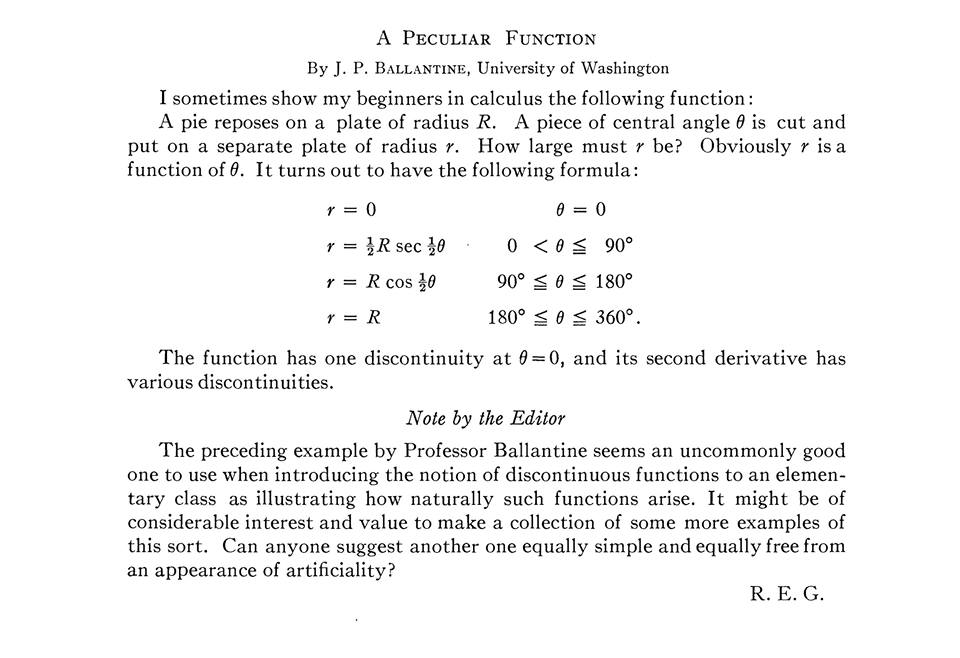
The following tidbit that was published on the American Mathematical Monthly’s Facebook page caught my attention:

discontinuousSource: https://www.facebook.com/AmerMathMonthly/photos/a.250425975006394.53155.241224542593204/1021059947942989/?type=3&theater

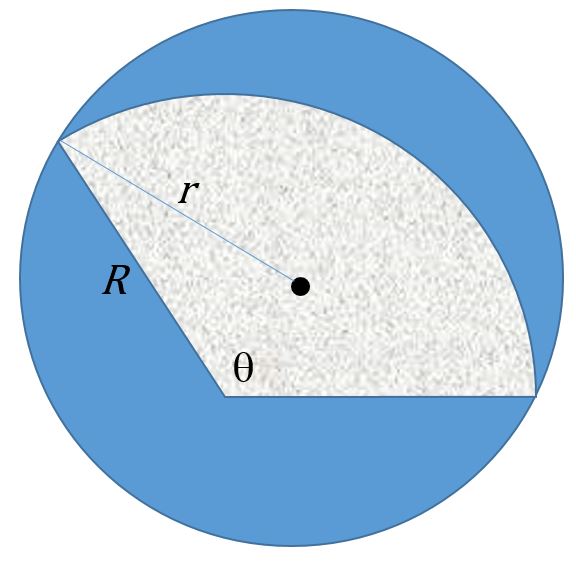
Here’s the relationship between r, R, and \theta in case it isn’t clear from the description. The gray sector is determined by r and \theta, and then the blue circle with radius r is chosen to enclose the sector.
discontinuity0

Unfortunately, there was typo for the third case; it should have been r = R \sin \frac{1}{2} \theta if 90^\circ \le \theta \le 180^\circ. Here’s the graph if R = 1, using radians instead of degrees:

discontinuity1

As indicated in the article, there’s a discontinuity at t=0. However, the rest of the graph looks nice and smooth.
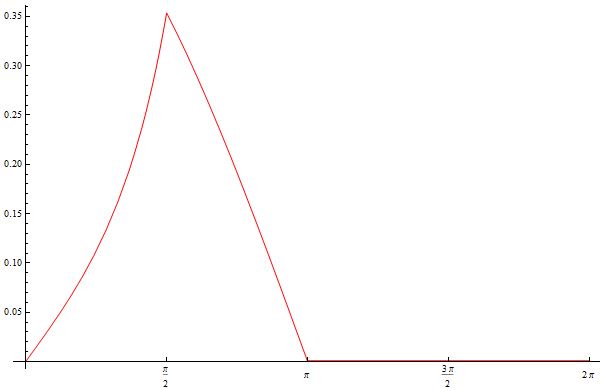
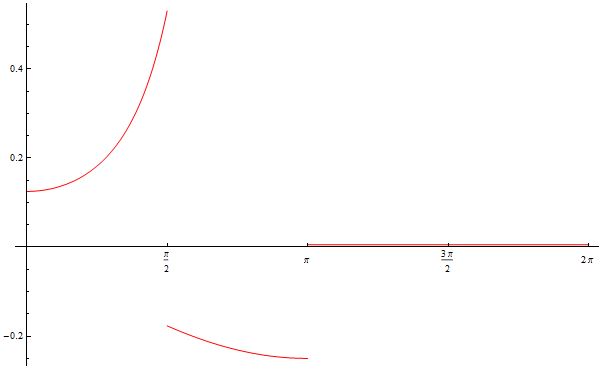
Here’s the graph of the first derivative:

discontinuity2

The first derivative is continuous (and so the original graph is smooth). However, there are obvious corners in the graph of the first derivative, which betray discontinuities in the graph of the second derivative:

discontinuity3

Stump the Prof: An Activity for Calculus I

After finishing the Product, Quotient, and Chain Rules in my calculus class, I’d tell my class the following: “Next time, we’re going to play Stump the Prof. Anything that you can write on the board in 15 seconds, I will differentiate. Anything. I don’t care how hard it looks, I’ll differentiate it (if it has a derivative). So do your best to stump me.”

At the next lecture, I would devote the last 15-20 minutes of class time to Stump the Prof. Students absolutely loved it… their competitive juices got flowing as they tried to think of the nastiest, hairiest functions that they could write on the board in 15 seconds. And I’d differentiate them all using the rules we’d just covered.. though I never promised that I would simplify the derivatives!

Sometimes the results were quite funny. Every once in a while, a student would write some amazingly awful expression but forgot to include an x anywhere. Since the given function was a constant, the derivative of course was zero.

The worst one I ever got was something like this:

y = \csc^4(\sec^5(\csc^8(\sec^7(\csc^4(\sec^5(x)))))

Differentiating this took a good 3-4 minutes and took maybe 5 lines across the entire length of the chalkboard; I remember that my arm was sore after writing down the derivative. Naturally, some wise guy used his 15 seconds to write y = in front of my answer, asking me to find the second derivative. At that, I waved my white handkerchief and  surrendered.

The point of this exercise is to illustrate to students that differentiation is a science; there are rules to follow, and by carefully following the rules, one can find the derivative of any “standard” function.

Later on, when we hit integration, I’ll draw a contrast: differentiation is a science, but integration is a combination of both science and art.

Mathematics that Swings: The Math Behind Golf

From the YouTube description:

Mathematics is everywhere, and the golf course is no exception. Many aspects of the game of golf can be illuminated or improved through mathematical modeling and analysis. We will discuss a few examples, employing mathematics ranging from simple high school algebra to computational techniques at the frontiers of contemporary research.