My Favorite One-Liners: Part 91

In this series, I’m compiling some of the quips and one-liners that I’ll use with my students to hopefully make my lessons more memorable for them.

Everyone once in a while, a student might make a careless mistake  — or just choose an incorrect course of action — that changes what was supposed to be a simple problem into an incredibly difficult problem. For example, here’s a problem that might arise in Calculus I:

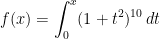
Find f'(x) if f(x) = \displaystyle \int_0^x (1+t^2)^{10} \, dt

The easy way to do this problem, requiring about 15 seconds to complete, is to use the Fundamental Theorem of Calculus. The hard way is by multiplying out (1+t^2)^{10} — preferably using Pascal’s triangle — taking the integral term-by-term, and then taking the derivative of the result. Naturally, a student who doesn’t see the easy way of doing the problem might get incredibly frustrated by the laborious calculations.

So here’s the advice that I give my students to trying to discourage them from following such rabbit trails:

If you find yourself stuck on what seems to be an incredibly difficult problem, you should ask yourself, “Just how evil do I think my professor is?”


My Favorite One-Liners: Part 88

In this series, I’m compiling some of the quips and one-liners that I’ll use with my students to hopefully make my lessons more memorable for them.

In the first few weeks of my calculus class, after introducing the definition of a derivative,

\displaystyle \frac{dy}{dx} = y' = f'(x) = \lim_{h \to 0} \displaystyle \frac{f(x+h) - f(x)}{h},

I’ll use the following steps to guide my students to find the derivatives of polynomials.

  1. If f(x) = c, a constant, then \displaystyle \frac{d}{dx} (c) = 0.
  2. If f(x) and g(x) are both differentiable, then (f+g)'(x) = f'(x) + g'(x).
  3.  If f(x) is differentiable and c is a constant, then (cf)'(x) = c f'(x).
  4. If f(x) = x^n, where n is a nonnegative integer, then f'(x) = n x^{n-1}.
  5. If f(x) = a_n x^n + a_{n-1} x^{n-1} + \dots + a_1 x + a_0 is a polynomial, then f'(x) = n a_n x^{n-1} + (n-1) a_{n-1} x^{n-2} + a_1.

After doing a few examples to help these concepts sink in, I’ll show the following two examples with about 3-4 minutes left in class.

Example 1. Let A(r) = \pi r^2. Notice I’ve changed the variable from x to r, but that’s OK. Does this remind you of anything? (Students answer: the area of a circle.)

What’s the derivative? Remember, \pi is just a constant. So A'(r) = \pi \cdot 2r = 2\pi r.

Does this remind you of anything? (Students answer: Whoa… the circumference of a circle.)

Generally, students start waking up even though it’s near the end of class. I continue:

Example 2. Now let’s try V(r) = \displaystyle \frac{4}{3} \pi r^3. Does this remind you of anything? (Students answer: the volume of a sphere.)

What’s the derivative? Again, \displaystyle \frac{4}{3} \pi is just a constant. So V'(r) = \displaystyle \frac{4}{3} \pi \cdot 3r^2 = 4\pi r^2.

Does this remind you of anything? (Students answer: Whoa… the surface area of a sphere.)

By now, I’ve really got my students’ attention with this unexpected connection between these formulas from high school geometry. If I’ve timed things right, I’ll say the following with about 30-60 seconds left in class:

Hmmm. That’s interesting. The derivative of the area of a circle is the circumference of the circle, and the derivative of the area of a sphere is the surface area of the sphere. I wonder why this works. Any ideas? (Students: stunned silence.)

This is what’s known as a cliff-hanger, and I’ll give you the answer at the start of class tomorrow. (Students groan, as they really want to know the answer immediately.) Class is dismissed.

If you’d like to see the answer, see my previous post on this topic.

My Favorite One-Liners: Part 87

In this series, I’m compiling some of the quips and one-liners that I’ll use with my students to hopefully make my lessons more memorable for them.

When teaching Calculus I, I use the following mantra throughout the semester. I heard this from my calculus instructor back in 1984, and I repeat it for my own students:

There are two themes of calculus: approximating curved things by straight things, and passing to limits.

For example, to find a derivative, we approximate a curved function by a straight tangent line and then pass to a limit. Later in the semester, to find a definite integral, we approximate the area under a curve by the sum of a bunch of straight rectangles and then pass to a limit.

For further reading, I’ll refer to this series of posts on what I typically do on the first day of my calculus class.


My Favorite One-Liners: Part 83

In this series, I’m compiling some of the quips and one-liners that I’ll use with my students to hopefully make my lessons more memorable for them.

Here’s a problem from calculus:

Let f(x) = x^2 e^{3x}. Find f''(x).

We begin by finding the first derivative using the Product Rule:

f'(x) = 2x e^{3x} + 3x^2 e^{3x}.

Next, we apply the Product Rule again to find the second derivative:

f''(x) = (2 e^{3x} + 6x e^{3x}) + (6x e^{3x} + 9x^2 e^{3x}).

At this point, before simplifying to get the final answer, I’ll ask my students why the 6x e^{3x} term appears twice. After a moment, somebody will usually volunteer the answer: the first term came from differentiating x^2 first and then e^{3x} second, while the other term came from differentiating e^{3x} first and then x^2 second. Either way, we end up with the same term.

I then tell my class that there’s a technical term for this: Oops, I did it again.

While on the topic, I can’t resist also sharing this (a few years ago, this was shown on the JumboTron of Dallas Mavericks games during timeouts):

My Favorite One-Liners: Part 82

In this series, I’m compiling some of the quips and one-liners that I’ll use with my students to hopefully make my lessons more memorable for them.

In differential equations, we teach our students that to solve a homogeneous differential equation with constant coefficients, such as

y'''+y''+3y'-5y = 0,

the first step is to construct the characteristic equation

r^3 + r^2 + 3r - 5 = 0

by essentially replacing y' with r, y'' with r^2, and so on. Standard techniques from Algebra II/Precalculus, like the rational root test and synthetic division, are then used to find the roots of this polynomial; in this case, the roots are r=1 and r = -1\pm 2i. Therefore, switching back to the realm of differential equations, the general solution of the differential equation is

y(t) = c_1 e^{t} + c_2 e^{-t} \cos 2t + c_3 e^{-t} \sin 2t.

As t \to \infty, this general solution blows up (unless, by some miracle, c_1 = 0). The last two terms decay to 0, but the first term dominates.

The moral of the story is: if any of the roots have a positive real part, then the solution will blow up to \infty or -\infty. On the other hand, if all of the roots have a negative real part, then the solution will decay to 0 as t \to \infty.

This sets up the following awful math pun, which I first saw in the book Absolute Zero Gravity:

An Aeroflot plan en route to Warsaw ran into heavy turbulence and was in danger of crashing. In desparation, the pilot got on the intercom and asked, “Would everyone with a Polish passport please move to the left side of the aircraft.” The passengers changed seats, and the turbulence ended. Why? The pilot achieved stability by putting all the Poles in the left half-plane.

My Favorite One-Liners: Part 75

In this series, I’m compiling some of the quips and one-liners that I’ll use with my students to hopefully make my lessons more memorable for them.

The \delta-\epsilon definition of a limit is often really hard for students to swallow:

\forall \epsilon > 0 \exists \delta > 0 \forall x (0 < |x - c| < \delta \Rightarrow |f(x) - L| < \epsilon)

To make this a little more palatable, I’ll choose a simple specific example, like \lim_{x \to 2} x^2 = 4, or

\forall \epsilon > 0 \exists \delta > 0 \forall x (0 < |x - 2| < \delta \Rightarrow |x^2 - 4| < \epsilon)

I’ll use one of the famous lines from “Annie Get Your Gun”:

Anything you can do, I can do better.

In other words, no matter how small a \delta they give me, I can find an \epsilon that meets the requirements of this limit.


My Favorite One-Liners: Part 74

In this series, I’m compiling some of the quips and one-liners that I’ll use with my students to hopefully make my lessons more memorable for them.

After presenting the Fundamental Theorem of Calculus to my calculus students, I make a point of doing the following example in class:

\displaystyle \int_0^4 \frac{1}{4} x^2 \, dx

Hopefully my students are able to produce the correct answer:

\displaystyle \int_0^4 \frac{1}{4} x^2 \, dx = \displaystyle \left[ \frac{x^3}{12} \right]^4_0

= \displaystyle \frac{(4)^3}{12} - \frac{(0)^3}{12}

= \displaystyle \frac{64}{12}

= \displaystyle \frac{16}{3}

Then I tell my students that they’ve probably known the solution of this one since they were kids… and I show them the classic video “Unpack Your Adjectives” from Schoolhouse Rock. They’ll watch this video with no small amount of confusion (“How is this possibly connected to calculus?”)… until I reach the 1:15 mark of the video below, when I’ll pause and discuss this children’s cartoon. This never fails to get an enthusiastic response from my students.

If you have no idea what I’m talking about, be sure to watch the first 75 seconds of the video below. I think you’ll be amused.

My Favorite One-Liners: Part 73

In this series, I’m compiling some of the quips and one-liners that I’ll use with my students to hopefully make my lessons more memorable for them.

Today’s entry is courtesy of Season 1 of The Simpsons. I’ll tell this joke just after introducing derivatives to my calculus students. Here is some dialogue from the episode “Bart The Genius”:

Teacher:  So y = r cubed over 3. And if you determine the rate of change in this curve correctly, I think you’ll be pleasantly surprised.
[The class laughs except for Bart who appears confused.]
Teacher:  Don’t you get it, Bart? Derivative dy = 3 r squared dr over 3, or r squared dr, or r dr r. Har-de-har-har!  Get it?

For a more detailed listing of mathematical references, I highly recommend http://www.simpsonsmath.com (or http://mathsci2.appstate.edu/~sjg/simpsonsmath/), maintained by Dr. Sarah J. Greenwald of Appalachian State University and Dr. Andrew Nestler of Santa Monica College.

My Favorite One-Liners: Part 72

In this series, I’m compiling some of the quips and one-liners that I’ll use with my students to hopefully make my lessons more memorable for them.

In calculus, the Intermediate Value Theorem states that if f is a continuous function on the closed interval [a,b] and y_0 is any number between f(a) and f(b), then there is at least one point c \in [a,b] so that $f(c) =y_0$.

When I first teach this, I’ll draw some kind of crude diagram on the board:

In this picture, f(a) is less than y_0 while f(b) is greater than y_0. Hence the one-liner:

I call the Intermediate Value Theorem the Goldilocks principle. After all, f(a) is too low, and f(b) is too high, but there is some point in between that is just right.


My Favorite One-Liners: Part 60

In this series, I’m compiling some of the quips and one-liners that I’ll use with my students to hopefully make my lessons more memorable for them.

I’m a big believer using scaffolded lesson plans, starting from elementary ideas and gradually building up to complicated ideas. For example, when teaching calculus, I’ll use the following sequence of problems to introduce students to finding the volume of a solid of revolution using disks, washers, and shells:

  • Find the volume of a cone with height h and base radius r.
  • Find the volume of the solid generated by revolving  the region bounded by y=2, y=2\sin x for 0 \le x \le \pi/2, and the y-axis about the line y=2.
  • Find the volume of the solid generated by revolving the region bounded by y=2, y=\sqrt{x}, and the y-axis about the line y=2 .
  • Find the volume of the solid generated by revolving the region bounded by y=2, y=\sqrt{x}, and the y-axis about the y-axis .
  • Find the volume of the solid generated by revolving the region bounded by x=\sqrt{2y}/(y+1), y=1, and the y-axis about the y-axis .
  • Find the volume of the solid generated by revolving  the region bounded by the parabola x=y^2+1 and the line x=3 about the line x=3.
  • Water is poured into a spherical tank of radius R to a depth h. How much water is in the tank?
  • Find the volume of the solid generated by revolving the region bounded by y= x^2, the x-axis, and x=4 about the x-axis.
  • Find the volume of the solid generated by revolving the region bounded by y= x^2, the x-axis, and x=4 about the y-axis.
  • Repeat the previous problem using cylindrical shells.

In this sequence of problems, I slowly get my students accustomed to the ideas of horizontal and vertical slices, integrating with respect to either x and y, the creation of disks and washers and (eventually) cylindrical shells.

As the problems increase in difficulty, I enjoy using the following punch line:

To quote the great philosopher Emeril Lagasse, “Let’s kick it up a notch.”