Engaging students: Equations of two variables

In my capstone class for future secondary math teachers, I ask my students to come up with ideas for engaging their students with different topics in the secondary mathematics curriculum. In other words, the point of the assignment was not to devise a full-blown lesson plan on this topic. Instead, I asked my students to think about three different ways of getting their students interested in the topic in the first place.

I plan to share some of the best of these ideas on this blog (after asking my students’ permission, of course).

This student submission again comes from my former student Taylor Bigelow. Her topic, from Algebra: equations of two variables.

green line

What interesting (i.e., uncontrived) word problems using this topic can your students do now?

This topic is perfect for word problems, you can make a lot of interesting word problems using 2 variables. Here are some examples of word problems.

● Sam is mowing lawns for money over the summer. They charge $10 an hour. They have a family discount of 20% per hour. If they mow non-family members laws for 10 hours this week and mowed family members laws for 3 hours, how much money did they make this week?
○ 10N+8F=?
○ N=10 and F=3
○ 10(10)+8(3)=124
○ So they made $124

● John is buying blue and yellow gummy bears at the store. He has $20 to spend on candy. Blue gummy bears come in bags of 20 for $1 each, and Yellow gummy bears come in bags of 50 for $3 each. He knows we want exactly 100 Blue gummy bears. How many yellow gummy bears can he buy?
○ B=Blue gummy Bears Y=Yellow gummy Bears
○ 20=B+Y
○ B= 100/20= $5 for 100 gummy bears
○ 20= 5+Y so Y=$15
○ With $15 he can buy 5 bags of yellow gummy bears. 5*50=250. So he can buy
250 yellow gummy bears

● Alex is building a fence for her backyard. She is building it in a rectangular shape, and she wants the length of the fence to be twice as long as the width of the fence. If the area of her backyard is 200 feet, how long is the width, and how long is the length?
○ L=length W=width
○ L*W=200
○ L=2W
○ 2W*W=200
○ 2W^2=200
○ W^2=100
○ W=10
○ So L=2(10)=20

These are just 3 examples I came up with on the spot. You can create a lot more, and
with a variety of difficulties.

green line

How does this topic extend what your students should have learned in previous courses?
This topic builds on knowledge from elementary school and extends into almost all future math. It starts with kids understanding multiplication and addition, then to them being introduced to solving equations in middle school, and then is heavily used in high school math classes, and any math class that requires basic algebra skills in the future. I looked through some of the teks to find references to two-variable equations and found it only referenced in algebra 1 and 2. I also went back through 6th, 7th, and 8th grade and found where they were using one-variable equations since that is the prior knowledge that they are building onto with two-variable equations.

● 6th Grade
○ (9) Expressions, equations, and relationships. The student applies mathematical
process standards to use equations and inequalities to represent situations. The
student is expected to:
■ (A) write one-variable, one-step equations and inequalities to represent
constraints or conditions within problems;
■ (B) represent solutions for one-variable, one-step equations and
inequalities on number lines; and
■ (C) write corresponding real-world problems given one-variable,
one-step equations or inequalities.
○ (10) Expressions, equations, and relationships. The student applies
mathematical process standards to use equations and inequalities to solve
problems. The student is expected to:
■ (A) model and solve one-variable, one-step equations and inequalities
that represent problems, including geometric concepts; and
■ (B) determine if the given value(s) make(s) one-variable, one-step
equations or inequalities true.
● 7th Grade
○ (10) Expressions, equations, and relationships. The student applies
mathematical process standards to use one-variable equations and inequalities
to represent situations. The student is expected to:
■ (A) write one-variable, two-step equations and inequalities to represent
constraints or conditions within problems;
■ (B) represent solutions for one-variable, two-step equations and
inequalities on number lines; and
■ (C) write a corresponding real-world problem given a one-variable,
two-step equation or inequality.
○ (11) Expressions, equations, and relationships. The student applies
mathematical process standards to solve one-variable equations and inequalities.
The student is expected to:
■ (A) model and solve one-variable, two-step equations and inequalities;
■ (B) determine if the given value(s) make(s) one-variable, two-step
equations and inequalities true
● 8th Grade
○ Expressions, equations, and relationships. The student applies mathematical
process standards to use one-variable equations or inequalities in problem
situations. The student is expected to:
■ (A) write one-variable equations or inequalities with variables on both
sides that represent problems using rational number coefficients and
constants;
■ (B) write a corresponding real-world problem when given a
one-variable equation or inequality with variables on both sides of the
equal sign using rational number coefficients and constants;
■ (C) model and solve one-variable equations with variables on both
sides of the equal sign that represent mathematical and real-world
problems using rational number coefficients and constants
● Algebra 1
○ (2) Linear functions, equations, and inequalities. The student applies the
mathematical process standards when using properties of linear functions to
write and represent in multiple ways, with and without technology, linear
equations, inequalities, and systems of equations. The student is expected to:
■ (B) write linear equations in two variables in various forms, including y
= mx + b, Ax + By = C, and y – y1 = m (x – x1 ), given one point and the
slope and given two points;
■ (C) write linear equations in two variables given a table of values, a
graph, and a verbal description;
■ (H) write linear inequalities in two variables given a table of values, a
graph, and a verbal description
○ (3) Linear functions, equations, and inequalities. The student applies the
mathematical process standards when using graphs of linear functions, key
features, and related transformations to represent in multiple ways and solve,
with and without technology, equations, inequalities, and systems of equations.
The student is expected to:
■ (D) graph the solution set of linear inequalities in two variables on the
coordinate plane;
■ (F) graph systems of two linear equations in two variables on the
coordinate plane and determine the solutions if they exist;
■ (G) estimate graphically the solutions to systems of two linear
equations with two variables in real-world problems; and
■ (H) graph the solution set of systems of two linear inequalities in two
variables on the coordinate plane.
○ (5) Linear functions, equations, and inequalities. The student applies the
mathematical process standards to solve, with and without technology, linear
equations and evaluate the reasonableness of their solutions. The student is
expected to:
■ (C) solve systems of two linear equations with two variables for
mathematical and real-world problems.
● Algebra 2
○ (3) Systems of equations and inequalities. The student applies mathematical
processes to formulate systems of equations and inequalities, use a variety of
methods to solve, and analyze reasonableness of solutions. The student is
expected to:
■ (C) solve, algebraically, systems of two equations in two variables
consisting of a linear equation and a quadratic equation;
■ (D) determine the reasonableness of solutions to systems of a linear
equation and a quadratic equation in two variables;
■ (E) formulate systems of at least two linear inequalities in two variables;
■ (F) solve systems of two or more linear inequalities in two variables; and
■ (G) determine possible solutions in the solution set of systems of two or
more linear inequalities in two variables.

green line

What interesting things can you say about the people who contributed to the discovery and/or the development of this topic?

Algebra is a really old concept, dating back almost 4 thousand years ago. (So kids have been doing the same thing in classes for millennia.) The Babylonians were the first to use algebra in the 1900s. The Egyptians also used algebra around the same time, but they focused on linear algebra, while the Babylonians did quadratic and cubic equations. The ancient Greeks used geometric algebra around 300 BC. They solved algebra equations using geometry, and their methods are very different from the ones we use today. A thousand years later, around 800 AD, Muhammad ibn Musa al-Khwarizmi became the father of modern algebra. The middle east used Arabic numerals (the numbers 0-9 which we still use today). The word algorithm is even derived from his name. Algebra started thousands of years ago to solve problems and has been developed over time into what it is today.

Citations:
https://www.mathtutordvd.com/public/Who-Invented-Algebra.cfm
https://texreg.sos.state.tx.us/public/readtac$ext.ViewTAC?tac_view=4&ti=19&pt=2&ch=111

Engaging students: The quadratic formula

In my capstone class for future secondary math teachers, I ask my students to come up with ideas for engaging their students with different topics in the secondary mathematics curriculum. In other words, the point of the assignment was not to devise a full-blown lesson plan on this topic. Instead, I asked my students to think about three different ways of getting their students interested in the topic in the first place.

I plan to share some of the best of these ideas on this blog (after asking my students’ permission, of course).

This student submission again comes from my former student Sydney Araujo. Her topic, from Algebra: the quadratic formula.

green line

D4. What are the contributions of various cultures to this topic?

The quadratic formula can be traced all the way back to the Ancient Egyptians. The ancient Egyptians knew how to calculate the area of different shapes but did not know how to calculate the length of the sides of a shape. Moving forward, it is speculated that the Babylonians developed the completing the square method to solve problems involving areas. The Babylonians used a more similar number system to the one we use today. Instead, they used hexagesimal which made addition and multiplication easier. We can also see a similar method used by the Chinese around the same time. Pythagoras and Euclid were some of the first to attempt to find a more general formula to solve quadratic equations, both using a geometric approach. They’re ideas differ slightly, Pythagoras observed that the value of a square root is not always an integer but he refused to allow for proportions that were not rational. Whereas Euclid proposed that irrational square roots are also possible. At the time, the ancient Greeks did not use the same number system that we use, so it was impossible to calculate square roots by hand. It wasn’t until the Indian mathematician, Brahmagupta, who came up with the solution to the quadratic formula. This is because Indian mathematics used the decimal system as well as zero which had a massive advantage over the Egyptians and Greeks. Brahmagupta was the one that recognized that there are two roots in the solution to the quadratic equation and described the quadratic formula.

green line

A2. How could you as a teacher create an activity or project that involves your topic?

One of my fondest high school memories is from my junior year physics class. It was the famous Punkin’ Chunkin’ project. Students were put in groups and asked to build a trebuchet or catapult that could launch a pumpkin across a field. The only requirement was for the device to work, the distance was just fun extra credit. For this project we had to predict the pumpkins trajectory using different variables like the pumpkin’s weight, force, momentum, etc. However, by the time we were juniors, we had either taken Algebra 2 or were currently in it. So, our physics and algebra teacher were working together so that by the time this project came around we were working on quadratic equations in algebra. As the shape of the trajectory of a pumpkin was a parabola. Because of this experience, I can create an activity or even a similar project with the physics teacher. This way students see the different applications of quadratic equations and have a tangible real world math experience.

green line

B2. How does this topic extend what your students should have learned in previous courses?

As the quadratic formula is taught in Algebra 1, students have only seen linear equations prior to that point. Students recognize that when they are solving these equations, they are looking for one solution, no solution, or infinitely many solutions. The one solution being a singular ordered pair and then they are done. What students then must extend on when they reach quadratic equations, and the quadratic formula is that they’re now looking for two separate solutions. So, at this point they know how to solve for x and understand inverses which is important when it comes to quadratic equations. During the solving process of a quadratic equation, students may have to take the square root of both sides of the equation which will give you a plus or minus sign in front of the square root. Which makes the connection on why there are two solutions to a quadratic equation and the quadratic formula, because a parabola has two roots.

Works Cited:

Brahambhatt, Rupendra. “Quadratic Formula: What, Why, and How It Changed Mathematics.” Interesting Engineering, Interesting Engineering, 16 July 2021, interestingengineering.com/quadratic-formula-what-why-and-how-it-changed-mathematics.

Engaging students: Powers and exponents

In my capstone class for future secondary math teachers, I ask my students to come up with ideas for engaging their students with different topics in the secondary mathematics curriculum. In other words, the point of the assignment was not to devise a full-blown lesson plan on this topic. Instead, I asked my students to think about three different ways of getting their students interested in the topic in the first place.

I plan to share some of the best of these ideas on this blog (after asking my students’ permission, of course).

This student submission comes from my former student Ashlyn Farley. Her topic, from Pre-Algebra: powers and exponents.

green line

One class activity that will engage students while reviewing and/or teaching Exponent/Power concepts is “Marshmallow and Toothpicks.” This activity can be used for teaching the basic of exponents, as well as exponent laws. The idea is that the toothpicks are different colors, and the different colors represent different bases, thus the same color means it’s the same base. The marshmallows represent the exponent, i.e. the number of times the student needs to multiply the base. By following a worksheet of questions, the students should be able to solve exponent problems physically, visually, and abstractly. This activity, I believe, is best done with partners or groups so that the students can discuss how they think the exponents/exponent laws work. After the activity, the students are also able to eat their marshmallows, which encourages the students to participate and complete their work.

green line

Exponents are used in functions, equations, and expressions throughout math, thus having a deep understanding of exponents and their laws is very important. By fully mastering exponents and exponent laws, the students will be able to more easily grasp more difficult material that uses these concepts. Some specific ideas that use exponents and/or exponent laws in future math courses are: multiplying polynomials, finding the volume and surface area of prisms and cylinders, as well as computing the composition of two functions. Exponents are also used in many other situations than just math, such as in science or even in careers. Some careers that consistently use exponents and/or exponent laws are: Bankers, Computer Programmers, Mechanics, Plumbers, and many more.

green line

How can technology (YouTube, Khan Academy [khanacademy.org], Vi Hart, Geometers Sketchpad, graphing calculators, etc.) be used to effectively engage students with this topic?

An easy way to introduce students who have never seen exponents or exponential growth before is to use a graphing calculator. By plugging in an exponential function into the calculator and viewing the graph and zooming out, students can easily see how quickly numbers start to get The website Legends of Learning focuses on creating educational games for students in kindergarten through 9th grade. One game that goes over exponents, as well as the exponent laws, is Expodyssey. This game has the students solve problems to “fix” a spaceship to get back to Earth. The problems are built upon each other, so it starts by having the student answer what an exponent is, then what multiplying two exponents same base is, and keeps building from there. Each concept has multiple problems to be solved before moving on so that the students can show their mastery of the content. I believe that this game also helps improve cognitive skills by having the students do various activities simultaneously, such as calculating, reading, maneuvering elements and/or filling answers as required.

References:
Blog: Number Dyslexia
Link: https://numberdyslexia.com/top-7-games-for-understanding-math-exponents/

Engaging students: Computing the determinant of a matrix

In my capstone class for future secondary math teachers, I ask my students to come up with ideas for engaging their students with different topics in the secondary mathematics curriculum. In other words, the point of the assignment was not to devise a full-blown lesson plan on this topic. Instead, I asked my students to think about three different ways of getting their students interested in the topic in the first place.

I plan to share some of the best of these ideas on this blog (after asking my students’ permission, of course).

This student submission again comes from my former student Brendan Gunnoe. His topic: computing the determinant of a matrix.

green line

How can this topic be used in your students’ future courses in mathematics or science?

When students learn about the determinant of a matrix, they only learn about computing it and don’t learn about the applications of the determinant or what they signify. One interesting use of the determinant is finding the eigenvectors of a matrix. A visual understanding of what an eigenvector is can be done by showing what a matrix does to the any generic vector, and what it does to the eigenvectors. For a generic vector that is different from an eigenvector, the matrix knocks the vector off the span of the original vector. What makes an eigenvector special is the fact that the matrix transformation keeps the eigenvector on its span but rescales said eigenvector by its eigenvalue. For example, take the matrix

\left[ \begin{array}{cc} 5 & 3 \\ 3 & 5 \end{array} \right].

This matrix’s eigenvectors are \left[ \begin{array}{c} 1 \\ 1 \end{array} \right] and \left[ \begin{array}{c} 1 \\ -1 \end{array} \right] with eigenvalues 8 and 2 respectively. That is,

\left[ \begin{array}{cc} 5 & 3 \\ 3 & 5 \end{array} \right] \left[ \begin{array}{c} 1 \\ 1 \end{array} \right] = \left[ \begin{array}{c} 8 \\ 8 \end{array} \right] = 8 \left[ \begin{array}{c} 1 \\ 1 \end{array} \right]

and

\left[ \begin{array}{cc} 5 & 3 \\ 3 & 5 \end{array} \right] \left[ \begin{array}{c} 1 \\ -1 \end{array} \right] = \left[ \begin{array}{c} 2 \\ -2 \end{array} \right] = 2 \left[ \begin{array}{c} 1 \\ -1 \end{array} \right].

Eigenvectors have many useful applications in future math and science classes including electronics, linear algebra, differential equations and mechanical engineering.

green line

How can technology (YouTube, Khan Academy [khanacademy.org], Vi Hart, Geometers Sketchpad, graphing calculators, etc.) be used to effectively engage students with this topic? Note: It’s not enough to say “such-and-such is a great website”; you need to explain in some detail why it’s a great website.

The YouTube channel 3Blue1Brown has a fantastic video on determinates and linear transformations. Grant, the channel owner, uses animations to visualize what a matrix transformation does to the plane . He starts by showing what a transformation does to a single square then shows why the change of change of that one area shows what happens to the area of any region. He also gives multiple explanations for what a negative determinate means in terms of orientation of the axes. Then he explains what happens when the determinate is 0. All of this is already extremely useful for understanding what a 2×2 matrix does, but Grant continues and extends all the same things for 3×3 transformations. Lastly, Grant gives a few explanations on why the formula for the determinate is what it is and poses a small puzzle for the viewer to contemplate. This video explains what and why we use determinates and how they can be useful all while showing pleasing visual examples and other explanations.

green line

What interesting word problems using this topic can your students do now?

Using determinates to see if a set of vectors is a basis.

The determinant can tell you when a matrix squishes space into a lower dimensional space like a line or a plane. Thus, taking the determinate of a matrix composed of a set of vectors tells you if those vectors are a basis for the matrix’s dimension.

Part 1. A 3D printer’s axes are set up in such a way that the print head can only travel in the direction \left[ \begin{array}{c} 1 \\ 1 \end{array} \right] and \left[ \begin{array}{c} -1 \\ 1 \end{array} \right]. Assume that the place where the print head is right now is the origin \left[ \begin{array}{c} 0 \\ 0 \end{array} \right]. Can you move the print head to the location \left[ \begin{array}{c} x \\ y \end{array} \right] and \left[ \begin{array}{c} 1 \\ -1 \end{array} \right] by only moving in the directions of \left[ \begin{array}{c} 1 \\ 1 \end{array} \right] and \left[ \begin{array}{c} -1 \\ 1 \end{array} \right]?

Hint: Try to solve \left[ \begin{array}{cc} 1 & -1 \\ 1 & 1 \end{array} \right] \left[ \begin{array}{c} a \\ b \end{array} \right] = \left[ \begin{array}{c} x \\ y \end{array} \right] . Does this always have a solution \left[ \begin{array}{c} a \\ b \end{array} \right]?

Part 2. Next time you turn on your 3D printer, one of the motor’s broke and now the print head can only move in the direction of \left[ \begin{array}{c} 1 \\ 0 \end{array} \right]. Assume that the place where the print head is right now is the origin \left[ \begin{array}{c} 0 \\ 0 \end{array} \right]. Can you move the print head to the location  by only moving in the direction of \left[ \begin{array}{c} 1 \\ 0 \end{array} \right]?

Hint: Try to solve \left[ \begin{array}{cc} 1 & 0 \\ 0 & 0 \end{array} \right] \left[ \begin{array}{c} a \\ b \end{array} \right] = \left[ \begin{array}{c} x \\ y \end{array} \right] . Does this always have a solution \left[ \begin{array}{c} a \\ b \end{array} \right]?

Part 3. You buy a new 3D printer that it can move in all three directions: up/down, left/right, forward/backwards. When you test out the movement of the print head, you see that each axis moves in the directions of \left[ \begin{array}{c} 1 \\ 0 \\ 0 \end{array} \right], \left[ \begin{array}{c} 0 \\ 1 \\ 0 \end{array} \right], and \left[ \begin{array}{c} 0 \\ 0 \\ 1 \end{array} \right]. Can you use your new 3D printer to go to any location \left[ \begin{array}{c} x \\ y \\ z \end{array} \right], inside the printing space?

Hint: Think about solving \left[ \begin{array}{ccc} 1 & 0 & 0 \\ 0 & 1 & 0 \\ 0 & 0 & 1 \end{array} \right] \left[ \begin{array}{c} a \\ b \\ c \end{array} \right] = \left[ \begin{array}{c} x \\ y \\ z \end{array} \right] . Does this always have a solution \left[ \begin{array}{c} a \\ b \\ c \end{array} \right]? How do you know?

Part 4. Your little sibling messed around with your new 3D printer and now it moves in the directions \left[ \begin{array}{c} 1 \\ 0 \\ 1 \end{array} \right], \left[ \begin{array}{c} 1 \\ 1 \\ 0 \end{array} \right], and \left[ \begin{array}{c} 2 \\ 1 \\ 1 \end{array} \right]. Is your 3D printer able to get to some point \left[ \begin{array}{c} x \\ y \\ z \end{array} \right] inside the printing space as is, or do you need to fix your printer?

Hint: Think about solving \left[ \begin{array}{ccc} 1 & 1 & 2 \\ 0 & 1 & 1 \\ 1 & 0 & 1 \end{array} \right] \left[ \begin{array}{c} a \\ b \\ c \end{array} \right] = \left[ \begin{array}{c} x \\ y \\ z \end{array} \right]. Does this always have a solution \left[ \begin{array}{c} a \\ b \\ c \end{array} \right]? How do you know?

Engaging students: Using a recursively defined sequence

In my capstone class for future secondary math teachers, I ask my students to come up with ideas for engaging their students with different topics in the secondary mathematics curriculum. In other words, the point of the assignment was not to devise a full-blown lesson plan on this topic. Instead, I asked my students to think about three different ways of getting their students interested in the topic in the first place.

I plan to share some of the best of these ideas on this blog (after asking my students’ permission, of course).

This student submission comes from my former student Enrique Alegria. His topic, from Precalculus: using a recursively defined sequence.

green line

How can this topic be used in your students’ future courses in mathematics or science?

            Recursion is heavily emphasized within the branches of computer science. The technique can be used more than just in arithmetic and geometric sequences for finding the next term. Within computer science, recursion techniques can be utilized for sorting algorithms. The content will be able to transfer easily. Instead of finding the previous term to use to find the current term, within sorting algorithms, a set of numbers is chunked into smaller and smaller sets such that the original set of numbers becomes sorted.

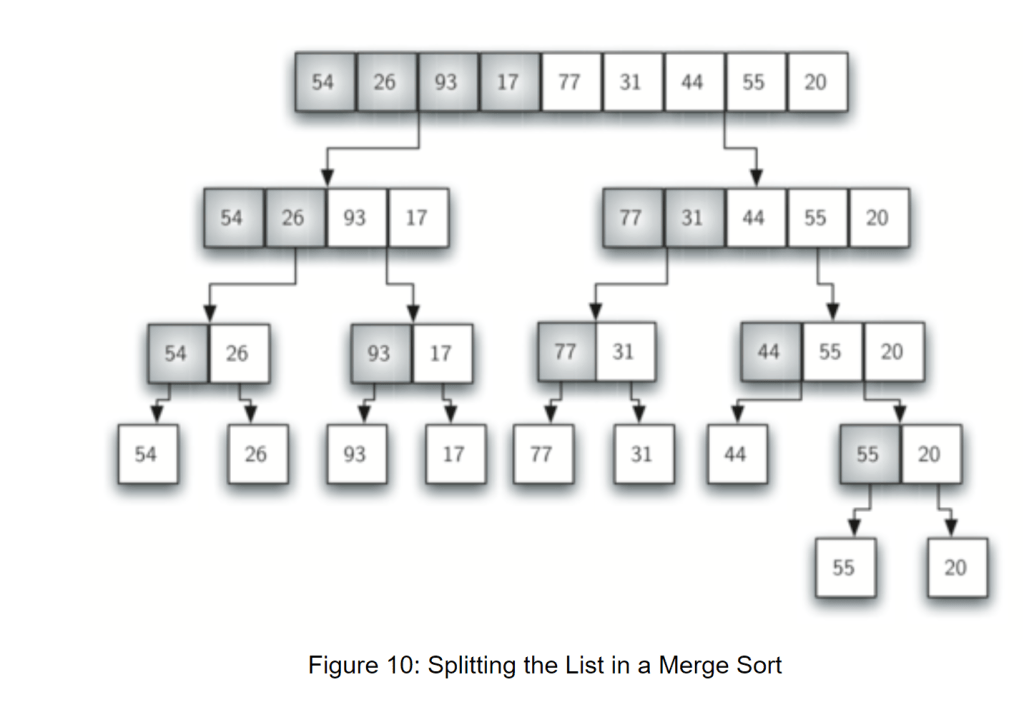
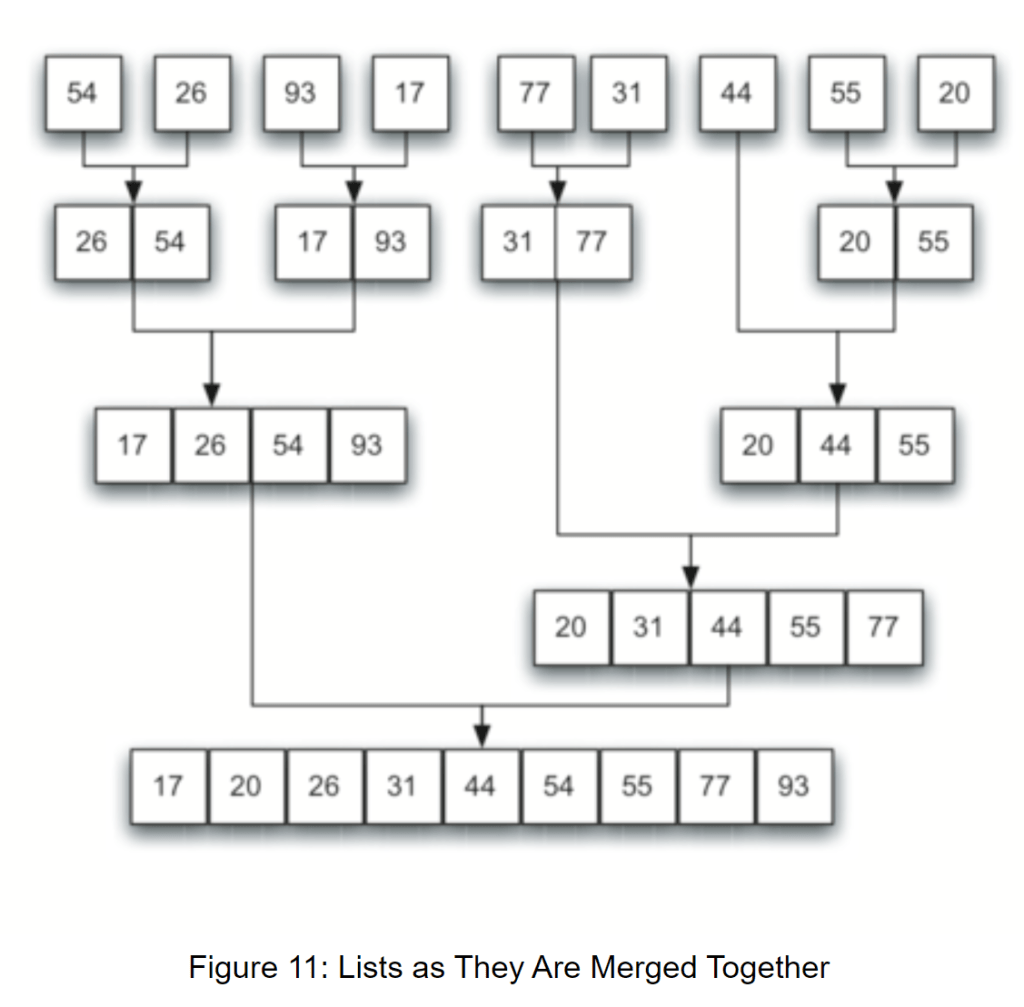
            We can take a deeper look at Merge Sort which is a recursive sorting algorithm. What occurs is the set of numbers repeatedly gets cut in half until there is only one element in the list. From there the elements are sorted in increasing order. Traversing back into the original size of the list with all of the elements contained except the final output is the list in increasing order.

This image has an empty alt attribute; its file name is mergesort1.png

This image has an empty alt attribute; its file name is mergesort2.png

Students can inspect the algorithm visually and need not to understand the implementation of code to comprehend the functionality of recursion. Guiding the students towards the smallest part of the process which is the single element and from there rearranging the elements of the list.

green line

How has this topic appeared in high culture (art, classical music, theatre, etc.)?

            Recursively defined sequences influenced a renowned artist who is M.C. Escher. The concept of a sequence beginning at one point and continuing infinitely is how Escher exhibits recursion. Escher challenges the viewer of his work to determine the patterns from the artistic series.

This image has an empty alt attribute; its file name is drawinghands.png

For example, when observing the piece Drawing Hands, a student can predict what the ‘base case’ of the artwork would be followed by the next steps of the drawing. The spectator of this piece can break it apart into smaller and smaller partitions of the whole. And once they reach a starting point, they can put together the whole picture once again.

This image has an empty alt attribute; its file name is twobirds.png

Similarly, students can view this piece titled Two Birds to follow the patterns. Without saying the name of the piece students can again predict the base case and determine how recursion techniques would be used for this sequence. Students can begin to learn how to think of how recursively defined sequences are applied through visual representations of M.C. Escher’s artwork.

green line

How can technology be used to effectively engage students with this topic?

            Technology can be used to effectively engage students with recursion by showcasing the YouTube video “Recursion: The Music Videos of Michel Gondry” by Polyphonic. Through this video, students can compare recursively defined sequences to music they listen to. The video starts with singular notes and then repeating the notes to create a rhythm. Compiling the initial sounds into something familiar through loops of samples and sound bites. This video goes into the repetitive patterns of the small chunks of sound are shown through visual representations with the music videos by Michel Gondry. In the music video “Star Guitar” by The Chemical Brothers, the video starts off with the listener on a train ride going through a landscape. Slowly patterns emerge as buildings uniquely correspond to the notes and rhythms within the song. With this YouTube video students obtain a great introduction to recursion and hopefully continue to find patterns of recursion to music they listen to in the future.

References

Greenberg I., Xu D., Kumar D. (2013) Drawing with Recursion. In: Processing. Apress, Berkeley, CA. https://doi.org/10.1007/978-1-4302-4465-3_8

Miller, B., & Ranum, D. (2020). 6.11. The Merge Sort — Problem Solving with Algorithms and Data Structures. Runestone.academy. https://runestone.academy/runestone/books/published/pythonds/SortSearch/TheMergeSort.html.

https://www.youtube.com/watch?v=-rfezNHtwhg

Engaging students: Powers and exponents

In my capstone class for future secondary math teachers, I ask my students to come up with ideas for engaging their students with different topics in the secondary mathematics curriculum. In other words, the point of the assignment was not to devise a full-blown lesson plan on this topic. Instead, I asked my students to think about three different ways of getting their students interested in the topic in the first place.

I plan to share some of the best of these ideas on this blog (after asking my students’ permission, of course).

This student submission comes from my former student Austin Stone. His topic, from Pre-Algebra: powers and exponents.

green line

What interesting (i.e., uncontrived) word problems using this topic can your students do now?

“The number of people who are infected with COVID-19 can double each day. If it does double every day, and one person was infected on day 0, how many people would be infected after 20 days?” This problem can be a current real-life word problem that all students can relate to given the times we are in. This problem would be a good introductory for students to see how quickly numbers can get when using exponents. This would be an engaging introductory to exponents and will get the students interested because they can easily see that this can be used in current problems facing the world. This problem could also work later in Algebra if you ask how many days it would take to infect “blank” amount of people. This makes the question more of a challenge because they would have to solve for “x” (days) which is the exponent.

green line

How has this topic appeared in the news?

This topic has been the news so far in 2020 if we are being honest. COVID-19 is a virus that has an exponential infection rate, just like any virus. When talking about COVID-19, news reporters and doctors usually use graphs to depict the infection rate. These graphs start off small but then grow exponentially until it slows down due to either people being more aware of their hygiene habits and/or the human immune system getting more familiar with the virus. Knowing how exponents work helps people better understand the seriousness of viruses such as COVID-19 and the everlasting impact it can have on the world. Doctors study what are the best ways to slow down the exponential growth so that a limited number of people contract and potentially die from the virus. To do this, they predict the exponential growth keeping in mind the regulations that may be enforced. Whatever regulation(s) slow down the virus the most are the ones that they try to enforce.

green line

How can technology (YouTube, Khan Academy [khanacademy.org], Vi Hart, Geometers Sketchpad, graphing calculators, etc.) be used to effectively engage students with this topic?

An easy way to introduce students who have never seen exponents or exponential growth before is to use a graphing calculator. By plugging in an exponential function into the calculator and viewing the graph and zooming out, students can easily see how quickly numbers start to get massively large. A teacher can set this up by giving the students a problem to think about such as, “how many people would be infected with the virus after “blank” amount of day?” Students then could guess what they believe it would be. After revealing the graph and the actual number, students will probably be surprised at how big the number is in just a short amount of time. After that, the teacher could show a video on YouTube about exponential growth and/or infection rates of viruses and how quickly a small virus can turn into a pandemic. This also has very current real-world applications.

Reference: https://www.osfhealthcare.org/blog/superspreaders-these-factors-affect-how-fast-covid-19-can-spread/

Engaging students: Using Pascal’s triangle

In my capstone class for future secondary math teachers, I ask my students to come up with ideas for engaging their students with different topics in the secondary mathematics curriculum. In other words, the point of the assignment was not to devise a full-blown lesson plan on this topic. Instead, I asked my students to think about three different ways of getting their students interested in the topic in the first place.

I plan to share some of the best of these ideas on this blog (after asking my students’ permission, of course).

This student submission comes from my former student Jaeda Ransom. Her topic, from Precalculus: using Pascal’s triangle.

green line

How could you as a teacher create an activity or project that involves your topic?

A great activity that involves Pascal’s Triangle would be the sticky note triangle activity. For this activity students will be recreating an enlarged version of Pascal’s Triangle. To complete this activity students will need a poster of Pascal’s Triangle, poster board, markers, sticky notes, classroom wall (optional), and tape (optional). The teacher’s role is to show students Pascal’s Triangle, along with an explanation of how it was made. Students will be working in pairs and grabbing the necessary materials needed to complete this activity.On the poster board the students will recreate Pascal’s Triangle. Students will write a number 1 on a sticky note and place it at the top of the posterboard, they will then write 2 number 1’s on a sticky note and place it directly under. The students will continue recreating the triangle on their poster board until they run out of space. You can also consider having students use smaller sticky notes so that students are engaged with creating more rows.green line

What interesting things can you say about the people who contributed to the discovery and/or the development of this topic?

Pascal’s Triangle was named after French mathematician Blaise Pascal. At just the age of 16 years old Pascal wrote a significant treatise on the subject of projective geometry marking him as a child prodigy. Amongst that, Pascal also corresponded with other mathematicians on probability theory, which vastly encouraged the development of modern economics and social science. Pascal was also one of the first two inventors of the mechanical calculator when he started pioneering work on calculating machines, these were called Pascal’s calculators and later Pascalines. Pascal impressively created and invented all of this as a teenager. Though the Pascal Triangle was named after Blaise Pascal, this theory was established well before Pascal in India, Persia, China, Germany, and Italy. As a matter of fact, in China they still call it the Yang Hui’s triangle, named after Chinese mathematician Yang Hui who presented the triangle in the 13th century, though the triangle was known in China since the early 11th century.

green line

How can this topic be used in your students’ future courses in mathematics or science?

This topic can be used in my students future mathematics course to introduce binomial expansions, where it is known that Pascal’s Triangle determines the coefficients that arise in binomial expansion. The coefficients aᵢ in a binomial expansion represents the number of row n in the Pascal’s Triangle. Thus, a_i = \displaystyle {n \choose i}.

Another useful application of this topic is in the calculations of combinations. The equation to find the combination is also the formula to find a cell for Pascal’s Triangle. So, instead of performing the calculations using the equation a student can simply use Pascal’s Triangle. In doing this you can continue a lesson over probability or even do an activity using Pascal’s Triangle while implicating probability questions.

Resources:

https://en.wikipedia.org/wiki/Pascal%27s_triangle#Formula

https://study.com/academy/lesson/pascals-triangle-activities-games.html

Engaging students: Using sequences

In my capstone class for future secondary math teachers, I ask my students to come up with ideas for engaging their students with different topics in the secondary mathematics curriculum. In other words, the point of the assignment was not to devise a full-blown lesson plan on this topic. Instead, I asked my students to think about three different ways of getting their students interested in the topic in the first place.

I plan to share some of the best of these ideas on this blog (after asking my students’ permission, of course).

This student submission comes from my former student Gary Sin. His topic, from Precalculus: using sequences.

green line

How has this topic appeared in pop culture?

Probably the most used sequence in pop culture or art is the Fibonacci sequence. I learned about the Fibonacci sequence myself from “The Da Vinci Code” by Dan Brown. The Fibonacci sequence has been explored by many mathematicians over the years and if we divided 2 successive numbers (larger divided by the smaller), the limit of the ratio is the golden ratio.

The golden ratio was heavily believed to be seen in nature itself. Naturally people were fascinated that such a number could be seen everywhere in nature. Many artists based their art on the golden ratio, believing that the ratio is aesthetically pleasing. A great example is the polyhedral seen in “’The Sacrament of the  Last Supper” by  Salvador Dali. Modern architects also utilize the golden ratio in their builds. It was also believed that the proportions of the different parts of the limbs of humans are in the golden ratio.

The Fibonacci Sequence is fascinating and is a great way to demonstrate to students the beauty in math and how even artists are influenced by it and is a beautiful link to how mathematics can also be seen in nature.

green line

How could you as a teacher create an activity or project that involves your topic?

Sequences are fun to play around with as some sequences are infinite or finite and the series they form could converge to a number. Students could be given a starting sequence and are asked to find the nth term of a sequence. I could also point out how sequences can be seen in something as simple as the list of natural numbers, multiples of positive integers.

Students could also be given both arithmetic and geometric sequences and plot them on a graph accordingly to see if the sequence progresses linearly or exponentially. I could also introduce sequences that are neither and that are divergent.

One of the important usefulness of sequences is how it relates to limits of a sequence. I could provide a fun riddle for students to figure out the limit of a sequence using word problems like Zeno’s Paradox. Students can figure out the rule of a sequence and plot it on the graph to see how it converges toward a number.

green line

How does this topic extend what your students’ should have learned in previous courses?

The most amazing thing about sequences is that students use them from the moment they learn how to count as kids. Natural numbers are sequences that are obtained by adding 1 to the previous term. Naturally, the multiples of positive integers are also sequences. Students will also realize that the powers of a base are geometric sequences. When learning about plotting functions, linear, quadratic or cubic; the students are basically using sequences and basic pattern recognition to create tables of values and observing the rate of change.

Sequences are especially important in bridging a simple concept like a sequence to limits of functions, limits of infinity are an important abstract idea that provokes the students to think more about how a function would act if it  kept going forever.

When determining a recursive of exclusive formula for sequences, students will also have to apply basic algebra, order of operations, arithmetic, exponents in order to create or prove that a formula works for a sequence.

Engaging students: Computing logarithms with base 10

In my capstone class for future secondary math teachers, I ask my students to come up with ideas for engaging their students with different topics in the secondary mathematics curriculum. In other words, the point of the assignment was not to devise a full-blown lesson plan on this topic. Instead, I asked my students to think about three different ways of getting their students interested in the topic in the first place.

I plan to share some of the best of these ideas on this blog (after asking my students’ permission, of course).

This student submission comes from my former student Jonathan Chen. His topic, from Precalculus: computing logarithms with base 10.

green line

What interesting (i.e., uncontrived) word problems using this topic can your students do now?

Computing logarithms with base 10 can appear in many scientific applications for word problems. To define the acidity or alkalinity of a substance, Chemists use the formula pH = \log [H^+]. “[H+] is the hydrogen ion concentration that is measured in moles per liter” (Stapel, n.d.). We know lemon juice is acidic because the pH value is less than 7. We know bleach is basic because the pH value is greater than 7. When a pH value is equal to 7, the solution is neutral. An example of something neutral would be pure water. Teacher can create word problems based on the information given about a liquid solution. Noise can be measured in decibels. The formula used to measure the strength of a sound is dB = 10 \log(I \div I_0). “I0 is the intensity of ‘threshold sound,’ or sound that can be barely be perceived” (Stapel, n.d.). Teachers can create word problems based on the defined terms of how many times more intense a sound is than the threshold sound. Similar problems with the topic of computing logarithms can be made involving earthquake intensity.

green line

How can this topic be used in your students’ future courses in mathematics or science?

As shown in the above answer, this topic can reappear in student’s future science course in the topic of pH levels, earthquake intensity, or “loudness” measured in decibels. In order to find the pH levels, [H+] concentration, or the [OH] concentration you may need to know how to calculate logarithms with base 10 when dealing with the equation pH = \log [H^+]. Similar things can be said about measuring “loudness” and earthquake intensity. Their formulas involve calculating logarithms with base 10. Other future topics students may encounter in mathematics are logarithmic functions, Euler’s number, natural log, and logarithm rules. While not all of these future topics are strongly related to the topic of calculating logarithms with base 10, they can be loosely connected to where the practice of calculating logarithms with base 10 makes it easier to understand and do things related to the future topics. With the topic of logarithmic rules, it can help better simply and calculate with logarithms with base 10.

green line

How was this topic adopted by the mathematical community?

Calculating logarithms with base 10 has been around since 1614. John Napier invented logarithms and ever since then small additions have been made. Additions such as a logarithmic table made it easier to solve logarithmic problems. The logarithmic tables are similar to the multiplication tables elementary schoolers memorize to calculate simple multiplication faster for their future problems. Many mathematicians made their contributions to add more to the logarithmic table to the point where the calculations reached up to 200,000. Aside from the logarithmic tables, there were other methods to calculate logarithms with base 10 such as the slide rule. It was also possible to memorize the values of the logs with base 10 of 1 through 10 and use the logarithmic rules to calculate bigger values. Because

\log 400 = \log(100 \times 4) = \log 4 + \log 100

by expansion and logarithmic rules, people can solve this problem my memorizing that \log 4 = 0.602 and knowing that \log 100 = \log 10^2 = 2. Knowing this makes the equation more clear to recognize and easier to solve by hand. Calculating logarithms with base 10 were used extensively until the creation of the calculator made it easier to calculate anything, including logarithms.

References

“The Log Log Duplex Trig” “Slide Rule”. (n.d.). Retrieved from Web Archive: https://web.archive.org/web/20090214020502/http://www.mccoys-kecatalogs.com/K%26EManuals/4081-3_1943/4081-3_1943.htm

Bourne, M. (n.d.). 4. Logarithms to Base 10. Retrieved from Interactive Mathematics: https://www.intmath.com/exponential-logarithmic-functions/4-logs-base-10.php

Calculating Base 10 Logarithms in your Head. (n.d.). Retrieved from Nerd Paradise: https://nerdparadise.com/math/base10logs

John Napier and the invention of logarithms, 1614; a lecture. (n.d.). Retrieved from Archive.org: https://archive.org/details/johnnapierinvent00hobsiala/page/18/mode/2up

Stapel, E. (n.d.). Logarithmic Word Problems. Retrieved from Purple Math: https://www.purplemath.com/modules/expoprob.htm

Engaging students: Finding the slope of a line

In my capstone class for future secondary math teachers, I ask my students to come up with ideas for engaging their students with different topics in the secondary mathematics curriculum. In other words, the point of the assignment was not to devise a full-blown lesson plan on this topic. Instead, I asked my students to think about three different ways of getting their students interested in the topic in the first place.

I plan to share some of the best of these ideas on this blog (after asking my students’ permission, of course).

This student submission again comes from my former student Austin Stone. His topic, from Algebra: finding the slope of a line.

green line

How could you as a teacher create an activity or project that involves your topic?

Using “pull back” toy cars, you can create a fun little activity that students can compete in to see who wins. Students can be put into groups or do it individually depending on how many cars you have available. The idea of the activity would have students pull back the cars a small amount and record how far they took it back and how far the car went. After doing this from three or four different distances, the students would then graph their data with x=how far they took it back and y=how far the car went. Then the teacher would tell the students to find how far back they would need to pull for the car to go a specified distance by finding the slope of their line (or rate of change in this example). After students have done their calculations, they would then pull back their cars however far they calculated and the closest team to the distance gets a prize.

green line

How can this topic be used in your students’ future courses in mathematics or science?

Students will continually use slope throughout their future math and science classes. In math courses, slope is used to graph data and predict what will happen if certain numbers are used. It is also used to notice observations about the graph such as steepness (how quickly it changes) and if the rate of change is increasing or decreasing. It is also used in science for very similar reasons. In physics, slope is used commonly to calculate velocity and force. In chemistry labs, slope is used to predict how much of a certain substance needs to be added to find observational differences. In calculus, when taking the first derivative of a function, if the slope is negative, then the function is decreasing during that interval and vice versa if it is positive. Slope is also widely used in Algebra II, so learning how to find the slope is very important for future math and science classes whether it be in high school or college.

green line

How does this topic extend what your students should have learned in previous courses?

Students should have already learned how to graph points on the coordinate plane. They can take this knowledge and now not only plot seemingly random points, but now see the relationship between these points. Plotting points is a skill usually learned around 6th grade and is used regularly after that. Also, finding the x and y axis can be used when finding the slope of a line. If you have a function with no points, finding the x and y axis can let you find the slope. Finding the x and y axis is learned in Algebra I so this would be fresh on students’ minds. Finding the slope of a line can be scaffolded with finding the x and y axis in lectures or in PBL experience. Also refreshing students on how to graph not only in the first quadrant, but in all four quadrants could be a quick little activity at the beginning of the PBL experience.

Reference:

http://www.andrewbusch.us/home/racing-day-algebra-2