Engaging students: Solving logarithmic equations

In my capstone class for future secondary math teachers, I ask my students to come up with ideas for engaging their students with different topics in the secondary mathematics curriculum. In other words, the point of the assignment was not to devise a full-blown lesson plan on this topic. Instead, I asked my students to think about three different ways of getting their students interested in the topic in the first place.

I plan to share some of the best of these ideas on this blog (after asking my students’ permission, of course).

This student submission again comes from my former student Caitlin Kirk. Her topic: how to engage Algebra II or Precalculus students when solving logarithmic equations.

green line

B. Curriculum: How does this topic extend what your students should have learned in previous courses?

Logarithms are a topic that appears at multiple levels of high school math. In Algebra II, students are first introduced to logarithms when they are asked to identify graphs of parent functions including f (x) = logax. Later in the same class, they learn to formulate equations and inequalities based on logarithmic functions by exploring the relationship between logarithms and their inverses. From there, they can develop a definition of a logarithm.

Solving logarithmic equations extends what students learned about logarithms in Algebra II. Once a proper definition of logarithms has been established, along with a graphical foundation of logs, students learn to solve logarithmic equations.  Properties of logarithms are used to expand, condense, and solve logarithms without a calculator in Pre Calculus. Practical applications of the logarithmic equation also follow from previous skills. Students learn to calculate the pH of a solution, decibel voltage gain, intensity of earthquakes measure on the Richter scale, depreciation, and the apparent loudness of sound using logarithms.

green line

C. Culture: How has this topic appeared in the news?

One application of logarithmic equations is calculating the intensity of earthquakes measured on the Richter scale using the following equation:

R = \log(A/P)

where A is the amplitude of the tremor measured in micrometers and P is the period of the tremor (time of one oscillation of the earth’s surface) measured in seconds.

Reports of earthquake activity appear in the news often and are always accompanied by a measurement from the Richter scale. One such report can be found here: http://www.bbc.co.uk/news/world-asia-20638696. As the story says, a 7.3 magnitude earthquake struck off the coast of Japan in December of 2012, and created a small tsunami. There were six aftershocks of this quake whose Richter scale measurements are also given. The article also explains how Japan has been able to enact an early warning system that predicts the intensity of an earthquake before it causes damage. All of the calculations given in this story, and almost all others involving earthquakes, involves the use of the Richter scale logarithmic equation.

green line

D. History: What are the contributions of various cultures to this topic?

The development of logarithms saw contributions from several different countries beginning with the Babylonians (2000-1600 BC) who developed the first known mathematical tables. They also introduced square multiplication in which they simply but accurately multiplied two numbers using only addition and subtraction. Michael Stifel, of Germany, was the first mathematician to use an exponent in 1544. He developed an early version of the logarithmic table containing integers and powers of 2. Perhaps the most important contribution to logarithms came from John Napier in Scotland in 1619. He, like the Babylonians, was working with on breaking multiplication, division, and root extraction down to only addition and subtraction. Therefore, he created the “logarithm” L of a number N defined as follows:

N = 10^7 (1-10^{-7})^L

for which he wrote \hbox{NapLog}(N) = L.

 Napier’s definition of the logarithm led to the following logarithmic identities that are still taught today:


\hbox{NapLog}(\sqrt{N_1N_2}) = \frac{1}{2} (\hbox{NapLog} N_1 + \hbox{NapLog} N_2)

\hbox{NapLog}(10^{-7} N_1 N_2) = \hbox{NapLog} N_1 + \hbox{NapLog} N_2

\hbox{NapLog} \left( 10^{-7} \displaystyle \frac{N_1}{N_2} \right)= \hbox{NapLog} N_1 - \hbox{NapLog} N_2

Henry Briggs, in England, published his work on logarithms in 1624, which included logarithms of 30,000 natural numbers to the 14th decimal place worked by hand! Shortly after, back in Germany, Johannes Kepler used a logarithmic scale on a Cartesian plane to create a linear graph the elliptical shape of the cosmos.  In 1632, in Italy, Bonaventura Cavalieri published extensive tables of logarithms including the logs of trig functions (excluding cosine).  Finally, Leonhard Euler made one of the most commonly known contributions to logarithms by making the number e = 2.71828\dots the base of the natural logarithm (which was also developed by Napier). While it is untrue, as is commonly believed, that Euler invented the number 2.71828\dots, he did give it the name e. He was interested in the number because he wanted to calculate the amount that would result from continually compounded interested on a sum of money and the number 2.71828\dots kept appearing as a constant in his equation. Therefore he tied e to the natural logarithm that was not as widely used because it did not have a base.

Logarithms were developed as a result of the contributions of many cultures spanning Europe and beyond, dating back over 4000 years.

Why does x^0 = 1 and x^(-n) = 1/x^n? (Part 2)

I distinctly remember when, in my second year as a college professor, a really good college student — with an SAT Math score over 650 — asked me why x^0 = 1 and x^{-n} = \displaystyle \frac{1}{x^n}. Of course, he knew that these rules were true and he could apply them in complex problems, but he didn’t know why they were true. And he wanted to have this deeper knowledge of mathematics beyond the ability to solve routine algebra problems.

He also related that he had asked his math teachers in high school why these rules worked, but he never got a satisfactory response. So he asked his college professor.

Looking back on it, I see that this was one of the incidents that sparked my interest in teacher education. As always, I never hold a grudge against a student for asking a question. Indeed, I respected my student for posing a really good question, and I was upset for him that he had not received a satisfactory answer to his question.

This is the second of two posts where I give two answers to this question from two different points of view.

Answer #2. This explanation relies on one of the laws of exponents:

x^n \cdot x^m = x^{n+m}

For positive integers n and m, this can be proven by repeated multiplication:

x^n x^m = (x \cdot x \dots \cdot x) \cdot (x \cdot x \dots \cdot x)       repeated n times and m times

x^n x^m = x \cdot x \cdot \dots \cdot x \cdot x \cdot \dots \cdot x       repeated n+m times

x^n \cdot x^m = x^{n+m}

Ideally, x^0 and x^{-n} should be defined so that this rule still holds even if one (or both) of n and m is either zero or a negative integer. In particular, we should define x^0 so that the following rule holds:

x^n \cdot x^0 = x^{n+0}

x^n \cdot x^0 = x^n

In other words, the product of something with x^0 should be the original something. Clearly, the only way to make this work is if we define x^0 = 1.

In the same way, we should define x^{-n} so that the following rule holds:

x^n \cdot x^{-n} = x^{n + (-n)}

x^n \cdot x^{-n} = x^0

Being a good MIT freshman and using previous work, we see that

x^n \cdot x^{-n} = 1

Dividing, we see that

x^{-n} = \displaystyle \frac{1}{x^n}

Why does x^0 = 1 and x^(-n) = 1/x^n? (Part 1)

I distinctly remember when, in my second year as a college professor, a really good college student — with an SAT Math score over 650 — asked me why x^0 = 1 and x^{-n} = \displaystyle \frac{1}{x^n}. Of course, he knew that these rules were true and he could apply them in complex problems, but he didn’t know why they were true. And he wanted to have this deeper knowledge of mathematics beyond the ability to solve routine algebra problems.

He also related that he had asked his math teachers in high school why these rules worked, but he never got a satisfactory response. So he asked his college professor.

Looking back on it, I see that this was one of the incidents that sparked my interest in teacher education. As always, I never hold a grudge against a student for asking a question. Indeed, I respected my student for posing a really good question, and I was upset for him that he had not received a satisfactory answer to his question.

This is the first of two posts where I give two answers to this question from two different points of view.

Answer #1. Let’s recall the definition of x^n for positive integers x:

x^4 = x \cdot x \cdot x \cdot x \cdot x

x^3 = x \cdot x \cdot x

x^2 = x \cdot x

x^1 = x

Starting from the bottom, the exponents increase by 1 with each step up, while an extra x is multiplied with each step up.

Of course, there’s no reason why we can’t proceed downward instead of upward. With each step down, the exponents decrease by 1, while an extra x is divided from the right-hand side. So it makes sense to define

x^0 = \displaystyle \frac{x}{x} = 1.

We can continue decreasing the exponent — into the negative numbers — by continuing to divide by x:

x^{-1} = \displaystyle \frac{1}{x}

x^{-2} = \displaystyle \frac{1/x}{x} = \displaystyle \frac{1}{x^2}

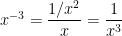
x^{-3} = \displaystyle \frac{1/x^2}{x} = \displaystyle \frac{1}{x^3}

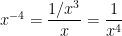
x^{-4} = \displaystyle \frac{1/x^3}{x} = \displaystyle \frac{1}{x^4}

We see that, if n is positive and -n is negative, that x^{-n} = \displaystyle \frac{1}{x^n}.

Technically, this only provides an explanation for this rule for negative integers. However, I haven’t met a student that didn’t believe this rule held for negative rational exponents (or negative irrational exponents) after seeing the above explanation for negative integers.

Why does 0! = 1? (Part 2)

This common question arises because 0! does not fit the usual definition for n!. Recall that, for positive integers, we have

5! = 5 \cdot 4 \cdot 3 \cdot 2 \cdot 1 = 120

4! = 4 \cdot 3 \cdot 2 \cdot 1 = 24

3! = 3 \cdot 2 \cdot 1 = 6

2! = 2 \cdot 1 = 2

1! = 1

In Part 1 of this series, I discussed descending down this lines with repeated division to define 0!.

Here’s a second way of explaining why 0!=1 that may or may not be as convincing as the first explanation. Let’s count the number of “words” that can made using each of the three letters A, B, and C exactly once. Ignoring that most of these don’t appear in the dictionary, there are six possible words:

ABC, ACB, BAC, BCA, CAB, CBA

With two letters, there are only two possible words: AB and BA.

With four letters, there are 24 possible words:

ABCD, ABDC, ACBD, ACDB, ADBC, ADCB,
BACD, BADC, BCAD, BCDA, BDAC, BDCA,
CABD, CADB, CBAD, CBDA, CDAB, CDBA,
DABC, DACB, DBAC, DBCA, DCAB, DCBA.

Evidently, there are 4! different words using four letters, 3! different words using three letters, and 2! different words using two letters.

Why does this happen? Let’s examine the case of four letters. First, there are 4 different possible choices for the first letter in the word. Next, the second letter can be anything but the first letter, so there are 3 different possibilities for the second letter. Then there are 2 remaining possibilities for the third letter, leaving 1 possibility for the last.

In summary, there are 4 \cdot 3 \cdot 2 \cdot 1, or 4!, different possible words. The same logic applies for words formed from three letters or any other number of letters.

What if there are 0 letters? Then there is only 1 possibility: not making any words. So it’s reasonable to define 0!=1.

green line

It turns out that there’s a natural way to define x! for all complex numbers x that are not negative integers. For example, there’s a reasonable way to define \left( \frac{1}{2} \right)!, \left(- \frac{7}{3} \right)! and even (1+2i)!. I’ll probably discuss this in a future post.

Why does 0! = 1? (Part 1)

This common question arises because 0! does not fit the usual definition for n!. Recall that, for positive integers, we have

5! = 5 \cdot 4 \cdot 3 \cdot 2 \cdot 1 = 120

4! = 4 \cdot 3 \cdot 2 \cdot 1 = 24

3! = 3 \cdot 2 \cdot 1 = 6

2! = 2 \cdot 1 = 2

1! = 1

Going from the bottom line to the top, we see that start at 1, and then multiply by 2, then multiply by 3, then multiply by 4, then multiply by 5. To get 6!, we multiply the top line by 6:

6! = 6 \cdot 5! = 6 \cdot 120 = 720.

Because they’re formed by successive multiplications, the factorials get large very, very quickly. I still remember, years ago, writing lesson plans while listening to the game show Wheel of Fortune. After the contestant solved the final puzzle, Pat Sajak happily announced, “You’ve just won $40,320 in cash and prizes.” My instantaneous reaction: “Ah… that’s 8!.” Then I planted a firm facepalm for having factorials as my first reaction. (Perhaps not surprisingly, I was still single when this happened.)

Back to 0!. We can also work downward as well as upward through successive division. In other words,

5! divided by 5 is equal to 4!.

4! divided by 4 is equal to 3!.

3! divided by 3 is equal to 2!.

2! divided by 2 is equal to 1!.

Clearly, there’s one more possible step: dividing by 1. And so we define 0! to be equal to 1! divided by 1, or

0! = \displaystyle \frac{1!}{1} = 1.

Notice that there’s a natural way to take another step because division by 0 is not permissible. So we can define 0!, but we can’t define (-1)!, (-2)!, \dots.

In Part 2, I’ll present a second way of approaching this question.

Cryptography As a Teaching Tool

From the webpage Cryptography As a Teaching Tool, found at http://www.math.washington.edu/~koblitz/crlogia.html, which was written by Dr. Neal Koblitz, Professor of Mathematics at the University of Washington:

Cryptography has a tremendous potential to enrich math education. In the first place, it puts mathematics in a dramatic setting. Children are fascinated by intrigue and adventure. More is at stake than a grade on a test: if you make a mistake, your agent will be betrayed.

In the second place, cryptography provides a natural way to get students to discover certain key mathematical concepts and techniques on their own. Too often math teachers present everything on a silver platter, thereby depriving the children of the joy of discovery. In contrast, if after many hours the youngsters finally develop a method to break a cryptosystem, then they will be more likely to appreciate the power and beauty of the mathematics that they have uncovered. Later I shall describe cryptosystems that the children can break if they rediscover such fundamental techniques of classical mathematics as the Euclidean algorithm and Gaussian elimination.

In the third place, a central theme in cryptography is what we do not know or cannot do. The security of a cryptosystem often rests on our inability to efficiently solve a problem in algebra, number theory, or combinatorics. Thus, cryptography provides a way to counterbalance the impression that students often have that with the right formula and a good computer any math problem can be quickly solved.

Mathematics is usually taught as if it were a closed book. Other areas of science are associated in children’s minds with excitement and mystery. Why did the dinosaurs die out? How big is the Universe? M. R. Fellows has observed that in mathematics as well, the frontiers of knowledge can and should be put within reach of young students.

Finally, cryptography provides an excellent opportunity for interdisciplinary projects… in the middle or even primary grades.

This webpage provides an excellent mathematical overview as well as some details about to engage students with the mathematics of cryptography.

Engaging students: Solving one-step and two-step inequalities

In my capstone class for future secondary math teachers, I ask my students to come up with ideas for engaging their students with different topics in the secondary mathematics curriculum. In other words, the point of the assignment was not to devise a full-blown lesson plan on this topic. Instead, I asked my students to think about three different ways of getting their students interested in the topic in the first place.

I plan to share some of the best of these ideas on this blog (after asking my students’ permission, of course).

This first student submission comes from my former student Jesse Faltys (who, by the way, was the instigator for me starting this blog in the first place). Her topic: how to engage students when teaching one-step and two-step inequalities.

green line

A. Applications – How could you as a teacher create an activity or project that involves your topic?

  1. Index Card Game: Make two sets of cards. The first should consist of different inequalities. The second should consist of the matching graph. Put your students in pairs and distribute both sets of cards.  The students will then practice solving their inequalities and determine which graph illustrates which inequality.
  2. Inequality Friends: Distribute index cards with simple inequalities to a handful of your students (four or five different inequalities) and to the rest of the students pass of cards that only contain numbers. Have your students rotate around the room and determine if their numbers and inequalities are compatible or not. If they know that their number belongs with that inequality then the students should become “members” and form a group. Once all the students have formed their groups, they should present to the class how they solved their inequality and why all their numbers are “members” of that group.

Both applications allow for a quick assessment by the teacher.  Having the students initially work in pairs to explore the inequality and its matching graph allows for discover on their own.  While ending the class with a group activity allows the teacher to make individual assessments on each student.

green line

B. Curriculum: How does this topic extend what your students should have learned in previous courses?

In a previous course, students learned to solve one- and two-step linear equations.  The process for solving one-step equality is similar to the process of solving a one-step inequality.  Properties of Inequalities are used to isolate the variable on one side of the inequality.  These properties are listed below.  The students should have knowledge of these from the previous course; therefore not overwhelmed with new rules.

Properties of Inequality

1. When you add or subtract the same number from each side of an inequality, the inequality remains true. (Same as previous knowledge with solving one-step equations)

2. When you multiply or divide each side of an inequality by a positive number, the inequality remains true. (Same as previous knowledge with solving one-step equations)

3. When you multiply or divide each side of an inequality by a negative number, the direction of the inequality symbol must be reversed for the inequality to remain true. (THIS IS DIFFERENT)

There is one obvious difference when working with inequalities and multiply/dividing by a negative number there is a change in the inequality symbol.  By pointing out to the student, that they are using what they already know with just one adjustment to the rules could help ease their mind on a new subject matter.

green line

C. CultureHow has this topic appeared in pop culture?

Amusement Parks – If you have ever been to an amusement park, you are familiar with the height requirements on many of the rides.  The provide chart below shows the rides at Disney that require 35 inches or taller to be able to ride. What rides will you ride?

(Height of Student \ge  Height restriction)

Blizzard Beach Summit Plummet 48″
Magic Kingdom Barnstormer at Goofy’s Wiseacres Farm 35″
Animal Kingdom Primeval Whirl 48″
Blizzard Beach Downhill Double Dipper 48″
DisneyQuest Mighty Ducks Pinball Slam 48″
Typhoon Lagoon Bay Slide 52″
Animal Kingdom Kali River Rapids 38″
DisneyQuest Buzz Lightyear’s AstroBlaster 51″
DisneyQuest Cyberspace Mountain 51″
Epcot Test Track 40″
Epcot Soarin’ 40″
Hollywood Studios Star Tours: The Adventures Continue 40″
Magic Kingdom Space Mountain 44″
Magic Kingdom Stitch’s Great Escape 40″
Typhoon Lagoon Humunga Kowabunga 48″
Animal Kingdom Expedition Everest 44″
Blizzard Beach Cross Country Creek 48″
Epcot Mission Space 44″
Hollywood Studios The Twilight Zone Tower of Terror 40″
Hollywood Studios Rock ‘n’ Roller Coaster Starring Aerosmith 48″
Magic Kingdom Splash Mountain 40″
Magic Kingdom Big Thunder Mountain Railroad 40″
Animal Kingdom Dinosaur 40″
Epcot Wonders of Life / Body Wars 40″
Blizzard Beach Summit Plummet 48″
Magic Kingdom Barnstormer at Goofy’s Wiseacres Farm 35″
Animal Kingdom Primeval Whirl 48″
Blizzard Beach Downhill Double Dipper 48″
DisneyQuest Mighty Ducks Pinball Slam 48″
Typhoon Lagoon Bay Slide 52″

Sports – Zdeno Chara is the tallest person who has ever played in the NHL. He is 206 cm tall and is allowed to use a stick that is longer than the NHL’s maximum allowable length. The official rulebook of the NHL state limits for the equipment players can use.  One of these rules states that no hockey stick can exceed160 cm.  (Hockey stick \le 160 cm) The world’s largest hockey stick and puck are in Duncan, British Columbia. The stick is over 62 m in length and weighs almost 28,000 kg.  Is your equipment legal?

hockey

Weather – Every time the news is on our culture references inequalities by the range in the temperature throughout the day.  For example, the most extreme change in temperature in Canada took place in January 1962 in Pincher Creek, Alberta. A warm, dry wind, known as a chinook, raised the temperature from -19 °C to 22 °C in one hour. Represent the temperature during this hour using a double inequality. (-19 < the temperature < 22) What Inequality is today from the weather in 1962?

That Makes It Invertible!

There are several ways of determining whether an n \times n matrix {\bf A} has an inverse:

  1. \det {\bf A} \ne 0
  2. The span of the row vectors is \mathbb{R}^n
  3. Every matrix equation {\bf Ax} = {\bf b} has a unique solution
  4. The row vectors are linearly independent
  5. When applying Gaussian elimination, {\bf A} reduces to the identity matrix {\bf I}
  6. The only solution of {\bf Ax} = {\bf 0} is the trivial solution {\bf x} = {\bf 0}
  7. {\bf A} has only nonzero eigenvalues
  8. The rank of {\bf A} is equal to n

Of course, it’s far more fun to remember these facts in verse (pun intended). From the YouTube description, here’s a Linear Algebra parody of One Direction’s “What Makes You Beautiful”. Performed 3/8/13 in the final lecture of Math 40: Linear Algebra at Harvey Mudd College, by “The Three Directions.”

While I’m on the topic, here’s a brilliant One Direction mashup featuring the cast of Downton Abbey. Two giants of British entertainment have finally joined forces.

More on divisibility

Based on my students’ reactions, I gave my best math joke in years as I went over the proofs for checking that an integer was a multiple of 3 or a multiple of 9. I started by proving a lemma that 9 is always a factor of 10^k - 1. I asked my students how I’d write out 10^k - 1, and they correctly answered 99{\dots}9, a numeral with k consecutive 9s. So I said, “Who let the dogs out? Me. See: k nines.”

Some of my students laughed so hard that they cried.

There are actually at least three ways of proving this lemma. I love lemmas like these, as they offer a way of, in the words of my former professor Arnold Ross, to think deeply about simple things.

(1) By subtracting, 10^k - 1 = 99{\dots}9 = 9 \times 11{\dots}1, which is clearly a multiple of 9.

(2) We can use the rule

a^k - b^k = (a-b) \left(a^{k-1} + a^{k-2} b + \dots + a b^{k-2} + b^{k-1} \right)

The conclusion follows by letting a = 10 and b =1.

From my experience, my senior math majors all learned the rule for factoring the difference of two squares, but very few learned the rule for factoring the difference of two cubes, while almost none of them learned the general factorization rule above. As always, it’s not my students’ fault that they weren’t taught these things when they were younger.

I also supplement this proof with a challenge to connect Proof #2 with Proof #1… why does 11{\dots}1 = \left(a^{k-1} + a^{k-2} b + \dots + a b^{k-2} + b^{k-1} \right)?

(3) We can use mathematical induction.

If k = 0, then 10^k - 1 = 0, which is a multiple of 9.

We now assume that 10^k - 1 is a multiple of 9.

To show that 10^{k+1}-1 is a multiple of 9, we observe that

10^{k+1}-1 = \left(10^{k+1} - 10^k \right) + \left(10^k - 1\right) = 10^k (10-1) + \left(10^k - 1\right),

and both terms on the right-hand side are multiples of 9. (I also challenge my students to connect the right-hand side with the original expression 99{\dots}9.)

\hbox{QED}