Is 2i less than 3i? (Index)

I’m doing something that I should have done a long time ago: collecting a series of posts into one single post. The following links comprised my series on why it doesn’t make sense to say one complex number is less than another complex number (using the usual definition of “less than”).

Part 1: A sketch of a direct proof based on the order axioms proving that i is not an element of a number system that has the usual definition of inequality.

Part 2: An indirect proof.

Part 3: Discussion about the lexicographic ordering, which almost works.

Part 4: Two other partial orderings which almost work.


Lessons from teaching gifted elementary school students: Index (updated)

I’m doing something that I should have done a long time ago: collect past series of posts into a single, easy-to-reference post. The following posts formed my series on various lessons I’ve learned while trying to answer the questions posed by gifted elementary school students. (This is updated from my previous index.)

Part 1: A surprising pattern in some consecutive perfect squares.

Part 2: Calculating 2 to a very large exponent.

Part 3a: Calculating 2 to an even larger exponent.

Part 3b: An analysis of just how large this number actually is.

Part 4a: The chance of winning at BINGO in only four turns.

Part 4b: Pedagogical thoughts on one step of the calculation.

Part 4c: A complicated follow-up question.

Part 5a: Exponentiation is multiplication as multiplication is to addition. So, multiplication is to addition as addition is to what? (I offered the answer of incrementation, but it was rejected: addition requires two inputs, while incrementation only requires one.)

Part 5b: Why there is no binary operation that completes the above analogy.

Part 5c: Knuth’s up-arrow notation for writing very big numbers.

Part 5d: Graham’s number, reputed to be the largest number ever to appear in a mathematical proof.

My Mathematical Magic Show: Part 8c

This mathematical trick was not part of my Pi Day magic show but probably should have been… I’ve performed this for my Precalculus classes in the past but flat forgot about it when organizing my Pi Day show. The next time I perform a magic show, I’ll do this one right after the 1089 trick. (I think I learned this trick from a Martin Gardner book when I was young, but I’m not sure about that.)

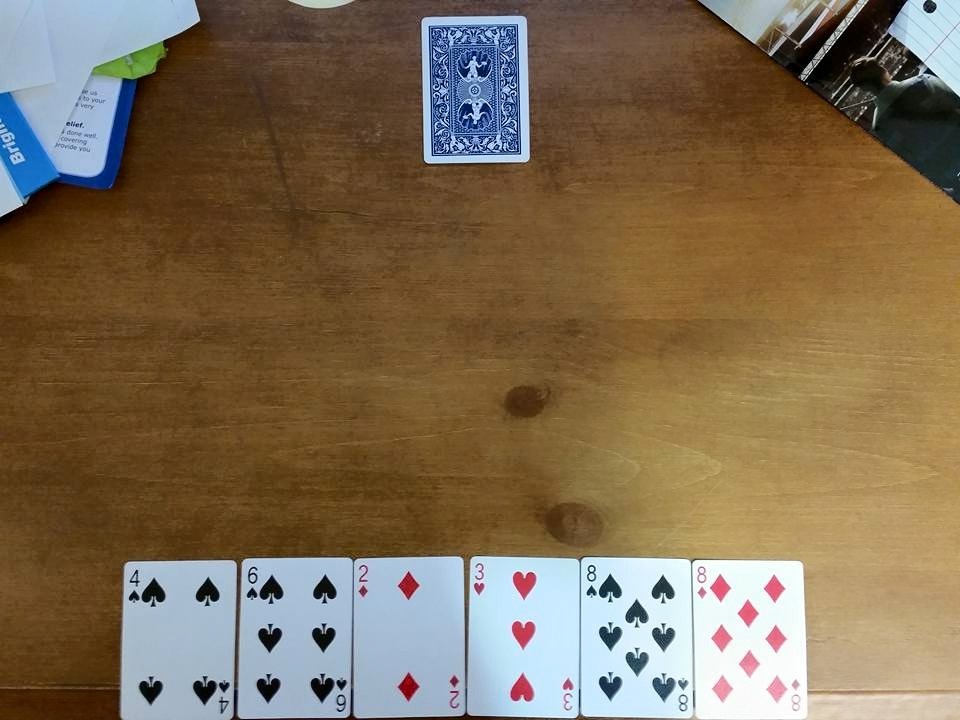
Here’s a description of the trick. I give my audience a deck of cards and ask them to select six cards between ace and nine (in other words, no tens, jacks, queens, or kings). The card are placed face up, side by side.

After about 5-10 seconds, I secretly write a pull out a card from the deck and place it face down above the others.


pascalcardtrick1

I then announce that we’re going to some addition together… with the understanding that I’ll never write down a number larger than 9. For example, the 4 and 6 of spades are next to each other. Obviously, 4+6 = 10, but my rule is that I’m going to write down a number larger than 9. So I’ll subtract 9 whenever necessary: 10-9 = 1. Since 1 corresponds to ace, I place an ace about the 4 and 6 of spades.

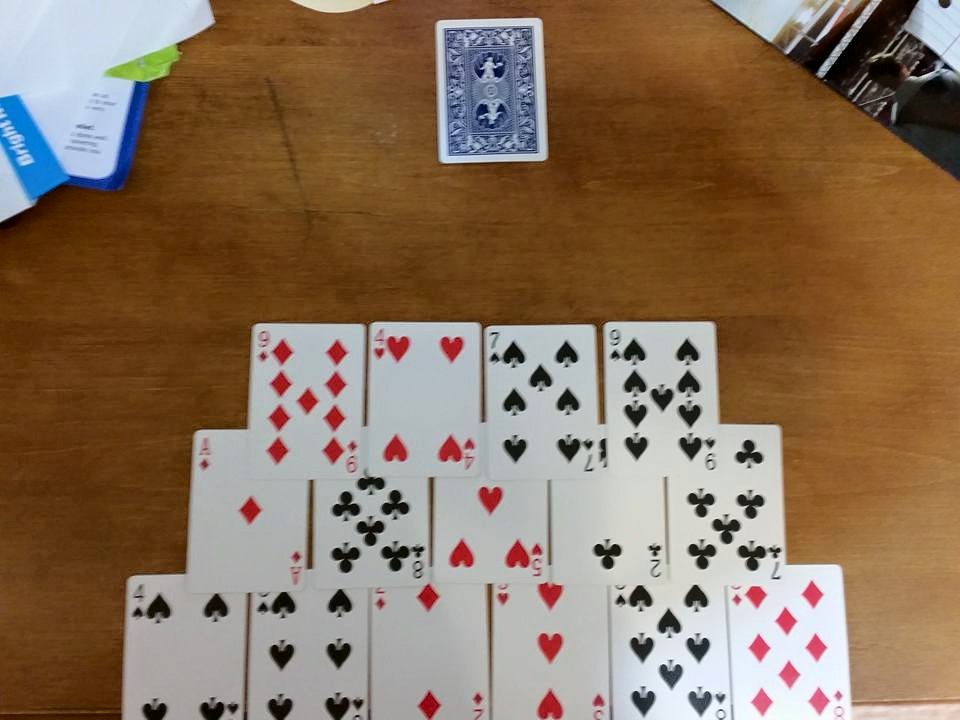
Continuing in this way (and having the audience participate in the arithmetic so that this doesn’t get boring), I eventually get to this position:
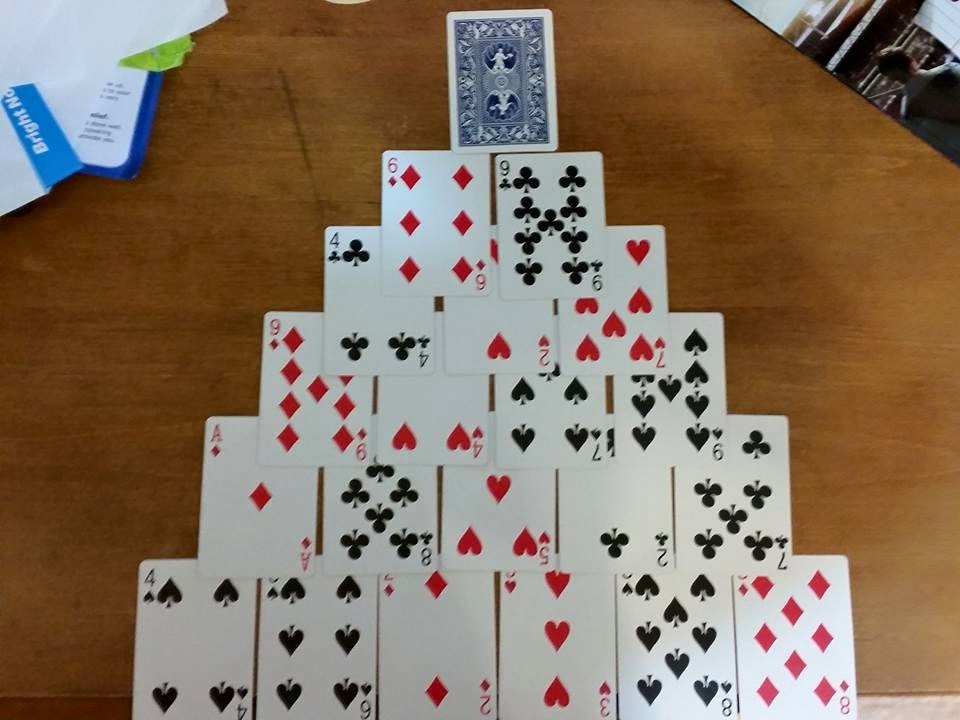
pascalcardtrick5

Finally, I add the two cards at the top (and, in this case, subtract 9) to get 6+9-9 = 6, and I dramatically turn over the last card to reveal a 6.
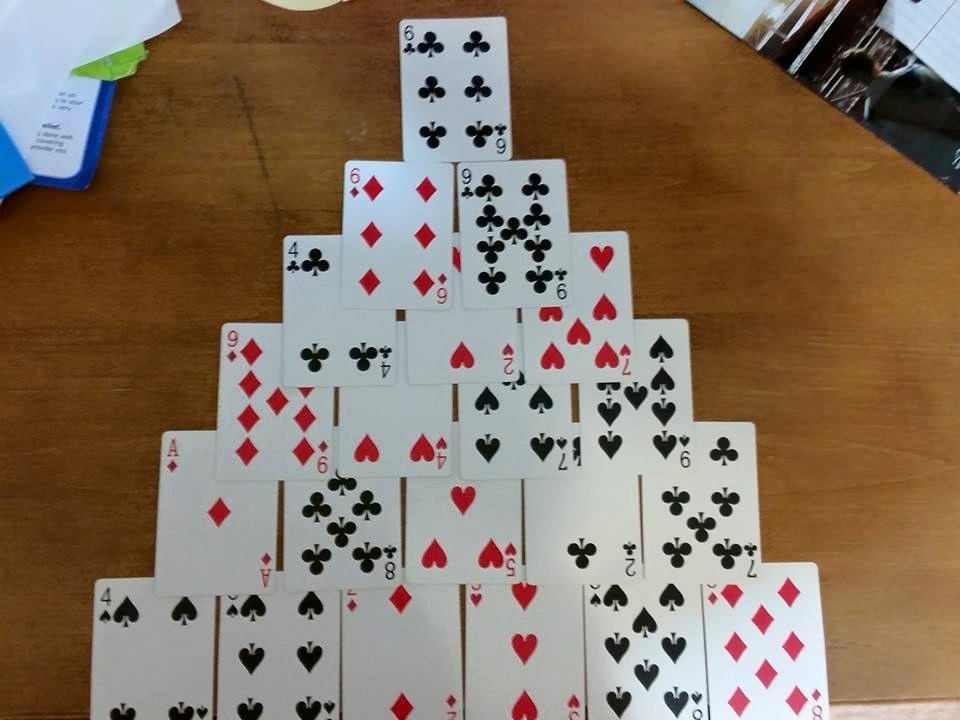
pascalcardtrick6

I’ll often perform this trick when teaching Precalculus, as the final answer involving Pascal’s triangle. As discussed yesterday, suppose that the six cards are a, b, c, d, e, and f. Forgetting for now about subtracting by 9, here’s how the triangle unfolds (turning the triangle upside down):

a \qquad \qquad \qquad \quad b \qquad \qquad \qquad \quad c \qquad \qquad \qquad \quad d \qquad \qquad \qquad \quad e \qquad \qquad \qquad \quad f

a+b \qquad \qquad \qquad b+c \qquad \qquad \qquad c+d \qquad \qquad \qquad d+e \qquad \qquad \qquad e+f

a+2b+c \qquad \qquad b+2c+d \qquad \qquad c+2d+e \qquad \qquad d+2e+f

a+3b+3c+d \qquad \quad b+3c+3d+e \qquad \quad c+3d+3e+f

a+4b+6c+4d+e \qquad b+4c+6d+5e+f

a+5b+10c+10d+5e+f

 Not surprisingly, the coefficients in the above chart involve the numbers in Pascal’s triangle. Indeed, the reason that I chose to use 6 cards (as opposed to any other number of cards) is that the bottom row has only 1, 5, and 10 as coefficients, and 10 \equiv 1 (\mod 9). Therefore, the only tricky part of the calculation is multiplying b+e by 5, as the final answer can then be found by adding the remaining four numbers.

My students usually find this to be a clever application of Pascal’s triangle for impressing their friends after class.

green lineP.S. After typing this series, it hit me that it’s really easy to do this trick mod 10 (which means getting rids of only the face cards prior to the trick). All the magician has to do is subtly ensure that the second and fifth cards are both even or both odd, so that b+e is even and hence 5(b+e) is a multiple of 10. Therefore, since 10c+10d is also a multiple of 10, the answer will be just a+f or a+f-10.

(If the magician can’t control the placement of the second and fifth cards so that one is even and one is odd, the answer will be just a+f+5 or a+f-5.)

Henceforth, I’ll be doing this trick mod 10 instead of mod 9.


My Mathematical Magic Show: Part 8b

This mathematical trick was not part of my Pi Day magic show but probably should have been… I’ve performed this for my Precalculus classes in the past but flat forgot about it when organizing my Pi Day show. The next time I perform a magic show, I’ll do this one right after the 1089 trick. (I think I learned this trick from a Martin Gardner book when I was young, but I’m not sure about that.)

Here’s a description of the trick. I give my audience a deck of cards and ask them to select six cards between ace and nine (in other words, no tens, jacks, queens, or kings). The card are placed face up, side by side.

After about 5-10 seconds, I secretly write a pull out a card from the deck and place it face down above the others.


pascalcardtrick1

I then announce that we’re going to some addition together… with the understanding that I’ll never write down a number larger than 9. For example, the 4 and 6 of spades are next to each other. Obviously, 4+6 = 10, but my rule is that I’m going to write down a number larger than 9. So I’ll subtract 9 whenever necessary: 10-9 = 1. Since 1 corresponds to ace, I place an ace about the 4 and 6 of spades.

Continuing in this way (and having the audience participate in the arithmetic so that this doesn’t get boring), I eventually get to this position:

pascalcardtrick5

Finally, I add the two cards at the top (and, in this case, subtract 9) to get 6+9-9 = 6, and I dramatically turn over the last card to reveal a 6.

pascalcardtrick6

How does this trick work? This is an exercise in modular arithmetic (see also Wikipedia). Suppose that the six cards are a, b, c, d, e, and f. Forgetting for now about subtracting by 9, here’s how the triangle unfolds (turning the triangle upside down):


a \qquad \qquad \qquad \quad b \qquad \qquad \qquad \quad c \qquad \qquad \qquad \quad d \qquad \qquad \qquad \quad e \qquad \qquad \qquad \quad f

a+b \qquad \qquad \qquad b+c \qquad \qquad \qquad c+d \qquad \qquad \qquad d+e \qquad \qquad \qquad e+f

a+2b+c \qquad \qquad b+2c+d \qquad \qquad c+2d+e \qquad \qquad d+2e+f

a+3b+3c+d \qquad \quad b+3c+3d+e \qquad \quad c+3d+3e+f

a+4b+6c+4d+e \qquad b+4c+6d+5e+f

a+5b+10c+10d+5e+f

 Therefore, the top card will simply be a+5b+10c+10d+5e+f minus a multiple of 9.

That’s a pretty big calculation for the magician to do on the spot. Fortunately, 9c + 9d is also a multiple of 9, and so the top card will be

 a+5b+10c+10d+5e+f - (9c + 9d) minus a multiple of 9, or

5(b+e) + a +  c + d +  f minus a multiple of 9.

For the case at hand, b = 6 and e =8, so 5(b+e) = 70. That’s still a big number to keep straight when performing the trick. However, since I’m going to be subtracting 9’s anyway, I can do this faster by replacing the 8 by 8 - 9 = -1. So, for the purposes of the trick, 5(b+e) = 5 \times (6-1) = 25, and I subtract 18 to get 7.

I now add the rest of the cards, subtracting 9 as I go along. For this example, I’d add the 2 first to get 9, which is 0 after subtracting another 9. I then add the remaining cards of 4, 3, and 8 (remembering that the 8 is basically 8-9 = -1, yielding 4+3-1 = 6. So the top card has to be 6.

The key point of this calculation is to subtract 9 whenever possible to keep the numbers small, making it easier to do in your head when performing the trick.


My Mathematical Magic Show: Part 8a

This mathematical trick was not part of my Pi Day magic show but probably should have been… I’ve performed this for my Precalculus classes in the past but flat forgot about it when organizing my Pi Day show. The next time I perform a magic show, I’ll do this one right after the 1089 trick. (I think I learned this trick from a Martin Gardner book when I was young, but I’m not sure about that.)

Here’s a description of the trick. I give my audience a deck of cards and ask them to select six cards between ace and nine (in other words, no tens, jacks, queens, or kings). The card are placed face up, side by side.

After about 5-10 seconds, I secretly write a pull out a card from the deck and place it face down above the others.


pascalcardtrick1

I then announce that we’re going to some addition together… with the understanding that I’ll never write down a number larger than 9. For example, the 4 and 6 of spades are next to each other. Obviously, 4+6 = 10, but my rule is that I’m going to write down a number larger than 9. So I’ll subtract 9 whenever necessary: 10-9 = 1. Since 1 corresponds to ace, I place an ace about the 4 and 6 of spades.

Next, I consider the 6 of spades and 2 of diamonds. Adding, I get 8. That’s less than 9, so I pull an 8 out of the deck.

Next, 2+3 = 5, so I pull out a 5 from the deck.

Next, 8+8=16, and 16-9=7. So I pull out a 7.

(To keep this from getting dry, I have the audience perform the arithmetic with me.)

pascalcardtrick2

On the the next row. The next cards are 1+8 = 9, 8+5-9 = 4, 5+2 =7, and 2+7 = 9.

pascalcardtrick3

On the the next row. The next cards are 9+4-9=4, $latex $4+7-9 = 2$, and 7+9-9 = 7.

pascalcardtrick4

Almost there: 4+2 = 6 and 2+7= 9.


pascalcardtrick5

Finally, 6+9-9 = 6, and I dramatically turn over the last card to reveal a 6.


pascalcardtrick6


Naturally, everyone wonders how I knew what the last card would be without first getting all of the cards in the middle. I’ll discuss this in tomorrow’s post.


Thoughts on Infinity (Part 2b)

Last summer, Math With Bad Drawings had a nice series on the notion of infinity that I recommend highly. This topic is a perennial struggle for math majors to grasp, and I like the approach that the author uses to sell this difficult notion.

Here’s Part 2 on the harmonic series, which is extremely well-written and which I recommend highly. Here’s a brief summary: the infinite harmonic series

\displaystyle \sum_{n=1}^\infty \frac{1}{n}

diverges. However, if you eliminate from the harmonic series all of the fractions whose denominator contains a 9, then the new series converges! This series has been called the Kempner series, named after the mathematician who first published this result about 100 years ago.

Source: http://smbc-comics.com/index.php?id=3777

To prove this, we’ll examine the series whose denominators are between 1 and 8, between 10 and 88, between 100 and 888, etc. First, each of the terms in the partial sum

\displaystyle 1 + \frac{1}{2} + \frac{1}{3} + \frac{1}{4} + \frac{1}{5} + \frac{1}{6} + \frac{1}{7} + \frac{1}{8}

is less than or equal to 1, and so the sum of the above eight terms must be less than 8.

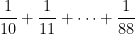
Next, each of the terms in the sum

\displaystyle \frac{1}{10} + \frac{1}{11} + \dots + \frac{1}{88}

is less than \displaystyle \frac{1}{10}. Notice that there are 72 terms in this sum since there are 8 possibilities for the first digit of the denominator (1 through 8) and 9 possibilities for the second digit (0 through 8). So the sum of these 72 terms must be less than \displaystyle 8 \times \frac{9}{10}.

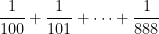
Next, each of the terms in the sum

\displaystyle \frac{1}{100} + \frac{1}{101} + \dots + \frac{1}{888}

is less than \displaystyle \frac{1}{100}. Notice that there are 8 \times 9 \times 9 terms in this sum since there are 8 possibilities for the first digit of the denominator (1 through 8) and 9 possibilities for the second and third digits (0 through 8). So the sum of these 8 \times 9 \times 9 terms must be less than 8 \times \displaystyle \frac{9^2}{100}.

Continuing, we see that the Kempner series is bounded above by

\displaystyle 8 + 8 \times \frac{9}{10} + 8 \times \frac{9^2}{10^2} + \dots

Using the formula for an infinite geometric series, we see that the Kempner series converges, and the sum of the Kempner series must be less than 8 \times \displaystyle \frac{1}{1-9/10} = 80.

Using the same type of reasoning, much sharper bounds for the sum of the Kempner series can also be found. This 100-year-old article from the American Mathematical Monthly demonstrates that the sum of the Kempner series is between 22.4 and 23.3.  For more information about approximating the sum of the Kempner series, see Mathworld and Wikipedia.

It should be noted that there’s nothing particularly special about the number 9 in the above discussion. If all denominators containing 314159265, or any finite pattern, are eliminated from the harmonic series, then the resulting series will always converge.

Thoughts on Infinity (Part 2a)

Last summer, Math With Bad Drawings had a nice series on the notion of infinity that I recommend highly. This topic is a perennial struggle for math majors to grasp, and I like the approach that the author uses to sell this difficult notion.

Here’s Part 2 on the harmonic series, which is extremely well-written and which I recommend highly. Here’s a brief summary: the infinite harmonic series

\displaystyle \sum_{n=1}^\infty \frac{1}{n}

diverges. This is a perennial head-scratcher for students, as the terms become smaller and smaller yet the infinite series diverges.

To show this, notice that

\displaystyle \frac{1}{3} + \frac{1}{4} > \displaystyle \frac{1}{4} + \frac{1}{4} = \displaystyle \frac{1}{2},

\displaystyle \frac{1}{5} + \frac{1}{6} + \frac{1}{7} + \frac{1}{8} > \displaystyle \frac{1}{8} + \frac{1}{8} + \frac{1}{8} + \frac{1}{8} = \displaystyle \frac{1}{2},

and so on. Therefore,

\displaystyle 1 + \frac{1}{2} + \frac{1}{3} + \frac{1}{4} > \displaystyle 1 + \frac{1}{2} + \frac{1}{2} = 2,

\displaystyle 1 + \frac{1}{2} + \frac{1}{3} + \frac{1}{4} +\frac{1}{5} + \frac{1}{6} + \frac{1}{7} + \frac{1}{8} > \displaystyle 1 + \frac{1}{2} + \frac{1}{2} + \frac{1}{2} = \displaystyle \frac{5}{2},

and, in general,

\displaystyle 1 + \frac{1}{2} + \frac{1}{3} + \dots + \frac{1}{2^n} > \displaystyle 1+\frac{n}{2}.

Since \displaystyle \lim_{n \to \infty} \left(1 + \frac{n}{2} \right) = \infty, we can conclude that the harmonic series diverges.

However, here’s an amazing fact which I hadn’t known before the Math With Bad Drawings post: if you eliminate from the harmonic series all of the fractions whose denominator contains a 9, then the new series converges!

I’ll discuss the proof of this fact in tomorrow’s post. Until then, here’s a copy of the comic used in the Math With Bad Drawings post.

Source: http://smbc-comics.com/index.php?id=3777

The antiderivative of 1/(x^4+1): Part 6

This antiderivative has arguable the highest ratio of “really hard to compute” to “really easy to write”:

\displaystyle \int \frac{1}{x^4 + 1} dx

So far, I’ve shown that the denominator can be factored over the real numbers:

\displaystyle \int \frac{dx}{x^4 + 1} = \displaystyle \int \frac{dx}{\left(x^2 - x \sqrt{2} + 1 \right) \left(x^2 + x \sqrt{2} + 1\right)}

= \displaystyle \int \frac{ -\displaystyle \frac{\sqrt{2}}{4} x + \frac{1}{2}}{ x^2 - x \sqrt{2} + 1 } dx + \int \frac{ \displaystyle \frac{\sqrt{2}}{4} x + \frac{1}{2}}{ x^2 - x \sqrt{2} + 1 } dx

= \displaystyle \frac{\sqrt{2}}{8} \ln \left( \frac{x^2 + x\sqrt{2} + 1}{x^2 - x\sqrt{2} + 1} \right) + \frac{1}{4} \int \frac{ dx }{ x^2 - x \sqrt{2} + 1 } + \frac{1}{4} \int \frac{ dx }{ x^2 + x \sqrt{2} + 1 } dx

To evaluate the remaining two integrals, I’ll use the antiderivative

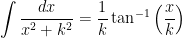
\displaystyle \int \frac{dx}{x^2 + k^2} = \displaystyle \frac{1}{k} \tan^{-1} \left( \frac{x}{k} \right).

To begin, I’ll complete the squares:

\displaystyle \frac{1}{4} \int \frac{ dx }{ x^2 - x \sqrt{2} + 1 } + \frac{1}{4} \int \frac{ dx }{ x^2 + x \sqrt{2} + 1 } dx = \displaystyle \frac{1}{4} \int \frac{ dx }{ x^2 - x \sqrt{2} + \displaystyle \frac{1}{2} + \displaystyle \frac{1}{2} } + \frac{1}{4} \int \frac{ dx }{ x^2 + x \sqrt{2} + \displaystyle \frac{1}{2} + \displaystyle \frac{1}{2} }

= \displaystyle \frac{1}{4} \int \frac{ dx }{ \left(x - \displaystyle \frac{ \sqrt{2}}{2} \right)^2 + \left(\displaystyle \frac{\sqrt{2}}{2} \right)^2 } + \frac{1}{4} \int \frac{ dx }{\left(x + \displaystyle \frac{ \sqrt{2}}{2} \right)^2 + \left(\displaystyle \frac{\sqrt{2}}{2} \right)^2 }

Applying the substitutions u = x - \displaystyle \frac{ \sqrt{2}}{2} and v = x + \displaystyle \frac{ \sqrt{2}}{2}, I can continue:

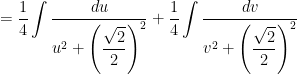
= \displaystyle \frac{1}{4} \int \frac{ du }{ u^2 + \left(\displaystyle \frac{\sqrt{2}}{2} \right)^2 } + \frac{1}{4} \int \frac{ dv }{v^2 + \left(\displaystyle \frac{\sqrt{2}}{2} \right)^2 }

= \displaystyle \frac{\sqrt{2}}{4} \tan^{-1} \left( \frac{u}{\sqrt{2}/2} \right) + \frac{\sqrt{2}}{4} \tan^{-1} \left( \frac{v }{\sqrt{2}/2} \right) + C

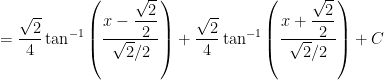
= \displaystyle \frac{\sqrt{2}}{4} \tan^{-1} \left( \frac{x - \displaystyle \frac{ \sqrt{2}}{2}}{\sqrt{2}/2} \right) + \frac{\sqrt{2}}{4} \tan^{-1} \left( \frac{x + \displaystyle \frac{ \sqrt{2}}{2} }{\sqrt{2}/2} \right) + C

= \displaystyle \frac{\sqrt{2}}{4} \tan^{-1} \left( x\sqrt{2} - 1 \right) + \frac{\sqrt{2}}{4} \tan^{-1} \left( x \sqrt{2} + 1 \right) + C

Combining, I finally arrive at the answer for \displaystyle \int \frac{dx}{x^4 + 1}:

\displaystyle \frac{\sqrt{2}}{8} \ln \left(\frac{x^2 + x\sqrt{2} + 1}{x^2 - x\sqrt{2} + 1} \right) + \frac{\sqrt{2}}{4} \tan^{-1} ( x\sqrt{2} - 1 ) + \frac{\sqrt{2}}{4} \tan^{-1}( x \sqrt{2} + 1) + C

 Naturally, this can be checked by differentiation, but I’m not going type that out.

The antiderivative of 1/(x^4+1): Part 4

This antiderivative has arguable the highest ratio of “really hard to compute” to “really easy to write”:

\displaystyle \int \frac{1}{x^4 + 1} dx

So far, I’ve shown that the denominator can be factored over the real numbers:

\displaystyle \int \frac{dx}{x^4 + 1} = \displaystyle \int \frac{dx}{\left(x^2 - x \sqrt{2} + 1 \right) \left(x^2 + x \sqrt{2} + 1\right)} ,

so that the technique of partial fractions can be applied. Since both quadratics in the denominator are irreducible (and the degree of the numerator is less than the degree of the denominator), the partial fractions decomposition has the form

\displaystyle \frac{1}{\left(x^2 - x \sqrt{2} + 1 \right) \left(x^2 + x \sqrt{2} + 1\right)} = \displaystyle \frac{Ax + B}{\left(x^2 - x \sqrt{2} + 1 \right)} + \displaystyle \frac{Cx + D}{ \left(x^2 + x \sqrt{2} + 1\right)}

Clearing out the denominators, I get

1 = (Ax + B) \left(x^2 + x \sqrt{2} + 1\right) + (Cx + D) \left(x^2 - x \sqrt{2} + 1\right)

or

1 = Ax^3 + Bx^2 + Ax^2 \sqrt{2} + Bx\sqrt{2} + Ax + B + Cx^3 + Dx^2 - Cx^2 \sqrt{2} - Dx\sqrt{2} + Cx + D

or

0x^3 + 0x^2 + 0x + 1 = (A + C)x^3 + (A \sqrt{2} + B - C \sqrt{2} + D)x^2 + (A + B\sqrt{2} + C - D \sqrt{2} ) x + (B+D)

Matching coefficients yields the following system of four equations in four unknowns:

A + C = 0

A\sqrt{2} + B - C\sqrt{2} + D = 0

A + B \sqrt{2} + C - D\sqrt{2} = 0

B + D = 1

Ordinarily, four-by-four systems of linear equations are somewhat painful to solve, but this system isn’t too bad. Since A + C = 0 from the first equation, the third equation becomes

0 + B \sqrt{2} - D \sqrt{2} = 0, or B = D.

From the fourth equation, I can conclude that B = 1/2 and D = 1/2. The second and third equations then become

A\sqrt{2} + \displaystyle \frac{1}{2} - C\sqrt{2} + \frac{1}{2} = 0

A + \displaystyle \frac{\sqrt{2}}{2} + C - \frac{\sqrt{2}}{2} = 0,

or

A - C = \displaystyle -\frac{\sqrt{2}}{2},

A + C = 0.

Adding the two equations yields 2A = -\displaystyle \frac{\sqrt{2}}{4}, so that A = -\displaystyle \frac{\sqrt{2}}{4} and C = \displaystyle \frac{\sqrt{2}}{4}.

Therefore, the integral can be rewritten as

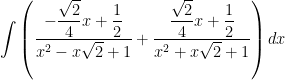
\displaystyle \int \left( \frac{ -\displaystyle \frac{\sqrt{2}}{4} x + \frac{1}{2}}{ x^2 - x \sqrt{2} + 1 } + \frac{ \displaystyle \frac{\sqrt{2}}{4} x + \frac{1}{2}}{ x^2 + x \sqrt{2} + 1 } \right) dx

I’ll start evaluating this integral in tomorrow’s post.