Engaging students: Define the term angle and the measure of an angle

In my capstone class for future secondary math teachers, I ask my students to come up with ideas for engaging their students with different topics in the secondary mathematics curriculum. In other words, the point of the assignment was not to devise a full-blown lesson plan on this topic. Instead, I asked my students to think about three different ways of getting their students interested in the topic in the first place.

I plan to share some of the best of these ideas on this blog (after asking my students’ permission, of course).

This student submission comes from my former student Perla Perez. Her topic, from Geometry: defining the term angle and the measure of an angle.

green line

How could you as a teacher create an activity or project that involves your topic?


On teacherideas.co.uk, there is a very fun activity that helps students understand what an angle is. Karen Westley’s activity, Learning About Angles, involves the students forming a human angle by getting into two lines (Karen uses only one line) that connect at one point. The instructor then asks them to form angles of different degrees: 45º, 90º, 180º, etc. This activity is meant for ages five to eleven, but it can still be helpful for high school students, and can be modified to fit your class. For example, after finishing this activity have the students give a written definition of what an angle is based on their activity and their knowledge of line segments, vertices, rays, etc.

Resources:

http://www.teachingideas.co.uk/maths/learningaboutangles.htm


green line

How can this topic be used in your students’ future courses in mathematics or science?


Angles are a fundamental part of geometry. It is essential that students know how to measure them because when coupled with the right information angles can help determine many different things about a shape, such as area, length of an arc, etc. The students will return to these ideas in more advanced math courses, specifically trigonometry and pre-calculus. For example a problem given in inmath.com says: “Find the area of the sector with radius with 7cm and central angle of 2.5 radians.” In order to answer this question, a student must know the two common types of measurement, degrees and radians. The student will also need to differentiate between the radius and radians since they sound similar and can be easily misinterpreted. When it comes to polar coordinates students will need to convert from the measure of an angle to rectangular coordinates which are in the form (x,y) rather in (r,theta).

Resources:

http://www.intmath.com/trigonometric-functions/8-applications-of-radians.php


green line

What interesting things can you say about the people who contributed to the discovery and/or the development of this topic?


The measure of an angle can be found in two common ways, through radians and through degrees. Dave Joyce from Clark University in his article “Measurements of Angles” says that even before Thomas Muir created the word radians, many mathematicians like Euler were using the idea long before him. That in fact was essential for his famous formula “e = cos θ + i sin θ”, which is true because “[you] measure angles by the length of the arc cut off in the unit circle”. Over time, mathematicians like Thomas Muir began to rediscover the measure of angles in the same way Euler did. An interesting fact about radians is that the angle is equal to the arc length divided by the radius. It was Euclid’s postulates that contributed to the finding the measures of angles without actually stating whether one uses a form of degrees or radians. This information can be found on the website: http://www.storyofmathematics.com/hellenistic_euclid.html and his book Euclid Elements.


Resources:

http://www.clarku.edu/~djoyce/trig/angle.html

http://www.storyofmathematics.com/hellenistic_euclid.html

Euclid’s Elements Book


Engaging students: Finding the slope of a line

In my capstone class for future secondary math teachers, I ask my students to come up with ideas for engaging their students with different topics in the secondary mathematics curriculum. In other words, the point of the assignment was not to devise a full-blown lesson plan on this topic. Instead, I asked my students to think about three different ways of getting their students interested in the topic in the first place.

I plan to share some of the best of these ideas on this blog (after asking my students’ permission, of course).

This student submission again comes from my former student Jason Trejo. His topic, from Algebra: finding the slope of a line.

green line

A2) How could you as a teacher create an activity or project that involves your topic?

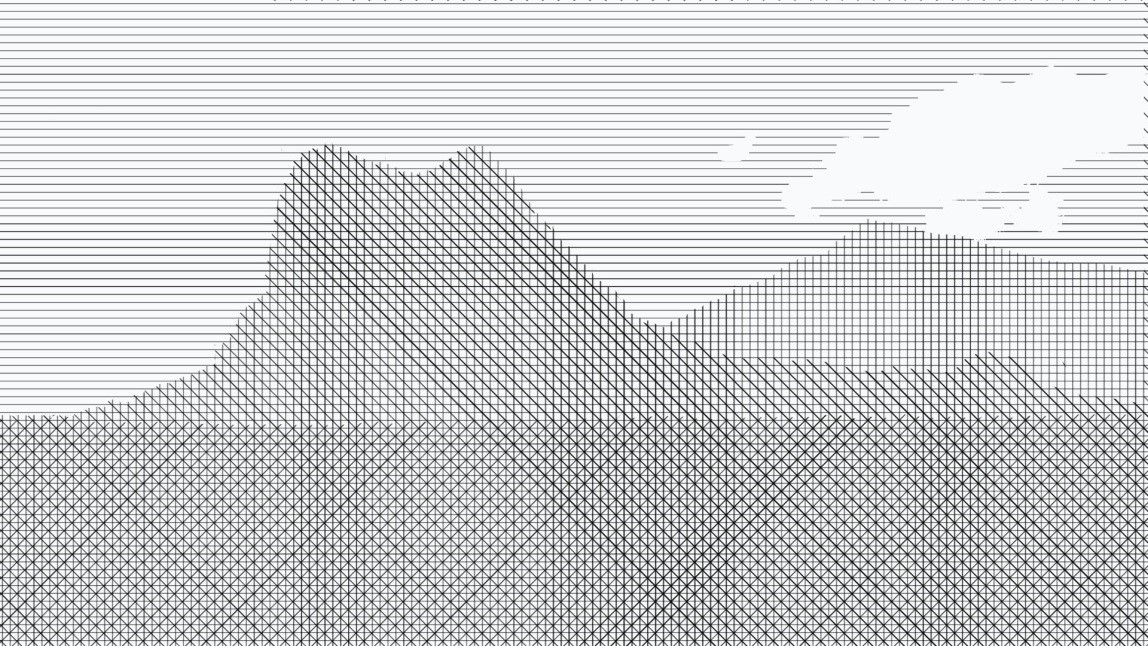
I have to start off by giving some credit to my 5th grade math teacher for giving me the idea on how I could create an activity involving this topic. You see, back in my 5th grade math class, we were to plot points given to us on a Cartesian plane and then connect the dots to create a picture (which turned out to be a caveman). Once we created the picture, we were to add more to it and the best drawing would win a prize. My idea is to split the class up into groups and give them an assortment of lines on separate pieces of transparent graphing sheets. They would then find the slopes and trace over the line in a predetermined color (e.g. all lines with m=2 will be blue, when m=1/3 then red, etc.). Next they stack each line with matching slopes above the other to create pictures like this:

slopeart

slopeart2

Of course, what I have them create would be more intricate and colorful, but this is the idea for now. It is also possible to have the students fine the slope of lines at certain points to create a picture like I did back in 5th grade and then have them color their drawing. They would end up with pictures such as:

slopeart3


green line

C1) How has this topic appeared in pop culture (movies, TV, current music, videogames, etc.)?

Sure there aren’t many places where finding the slope of a line will be the topic that everyone goes on and one about on TV or on the hottest blog or all over Vine (whatever that is), but take a look around and you will be able to see a slope maybe on a building or from the top of Tom Hank’s head to the end of his shadow. Think about it, with enough effort, anyone could imagine a coordinate plane “behind” anything and try to find the slop from one point to another. The example I came up with goes along with this picture I edited:

motorcycle

*Picture not accurately to scale

This is the infamous, first double backflip ever landed in a major competition. The athlete: Travis Pastrana; the competition: the 2006 X-Games.

I would first show the video (found here: https://www.youtube.com/watch?v=rLKERGvwBQ8), then show them the picture above to have them solve for each of the different slopes seen. In reality this is a parabola, but we can break up his motion to certain points in the trick (like when Travis is on the ground or when Travis is upside down for the first backflip). When the students go over parabolas at a later time, we could then come back to this picture.


green line

B2) How does this topic extend what your students should have learned in previous courses?

It has been many years since I was first introduced to finding the slope of the line so I’m not sure exactly when I learned it, but I do know that I at least saw what a line was in 5th grade based on the drawing project I stated earlier. At that point, all I knew was to plot points on a graph and “connect the dots”, so this builds on that by actually being able to give a formula for those lines that connected the dots. Other than that, finding slopes on a Cartesian plane can give more insight on what negative numbers are and how they relate to positive numbers. Finally, students should have already learned about speed and time, so by creating a representation how those two relate, a line can be drawn. The students would see the rate of change based on speed and time.


References:

Minimalistic Landscape: http://imgur.com/a/44DNn

Minimalistic Flowers: http://imgur.com/Kwk0tW0

Graphing Projects: http://www.hoppeninjamath.com/teacherblog/wp-content/uploads/2014/03/Photo-Feb-25-5-32-24-PM.jpg

Double Backflip Image: http://cdn.motocross.transworld.net/files/2010/03/tp_doubleback_final.jpg

Double Backflip Video: : https://www.youtube.com/watch?v=rLKERGvwBQ8


Engaging students: Equations of two variables

In my capstone class for future secondary math teachers, I ask my students to come up with ideas for engaging their students with different topics in the secondary mathematics curriculum. In other words, the point of the assignment was not to devise a full-blown lesson plan on this topic. Instead, I asked my students to think about three different ways of getting their students interested in the topic in the first place.

I plan to share some of the best of these ideas on this blog (after asking my students’ permission, of course).

This student submission again comes from my former student Zacquiri Rutledge. His topic, from Algebra: equations of two variables.

green line

Seeing equations with two variables becomes quite common once students have been introduced to independent and dependent variables. However seeing equations in the form x+4y=16 would start as a confusing concept after being taught that equations are written in the format 4x-16=y. However, this concept is highly required when a teacher goes to explain about a system of equations. The reason for this is because a common method that is taught for solving a system of equations is substitution. In order to utilize the substitution method, a student must understand how to solve for a variable by using order of operations to isolate the variable. In fact, a student will use the same skills they did when learning to solve an equation that only has one variable, such as 3x+6=12. However, now the student must apply it to something new.

Another lesson that uses the knowledge from the Equations of Two Variables is interpretation of a graph for an equation with two variables. Before, the students would have learned what independent and dependent variables are, and how they are represented on a graph. Later on the students would further their understanding by finding the graphical representation of equations with two variables. The students would learn that, while the line on the graph during lessons over independent and dependent variables was only to show where the left side of an equation equaled y, the line can also show where x and y combine to equal a certain value. An example of this would be comparing x+4y=16 and (-1/4)x+4=y. They are the same equation, however one equation shows that x and 4y combine to equal 16, so every point on the line are the values of x and y required to equal 16. The second equation says that to find y for a given point x, x must be multiplied by (-1/4) and add 4. Just changing the nature of the equation can change what it is that the equation is saying, as well as give a different perspective one that could be useful when dealing with real life word problems.

green line

Two variable equations are very subtle, but are all around us. Even when we do not think it is being used, it is. The most common modern example of two variable equations is the American dollar, and how many coins of two different values are needed to make a dollar. Although this is a very easy explanation to use it can be very boring at times. How about classical music or concert music? While it may not seem obvious at first, it is in fact there. The standard set-up for a sheet of music is Four-Four time. What this means is that within every measure there are four beats and a quarter note counts as a whole beat. There are also other kinds of notes which are used in combination with quarter notes to fill a measure, examples being a whole note (four beats), half note (two beats), and eighth notes (half beat). So when a composer sits down to write a piece of music, he/she must keep in mind how many beats are in each measure. This is where the concept of two variable equations comes into play. Suppose the composer wants a measure made up of only half notes and quarter notes in four-four time, then his equation to figure out how many of each note he can have would be 2h+q=4, where h is half notes and q is quarter notes. Then, the next measure is going to be made up of eighth and half notes, therefore 2h+(1/2)e=4 would be the equation, where e is eighth notes. There are many different combinations someone can use when writing music to create a piece that is to be played in front of a live audience. Centuries ago, men like Beethoven and Mozart used this concept every day to create classic pieces such as Beethoven’s Symphony #5 or Mozart’s Moonlight Sonata. This is an excellent example that can be used for classes that include a large number of band students or choir students, to relate the music they are studying in their music classes to their math courses.


green line

With the previous response in mind, a teacher could very well use Youtube as an excellent method to engage their students. A lot of children today are not familiar with how classical music is written or how music is written at all. By playing pieces of music for their students that students are likely to have heard befor, via Youtube or even iTunes, such as Ride of the Valkyries or Beethoven’s Symphony #5, can spark an interest not only musically, but mathematically. A teacher could begin by asking students if they had heard the piece before, then go to the next piece and see who has heard it before. Repeat this process for about 2-4 clips of pieces, then ask which of the students know anything about how music is written. This would lead into what was discussed in the previous response. However, by including the technology as a way for the students to hear the music, and not just see it, can have tremendous effects on their attention.


My Mathematical Magic Show: Index

I’m doing something that I should have done a long time ago: collecting a series of posts into one single post. Here’s my series on the mathematical magic show that I’ll perform from time to time.

Part 1: Introduction.

Part 2a, 2b, and 2c: The 1089 trick.

Part 3a, 3b, and 3c: A geometric magic trick (see also here).

Part 4a, 4b, 4c, and 4d: A trick using binary numbers.

Part 5a, 5b, 5c, 5d: Predicting a digit that’s been erased from a number.

Part 6: Finale.

Part 7: The Fitch-Cheney 5-card trick.

Part 8a, 8b, 8c: A trick using Pascal’s triangle.


Error involving countable numbers in Glencoe Algebra 2 (2014)

Errors in textbooks happened when Pebbles Flintstone and Bamm-Bamm Rubble attended Flintstone Elementary, and they still happen on occasion today. But even with that historical perspective, this howler is a doozy.

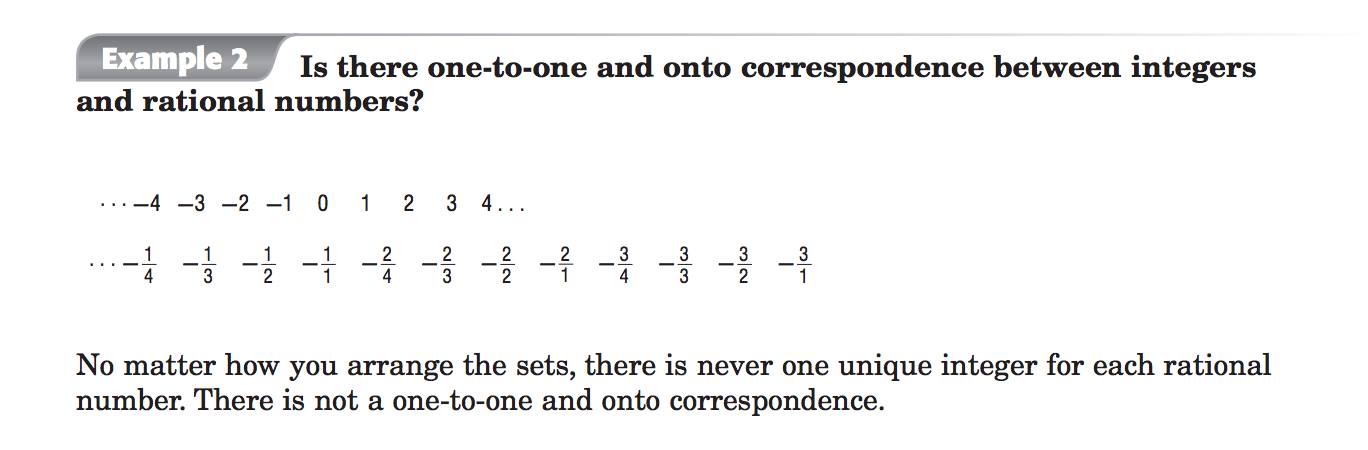
This was sent to me by a former student of mine. It appears in the chapter study guide for Section 2.1 of Glencoe’s Algebra 2 textbook (published in 2014), presumably as an enrichment activity for students learning about the definitions of “one to one functions” and “onto functions.”

countable infinityJust how bad is this mistake?

  • The above “proof” is only a blatant assertion, without any justification, either formal or informal, for why the authors think that the statement is false.
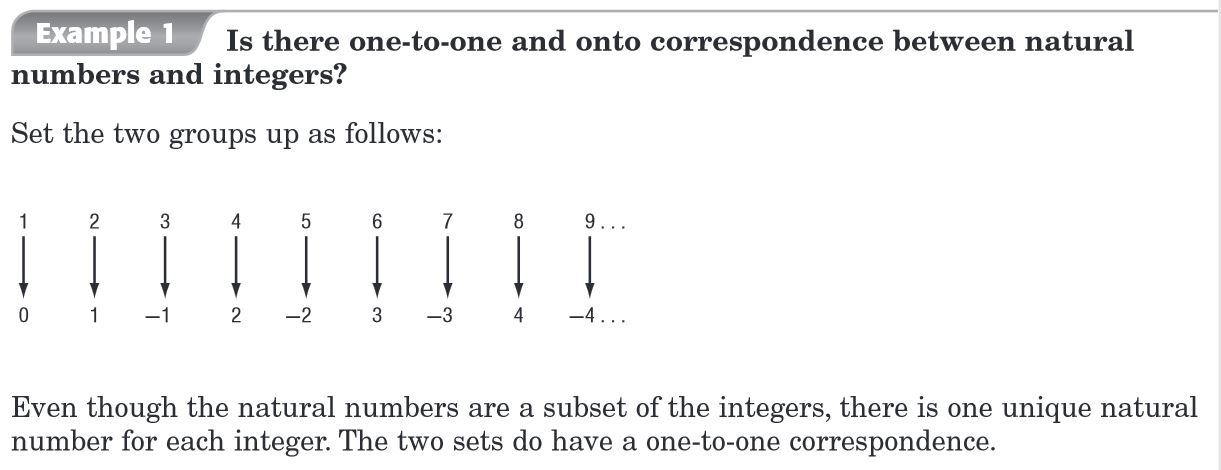
  • The ordering of the rational numbers in the way listed above is actually reasonably close to the listing that actually does produce the one-to-one correspondence between \mathbb{Q} and \mathbb{Z}.
  • Just above Example 2 was Example 1, which gives the correct proof that there’s a one-to-one correspondence between \mathbb{Z} and \mathbb{N}. If the authors had double-checked this proof in any reputable book, they should have also been able to double-check that their Example 2 was completely false.
countable infinity 2

green line

The full chapter study guide can be found here (it’s on the last page): http://nseuntj.weebly.com/uploads/1/8/2/0/18201983/2.1relations_and_functions.pdf

Reactions can be found here: https://www.reddit.com/r/math/comments/3k1qe6/this_is_in_a_high_school_math_textbook_in_texas/

Reference to this can be seen on page 10 of the teacher’s manual here: http://msastete.com/yahoo_site_admin1/assets/docs/Chpte2-1.25882808.pdf


Engaging students: Graphing parabolas

In my capstone class for future secondary math teachers, I ask my students to come up with ideas for engaging their students with different topics in the secondary mathematics curriculum. In other words, the point of the assignment was not to devise a full-blown lesson plan on this topic. Instead, I asked my students to think about three different ways of getting their students interested in the topic in the first place.

I plan to share some of the best of these ideas on this blog (after asking my students’ permission, of course).

This student submission again comes from my former student Irene Ogeto. Her topic, from Algebra: graphing parabolas.

green line

B2. How does this topic extend what your students should have learned in previous courses?

In previous courses, students should have learned about linear functions of the form y = mx + b. Parabolas are functions of the form y = a(x-h) + k. Graphing parabolas extends their thinking because it allows to students to see the graph of a function that is different from the graph of a line. Students can explore the similarities and differences between linear functions and quadratic functions. Students can apply the same logic they used when graphing linear functions by making a table and use the points to plot the graph. Students can use the graph of parabolas to determine the equation of the quadratic function. Students can apply transformations of graphs such as reflecting, stretching or compressing to parabolic functions as well. Graphing parabolas allows students to explore concepts they previously learned such as parent functions, y-intercepts, x-intercepts, and symmetry.

green line

C2. How has this topic appeared in high culture (art, classical music, theatre, etc.)?

Parabolic curves are all around us in buildings, churches, restaurants, homes, schools and other places. Parabolas are apparent in numerous places in architecture. One example where parabolic curves can be found in architecture is in suspension bridges such as the Brooklyn Bridge in New York, the Golden Gate Bridge in California, or the George Washington Bridge in New Jersey. Suspension bridges are mainly used to carry loads over a long distance and most suspension bridges are lengthy in distance. In suspension bridges, cables, ropes or chains are suspended throughout the road. The cables under tension form the parabolic curve. The towers and hangers are used to support the cables throughout the bridge. Seeing how parabolas appear in high culture will allow students to make a connection between math and the things that may see around them. Hopefully the students can see that math, specifically parabolas in this case are not only found in the classroom.

bridge1 bridge2


green line

E1. How can technology (YouTube, Khan Academy [khanacademy.org], VI Hart, Geometers Sketchpad, graphing calculators, etc.) be used to effectively engage students with this topic?

This YouTube video, “Water Slide Stunt,” is a great way to introduce students to graphing parabolas. It allows students to see the curve that parabolic functions make. In addition, it gives students an example of a real-world situation where projectile motion and parabolic functions can be seen. This video can be used at the beginning of a lesson on graphing parabolas. This video is engaging because it gets the students thinking about projectile motion and it shows how math can be related to different things in our society. In addition, students can also look up this video on YouTube on their own time and share with others.


References:

https://www.youtube.com/watch?v=3wAjpMP5eyo

http://science.howstuffworks.com/engineering/civil/bridge6.htm

Engaging students: Using the point-slope equation of a line

In my capstone class for future secondary math teachers, I ask my students to come up with ideas for engaging their students with different topics in the secondary mathematics curriculum. In other words, the point of the assignment was not to devise a full-blown lesson plan on this topic. Instead, I asked my students to think about three different ways of getting their students interested in the topic in the first place.

I plan to share some of the best of these ideas on this blog (after asking my students’ permission, of course).

This student submission again comes from my former student Tiffany Jones. Her topic, from Algebra: using the point-slope equation of a line.

green line


B1. How can this topic be used in your students’ future courses in mathematics or science?


The topic of using the point-slope equation of a line comes up in some of the early topics of Calculus 1 such as, how to find the equation of the tangent line of a curve at a given point. The slope, ­, of the tangent line of a curve at a given point, , is equal to the instantaneous rate of change or slope of the curve at that given point. The slope is calculated by evaluating the following limit:

\displaystyle m = \lim_{h \to 0} \frac{f(x_0+h)-f(x_0)}{h}

If the difference quotient has a limit as h approaches zero, then that limit is called the derivative of the function at . Then, values of  and  are substituted into the point-slope equation of a line to determine the equation of the tangent line of a curve at a given point.

y-y_0 = m(x-x_0)

green line

C1. How has this topic appeared in pop culture?

On December 31st 1965, Chuck Jones’ released an animated short titled “The Dot and The Line: A Romance in Low Mathematics”. This ten minute, Oscar-winning film explores the complex relationship between lines, dots, and disorganization. The Line as desperately in love with the Dot. Yet, the Dot is currently involved with a chaotic Squiggle. The Dot ignores the Line, disregarding him as boring and predictable. He lacks complexity. Through a montage following this rejection, the line teaches himself to create angles, form curves, and produce close-ended shapes as well. With this new confidence, he then reveals his newfound self to the Dot. The Dot sees that there is no method to the Squiggles madness.

While the topic of using the point slope equation of a line is not an explicit topic of the short, I feel that this video as an engage activity can be great conversation starter about the relationship between a point and a line. From there the lesson can go on to talk about the point-slope equation. Furthermore, this video can open discussions about the slope-intercept and the point-point forms of a line.

green line

E1. How can technology be used to effectively engage students with this topic?

Explore Learning offers a Gizmo and worksheet on the point-slope form of a line. The Gizmo is an interactive simulator that allows the student to physically move the point around the Cartesian plane or use the sliders to adjust the point values and the slope value. The Gizmo shows the resulting line. I think that the use of such a tool can reinforce the relationship of a particular slope and a particular point to give an equation of a line.

The Gizmo offers to the slope-intercept form of the equation. So this simulator can also be used for a lesson on the slope-intercept form. Also, the Gizmo can place a right triangle along the line with leg lengths to show how the rise and run values change with the overall slope value.

Additionally, I think that this simulator can be used to allow the students to explore the equation. For instance, the students can see why when the graph is shifted to the left 2 units, the resulting equation has (x+2).


References:

http://www.imdb.com/title/tt0059122/?ref_=ttawd_awd_tt

https://www.youtube.com/watch?v=OmSbdvzbOzY

https://www.explorelearning.com/index.cfm?ResourceID=16*4&method=cResource.dspDetail

https://s3.amazonaws.com/el-gizmos/materials/PointSlopeSE.pdf


Engaging students: Multiplying binomials

In my capstone class for future secondary math teachers, I ask my students to come up with ideas for engaging their students with different topics in the secondary mathematics curriculum. In other words, the point of the assignment was not to devise a full-blown lesson plan on this topic. Instead, I asked my students to think about three different ways of getting their students interested in the topic in the first place.

I plan to share some of the best of these ideas on this blog (after asking my students’ permission, of course).

This student submission again comes from my former student Perla Perez. Her topic, from Algebra: multiplying binomials.

green line

B1. How can this topic be used in your students’ future courses in mathematics or science?

As students progress through different levels of math, they will continue to utilize tools, such as multiplication of binomials. When I give students the solutions to a quadratic function and ask them to find the equation, I expect for them to know how to multiply the binomials. For example: find the quadratic equation with the solution x=-2,2. The students are to set up as: (x+2)(x-2) and go forth. The students can also be given a quadratic equation, x2+6x+8 and are to find the solutions in representation (x+2)(x+4). In order to arrive at the answer, the students will have to factor the original equation. To check their work, they can just multiply the answer that they get. Multiplying the binomials is a more complex form of the distributive property. It’s a building block for more challenging math concepts. Multiplying binomials essentially does the opposite of factorization, which students will learn later on in their algebra class. Binomials are also used in sciences, such as physics, biology, and computer science, so it helps for students to have a strong foundation on this topic.

green line

B2. How does this topic extend what your students should have learned in previous courses?


I’ve seen students panic when a new concept, equation, or definition is introduce. Before they begin thinking again that math is some sort of sorcery, showing them something familiar will help ease the students into a new topic that is an extension of what they previously learned. Students learn about distributive property in their pre-algebra course. In order for students to multiply binomials students need to understand distributive property. Distributive property is a building block that is needed for the multiplication of binomials. It works with singles terms being multiplied, where as binomial multiplication works with two. In a way it is like learning how to add single digits to double digits. In order to teach this, I would first reintroduce 4-5 problems they’ve seen in their previous class using distributive property with single terms such as 4(x+5). Once they begin to recognize and solve the problems, I will begin to introduce two terms rather than just one. When they compare their previous knowledge to this new idea they will see that it is not very different.


green line

A1. What interesting (i.e., uncontrived) word problems using this topic can your students do now? (You may find resources such as http://www.spacemath.nasa.gov to be very helpful in this regard; feel free to suggest others.)

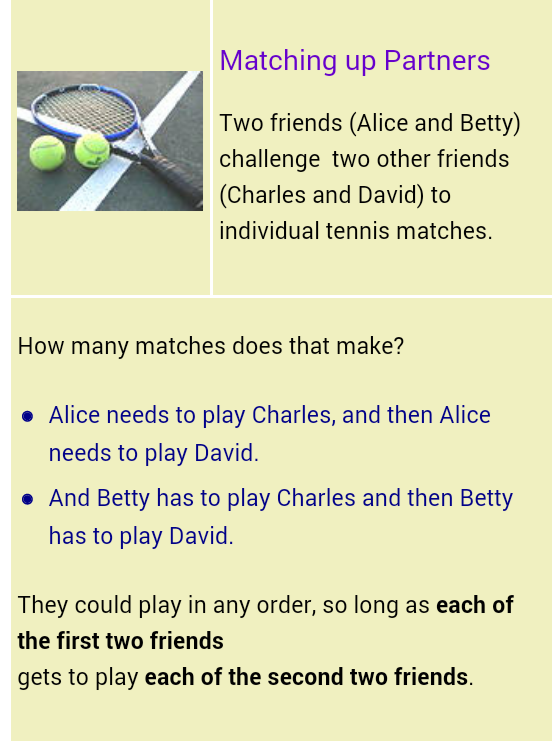
Students often find it difficult to understand why we use certain tools, such as the multiplication of binomials. Word problems are a good solution when introducing a new topic. There are many methods for multiplying binomials, such as the FOIL and the CLAW methods, and it is important that student learn them; however, students who struggle with the topic need new information to be presented in a different way. The website mathisfun.com has a great word problem for multiplying binomials.

tennis

I like this problem because it divides the topic into separate steps, making it easier for the student to understand what to do. With this particular word problem, the teacher can begin to see where the students are having difficulties. This allows the teacher to see what areas need to be revisited, such as order of operations, the multiplication of a negative or positive number etc. Word problems also help teachers evaluate the critical thinking skills of their students.

My References are:

https://www.mathsisfun.com/algebra/polynomials-multiplying.html

http://ritter.tea.state.tx.us/rules/tac/chapter111/ch111c.html