Why does 0.999… = 1? (Part 1)

Our decimal number system is so wonderful that it’s often taken for granted. (If you doubt me, try multiplying 12 and 61 or finding an 18\% tip on a restaurant bill using only Roman numerals.)

However, there’s one little quirk about our numbering system that some students find quite unsettling:

If a number has a terminating decimal representation, then the same number also has a second different terminating decimal representation. (However, a number that does not have a terminating decimal representation does not have a second representation.)

Stated another way, a decimal representation corresponds to a unique real number. However, a real number may not have a unique decimal representation.

Some (perhaps many) students find such equalities to be unsettling at first glance, and for good reason. They’d prefer to think that there is a one-to-one correspondence to the set of real numbers and the set of decimal representations. Stated more simply, students are conditioned to think that if two number look different (like 24 and 25), then they ought to be different.

However, there’s a subtle difference  between a number and a numerical representation. The number 1 is defined to be the multiplicative identity in our system of arithmetic. However, this number has two different representations in our numbering system: 1 and 0.999\dots. (Not to mention its representation in the numbering systems of the ancient Romans, Babylonians, Mayans, etc.)

As usual, let [0,1] be the set of real numbers from 0 to 1 (inclusive), and let D be the set of decimal representations of the form 0.d_1 d_2 d_3 \dots. Then there’s clearly a function f : D \to \mathbb{R}, defined by

f(0.d_1 d_2 d_3\dots) = \displaystyle \sum_{i=1}^\infty \frac{d_n}{10^n}

If I want to give my students a headache, I’ll ask, “In Calculus II, you saw that some series converge and some series diverge. So what guarantee do we have that this series actually converges?” (The convergence of the right series can be verified using the Direct Comparsion Test, the fact that d_i \le 9, and the formula for an infinite geometric series.)

In the language of mathematics: Using the completeness axiom, it can be proven (though no student psychologically doubts this) that f maps D onto [0,1]. In other words, every decimal representation corresponds to a real number, and every real number has a decimal representation. However, the function f is a surjection but not a bijection. In other words, a real number may have more than one decimal representation.

This is a big conceptual barrier for some students — even really bright students — to overcome. They’re not used to thinking that two different decimal expansions can actually represent the same number.

The two most commonly shown equal but different decimal representations are 0.999\dots = 1. Other examples are

0.125 = 0.124999\dots

3.458 = 3.457999 \dots

In this series, I will discuss some ways of convincing students that 0.999\dots = 1. That said, I have met a few math majors within a semester of graduating — that is, they weren’t dummies — who could recite all of these ways and were perhaps logically convinced but remained psychologically unconvinced. The idea that two different decimal representations could mean the same number just remained too high of a conceptual barrier for them to hurdle.

Method #1. This first technique is accessible to any algebra or pre-algebra student who’s comfortable assigning a variable to a number. We convert the decimal representation to a fraction using something out of the patented Bag of Tricks. If students aren’t comfortable with the first couple of steps (as in, “How would I have thought to do that myself?”), I tell my usual tongue-in-cheek story: Socrates gave the Bag of Tricks to Plato, Plato gave it to Aristotle, it passed down the generations, my teacher taught the Bag of Tricks to me, and I teach it to my students.

Let x =0.999\dots. Multiply x by 10, and subtract:

10x = 9.999\dots

x = 0.999\dots

\therefore (10-1)x = 9

x =1

0.999\dots = 1

Engaging students: Introducing variables and expressions

In my capstone class for future secondary math teachers, I ask my students to come up with ideas for engaging their students with different topics in the secondary mathematics curriculum. In other words, the point of the assignment was not to devise a full-blown lesson plan on this topic. Instead, I asked my students to think about three different ways of getting their students interested in the topic in the first place.

I plan to share some of the best of these ideas on this blog (after asking my students’ permission, of course).

This student submission again comes from my former student Caitlin Kirk. Her topic, from Pre-Algebra: introducing variables and expressions.

green line

To keep track of some of the coldest things in the universe, scientist use the Kelvin temperature scale that begins at 0 Kelvin, or Absolute Zero. Nothing can ever be colder than Absolute Zero because at this temperature, all motion stops. The table below shows some typical temperatures of different systems in the universe.

Table of Cold Places

Temp.(K)

Location

 183

Vostok, Antarctica

160

Phobos- a moon of Mars

128

Europa in the summer

120

Moon at night

88

Miranda surface temp.

81

Enceladus in the summer

70

Mercury at night

55

Pluto in the summertime

50

Dwarf Planet Quaoar

33

Pluto in the wintertime

1

Boomerang Nebula

0

ABSOLUTE ZERO

You are probably already familiar with the Celsius (C) and Fahrenheit (F) temperature scales. The two formulas below show how to switch from degrees-C to degrees-F.

C = \frac{5}{9} (F-32)

F = \frac{9}{5} C + 32

Because the Kelvin scale is related to the Celsius scale, we can also convert from Celsius to Kelvin (K) using the equation:

K = 273 + C

Problems

Use these three equations to convert between the three temperature scales:

Problem 1: 212 F converted to K

Problem 2: 0 K converted to F

Problem 3: 100 C converted to K

Problem 4: Two scientists measure the daytime temperature of the moon using two different instruments. The first instrument gives a reading of +107 C while the second instrument gives +221 F.

a. What are the equivalent temperatures on the Kelvin scale?

b. What is the average daytime temperature on the Kelvin scale?

Problem 5: Humans can survive without protective clothing in temperatures ranging from 0 F to 130 F. In what, if any, locations from the table above can humans survive?

Solutions

Problem 1: First convert to C:  C = 5/9 (212-32) = +100 C. Then convert from C to K: K = 273 + 100 = 373 Kelvin.

Problem 2: First convert to Celsius:    0 = 273 + C so C = -273. Then convert from C to F: F = 9/5 (-273) + 32 = -459 Fahrenheit.

Problem 3: K = 273 – 100 = 173 Kelvin.

Problem 4:

a. 107 C becomes K = 273 + 107 = 380 Kelvin.  221 F becomes C = 5/9(221-32) = 105 C, and so K = 273 + 105 = 378 Kelvin.

b. (380 + 378)/2 = 379 Kelvin

Problem 5:

First convert 0 F and 130 F to Celsius so that the conversion to Kelvin is quicker. 0 F becomes C = 5/9(0-32) = -18 C (rounded to the nearest degree) and 130 F becomes C = 5/9 (130-32) = 54 C (rounded to the nearest degree).

Next, convert -18 C and 54 C to Kelvin. -18 C becomes K = 273-18 = 255 and 54 C becomes k = 273 + 54 = 327 K.

None of the locations on the table have temperatures between 255 K and 327 K, therefore humans could not survive in any of these space locations.

green line

A. How can this topic be used in your students’ future courses in mathematics or science?

This topic is one of the first experiences students have with algebra. Since algebra is the point from which students dive into more advanced mathematics, this topic will be used in many different areas of future mathematics. After mastering the use of one variable, with the basic operations of addition, subtraction, multiplication, and division, students will be introduced to the use of more than one variable. They may be asked to calculate the area of a solid whose perimeter is given and whose side lengths are unknown variables. Or in a more advanced setting, they may be asked to calculate how much money will be in a bank account after five years of interest compounded continuously. In fact, the use of variables is present and important in every mathematics class from Algebra I through Calculus and beyond. There very well may never be a day in a mathematics students’ life where they will not see a variable after variables have been introduced.

green line

B.  How does this topic extend what your students should have learned in previous courses?

 In basic arithmetic, probably in elementary or early middle school math classes, students learn how to do calculations with numbers using the four basic operations of addition, subtraction, multiplication and division. They also learn simple applications of these basic operations by calculating the area and perimeter of a rectangle, for example. Introducing variables and expressions is a continuation of those same ideas except that one or more of the numbers is now an unknown variable. Students can rely on the arithmetic skills they already possess when learning this introduction to algebra with variables and expressions.

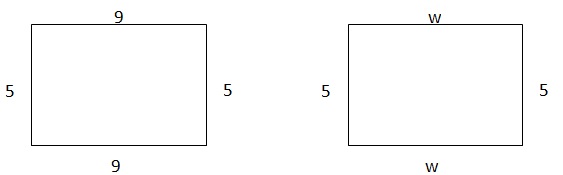
Students are familiar with calculating the area and perimeter of figures like the one on the left before they are introduced to variables. Later, they may see the same figure with the addition of a variable, as shown on the right. The addition of the variable will come with new instructions as well.
caitlin3

The difficulty of problems using variables is determined by the information given in the problems. For instance, the problem on the right can be a one step equation if an area and perimeter are given so that students only need to solve for w. The difficulty can be increased by giving only a perimeter so that students must solve for w and then for the area.

Thoughts on 1/7 and other rational numbers (Part 10)

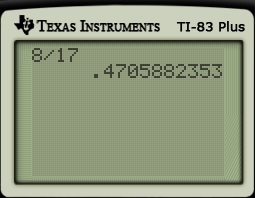
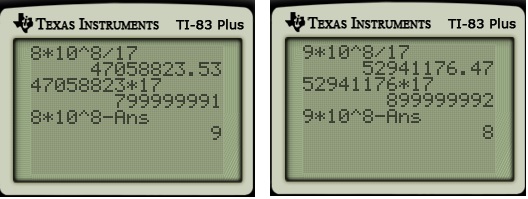
In the previous post, I showed a quick way of obtaining a full decimal representation using a calculator that only displays ten digits at a time. To review: here’s what a TI-83 Plus returns as the (approximate) value of 8/17:

TI817

Using this result and the Euler totient function, we concluded that the repeating block had length 16. So we multiply twice by 10^8 (since 10^8 \times 10^8 = 10^{16}) to deduce the decimal representation, concluding that
\displaystyle \frac{8}{17} = 0.\overline{4705882352941176}

TI817b

Though this is essentially multi-digit long division, most students are still a little suspicious of this result on first exposure. So here’s a second way of confirming that we did indeed get the right answer. The calculators show that

8 \times 10^8 = 17 \times 47058823 + 9 and 9 \times 10^8 = 17 \times 52941176 + 8

Therefore,

8 \times 10^{16} = 17 \times (47058823 \times 10^8) + 9 \times 10^8 and 9 \times 10^8 = 17 \times 52941176 + 8

so that

8 \times 10^{16} = 17 \times (47058823 \times 10^8) + 17 \times 52941176 + 8

8 \times 10^{16} = 17 \times 4705882352941176 + 8

8 \times 10^{16} - 8 = 17 \times 4705882352941176

8 (10^{16}-1) = 17 \times 4705882352941176

\displaystyle \frac{8}{17} = \displaystyle \frac{4705882352941176}{10^{16}-1}

Using the rule for dividing by 10^k -1, we conclude that

\displaystyle \frac{8}{17} = 0.\overline{4705882352941176}

Thoughts on 1/7 and other rational numbers (Part 8)

In Part 6 of this series, I mentioned the following fact concerning the decimal representation of \displaystyle \frac{a}{b}: if neither 2 nor 5 is a factor of b, then the repeating block in the decimal representation of \displaystyle \frac{a}{b} has a length k that must be a factor of \phi(b). This function is the Euler toitent function or the number of integers less than b that are relatively prime with b.

In this post, I’d like to provide a justification for this theorem.

As discussed earlier, k is the least integer so that b is a factor of 10^k - 1. In the language of congruence, k is the least integer so that

10^k \equiv 1 (\mod b)

In other words, let G_b be the multiplicative group of numbers less than b that are relatively prime with b. By assumption 10 \in G_b. Then k is the order of 10 in G_b, and there’s a theorem that states that the order of an element of a group must be a factor of the order of the group, or the number of elements in the group. In our case, the order of G_b is the number of integers less than b that are relatively prime with b, or \phi(b).

In other words, using these ideas from group theory, we can prove that k \mid \phi(b).

green line

Naturally, we don’t expect middle school students seeing long division for the first time to appreciate this property of decimal representations. Still, my main purpose in writing this post was to give a concrete example of how ideas from higher-level mathematics — like group theory — actually can shed insight into ideas that are first seen in school — even middle school. In other words, there’s a reason why UNT (and other universities) requires that college students who want to earn mathematics teaching certification with their degrees must have a major in mathematics.

Thoughts on 1/7 and other rational numbers (Part 6)

In Part 5 of this series, I showed that fractions of the form \displaystyle \frac{M}{10^d}, \displaystyle \frac{M}{10^k - 1}, and \displaystyle \frac{M}{10^d (10^k-1)} can be converted into their decimal representations without using long division and without using a calculator.

The amazing thing is that every rational number \displaystyle \frac{a}{b} can be written in one of these three forms. Therefore, after this conversion is made, then the decimal expansion can be found without a calculator.

green line

Case 1. If the denominator b has a prime factorization of the form 2^m 5^n, then \displaystyle \frac{a}{b} can be rewritten in the form \displaystyle \frac{M}{10^d}, where d = \max(m,n).

For example,

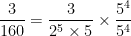
\displaystyle \frac{3}{160} = \displaystyle \frac{3}{2^5 \times 5}

\displaystyle \frac{3}{160} = \displaystyle \frac{3}{2^5 \times 5} \times \frac{5^4}{5^4}

\displaystyle \frac{3}{160} = \displaystyle \frac{3 \times 5^4}{2^5 \times 5^5}

\displaystyle \frac{3}{160} = \displaystyle \frac{1875}{10^5}

\displaystyle \frac{3}{160} = 0.01875

The step of multiplying both sides by \displaystyle \frac{5^4}{5^4} is perhaps unusual, since we’re so accustomed to converting fractions into lowest terms and not making the numerators and denominators larger. This particular form of 1 was chosen in order to get a power of 10 in the denominator, thus facilitating the construction of the decimal expansion.

green line

Case 2. If the denominator b is neither a multiple of 2 nor 5, then  \displaystyle \frac{a}{b} can be rewritten in the form \displaystyle \frac{M}{10^k - 1}.

For example,

\displaystyle \frac{3}{11} = \displaystyle \frac{3}{11} \times \frac{9}{9}

\displaystyle \frac{3}{11} = \displaystyle \frac{27}{99}

\displaystyle \frac{3}{11} = 0.\overline{27}

This example wasn’t too difficult since we knew that 9 \times 11 = 99. However, finding the smallest value of k that works can be a difficult task requiring laborious trial and error.

However, we do have a couple of theorems that can assist in finding k. First, since k is the length of the repeating block, we are guaranteed that k must be less than the denominator b since, using ordinary long division, the length of the repeating block is determined by how many steps are required until we get a remainder that was seen before.

However, we can do even better than that. Using ideas from number theory, it can be proven that k must be a factor of \phi(b), which is the Euler toitent function or the number of integers less than b that are relatively prime with b. In the example above, the denominator was 11, and clearly, if 1 \le n < 11, then \gcd(n,11) = 1. Since there are 10 such numbers, we know that k must be a factor of 10. In other words, k must be either 1, 2, 5, or 10, thus considerably reducing the amount of guessing and checking that has to be done. (Of course, for the example above, k=2 was the least value of k that worked.)

In general, if n = p_1^{a_1} p_2^{a_2} \dots p_r^{a_r} is the prime factorization of n, then

\phi(n) = n \left( \displaystyle 1 - \frac{1}{p_1} \right) \left( \displaystyle 1 - \frac{1}{p_2} \right) \dots \left( \displaystyle 1 - \frac{1}{p_r} \right)

For the example above, since 11 was prime, we have \phi(11) = 11 \left( \displaystyle 1 - \frac{1}{11} \right) = 10.

green line

Case 3. Suppose the prime factorization of the denominator b both (1) contains 2 and/or 5 and also (2) another prime other than 2 and 5. This is a mixture of Cases 1 and 2, and the fraction \displaystyle \frac{a}{b} can be rewritten in the form \displaystyle \frac{M}{10^d (10^k-1)}.

For example, consider

\displaystyle \frac{11}{74} = \displaystyle \frac{11}{2 \times 37}

Following the rule for Case 1, we should multiply by \displaystyle \frac{5}{5} to get a 10 in the denominator:

\displaystyle \frac{11}{74} = \displaystyle \frac{11}{2 \times 37} \times \frac{5}{5} = \frac{55}{10 \times 37}

Next, we need to multiply 37 by something to get a number of the form 10^k - 1. Since 37 is prime, every number less than 37 is relatively prime with 37, so \phi(37) = 36. Therefore, k must be a factor of 36. So, k must be one of 1, 2, 3, 4, 6, 9, 12, 18, and 36.

(Parenthetically, while we’ve still got some work to do, it’s still pretty impressive that — without doing any real work — we can reduce the choices of k to these nine numbers. In that sense, the use of \phi(n) parallels how the Rational Root Test is used to determine possible roots of polynomials with integer coefficients.)

So let’s try to find the least value of k that works.

  • If k = 1, then 10^1 - 1 = 9, but 9 \div 37 is not an integer.
  • If k = 2, then 10^2 - 1 = 99, but 99 \div 37 is not an integer.
  • If k = 3, then 10^3 - 1 = 999, and it turns out that 999 \div 37 = 27, an integer.

Therefore,

\displaystyle \frac{11}{74} = \frac{55}{10 \times 37} \times \frac{27}{27}

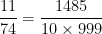
\displaystyle \frac{11}{74} = \frac{1485}{10 \times 999}

\displaystyle \frac{11}{74} = \frac{999 + 486}{10 \times 999}

\displaystyle \frac{11}{74} = \frac{999}{10 \times 999}+ \frac{486}{10 \times 999}

\displaystyle \frac{11}{74} = \frac{1}{10}+ \frac{486}{10 \times 999}

\displaystyle \frac{11}{74} = 0.1 + 0.0\overline{486}

\displaystyle \frac{11}{74} = 0.1\overline{486}

Thoughts on 1/7 and other rational numbers (Part 5)

Students are quite accustomed to obtaining the decimal expansion of a fraction by using a calculator. Here’s an (uncommonly, I think) taught technique for converting certain fractions into a decimal expansion without using long division and without using a calculator. I’ve taught this technique to college students who want to be future high school teachers for several years, and it never fails to surprise.

First off, it’s easy to divide any number by a power of 10, or 10^k. For example,

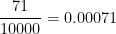
\displaystyle \frac{4312}{1000} = 4.312 and \displaystyle \frac{71}{10000} = 0.00071

What’s less commonly known is that it’s also easy to divide by 10^k - 1, or 99\dots 9, a numeral with k consecutive 9s. (This number can be used to prove the divisibility rules for 3 and 9 and is also the subject of one of my best math jokes.) The rule can be illustrated with a calculator:

TI999

In other words, if M < 10^k - 1, then the decimal expansion of \displaystyle \frac{M}{10^k-1} is a repeating block of k digits containing the numeral M, possibly adding enough zeroes to fill all k digits.
To prove that this actually works, we notice that

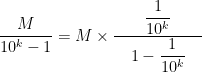
\displaystyle \frac{M}{10^k - 1} = M \times \frac{ \displaystyle \frac{1}{10^k}}{\quad \displaystyle 1 - \frac{1}{10^k} \quad}

 \displaystyle \frac{M}{10^k - 1} = M \times \left(\displaystyle \frac{1}{10^k} + \frac{1}{10^{2k}} + \frac{1}{10^{3k}} + \dots \right)

\displaystyle \frac{M}{10^k-1} = M \times 0.\overline{00\dots01}

The first line is obtained by multiplying the numerator and denominator by \displaystyle \frac{1}{10^k}. The second line is obtained by using the formula for an infinite geometric series in reverse, so that the first term is \displaystyle \frac{1}{10^k} and the common ratio is also \displaystyle \frac{1}{10^k}. The third line is obtained by converting the series — including only powers of 10 — into a decimal expansion.

If M > 10^k - 1, then the division algorithm must be used to get a numerator that is less than 10^k-1. Fortunately, dividing big numbers by 10^k-1 is quite easy and can be done without a calculator. For example, let’s find the decimal expansion of \displaystyle \frac{123456}{9999} without a calculator. First,

123456 = 12(10000) + 3456

123456 = 12(9999 + 1) + 3456

123456 = 12(9999) + 12(1) + 3456

123456 = 12(9999) + 3468

Therefore,

\displaystyle \frac{123456}{9999} = \displaystyle \frac{12(9999) + 3468}{9999}

\displaystyle \frac{123456}{9999} = \displaystyle \frac{12(9999)}{9999} + \frac{3468}{9999}

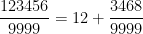
\displaystyle \frac{123456}{9999} = \displaystyle 12 + \frac{3468}{9999}

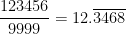
\displaystyle \frac{123456}{9999} = \displaystyle 12.\overline{3468}

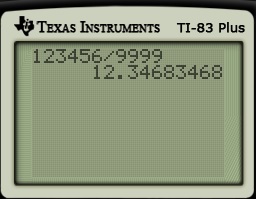
This can be confirmed with a calculator. Notice that the repeating block doesn’t quite match the digits of the numerator because of the intermediate step of applying the division algorithm.

TI9999

green line

In the same vein, it’s also straightforward to find the decimal expansion of fractions of the form \displaystyle \frac{M}{10^d (10^k-1)}, so that the denominator has the form 99\dots9900\dots00. This is especially easy if M < 10^k -1. For example,

\displaystyle \frac{123}{99900} = \frac{1}{100} \times \frac{123}{999} = \frac{1}{100} \times 0.\overline{123} = 0.00\overline{123}

On the other hand, if M > 10^k-1, then the division algorithm must be applied as before. For example, let’s find the decimal expansion of \displaystyle \frac{51237}{99000}. To begin, we need to divide the numerator by 99, as before. Notice that, for this example, an extra iteration of the division algorithm is needed to get a remainder less than 99.

51237 = 512(100) + 37

51237 = 512(99 + 1) + 37

51237 = 512(99) + 512 + 37

51237 = 512(99) + 549

51237= 512(99) + 5(100) + 49

51237 = 512(99) + 5(99 + 1) + 49

51237 = 512(99) + 5(99) + 5 + 49

51237 = 517(99) + 54

Therefore,

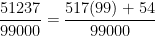
\displaystyle \frac{51237}{99000} = \displaystyle \frac{517(99) + 54}{99000}

\displaystyle \frac{51237}{99000} = \displaystyle \frac{517(99)}{99000} + \frac{54}{99000}

\displaystyle \frac{51237}{99000} = \displaystyle \frac{517}{1000} + \frac{54}{99000}

\displaystyle \frac{51237}{99000} = 0.517 + 0.000\overline{54}

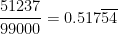
\displaystyle \frac{51237}{99000} = 0.517\overline{54}

In particular, notice that the three 0s in the denominator correspond to a delay of length 3 (the digits 517), while the 99 = 10^2 - 1 in the denominator corresponds to the repeating block of length 2.
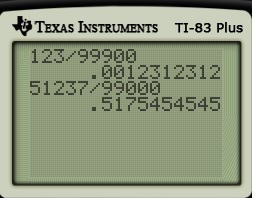
These can be confirmed for students who may be reluctant to believe that decimal expansions can be found without a calculator.

TI99000

Square roots and logarithms without a calculator (Part 2)

I’m in the middle of a series of posts concerning the elementary operation of computing a square root. This is such an elementary operation because nearly every calculator has a \sqrt{~~} button, and so students today are accustomed to quickly getting an answer without giving much thought to (1) what the answer means or (2) what magic the calculator uses to find square roots.

I like to show my future secondary teachers a brief history on this topic… partially to deepen their knowledge about what they likely think is a simple concept, but also to give them a little appreciation for their elders. Indeed, when I show this method to today’s college students, they are absolutely mystified that a square root can be extracted by hand, without the aid of a calculator.

To begin, let’s again go back to a time before the advent of pocket calculators… say, ancient Rome. (I personally love using Back to the Future for the pedagogical purpose of simulating time travel, but I already used that in the previous post.)

How did previous generations figure out \sqrt{4213} without a calculator? In the previous post, I introduced a trapping method that directly used the definition of \sqrt{~~} for obtaining one digit at a time. Here’s a second trapping method that’s significantly more efficient. As we’ll see, this second method works because of base-10 arithmetic and a very clever use of Algebra I. My understanding is that this procedure was a standard topic in the mathematical training of children as little as 50 years ago.

Personally, I was taught this method when I was maybe 10 or 11 years old by my math teacher; I don’t doubt that she had to learn to extract square roots by hand when she was a student. Of course, this trapping method fell out of pedagogical favor with the advent of cheap pocket calculators.

I’ll illustrate this method again with \sqrt{4213}. After illustrating the method, I’ll discuss how it works using Algebra I.

green line

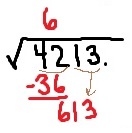
1. To begin, we start from the decimal point and group digits in block of two. (If the number had been 413, then the 4 would have been in a group by itself.) I start with the 42. What perfect square is closest to 42 without going over? Clearly, the answer is 6. So, mimicking the algorithm for long division:

  • We’ll place a 6 over the 42, signifying that the answer is in the 60s.
  • We’ll subtract 36 from 42, for an answer of 6.

sqrt12. On the next step, we’ll do a couple of things that are different from ordinary long division:

  • We’ll bring down the next two digits. So we’ll work with 613.
  • We’ll double the number currently on top and place the result to the side. In our case $6 \times 2 = 12$.
  • We’ll place a small ___ after the 12 and under the 12.
  • The basic question is: I need 120something times the same something to be as close to 613 as possible without going over. I like calling this The Price Is Right problem, since so many games on that game show involve guessing a price without going over the actual price. For example…

121 \times 1 = 121: too small

122 \times 2 = 244: too small

123 \times 3 = 369: too small

124 \times 4 = 496: too small

125 \times 5 = 625: too big

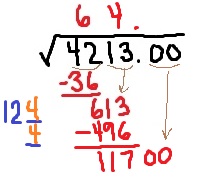
  • Based on the above work, the next digit is 4. We place the 4 over the next block of digits and subtract 124 \times 4 = 496 from 613. So we will work with 613-496 = 117 on the next step.

sqrt23. On the next step, we’ll do a couple of things that are different from ordinary long division:

  • We’ll bring down the next two digits. On this step, the next two digits are the first two zeroes after the decimal point. So we’ll work with 11,700.
  • We’ll double the number currently on top and place the result to the side. In our case $64 \times 2 = 128$.
  • We’ll place a small ___ after the 128 and under the 128.
  • The basic question is: I need 1280something times the same something to be as close to 11,700 as possible without going over. For example…

1281 \times 1 = 1281: too small

1282 \times 2 = 2564: too small

1283 \times 3 = 3849: too small

1284 \times 4 = 5136: too small

1285 \times 5 = 6425: too small

1286 \times 6 = 7716: too small

1287 \times 7 = 9009: too small

1288 \times 8 = 10,304: too small

1289 \times 9 = 11,601: still too small

  • Based on the above work, the next digit is 9. We place the 9 over the next block of digits and subtract 1289 \times 9 = 11,601 from 11,700. So we will work with 11,700-11,601 = 99 on the next step.

Then, to quote The King and I, et cetera, et cetera, et cetera. Each step extracts an extra digit of the square root. With a little practice, one gets better at guessing the correct value of x.

A personal story: when I was a teenager and too cheap to buy a magazine, I would extract square roots to kill time while waiting in the airport for a flight to start boarding. My parents hated missing flights, so I was always at the gate with plenty of time to spare… and I could extract about 20 digits of \sqrt{2} while waiting for the boarding announcement.

So why does this algorithm work? I offer a thought bubble if you’d like to think about before I give the answer.

P.S. In case anyone complains, the people of ancient Rome could not have performed this algorithm since they used Roman numerals and not a base 10 decimal system.

green_speech_bubble

To see why this works, let’s consider the first two steps of finding \sqrt{4213}. Clearly, the answer lies between 60 and 70 somewhere (that was Step 1). So the basic problem is to solve for x if

(60+x)^2 = 4213,

where x is the excess amount over 60. Squaring, we obtain

3600 + 120x + x^2 = 4213,

or

120x + x^2 = 613,

or

(120+x)x = 613

Notice that the right-hand side is 4213-3600, which was obtained at the start of Step 2. The left-hand side has the form 120something times the same something, which was the key part of completing Step 2. So the value of x that gets (120+x)x as close to 613 as possible (without going over) will be the next digit in the decimal representation of \sqrt{4213}.

The logic for the remaining digits is similar.

green line

I should mention that third roots, fourth roots, etc. can (in principle) be found using algebra to find excess amounts. However, it’s quite a bit more work for these higher roots. For example, to find the cube root of 4213, we immediately see that 10^3 = 1000 < 4213 < 8000 = 20^3, so that the answer lies between 10 and 20. To find the excess amount over 10, we need to solve

(10+x)^3 = 4213,

which reduces to

(300 + 30x + x^2)x = 3213.

So we then try out values of x so that the left-hand side gets as close to 3213 as possible without going over.

In closing, in honor of this method, here’s a great compilation of clips from The Price Is Right when the contestant guessed a price that was quite close to the actual price without going over.

Square roots and logarithms without a calculator (Part 1)

This post begins a series of posts concerning the elementary operation of computing a square root. This is such an elementary operation because nearly every calculator has a \sqrt{~~} button, and so students today are accustomed to quickly getting an answer without giving much thought to (1) what the answer means or (2) what magic the calculator uses to find square roots.

I like to show my future secondary teachers a brief history on this topic… partially to deepen their knowledge about what they likely think is a simple concept, but also to give them a little appreciation for their elders.

To begin, let’s go back to a time before the advent of pocket calculators… say, 1955. (When actually teaching this in class, I find the movie clip to be a great and brief way to get students into the mindset of going back in time.)

How did people in 1955 figure out \sqrt{4213}? After all, plenty of marvelous feats of engineering were made before the advent of calculators. So was this computed back then?

green lineOne rudimentary method is simply by trapping the solution. In other words, let’s try guessing the answer to x^2 = 4213 and see if we get it right.

1. First, the tens digit.

  • 60^2 = 3600. Too small.
  • 70^2 = 4900. Too big.
  • Since 3600 < 4213 < 4900, the answer has to be somewhere between 60 and 70.

2. Next, the ones digit. Since 4213 is about halfway between 3600 and 4900, let’s start by guessing 65.

  • 65^2 = 4225. Too big, but not much too big. So let’s try 64 next, as opposed to 62 or 63.
  • 64^2 = 4096. Too small.
  • So the answer has to be somewhere between 64 and 65.

3. Next, the tenth digit. Since 4213 is so close to 4225, let’s start closer to 65 than to 64.

  • 64.8^2 = 4199.04
  • 64.9^2 = 4212.01
  • We already know that 65.0^2 = 4225
  • So the answer has to be somewhere between 64.9 and 65.

And we keep repeating this procedure, obtaining one digit at a time. (My next guess, for the hundredths digit, would be 64.91 or 64.92.) Back in 1955, all of the above squaring was done by hand, without a calculator. With enough patience, \sqrt{4213} can be obtained to as many digits as required.

I distinctly remember using this procedure, just for the fun of it, when I was 7 or 8 years old (with the help of calculator, however). This exercise was far more cumbersome that simply hitting the \sqrt{~~} button, but it really developed my number sense as a young child, not to mention internalizing the true meaning of what a square root actually was. Little insights like “let’s start closer to 65 than to 64 just don’t come naturally without this kind of trial-and-error practice.

For what it’s worth, the above procedure is the essence of the binary search algorithm (from computer science) or the method of successive bisections (from numerical analysis), with a little human intuition thrown in for good measure.

A great algebra question. (Or is it?)

I absolutely love the following algebra question:

Mrs. Ortiz made a batch of cookies for Carlos, Maria, Tina, and Joe. The children shared the cookies equally and finished them all right away.

Then Mrs. Ortiz made another batch of cookies, twice as big as the first. When she took the cookies off the cookie sheet, 6 of them crumbled, so she didn’t serve them to the children. She gave the children the rest of the cookies.

Just then, Mr. Ortiz came home and ate 2 cookies from the children’s tray. Each of the children ate 3 more cookies along with a glass of milk. They were stuffed, so they decided to leave the last 4 cookies on the tray.

1. How many cookies were in the first batch?

2. How many cookies did each of the children eat?

The reason I love this algebra question is that it wasn’t an algebra question. It was a question that was posed to upper elementary students. (Here are the Google results for this question; most of the results are brain-teaser type questions for students ranging from 4th grade to 6th grade.)

As a math person, my first instinct probably would be to let x represent the number of cookies that each child ate on the first day and then set up an equation for x based on the information from the second day. There may be other algebraic ways of solving this problem that are just as natural (or even better than my approach.)

So try to think about this problem from the perspective of a child who hasn’t learned algebra yet.  How would you even start tackling a complex problem like this if you didn’t know you could introduce an x someplace?

I encourage you to take a few minutes and try to solve this problem as a 4th or 5th grader might try to solve it.

While this problem doesn’t require the use of algebra, it does require the use of algebraic thinking. That’s what I love about this problem: even a 9-year-old child can be reasonably expected to think through a solution to this problem, even if the methods that they might choose may not be those chosen by students with more mathematical training.

My observation is that math majors in college — even those that have good teaching instincts and want to teach in high schools after graduating — have a difficult time thinking that far back in time. Of course, putting themselves in the place of students who have not learned algebra yet is a good exercise for anyone who wants to teach algebra. So that’s a major reason that I love this problem; it’s a good vehicle for forcing college students who are highly trained in mathematics to think once again like a pre-algebra student.


Cryptography As a Teaching Tool

From the webpage Cryptography As a Teaching Tool, found at http://www.math.washington.edu/~koblitz/crlogia.html, which was written by Dr. Neal Koblitz, Professor of Mathematics at the University of Washington:

Cryptography has a tremendous potential to enrich math education. In the first place, it puts mathematics in a dramatic setting. Children are fascinated by intrigue and adventure. More is at stake than a grade on a test: if you make a mistake, your agent will be betrayed.

In the second place, cryptography provides a natural way to get students to discover certain key mathematical concepts and techniques on their own. Too often math teachers present everything on a silver platter, thereby depriving the children of the joy of discovery. In contrast, if after many hours the youngsters finally develop a method to break a cryptosystem, then they will be more likely to appreciate the power and beauty of the mathematics that they have uncovered. Later I shall describe cryptosystems that the children can break if they rediscover such fundamental techniques of classical mathematics as the Euclidean algorithm and Gaussian elimination.

In the third place, a central theme in cryptography is what we do not know or cannot do. The security of a cryptosystem often rests on our inability to efficiently solve a problem in algebra, number theory, or combinatorics. Thus, cryptography provides a way to counterbalance the impression that students often have that with the right formula and a good computer any math problem can be quickly solved.

Mathematics is usually taught as if it were a closed book. Other areas of science are associated in children’s minds with excitement and mystery. Why did the dinosaurs die out? How big is the Universe? M. R. Fellows has observed that in mathematics as well, the frontiers of knowledge can and should be put within reach of young students.

Finally, cryptography provides an excellent opportunity for interdisciplinary projects… in the middle or even primary grades.

This webpage provides an excellent mathematical overview as well as some details about to engage students with the mathematics of cryptography.