Engaging students: Finding the asymptotes of a rational function

In my capstone class for future secondary math teachers, I ask my students to come up with ideas for engaging their students with different topics in the secondary mathematics curriculum. In other words, the point of the assignment was not to devise a full-blown lesson plan on this topic. Instead, I asked my students to think about three different ways of getting their students interested in the topic in the first place.

I plan to share some of the best of these ideas on this blog (after asking my students’ permission, of course).

This student submission again comes from my former student Belle Duran. Her topic, from Algebra: finding the asymptotes of a rational function.

green line

How has this topic appeared in high culture?

Although the topic itself has not appeared in high culture, idea of asymptotes brings me the idea of the myth of Tantalus. In a nutshell, Tantalus was always committing crimes against the Gods of Olympus but always going unpunished. One day, he invites the Gods to his home for a feast in which he serves the Gods a rather vile dish. This ultimately angered the Gods to the point of punishing Tantalus by hanging him from a fruit tree amidst a lake, sentencing him to suffer eternal hunger and thirst. Tantalus was always so close to the water and fruits, yet they stayed beyond his reach. In the same way, when a graph has an asymptote then a part of the graph will approach that asymptote without ever touching it or being equal to it.


green line

What interesting things can you say about the people who contributed to the discovery and/or the development of this topic?

The word, “asymptote” derives from the Greek word, “asumptotos” which translates to “not falling together.” The term was first introduced by Apollonius of Perga in his work on conic sections, but used the term to represent a line that will not meet the curve in any finite point. Other achievements by Apollonius includes the introduction of eccentric and epicyclic motion to explain the motion of the planets as well as the hemicyclium which is a sundial with hour lines drawn on the surface of a conic section to give greater accuracy.


green line

How does this topic be used in your students’ future courses in mathematics or science?

One way finding asymptotes can be used in students’ future courses are to understand finding the limits of a function. When it comes to limits, it can be shown that vertical asymptotes are concerned with objectives in which the function is not usually defined and near which the function becomes large positively or negatively, or if a line x=a is called a vertical asymptote for the graph of a function of either the limit to positive infinity as x approaches positive a or negative a. Likewise, horizontal asymptotes are concerned with finite values approached by the function as the independent variable grows large positively or negatively. In other words, a line y=b is a horizontal asymptote for the graph is either the limit of the function is b as x approaches positive infinity or negative infinity.

References

The myth of Tantalus

http://www-history.mcs.st-and.ac.uk/Biographies/Apollonius.html

http://jwilson.coe.uga.edu/emat6680/greene/emat6000/greek%20geom/Apollonius/apollonius.html

http://www.education.com/study-help/article/horizontal-vertical-asymptotes/

http://oregonstate.edu/instruct/mth251/cq/Stage3/Lesson/asymptotes.html


Engaging students: Multiplying binomials

In my capstone class for future secondary math teachers, I ask my students to come up with ideas for engaging their students with different topics in the secondary mathematics curriculum. In other words, the point of the assignment was not to devise a full-blown lesson plan on this topic. Instead, I asked my students to think about three different ways of getting their students interested in the topic in the first place.

I plan to share some of the best of these ideas on this blog (after asking my students’ permission, of course).

This student submission again comes from my former student Andy Nabors. His topic, from Algebra: multiplying binomials.

green line

A2. How could you as a teacher create an activity or project that involves your topic?

Multiplying binomials is an interesting concept because there are so many ways in which this can be done. I can think of five ways that binomials can be multiplied: FOIL, the box method, distribution, vertical multiplication, and with algebra tiles. I would incorporate these methods into one of two different ways. In either case, I would split the class into five groups.

  1. In the first way, I would assign each group a different method of multiplication. The groups would each be responsible for exploring their method, working together to master it. Then each group would be responsible for making a poster describing their method in detail. Then would then present their poster to the class, and the students not presenting would be taking notes. Already having one concept of binomial multiplication, the students would be seeing other methods and deciding which makes most sense to them.
  2. In my second idea, I would have five stations in the classroom each with their own method. The groups would rotate station to station figuring out the different methods collaboratively. The groups would rotate every 7-10 minutes until they had been to every station. Then the class would discuss the strengths/weaknesses of each method compared to the others in a class discussion moderated by the teacher.

These activities rely on the students being able to work and learn in groups effectively, which would present difficulty if the class was not used to group work.

green line

B1. How can this topic be used in your students’ future courses in mathematics or science?

I had the privilege of teaching a multiplying binomial lesson to a freshmen algebra one class in CI last spring. My partner and I focused on the box method first, and then used that to introduce FOIL. The box method was easier to grasp because of the visual nature of it. In fact, it looks a lot like something that the students will definitely see in their biology classes. The box method looks almost identical to gene Punnet Squares in biology. In fact, my partner and I used Punnet Squares in our Engage of that lesson. We reminded the students of what a Punnet Square was, and then showed them a filled out square. We went over how the boxes were filled: the letter on top of each column goes into the boxes below and the letters to the left of the box go in each box to the right. Then we showed them an empty Punnet Square with the same letters before. We inquired about what happens when two variables are multiplied together, then filled out the boxes with multiplication signs in between the letters. The students responded well and were able to grasp the concept fairly well from the onset.

green line

E1. How can technology be used to effectively engage students with this topic?

The internet is fast becoming the only place students will go for helpful solutions to school problems. This activity is designed to be a review of multiplying binomials that would allow students to use some internet resources, but make them report as to why the resource is helpful. The class will go to the computer lab or have laptops wheeled in and they will be given a list of sites that cover binomial multiplication. They will pick a site and write about the following qualities of their chosen site: what kind of site? (calculator, tutorial, manipulative, etc.), how is it presented? (organized/easy to use), was it helpful? (just give an answer opposed to listing the steps), did it describe the method it used?, can you use it to do classwork?, etc.

This is a sample list, I would want more sites, but it gives the general idea I’m going for. (general descriptions in parentheses for this project’s sake)

http://www.mathcelebrity.com/binomult.php (calculator, shows basic steps of FOIL of inputted problem)

http://www.webmath.com/polymult.html (calculator, shows very detailed and specific steps of FOIL of inputted problem)

http://calculator.tutorvista.com/foil-calculator.html (calculator, shows general steps of FOIL, not the inputted problem)

http://www.coolmath.com/crunchers/algebra-problems-multiplying-polynomials-FOIL-1.html (calculator but only problems it gives itself, more of a practice site)

http://www.mathwarehouse.com/algebra/polynomial/foil-method-binomials.php (FOIL tutorial site with practice problems with hidden steps)

http://www.themathpage.com/alg/quadratic-trinomial.htm (wordy explanation, lots of practice problems with hidden answers)

https://www.khanacademy.org/math/algebra/multiplying-factoring-expression/multiplying-binomials/v/multiplying-polynomials-2 (many tutoring videos, just the writing no person)

http://www.zooktutoring.com/now-available-my-very-first-instructional-math-video/ (many tutoring videos, tutor is seen with the work)

http://illuminations.nctm.org/Activity.aspx?id=3482 (algebra tile manipulator)

I will assume as a teacher that my students already look for easy solutions online, so I want to make sure they look in places that will help them gain understanding. I would stress that calculator sites are dangerous because if you just use them then you will not be able to perform on your own, but could be helpful to check your answer if you were worried. At the end of the lesson they would have a greater understanding of how to use internet sources effectively and have reviewed multiplying binomials.


Resources:

http://www.mathcelebrity.com/binomult.php

http://www.webmath.com/polymult.html

http://calculator.tutorvista.com/foil-calculator.html

http://www.coolmath.com/crunchers/algebra-problems-multiplying-polynomials-FOIL-1.html

http://www.mathwarehouse.com/algebra/polynomial/foil-method-binomials.php

http://www.themathpage.com/alg/quadratic-trinomial.htm

https://www.khanacademy.org/math/algebra/multiplying-factoring-expression/multiplying-binomials/v/multiplying-polynomials-2

http://www.zooktutoring.com/now-available-my-very-first-instructional-math-video/

http://illuminations.nctm.org/Activity.aspx?id=3482

Optimally Dancing to “Shout”

From the dual categories of “Someone Had To Figure This Out” and “Applied Mathematics At Work,” FiveThirtyEight.com has used a little algebra to answer one of our generation’s most vexing questions:

What’s the proper rate of descent during the “a little bit softer now” portion of the song “Shout?”

Here’s the link to the article: http://fivethirtyeight.com/datalab/shout-isley-brothers/

And, in case you haven’t been to a wedding reception recently, here’s the song:

Square any number up to 1000 without a calculator

The Mathematical Association of America has an excellent series of 10-minute lectures on various topics in mathematics that are nevertheless accessible to the general public, including gifted elementary school students.  From the YouTube description:

Mathemagician Art Benjamin [professor of mathematics at Harvey Mudd College] demonstrates and explains the mathematics underlying a mental arithmetic technique for quickly squaring numbers.

Engaging students: Finding points on the coordinate plane

In my capstone class for future secondary math teachers, I ask my students to come up with ideas for engaging their students with different topics in the secondary mathematics curriculum. In other words, the point of the assignment was not to devise a full-blown lesson plan on this topic. Instead, I asked my students to think about three different ways of getting their students interested in the topic in the first place.

I plan to share some of the best of these ideas on this blog (after asking my students’ permission, of course).

This student submission comes from my former student Tracy Leeper. Her topic, from Pre-Algebra: finding points on the coordinate plane.

green line

How could you as a teacher create an activity or project that involves your topic?

After introducing the topic to the students, I will inform the students that we will be playing a game on the computer. After pulling up the game on the screen and demonstrating how it works, I will then issue a challenge using the maze game. The challenge will be to see how many mines they can avoid while using the least number of moves. Before class, I will play to get my best score, to show the students what I am looking for, and then I will see who can beat my score. To encourage the students to try their best, I will offer extra credit to anyone who can get through the same number of mines, with fewer moves. Multiple attempts are possible, and I will allow students to turn in their best game by the end of the week. By offering extra credit, it will encourage the students to play the game at home as well as in the classroom. This game will be fun for the students, as well as support the topic of finding points on the coordinate plane. A common struggle is confusing the x and y axis, so by playing the game it will reinforce the proper name for the corresponding axis, and which coordinate goes first in the ordered pair.


green line

How can this topic be used in your students’ future courses in mathematics or science?

Finding points on the coordinate plane is used in a variety of disciplines. Any type of graph used to represent data, with the exception of a pie chart, uses at least one quadrant of the coordinate plane. Typically, it is quadrant 1, since both numbers are positive. The graph is just labeled to reflect the data shown, instead of using x and y. Scientist use graphs to represent data that has been collected from either observation or experimentation, usually labeled as time and the correlating measurement. In math the coordinate plane is used to represent any function, with x as the input and y as the output, as well as helping to graph things that are not functions, such as circles, and other polygons. As well as adding a third dimension, and including a z axis for graphing 3D objects, such as spheres and cubes. The coordinate plane is also used in other disciplines, such as geography, for determining map coordinates.


green line

How has this topic appeared in pop culture (movies, TV, current music, video games, etc.)?

Video games have changed tremendously since the days of Pong. The graphics, storylines, characters, and amount of programming required has become much more intricate. One aspect of the games that appeals to players is the moving background that changes and shifts according to where the character is in the game, and how the camera angle is changed by the player. This enables different scenery and perspectives throughout the game. This is done by using points on a 3D graph, and as the character moves, the reference changes according to their position. The fundamental skill for being able to build the game this way, is to first learn how to plot points on a 2D graph. Since most teenagers like video games, and the graphics involved, this would be a good point to make, so the students could see the connection between the math they are learning, and something they really enjoy doing. This same skill is used for calculating GPS coordinates on our phones and computers.

References:

http://www.shodor.org/interactivate/activities/MazeGame/


Engaging students: Solving for unknown parts of rectangles and triangles

In my capstone class for future secondary math teachers, I ask my students to come up with ideas for engaging their students with different topics in the secondary mathematics curriculum. In other words, the point of the assignment was not to devise a full-blown lesson plan on this topic. Instead, I asked my students to think about three different ways of getting their students interested in the topic in the first place.

I plan to share some of the best of these ideas on this blog (after asking my students’ permission, of course).

This student submission comes from my former student Nada Al Ghussain. Her topic, from Pre-Algebra: solving for unknown parts of rectangles and triangles.

green line

How has this topic appeared in high culture (art, classical music, theatre, etc.)?

In the mathematical classroom it is always easier to engage the left-brainers who excel in numbers, reasoning and logic. My right brainers on the other hand can also shine when engaging them through the underlying foundation of the arts. The Golden ratio \phi = \frac{a+b}{a} = \frac{a}{b} is seen in paintings and architecture. It shows how rectangles and triangles can organize the placement of other shapes and figures in an eye pleasing way. Artists and architectures constantly mapped out their masterpieces on blueprints, which required basic calculations that set up the Golden ratio. Artists using the Golden Rectangle would need to find the missing sides to be able to get the correct proportions for the Golden ratio. This is seen in Leonardo Da Vinci’s “The Last Supper” and in the Parthenon building. Rembrandt solved the third side of an acute triangle before he continued work on his self-portrait. He then drew the line from the apex of the triangle to the base, which cuts into the golden section. Finding the part of a triangle and rectangle contributes to creating masterpieces! Students, left and right brained will see beyond paint, color, and stones. As Luca Pacioli, a contemporary of Da Vinci had said, “Without mathematics there is no art.”
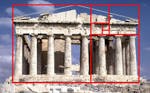
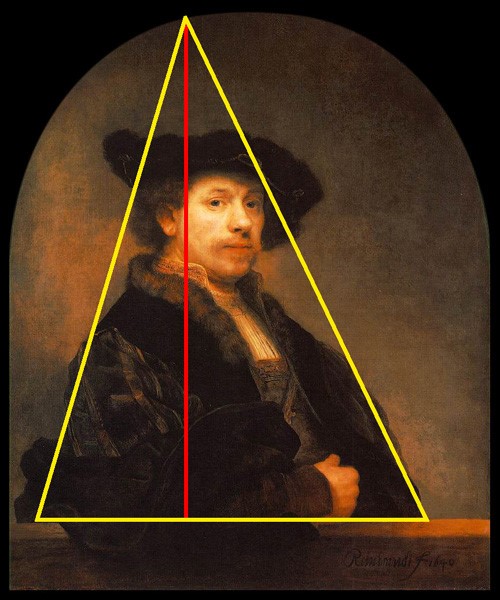
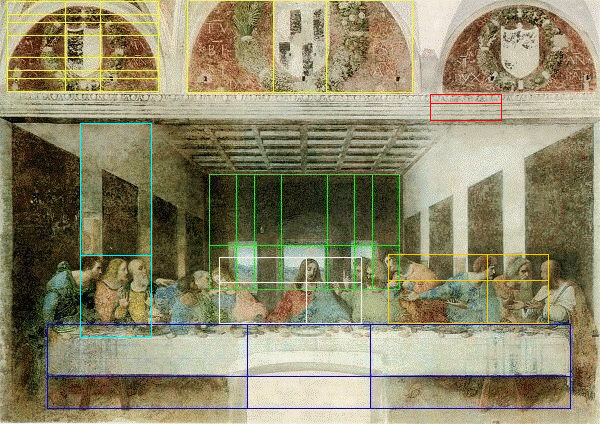
davinci1 davinci2 davinci3

green line

How does this topic extend what your students should have learned in previous courses?

Beginning Geometry students, Can with little and quick computational work solve for the unknown parts of any given rectangle and triangle. A great starter for a Pythagorean lesson is to get them to find missing parts using their shoes! Middle school students can take off their shoes as they work in groups and form the two legs of a right triangle. Once they compute the hypotenuse students can check it by adding the right amount of shoes. This lets students interact with each other and with the right triangle. They can see which triangle theorems can be formed, and discuss the type of angles found with the right triangle. Going beyond that, students can shoe in the missing sides of the squares. This sets up The Pythagorean theorem. This engagement can be quick or take a whole lesson. Students find different calculations, theorems, and set them up for figuring out the Pythagorean theorem.

green line

How can technology (YouTube, Khan Academy [khanacademy.org], Vi Hart, Geometers Sketchpad, graphing calculators, etc.) be used to effectively engage students with this topic? Note: It’s not enough to say “such-and-such is a great website”; you need to explain in some detail why it’s a great website.


Technology is information at our fingertips. Calculator Soup has a Triangle Theorems calculator that can calculate AAA, AAS, ASA, ASS, SAS, and SSS. This would be a great and quick way for students to explore triangles. As a teacher I would ask the students to make an acute SSS triangle using the digits 1through 10 for the sides. I then can ask them if a given side was 20 and the other two were between 1through 10, would I still have an acute triangle? Many quick questions can be used from this calculator. It has the students think about the relationship of the sides and angles as they form triangles. There are also Square, Rectangle, Parallelogram, and a Polygon calculator too. For the parallelogram, different angle measurements can be given to change the side length. Good ways to have students differentiate between rhombus and parallelograms. Calculator Soup is quick visual for students to help them understand the relations between different squares and triangles.


References:

http://www.goldennumber.net/art-composition-design/

http://britton.disted.camosun.bc.ca/goldslide/jbgoldslide.htm

http://psychology.about.com/od/cognitivepsychology/a/left-brain-right-brain.htm

http://www.mathsisfun.com/activity/pythagoras-theorem-shoes.html

http://www.regentsprep.org/regents/math/algebra/at1/pythag.htm

http://www.calculatorsoup.com/calculators/geometry-plane/triangle-theorems.php


Engaging students: Adding and subtracting fractions with unequal denominators

In my capstone class for future secondary math teachers, I ask my students to come up with ideas for engaging their students with different topics in the secondary mathematics curriculum. In other words, the point of the assignment was not to devise a full-blown lesson plan on this topic. Instead, I asked my students to think about three different ways of getting their students interested in the topic in the first place.

I plan to share some of the best of these ideas on this blog (after asking my students’ permission, of course).

This student submission comes from my former student Kristin Ambrose. Her topic, from Pre-Algebra: adding and subtracting fractions with unequal denominators.

green line

What interesting (i.e., uncontrived) word problems using this topic can your students do now?

Cooking is a great example of where you frequently add and subtract fractions with unequal denominators. For example, here is a real-world word problem I came up with for adding and subtracting fractions in cooking:

You are making dinner tonight and you’re having Lemon Chicken with Scalloped Potatoes. The recipes for these can be found below (and yes they are real recipes that you can use in real life).

Scalloped Potatoes4 med. potatoes

¼ cup flour

4 tbsp. butter

2 cups milk

1 cup grated cheese

Dash of garlic powder and white pepper

Salt and pepper to taste

Instructions:

Preheat oven to 350°. Peel and boil potatoes, then set aside to cool. Make 2 cups of cream sauce by melting the butter and blending in the flour. Stir constantly, slowly adding the milk. Stir until the sauce thickens. Add grated cheese and spices. Slice potatoes and arrange in casserole dish. Pour sauce over potatoes. Sprinkle with paprika and bake for 10 minutes at 350°.

Lemon Chicken:

½ lb. boneless chicken breasts

1/8 cup flour

¼ tsp. salt

1 tbsp. butter

½ tsp. lemon pepper seasoning

½ cup of asparagus

1 lemon

Instructions:

  1. Cover the chicken breasts with plastic wrap and pound until each pieces is about a ¾ of an inch thick. Place the flour and salt in a shallow dish and gently toss each chicken breast in the dish to coat. Melt the butter in a large skillet over medium high heat; add the chicken and sauté for 3-5 minutes on each side, until golden brown, sprinkling each side with the lemon pepper directly in the pan.
  2. When the chicken is cooked through, transfer to a plate. Add the lemon slices and chopped asparagus to the pan. Make sure the lemon slices are on the bottom so that they caramelize and pick up the browned bits left in the pan from the chicken and butter.
  3. When the asparagus is done and the lemons are golden brown, add the chicken back to the pan and rearrange everything (lemons on top) so it looks nice for serving.


You only have a half a cup of flour left in your pantry. Looking at the recipes above, do you have enough flour to make dinner? Or do you need to go to the grocery store to buy more flour?

In order to solve this problem students would first have to add the different amounts of flour for each recipe (1/4 + 1/8 = 3/8). Then students would have to subtract this amount from the amount of flour they had to see if they would have enough (1/2 – 3/8 = 1/8). Since 1/8 cup of flour would be left, they have enough flour to make dinner.


green line

How can this topic be used in your students’ future courses in mathematics or science?

It would be difficult to do mathematics without knowing how to add and subtract fractions with unequal denominators. In mathematics when adding or subtracting fractions, it doesn’t always work out nicely where the denominators are the same, so it’s important to be able to solve problems even when the denominators are different. One example of this is summations. Take \sum_{n=1}^4 \frac{1}{2n}; what this equation really means is to add 1/2+1/4+1/6+1/8=25/24 or 1 1/24. Therefore adding fractions with unequal denominators could arise in summations. Also, in Algebra students will study quadratic functions and the factors of quadratic functions often take a form similar to something like (x+a)(x-b), with a and b being numbers. Students will have to know how to multiply these factors out and simplify the expressions. For example, a set of factors could be (x+\frac{1}{2})(x-\frac{2}{3}). When multiplied out students will have x^2 + \frac{1}{2}x-\frac{2}{3}x - \frac{1}{3}. Students will have to know how to subtract 2/3 from 1/2 in order to simplify the expression.


green line

How can technology (YouTube, Khan Academy [khanacademy.org], Vi Hart, Geometers Sketchpad, graphing calculators, etc.) be used to effectively engage students with this topic?

YouTube can be a good source for finding videos to engage students in a topic. In particular, I found a short, funny video that reminds students of the significance of fractions. Here is the link to the video: https://www.youtube.com/watch?v=CBy8QbZyzy4. It makes a difference when a superhero only saves half of your stuff and not all of it. Just like you wouldn’t want only half your things saved, you wouldn’t want to add 2/3 of a cup of flour to a recipe that only calls for 1/4 a cup, or you wouldn’t want to fill up 2/3 of your tank of gas if it was already 1/2 of a tank full. Understanding fractions and how to add and subtract them is an important part of daily life.

I also found another video that demonstrates where fractions can come into play in science. Here is the link to the video: https://www.youtube.com/watch?v=hLGDJFGAmic. The YouTube channel ‘Numberphile’ in particular has many interesting videos involving numbers and mathematics, and would be a great resource for finding interesting videos to engage students.


Engaging students: Scientific notation

In my capstone class for future secondary math teachers, I ask my students to come up with ideas for engaging their students with different topics in the secondary mathematics curriculum. In other words, the point of the assignment was not to devise a full-blown lesson plan on this topic. Instead, I asked my students to think about three different ways of getting their students interested in the topic in the first place.

I plan to share some of the best of these ideas on this blog (after asking my students’ permission, of course).

This student submission comes from my former student Kelley Nguyen. Her topic, from Pre-Algebra: scientific notation.

green line

How could you as a teacher create an activity or project that involves your topic?


First, I would introduce the topic with a comparison towards abbreviating. For example, when text messaging, one could type “Idk” instead of “I don’t know.” For scientific notation, we’re getting a number and abbreviating it using powers of 10.


My activity would be a matching game, where there will be a set of pictures and a set of numbers (in basic units). I would ask the students to match each picture with one of the given lengths, e.g. a tree would be 5 meters in height. The students will then guess on more difficult pictures, such as the earth’s width or the length of the Atlantic Ocean from one continent to another. As they start working with these bigger numbers, I will introduce scientific notation, where one can shorten very small or very large numbers with the powers of 10. When it comes to these large numbers, students seem to be scared or uninterested in writing such lengthy numbers.


Another fun activity is to give half of my students a number and the rest of my students the numbers in scientific notation. Then, I can then ask them to find their match as they roam around the room.


green line

How can this topic be used in your students’ future courses in mathematics or science?


Scientific notation can definitely help in mathematics when working with very small or very large numbers. When writing numbers such as 3,200,000,000, you can shorten the solution with powers of 10. In this case, we can rewrite the solution to be 3.2 × 10⁹. This also goes for the length and width of very small or very large objects. For example, finding the length of a microchip in meters – that number would be entirely small, using a negative exponent of 10.


In science, scientific notation is especially important when dealing with mass, weight, etc. For example, when computing the mass of the sun in kilograms, one wouldn’t answer 1,989,100,000,000,000,000,000,000,000,000 kilograms. Instead, one will write 1.9891 × 1030. With this shorthand notation, students can move on to problems more quickly rather than spending the time to write and count out every zero. As scientists, they will learn that abbreviation is very useful when collecting data or computing expressions.


green line

What interesting things can you say about the people who contributed to the discovery and/or the development of this topic?


It has been debated on who discovered scientific notation, but there are many Greek mathematicians and scientists who contributed to the development of this notation. It was first brought about by Archimedes, who studied the Egyptian city of Alexandria. In one project, Archimedes used Greek letter numerals to calculate the number of grains of sand there were in the Archimedean universe. Of course, now, that’s quite impossible to do, but Archimedes did manage to compute that amount and resulted in a very large number. With that being said, that was the start to developing scientific notation and being able to notate very small or very large numbers as short expressions.


Other mathematicians and scientists that contributed to scientific notation include Galileo and Copernicus, who both played a big role in the world of science. Galileo used scientific notation when experimenting with the solar system. Copernicus had an idea of scientific notation when he was attempting to make a scaled model of the solar system.


References


Engaging students: Adding a mixture of positive and negative numbers

In my capstone class for future secondary math teachers, I ask my students to come up with ideas for engaging their students with different topics in the secondary mathematics curriculum. In other words, the point of the assignment was not to devise a full-blown lesson plan on this topic. Instead, I asked my students to think about three different ways of getting their students interested in the topic in the first place.

I plan to share some of the best of these ideas on this blog (after asking my students’ permission, of course).

This student submission comes from my former student Donna House. Her topic, from Pre-Algebra: adding a mixture of positive and negative numbers.

green line

How can this topic be used in your students’ future courses in mathematics or science?

Version 1

It would be difficult to do well in any future course in mathematics or science without understanding the concept of adding and subtracting positive and negative numbers. This concept is used for temperature, altitude, growth and decay, magnitude, distance, size, profit and loss, and many other topics.

An example from physics would be the students solving a problem involving force. They need to discover how much drag force is needed to stop a drag racing car at the end of the track. The forward force (speed) of the car is positive and needs to be “cancelled out” or reduced to zero in order to stop the car. The students will need to determine if the regular brakes (negative) on the car are sufficient to stop the racer in time, or if additional drag forces (negative) need to be added.

Version 2 (Written as an Engage)

How much force is needed to stop a drag racing car? If you do not stop the car in time, it will crash into the wall, or the fence, or maybe even the water tower and then where would you declare your undying love to Betty Sue? If you stop the car too quickly, you will lose the race and Betty Sue won’t love you anymore. And all this happened because you did not know about adding and subtracting positive and negative numbers!

To stop that racing car you will need to know how much drag force is needed to cancel out the forward force (speed) of the car. Since the forward force is positive, the drag force is negative. But the regular brakes may not give enough drag force to stop the car in time. You may need to add some negative numbers! Remember, your entire future with Betty Sue depends on adding positive and negative numbers!


green line

C1. How has this topic appeared in pop culture?

What if you thought you won the lottery, but found out you were wrong? In November of 2007 a scratch-off lottery card game in England was pulled from the shelves because customers did not understand the concept of negative numbers. Many people tried to claim their prizes only to be told they did not win. Why was there so much confusion? The cards involved negative numbers!

The “Cool Cash” scratch-offs had a cute picture of a penguin on the front. One scratched off windows trying to reveal a temperature that was lower than the temperature revealed on the card. All of the temperatures revealed were below zero and had negative signs. The problem was that many people could not understand whether -6 was larger or smaller than -8. What do you think?

http://www.manchestereveningnews.co.uk/news/greater-manchester-news/cool-cash-card-confusion-1009701


green line

D3. How did people’s conception of this topic change over time?           

Negative numbers have struggled for recognition since ancient times. Negative numbers were ignored by mathematicians for centuries, and considered to be false, non-existent, or simply absurd. Whenever a solution was found to be negative, it was discarded as nonsense. They got no respect. Eventually, the concept of adding and subtracting negative and positive numbers was used to indicate debt and payment, but not much else. Mathematicians just did not quite understand what negative numbers are, even though the negatives cried out to be seen as real numbers.

As time passed, negative numbers began to be recognized as useful, but were generally considered imaginary. They were not accepted as real numbers until the middle of the 18th century, but were still commonly ignored as solutions. The negatives protested peacefully. In the 19th century, negative numbers were finally accepted, but still not widely liked. However, their usefulness caused them to be recognized and they happily indicated the weather, the distance below sea level, and whether or not a golfer’s score was below par.

Today negative numbers have a very good relationship with positive numbers, and are loved by many people. The usefulness of adding and subtracting positive numbers cannot be denied. (Just try to break a world record in racing without this concept!)

http://webspace.ship.edu/kgmcgi/m400/Presentations/Chapter 5 Something Less Than Nothing.ppt

http://en.wikipedia.org/wiki/Negative_number#History


Engaging students: Solving two-step algebra problems

In my capstone class for future secondary math teachers, I ask my students to come up with ideas for engaging their students with different topics in the secondary mathematics curriculum. In other words, the point of the assignment was not to devise a full-blown lesson plan on this topic. Instead, I asked my students to think about three different ways of getting their students interested in the topic in the first place.

I plan to share some of the best of these ideas on this blog (after asking my students’ permission, of course).

This student submission comes from my former student Delaina Bazaldua. Her topic, from Pre-Algebra: solving two-step algebra problems.

green line

How can technology (YouTube, Khan Academy [khanacademy.org], Vi Hart, Geometers Sketchpad, graphing calculators, etc.) be used to effectively engage students with this topic?

I have a love for TED ED videos because of how the videos can explain math, science, etc. with real world examples which is often foreign to students. Bill Nye has always been a hero of mine growing up; his witty ways to communicate math and science to students is admirable. With that being said, when I found, http://ed.ted.com/on/vUO3lcyK#watch, I was really excited that Bill Nye and TED ED made a video that included a subject that was seemingly abstract to students and related it to something very common such as, in this case, cupcakes. Bill Nye takes the viewer on an errand he has to run to pick up cupcakes for his niece and nephew. Of course, since they’re siblings, they have to have an equal amount of cupcakes or World War III may happen. This creates balance between the equal sign. From there, he and we determine the amount of cupcakes in each box (the x) that he is giving to his niece and nephew.


green line

How could you as a teacher create an activity or project that involves your topic?


Every child loves playing games and students in Pre Algebra are no exception to this assumption. In order to manipulate math into games, the resource I found used Bingo as a game to play with a high school class: http://makingmathfun.wikispaces.com/file/view/Two-Step+EQ+BINGO.pdf. I find this as an exceptional game for students to receive practice solving two-step algebraic equations because they may not necessarily realize they’re learning math in the process of playing even though they inevitably are. I am a strong believer in making something seemingly difficult much more fun so that it can be enjoyed by more people. If Bingo is fulfilling this dream, then I am doing my job because passion in math through a game for example leads to understanding of the material and to hard-working students. Playing games to teach algebra makes math seem like less of a chore and hassle, which unfortunately, it is often perceived as. If I can, as a teacher, change this perspective, I could have an effect on students’ lives for the rest of their education career and possibly even their life.


green line

What interesting (i.e., uncontrived) word problems using this topic can your students do now?


As I had previously mentioned, algebra is often viewed by students as abstract and unrelated to the real world. I felt like I needed to include word problems that translate to things that happen in life such as the TED ED/Bill Nye video example that portrayed two-step algebraic equations; math isn’t just simply numbers, but instead is applicable to everyday activities. I found a great PDF file, http://cdn.kutasoftware.com/Worksheets/PreAlg/Two-Step%20Word%20Problems.pdf, which includes 14 word problems that students are familiar with. Another great characteristic about word problems is you can receive a deeper understanding about what a student knows and doesn’t know based on what numbers they write from the word problem that forms their equation. Way too often teachers give students the numbers they need to work with instead of allowing the students to figure out the numbers on their own from a problem that they may actually encounter in life. This habit becomes a disadvantage and a hindrance to students which is why they feel that math is foreign to the world around them and become frustrated with “a pointless subject.” These two reasons make word problems extremely important and useful for students and I believe the worksheet I chose is perfect for accomplishing the goal of allowing students to learn with relevant scenarios.


References:

http://ed.ted.com/on/vUO3lcyK#watch

http://makingmathfun.wikispaces.com/file/view/Two-Step+EQ+BINGO.pdf

http://cdn.kutasoftware.com/Worksheets/PreAlg/Two-Step%20Word%20Problems.pdf