Somebody had the brilliant idea of collecting all of the Calvin and Hobbes comic strips that were related to math: http://www.comicmath.com/calvin-and-hobbes-math-comics.html
See also the other comics: http://www.comicmath.com/comics.html
Somebody had the brilliant idea of collecting all of the Calvin and Hobbes comic strips that were related to math: http://www.comicmath.com/calvin-and-hobbes-math-comics.html
See also the other comics: http://www.comicmath.com/comics.html

I recently placed the following question on an exam: “Convert 201,850,622 into base 16.” The answer: C07FEFE.
After returning the exams, I explained that there’s no V in base 16, so I had to settle for using 7 instead.
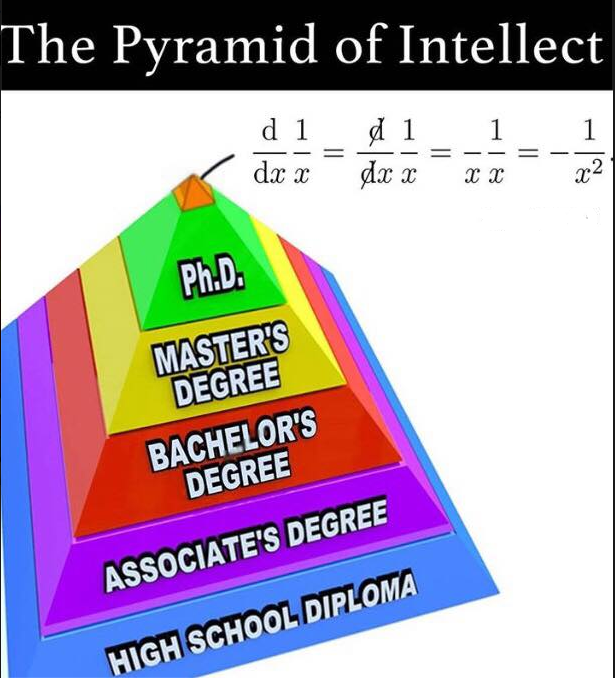
I enjoyed reading this article about John Urschel, a former professional football player who is now pursuing a Ph.D. in mathematics at MIT.
Another bonehead word problem. Notice the word “her”. While Usain Bolt holds the current 100-meter world record of 9.58 seconds, the women’s world record is currently 10.49 seconds.
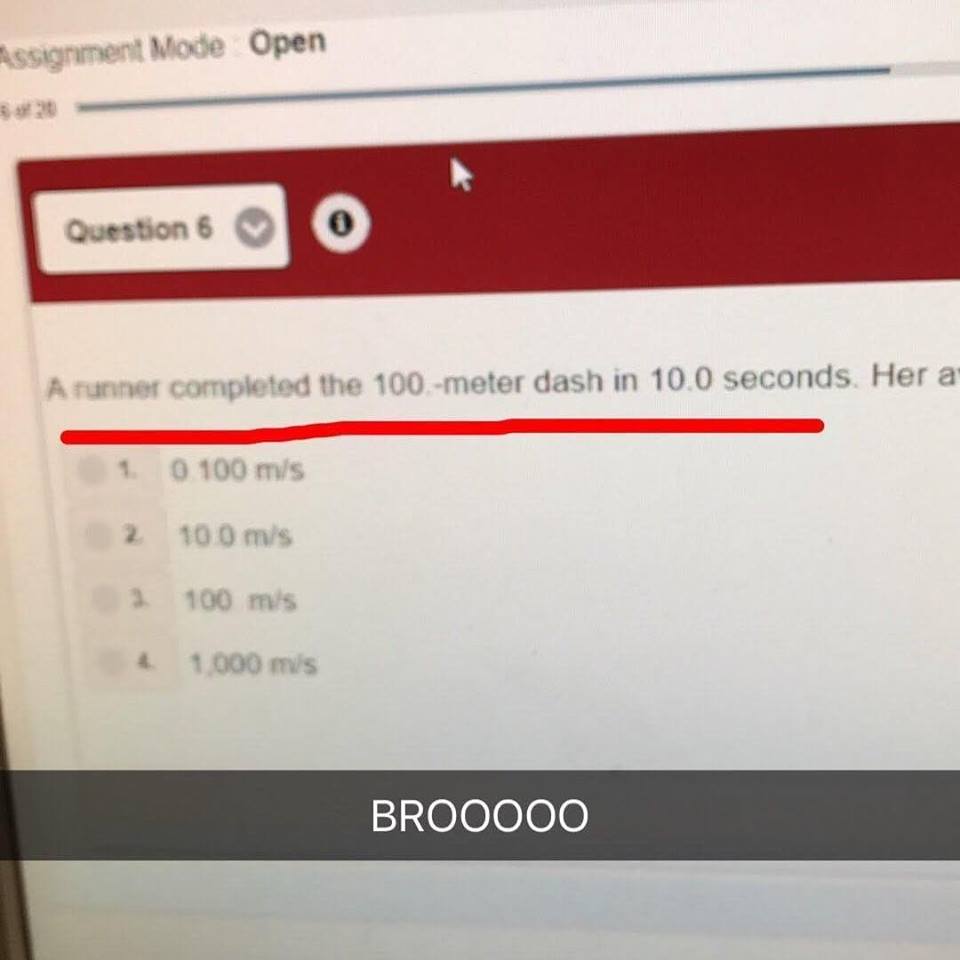
Source: https://www.facebook.com/FloTrack/photos/a.432324889444/10156764197654445/?type=3&theater
The current women’s world record for the long jump is 7.52 meters, or 24 feet, 8 inches.
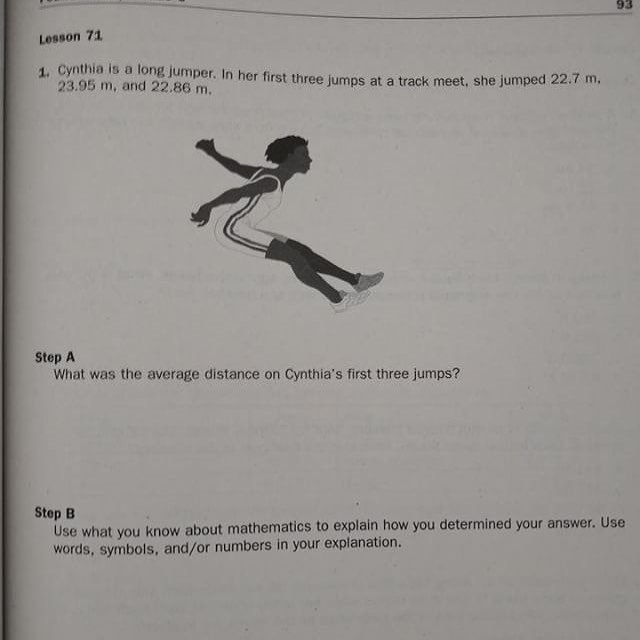 Source: https://www.facebook.com/FloTrack/photos/a.432324889444/10156740897914445/?type=3&theater
I’ve always enjoyed reading about the history of both mathematics and physics, and so I really appreciated this perspective from Physics Today magazine about the importance of this field. One of many insightful paragraphs:
And a more human physics is a good thing. For starters, it makes physics more accessible, particularly for students. Many promising students drop out of the sciences because the material seems disembodied and disconnected from their lives. Science education researchers have found that those lost students “hungered—all of them—for information about how the various methods they were learning had come to be, why physicists and chemists understand nature the way they do, and what were the connections between what they were learning and the larger world.” Students can potentially lose the wonder and curiosity that drew them to science in the first place. Historical narratives naturally raise conceptual, philosophical, political, ethical, or social questions that show the importance of physics for the students’ own lives. A field in which people are acknowledged as people is much more appealing than one in which they are just calculating machines.
The whole article can be found here: https://physicstoday.scitation.org/doi/full/10.1063/PT.3.3235