In this post, I take a deeper look at the standard mistake of “simplifying”  incorrectly as just
  .
.
In the previous post, we noted that the function  defined by
  fails the horizontal line test and thus does not have an inverse function.
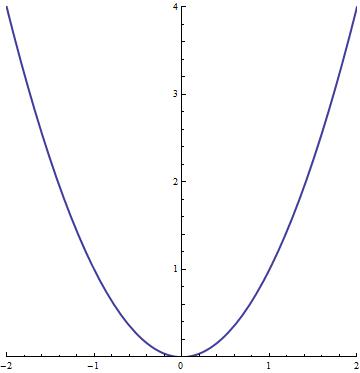
However, we can restrict the domain of  to make a new function that does satisfy the horizontal line test. This new function is identical to where both and
  are defined. Following tradition, we restrict the domain to
  :
:
 defined by
  .
.
So by essentially erasing the left half of the parabola, we form a function that passes the horizontal line test which therefore has an inverse. Naturally, this function is  . When I teach Precalculus, I like to write this as a sentence:
 means that
  and
and  .
.
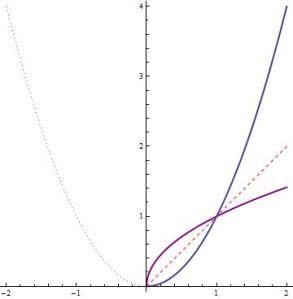
Since and  are inverse functions, it’s always true that
  and
and  whenever these functions are defined. For example,
 and
and

In other words, we are guaranteed that  is always equal to — as long lies in the domain of … or, in other words, as long as is nonnegative.
Because if is negative, all bets are off.
Remember, the original function does not have an inverse. In particular, and are not inverse functions, and so it’s possible for  to be something other than . For example,
 , but
, but

Of course, I don’t expect my Precalculus students to remember the subtle reason that this fails when they do their homework problems. But I do tell my Precalculus students that the nontrivial simplification of is a natural consequence of restricting the domain of a function that does not pass the horizontal line test to define an inverse function. In this example,  as long as
  . However, if
  , then the result really could be just about anything else. For the current example, we have the pairwise simplification
if ;
 if .
if .
The last line is often uncomfortable for students, and so I remind them that is assumed to be negative so that  is positive. Of course, there’s a new notation that mathematicians have developed so that this two-line simplification of can be compressed to a single line:

Unfortunately, in my opinion, this remains the problem that can be stated in two seconds or less (“Simplify the square root of squared”) that, in my opinion, is missed most often by mathematics students.



,
, and
.
 Of course, that’s an inaccurate picture that isn’t drawn to scale. A more accurate picture would look like this:
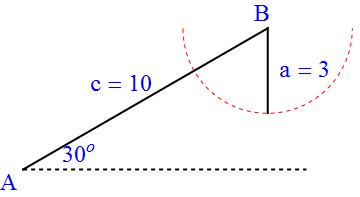 The red dashed circle with center




 In the next few posts of this series, I’ll consider the other SSA cases — including the case where two solutions are possible.
 to
to ![[-\pi/2,\pi/2]](https://s0.wp.com/latex.php?latex=%5B-%5Cpi%2F2%2C%5Cpi%2F2%5D&bg=ffffff&fg=000000&s=0&c=20201002) permits the definition of
permits the definition of  , shown in the purple graph.
![[\pi/2,3\pi/2]](https://s0.wp.com/latex.php?latex=%5B%5Cpi%2F2%2C3%5Cpi%2F2%5D&bg=ffffff&fg=000000&s=0&c=20201002) is a standard problem in a first course in real analysis.)
is a standard problem in a first course in real analysis.) is typically used as shorthand for
  , some students will make the natural mistake of thinking that
  is just shorthand for
  , or
, or  . So I like to address this head-on when introducing inverse trigonometric functions for the first time to my Precalculus students.
 by hand because the line of reflection
  actually is the linearization of
  at
at  . In other words,
  is the first term of the Taylor series of
  .
. and
and  . Therefore, after reflecting through the line
  and
and  .
. and
and  .
. and
and  .
.![g: [-\pi,2,\pi/2] \to [-1,1]](https://s0.wp.com/latex.php?latex=g%3A+%5B-%5Cpi%2C2%2C%5Cpi%2F2%5D+%5Cto+%5B-1%2C1%5D&bg=ffffff&fg=000000&s=0&c=20201002) and
and ![g^{-1}: [-1,1] \to [-\pi/2,\pi/2]](https://s0.wp.com/latex.php?latex=g%5E%7B-1%7D%3A+%5B-1%2C1%5D+%5Cto+%5B-%5Cpi%2F2%2C%5Cpi%2F2%5D&bg=ffffff&fg=000000&s=0&c=20201002) are inverse functions, it’s always true that
are inverse functions, it’s always true that ![f: \mathbb{R} \to [-1,1]](https://s0.wp.com/latex.php?latex=f%3A+%5Cmathbb%7BR%7D+%5Cto+%5B-1%2C1%5D&bg=ffffff&fg=000000&s=0&c=20201002) is the full sine function
is the full sine function  . Therefore, it’s possible for

 .
. to the trigonometric functions. We begin with
  .
.
 and
and  so that
  but
but  . Indeed, there are infinitely many such pairs.
![(-\infty,0]](https://s0.wp.com/latex.php?latex=%28-%5Cinfty%2C0%5D&bg=ffffff&fg=000000&s=0&c=20201002) . However, for the sine function, there are plenty of good options from which to choose. Indeed, here are four legitimate options just using the two periods of the sine function shown above. The fourth option is unorthodox, but it nevertheless satisfies the horizontal line test (as long as we’re careful with
. However, for the sine function, there are plenty of good options from which to choose. Indeed, here are four legitimate options just using the two periods of the sine function shown above. The fourth option is unorthodox, but it nevertheless satisfies the horizontal line test (as long as we’re careful with  .
.
![[-\pi/2, \pi/2]](https://s0.wp.com/latex.php?latex=%5B-%5Cpi%2F2%2C+%5Cpi%2F2%5D&bg=ffffff&fg=000000&s=0&c=20201002) . Why did they settle on this interval? That I can answer with one word: tradition.
. Why did they settle on this interval? That I can answer with one word: tradition.![g: [-\pi/2,\pi/2] \to [0,1]](https://s0.wp.com/latex.php?latex=g%3A+%5B-%5Cpi%2F2%2C%5Cpi%2F2%5D+%5Cto+%5B0%2C1%5D&bg=ffffff&fg=000000&s=0&c=20201002) defined by
defined by ![g^{-1}: [0,1] \to [-\pi/2,\pi/2]](https://s0.wp.com/latex.php?latex=g%5E%7B-1%7D%3A+%5B0%2C1%5D+%5Cto+%5B-%5Cpi%2F2%2C%5Cpi%2F2%5D&bg=ffffff&fg=000000&s=0&c=20201002)
 . The graph of
  , producing the purple graph below.
 is not equal to
  . We’ll discuss this further in future posts.
 .
. .
.

 and
and  so that
  . This can happen in two ways.
 or else
  . Students can visualize this by drawing a picture, talking through each step of its construction (first black, then red, then brown, then green, then blue).

 and $126.9 + 360n^{\circ}$, where
  is an integer. Since integers can be negative, there’s no need to write
  in the solution.
![\sqrt[n]{x}](https://s0.wp.com/latex.php?latex=%5Csqrt%5Bn%5D%7Bx%7D&bg=ffffff&fg=000000&s=0&c=20201002) and saw that the definition was a little different depending if
and saw that the definition was a little different depending if ![y = \sqrt[n]{x}](https://s0.wp.com/latex.php?latex=y+%3D+%5Csqrt%5Bn%5D%7Bx%7D&bg=ffffff&fg=000000&s=0&c=20201002) means that
means that  and
and  ) if
) if  , where
  and
and ![x^{m/n} = \left[ x^{1/n} \right]^m](https://s0.wp.com/latex.php?latex=x%5E%7Bm%2Fn%7D+%3D+%5Cleft%5B+x%5E%7B1%2Fn%7D+%5Cright%5D%5Em&bg=ffffff&fg=000000&s=0&c=20201002)
![(-32)^{3/5} = \left[ (-32)^{1/5} \right]^3 = [-2]^3 = -8](https://s0.wp.com/latex.php?latex=%28-32%29%5E%7B3%2F5%7D+%3D+%5Cleft%5B+%28-32%29%5E%7B1%2F5%7D+%5Cright%5D%5E3+%3D+%5B-2%5D%5E3+%3D+-8&bg=ffffff&fg=000000&s=0&c=20201002)
 is negative. For example,
![(-32)^{4/5} = \left[ (-32)^{4/5} \right]^3 = [-2]^4 = 16](https://s0.wp.com/latex.php?latex=%28-32%29%5E%7B4%2F5%7D+%3D+%5Cleft%5B+%28-32%29%5E%7B4%2F5%7D+%5Cright%5D%5E3+%3D+%5B-2%5D%5E4+%3D+16&bg=ffffff&fg=000000&s=0&c=20201002)

 to be equal to
 ![\left[ (-16)^{1/2} \right]^3](https://s0.wp.com/latex.php?latex=%5Cleft%5B+%28-16%29%5E%7B1%2F2%7D+%5Cright%5D%5E3&bg=ffffff&fg=000000&s=0&c=20201002) , but
, but  is undefined (using real numbers).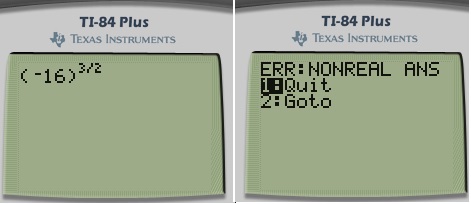
 ?. There are two legitimate choices… which lead to different answers!
![(-8)^{2/6} = \left[ (-8)^2 \right]^{1/6} = [64]^{1/6} = 2](https://s0.wp.com/latex.php?latex=%28-8%29%5E%7B2%2F6%7D+%3D+%5Cleft%5B+%28-8%29%5E2+%5Cright%5D%5E%7B1%2F6%7D+%3D+%5B64%5D%5E%7B1%2F6%7D+%3D+2&bg=ffffff&fg=000000&s=0&c=20201002)
 to lowest terms:
 has been reduced to lowest terms in order to remove the above ambiguity.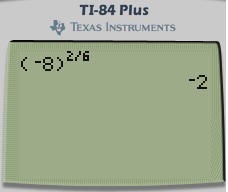

 . Let’s now repeat this logic to consider the definition of
 ![f(x) = \sqrt[n]{x} = x^{1/n}](https://s0.wp.com/latex.php?latex=f%28x%29+%3D+%5Csqrt%5Bn%5D%7Bx%7D+%3D+x%5E%7B1%2Fn%7D&bg=ffffff&fg=000000&s=0&c=20201002) , where
, where  is an integer. We begin with
  ; the graph of
  is shown below.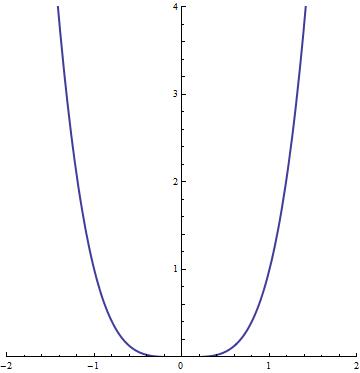
 fails the horizontal line test if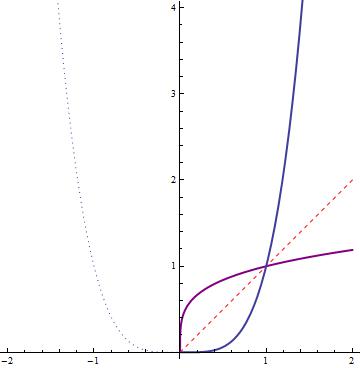


 and
and ![\sqrt[4]{-8}](https://s0.wp.com/latex.php?latex=%5Csqrt%5B4%5D%7B-8%7D&bg=ffffff&fg=000000&s=0&c=20201002) are both undefined since there is no (real) number
are both undefined since there is no (real) number  or
or  . However,
 ![\sqrt[3]{-8}](https://s0.wp.com/latex.php?latex=%5Csqrt%5B3%5D%7B-8%7D&bg=ffffff&fg=000000&s=0&c=20201002) is defined and is equal to
is defined and is equal to  since
since  .
.
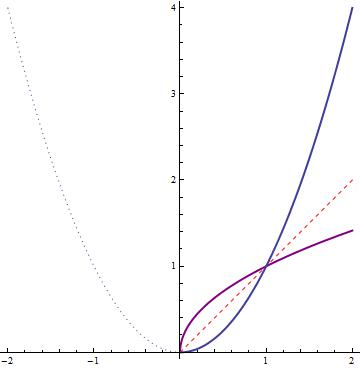
 for any
  — but that’s beside the point.)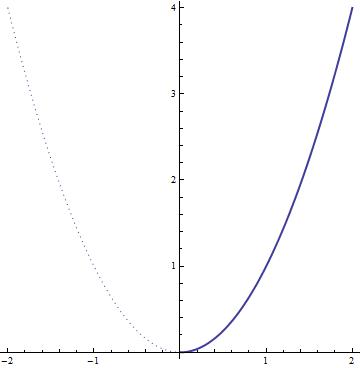

 is more customarily written as
 ![(-\infty,0])](https://s0.wp.com/latex.php?latex=%28-%5Cinfty%2C0%5D%29&bg=ffffff&fg=000000&s=0&c=20201002) is a standard problem in a first course in real analysis.
is a standard problem in a first course in real analysis.


 and
and  , and let $f(x) = x – 4$. This is an bijective function with inverse
  . Therefore,


 is the one and only one solution of this equation.






 ,
, !
! and
and  . We applied the function
  implies
  ,
, does not imply that
  .
. is an object
  is uniquely associated with an object
  . Stated more pedantically, if
  and
and  , then
  . More colloquially, in the graphs that ordinarily appear in secondary school, every
  coordinate of the graph is associated with a unique
  coordinate.
 . Equivalently,
  . In other words,
 is logically defined as
 and
and  for all
  is on the graph of
  is on the graph of
  through the line
  that the original function satisfies the horizontal line test.
