How I Impressed My Wife: Part 3b

Previously in this series, I showed that

Q = \displaystyle \int_0^{2\pi} \frac{dx}{\cos^2 x + 2 a \sin x \cos x + (a^2 + b^2) \sin^2 x} = \displaystyle \frac{2\pi}{|b|}.

My wife had asked me to compute this integral by hand because Mathematica 4 and Mathematica 8 gave different answers. At the time, I eventually obtained the solution by multiplying the top and bottom of the integrand by \sec^2 x and then employing the substitution u = \tan x (after using trig identities to adjust the limits of integration).
But this wasn’t the only method I tried. Indeed, I tried two or three different methods before deciding they were too messy and trying something different. So, for the rest of this series, I’d like to explore different ways that the above integral can be computed.
green line
So far, I have shown that

Q = \displaystyle \int_0^{2\pi} \frac{dx}{\cos^2 x + 2 a \sin x \cos x + (a^2 + b^2) \sin^2 x}

= \displaystyle \int_0^{2\pi} \frac{2 \, dx}{1+\cos 2x + 2 a \sin 2x + (a^2 + b^2)(1-\cos 2x)}

We now employ the substitution \theta = 2x, so that d\theta = 2 \, dx. Also, the limits of integration change from 0 \le x \le 2\pi to 0 \le \theta \le 4\pi, so that

Q = \displaystyle \int_0^{4\pi} \frac{d\theta}{1+\cos \theta + 2 a \sin \theta + (a^2 + b^2)(1-\cos \theta)}

= \displaystyle \int_0^{4\pi} \frac{d\theta}{(1+a^2+b^2) + 2 a \sin \theta + (1 - a^2 - b^2) \cos \theta}

Next, I’ll divide write Q = Q_1 + Q_2 by dividing the interval of integration (not to be confused with the Q_1 and Q_2 used in the previous method), where

Q_1 = \displaystyle \int_0^{2\pi} \frac{d\theta}{(1+a^2+b^2) + 2 a \sin \theta + (1 - a^2 - b^2) \cos \theta}

Q_2 = \displaystyle \int_{2\pi}^{4\pi} \frac{d\theta}{(1+a^2+b^2) + 2 a \sin \theta + (1 - a^2 - b^2) \cos \theta}

For Q_2, I employ the substitution u = \theta - 2\pi, so that \theta = u + 2\pi and du = d\theta. Under this substitution, the interval of integration changes from $2\pi \le \theta \le 4\pi$ to $0 \le u \le 2\pi$, and so

Q_2 = \displaystyle \int_{0}^{2\pi} \frac{du}{(1+a^2+b^2) + 2 a \sin (u+2\pi) + (1 - a^2 - b^2) \cos (u+2\pi)}

Next, I use the periodic property for both sine and cosine — \sin(u + 2\pi) = \sin u and \cos(u+ 2\pi) = \cos u — to rewrite Q_2 as

Q_2 = \displaystyle \int_{0}^{2\pi} \frac{du}{(1+a^2+b^2) + 2 a \sin u + (1 - a^2 - b^2) \cos u}

Except for the dummy variable u, instead of \theta, we see that Q_2 is identical to Q_1. Therefore,

Q = Q_1 + Q_2 = 2 Q_1 = 2 \displaystyle \int_0^{2\pi} \frac{d\theta}{(1+a^2+b^2) + 2 a \sin \theta + (1 - a^2 - b^2) \cos \theta}.

green line

I’ll continue this different method of evaluating this integral in tomorrow’s post.

How I Impressed My Wife: Part 3a

Previously in this series, I showed that

Q = \displaystyle \int_0^{2\pi} \frac{dx}{\cos^2 x + 2 a \sin x \cos x + (a^2 + b^2) \sin^2 x} = \displaystyle \frac{2\pi}{|b|}.

My wife had asked me to compute this integral by hand because Mathematica 4 and Mathematica 8 gave different answers. At the time, I eventually obtained the solution by multiplying the top and bottom of the integrand by \sec^2 x and then employing the substitution u = \tan x (after using trig identities to adjust the limits of integration).
But this wasn’t the only method I tried. Indeed, I tried two or three different methods before deciding they were too messy and trying something different. So, for the rest of this series, I’d like to explore different ways that the above integral can be computed.
green line
For this next technique, I begin by using the trigonometric identities

\sin^2 x = \displaystyle \frac{1-\cos 2x}{2},

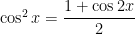
\cos^2x = \displaystyle \frac{1+\cos 2x}{2},

2 \sin x \cos x = \sin 2x.

Using these identities, we obtain

Q = \displaystyle \int_0^{2\pi} \frac{dx}{\displaystyle \frac{1+\cos 2x}{2} + a \sin 2x + (a^2 + b^2) \displaystyle \frac{1-\cos 2x}{2}}

= \displaystyle \int_0^{2\pi} \frac{2 \, dx}{1+\cos 2x + 2 a \sin 2x + (a^2 + b^2)(1-\cos 2x)}

In this way, the exponents have been removed from the denominator, thus making the integrand somewhat less complicated.

green line

I’ll continue this different method of evaluating this integral in tomorrow’s post.

How I Impressed My Wife: Part 2f

Some husbands try to impress their wives by lifting extremely heavy objects or other extraordinary feats of physical prowess.

That will never happen in the Quintanilla household in a million years.

But she was impressed that I broke an impasse in her research and resolved a discrepancy between Mathematica 4 and Mathematica 8 by finding the following integral by hand in less than an hour:

Q = \displaystyle \int_0^{2\pi} \frac{dx}{\cos^2 x + 2 a \sin x \cos x + (a^2 + b^2) \sin^2 x}

In this series, I’ll explore different ways of evaluating this integral.green lineSo far in this series, I’ve shown that

Q = 2 \displaystyle \int_{-\pi/2}^{\pi/2} \frac{dx}{\cos^2 x + 2 a \sin x \cos x + (a^2 + b^2) \sin^2 x}

= 2 \displaystyle \int_{-\pi/2}^{\pi/2} \frac{\sec^2 x dx}{1 + 2 a \tan x + (a^2 + b^2) \tan^2 x}

= 2 \displaystyle \int_{-\infty}^{\infty} \frac{du}{1 + 2 a u + (a^2+b^2) u^2}

= \displaystyle \frac{2}{a^2+b^2} \int_{-\infty}^{\infty} \frac{dv}{v^2 + \displaystyle \frac{b^2}{(a^2+b^2)^2} }

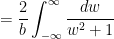
= \displaystyle \frac{2}{|b|} \int_{-\infty}^{\infty} \frac{ dw }{w^2 +1}

This last integral can be evaluated using a standard trick. Let \theta = \tan^{-1} w, so that w = \tan \theta. We differentiate this last equation with respect to w:

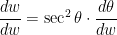
\displaystyle \frac{dw}{dw} = \sec^2 \theta \cdot \displaystyle \frac{d\theta}{dw}

Employing a Pythagorean identity, we have

1 = (1+ \tan^2 \theta) \cdot \displaystyle \frac{d\theta}{dw}

Since w = \tan \theta, we may rewrite this as

1 = (1+ w^2) \cdot \displaystyle \frac{d\theta}{dw}

\displaystyle \frac{1}{1+w^2} = \displaystyle \frac{d\theta}{dw}

\displaystyle \frac{1}{1+w^2} = \displaystyle \frac{d}{dw} \tan^{-1} w

Integrating both sides with respect to w, we obtain the antiderivative

\displaystyle \int \frac{1}{1+w^2} = \tan^{-1} w + C

We now employ this antiderivative to evaluate Q:

Q = \displaystyle \frac{2}{|b|} \int_{-\infty}^{\infty} \frac{ dw }{w^2 +1}

= \displaystyle \frac{2}{|b|} \displaystyle \left[ \tan^{-1} w \right]^{\infty}_{-\infty}

= \displaystyle \frac{2}{|b|} \displaystyle \left[ \displaystyle \frac{\pi}{2} - \frac{-\pi}{2} \right]

= \displaystyle \frac{2\pi}{|b|}

And so, at long last, we have arrived at the solution for the integral Q. Surprisingly, the answer is independent of the parameter a.

green line

These last few posts illustrated the technique that I used to compute this integral for my wife in support of her recent paper in Physical Review A. However, I had more than a few false starts along the way… or, at the time, I thought they were false starts. It turns out that there are multiple ways of evaluating this integral, and I’ll explore another method of attack beginning with tomorrow’s post.

How I Impressed My Wife: Part 2e

Some husbands try to impress their wives by lifting extremely heavy objects or other extraordinary feats of physical prowess.

That will never happen in the Quintanilla household in a million years.

But she was impressed that I broke an impasse in her research and resolved a discrepancy between Mathematica 4 and Mathematica 8 by finding the following integral by hand in less than an hour:

Q = \displaystyle \int_0^{2\pi} \frac{dx}{\cos^2 x + 2 a \sin x \cos x + (a^2 + b^2) \sin^2 x}

In this series, I’ll explore different ways of evaluating this integral.green lineSo far in this series, I’ve shown that

Q = 2 \displaystyle \int_{-\pi/2}^{\pi/2} \frac{dx}{\cos^2 x + 2 a \sin x \cos x + (a^2 + b^2) \sin^2 x}

= 2 \displaystyle \int_{-\pi/2}^{\pi/2} \frac{\sec^2 x dx}{1 + 2 a \tan x + (a^2 + b^2) \tan^2 x}

= 2 \displaystyle \int_{-\infty}^{\infty} \frac{du}{1 + 2 a u + (a^2+b^2) u^2}

= \displaystyle \frac{2}{a^2+b^2} \int_{-\infty}^{\infty} \frac{dv}{v^2 + \displaystyle \frac{b^2}{(a^2+b^2)^2} }

I now employ the substitution v = \displaystyle \frac{b}{a^2+b^2} w, so that dv = \displaystyle \frac{b \, dw}{a^2 + b^2}. If b > 0, then the interval of integration does not change under this substitution, and so

Q = \displaystyle \frac{2}{a^2+b^2} \int_{-\infty}^{\infty} \frac{ \displaystyle \frac{b \, dw}{a^2 + b^2}}{\displaystyle \left( \displaystyle \frac{b}{a^2+b^2} w \right)^2 + \displaystyle \frac{b^2}{(a^2+b^2)^2} }

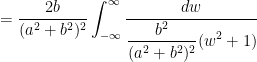
= \displaystyle \frac{2b}{(a^2+b^2)^2} \int_{-\infty}^{\infty} \frac{ dw }{\displaystyle \frac{b^2}{(a^2+b^2)^2} (w^2 +1)}

= \displaystyle \frac{2}{b} \int_{-\infty}^{\infty} \frac{ dw }{w^2 +1}

On the other hand, if b < 0, then the interval of integration does not change under this substitution but the endpoints get flipped:

Q = \displaystyle \frac{2}{a^2+b^2} \int_{\infty}^{-\infty} \frac{ \displaystyle \frac{b \, dw}{a^2 + b^2}}{\displaystyle \left( \displaystyle \frac{b}{a^2+b^2} w \right)^2 + \displaystyle \frac{b^2}{(a^2+b^2)^2} }

Q = \displaystyle -\frac{2}{a^2+b^2} \int_{-\infty}^{\infty} \frac{ \displaystyle \frac{b \, dw}{a^2 + b^2}}{\displaystyle \left( \displaystyle \frac{b}{a^2+b^2} w \right)^2 + \displaystyle \frac{b^2}{(a^2+b^2)^2} }

= \displaystyle -\frac{2b}{(a^2+b^2)^2} \int_{-\infty}^{\infty} \frac{ dw }{\displaystyle \frac{b^2}{(a^2+b^2)^2} (w^2 +1)}

= \displaystyle -\frac{2}{b} \int_{-\infty}^{\infty} \frac{ dw }{w^2 +1}

I can consolidate these two cases by writing

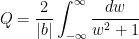
Q = \displaystyle \frac{2}{|b|} \int_{-\infty}^{\infty} \frac{ dw }{w^2 +1}

Clearly, the integral diverges if b = 0, and so I’ll ignore this special case from now on.

green line

I’m almost done; I’ll complete the evaluation of this integral in tomorrow’s post.

How I Impressed My Wife: Part 2d

Some husbands try to impress their wives by lifting extremely heavy objects or other extraordinary feats of physical prowess.

That will never happen in the Quintanilla household in a million years.

But she was impressed that I broke an impasse in her research and resolved a discrepancy between Mathematica 4 and Mathematica 8 by finding the following integral by hand in less than an hour:

Q = \displaystyle \int_0^{2\pi} \frac{dx}{\cos^2 x + 2 a \sin x \cos x + (a^2 + b^2) \sin^2 x}

In this series, I’ll explore different ways of evaluating this integral.green lineSo far in this series, I’ve shown that

Q = 2 \displaystyle \int_{-\pi/2}^{\pi/2} \frac{dx}{\cos^2 x + 2 a \sin x \cos x + (a^2 + b^2) \sin^2 x}

= 2 \displaystyle \int_{-\pi/2}^{\pi/2} \frac{\sec^2 x dx}{1 + 2 a \tan x + (a^2 + b^2) \tan^2 x}

= 2 \displaystyle \int_{-\infty}^{\infty} \frac{du}{1 + 2 a u + (a^2+b^2) u^2}

To evaluate this last integral, I complete the square in the denominator. I first factor (a^2+b^2) out of the denominator:

Q = \displaystyle \frac{2}{a^2+b^2} \int_{-\infty}^{\infty} \frac{du}{u^2 + \displaystyle \frac{2 a}{a^2+b^2} u + \displaystyle \frac{1}{a^2+b^2} }

= \displaystyle \frac{2}{a^2+b^2} \int_{-\infty}^{\infty} \frac{du}{\left( u^2 + \displaystyle \frac{2 a}{a^2+b^2} u + \displaystyle \frac{a^2}{(a^2+b^2)^2} \right) + \displaystyle \frac{1}{a^2+b^2} - \displaystyle \frac{a^2}{(a^2+b^2)^2} }

= \displaystyle \frac{2}{a^2+b^2} \int_{-\infty}^{\infty} \frac{du}{\left( u + \displaystyle \frac{a}{a^2+b^2} \right)^2 + \displaystyle \frac{a^2+b^2}{(a^2+b^2)^2} - \displaystyle \frac{a^2}{(a^2+b^2)^2} }

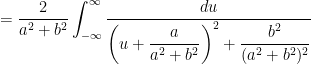
= \displaystyle \frac{2}{a^2+b^2} \int_{-\infty}^{\infty} \frac{du}{\left( u + \displaystyle \frac{a}{a^2+b^2} \right)^2 + \displaystyle \frac{b^2}{(a^2+b^2)^2} }

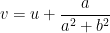
Next, I employ the substitution v = u + \displaystyle \frac{a}{a^2+b^2}, so that dv = du. The endpoint of the integral do not change with this substitution, and so

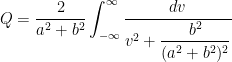
Q = \displaystyle \frac{2}{a^2+b^2} \int_{-\infty}^{\infty} \frac{dv}{v^2 + \displaystyle \frac{b^2}{(a^2+b^2)^2} }

green line

I’ll continue with the evaluation of this integral in tomorrow’s post.

How I Impressed My Wife: Part 2c

Some husbands try to impress their wives by lifting extremely heavy objects or other extraordinary feats of physical prowess.

That will never happen in the Quintanilla household in a million years.

But she was impressed that I broke an impasse in her research and resolved a discrepancy between Mathematica 4 and Mathematica 8 by finding the following integral by hand in less than an hour:

Q = \displaystyle \int_0^{2\pi} \frac{dx}{\cos^2 x + 2 a \sin x \cos x + (a^2 + b^2) \sin^2 x}

In this series, I’ll explore different ways of evaluating this integral.green lineSo far in this series, I’ve shown that

Q = 2 \displaystyle \int_{-\pi/2}^{\pi/2} \frac{dx}{\cos^2 x + 2 a \sin x \cos x + (a^2 + b^2) \sin^2 x}

= 2 \displaystyle \int_{-\pi/2}^{\pi/2} \frac{\sec^2 x dx}{1 + 2 a \tan x + (a^2 + b^2) \tan^2 x}

I now employ the substitution u = \tan x, so that du = \sec^2 x dx. Also, the endpoints change from -\pi/2 < x < \pi/2 to -\infty < u < \infty, so that

Q = 2 \displaystyle \int_{-\infty}^{\infty} \frac{du}{1 + 2 a u + (a^2+b^2) u^2}

green line

I’ll continue with the evaluation of this integral in tomorrow’s post.

How I Impressed My Wife: Part 2b

Some husbands try to impress their wives by lifting extremely heavy objects or other extraordinary feats of physical prowess.

That will never happen in the Quintanilla household in a million years.

But she was impressed that I broke an impasse in her research and resolved a discrepancy between Mathematica 4 and Mathematica 8 by finding the following integral by hand in less than an hour:

Q = \displaystyle \int_0^{2\pi} \frac{dx}{\cos^2 x + 2 a \sin x \cos x + (a^2 + b^2) \sin^2 x}

In this series, I’ll explore different ways of evaluating this integral.green lineIn yesterday’s post, I showed that

Q = 2 \displaystyle \int_{-\pi/2}^{\pi/2} \frac{dx}{\cos^2 x + 2 a \sin x \cos x + (a^2 + b^2) \sin^2 x}

We now multiply the top and bottom of the integrand by \sec^2 x. This is permissible because \sec^2 x is defined on the interior of the interval (-\pi/2, \pi/2) — which is why I needed to adjust the limits of integration in the first place. I obtain

Q = 2 \displaystyle \int_{-\pi/2}^{\pi/2} \frac{\sec^2 x dx}{\cos^2 x \sec^2 x + 2 a \sin x \cos x \sec^2 x + (a^2 + b^2) \sin^2 x \sec^2 x}
Next, I use some trigonometric identities to simplify the denominator:
  • \cos^2 x \sec^2 x = \cos^2 x \displaystyle \frac{1}{\cos^2 x} = 1
  • \sin x \cos x \sec^2 x = \sin x \cos x \frac{1}{\cos^2 x} = \displaystyle \frac{\sin x}{\cos x} = \tan x
  • \sin^2 x \sec^2 x = \sin^2 x \displaystyle \frac{1}{\cos^2 x} = \displaystyle \left( \frac{\sin x}{\cos x} \right)^2 = \tan^2 x

Therefore, the integral becomes

Q = 2 \displaystyle \int_{-\pi/2}^{\pi/2} \frac{\sec^2 x dx}{1 + 2 a \tan x + (a^2 + b^2) \tan^2 x}

green line

I’ll continue with the evaluation of this integral in tomorrow’s post.

How I Impressed My Wife: Part 2a

Some husbands try to impress their wives by lifting extremely heavy objects or other extraordinary feats of physical prowess.

That will never happen in the Quintanilla household in a million years.

But she was impressed that I broke an impasse in her research and resolved a discrepancy between Mathematica 4 and Mathematica 8 by finding the following integral by hand in less than an hour:

Q = \displaystyle \int_0^{2\pi} \frac{dx}{\cos^2 x + 2 a \sin x \cos x + (a^2 + b^2) \sin^2 x}

In this series, I’ll explore different ways of evaluating this integral.green lineI begin by adjusting the range of integration:

Q = Q_1 + Q_2 + Q_3,

where

Q_1 = \displaystyle \int_0^{\pi/2} \frac{dx}{\cos^2 x + 2 a \sin x \cos x + (a^2 + b^2) \sin^2 x},

Q_2 = \displaystyle \int_{\pi/2}^{3\pi/2} \frac{dx}{\cos^2 x + 2 a \sin x \cos x + (a^2 + b^2) \sin^2 x},

Q_3 = \displaystyle \int_{3\pi/2}^{2\pi} \frac{dx}{\cos^2 x + 2 a \sin x \cos x + (a^2 + b^2) \sin^2 x}.

I’ll begin with Q_3 and apply the substitution u = x - 2\pi, or x = u + 2\pi. Then du = dx, and the endpoints change from 3\pi/2 \le x 2\pi to -\pi/2 \le u \le 0. Therefore,

Q_3 = \displaystyle \int_{-\pi/2}^{0} \frac{du}{\cos^2 (u+2\pi) + 2 a \sin (u+2\pi) \cos (u+2\pi) + (a^2 + b^2) \sin^2 (u+2\pi)}.

Next, we use the periodic property for both sine and cosine — \sin(x + 2\pi) = \sin x and \cos(x + 2\pi) = \cos x — to rewrite Q_3 as

Q_3 = \displaystyle \int_{-\pi/2}^{0} \frac{du}{\cos^2 u + 2 a \sin u \cos u + (a^2 + b^2) \sin^2 u}.

Changing the dummy variable from u back to x, we have

Q_3 = \displaystyle \int_{-\pi/2}^{0} \frac{dx}{\cos^2 x + 2 a \sin x \cos x + (a^2 + b^2) \sin^2 x}.

Therefore, we can combined Q_3 + Q_1 into a single integral:

Q_3 + Q_1 = \displaystyle \int_{-\pi/2}^{0} \frac{dx}{\cos^2 x + 2 a \sin x \cos x + (a^2 + b^2) \sin^2 x}

+ \displaystyle \int_0^{\pi/2} \frac{dx}{\cos^2 x + 2 a \sin x \cos x + (a^2 + b^2) \sin^2 x}

Q_3 + Q_1 = \displaystyle \int_{-\pi/2}^{\pi/2} \frac{dx}{\cos^2 x + 2 a \sin x \cos x + (a^2 + b^2) \sin^2 x}

Next, we work on the middle integral Q_2. We use the substitution u = x - \pi, or x = u + \pi, so that du = dx. Then the interval of integration changes from \pi/2 \le x \le 3\pi/2 to -\pi/2 \le u \le \pi/2, so that

Q_2 = \displaystyle \int_{\pi/2}^{3\pi/2} \frac{dx}{\cos^2 x + 2 a \sin x \cos x + (a^2 + b^2) \sin^2 x}

= \displaystyle \int_{-\pi/2}^{\pi/2} \frac{du}{\cos^2 (u+\pi) + 2 a \sin (u+\pi) \cos (u+\pi) + (a^2 + b^2) \sin^2 (u+\pi)}.

Next, we use the trigonometric identities

\sin(u + \pi) = \sin u \cos \pi + \cos u \sin \pi = \sin u \cdot (-1) + \cos u \cdot 0 = - \sin u,

\cos(u + \pi) = \cos u \cos \pi - \sin u \sin \pi = \cos u \cdot (-1) - \sin u \cdot 0 = - \cos u,

so that the last integral becomes

Q_2 = \displaystyle \int_{-\pi/2}^{\pi/2} \frac{dx}{(-\cos u)^2 + 2 a (-\sin u)(- \cos u) + (a^2 + b^2) (-\sin u)^2}

= \displaystyle \int_{-\pi/2}^{\pi/2} \frac{du}{\cos^2 u + 2 a \sin u \cos u + (a^2 + b^2) \sin^2 u}

= \displaystyle \int_{-\pi/2}^{\pi/2} \frac{dx}{\cos^2 x + 2 a \sin x \cos x + (a^2 + b^2) \sin^2 x}

On the line above, I again replaced the dummy variable of integration from u to x. We see that Q_2 = Q_1 + Q_3, and so

Q = Q_1 + Q_2 + Q_3

Q = 2 Q_2

Q = 2 \displaystyle \int_{-\pi/2}^{\pi/2} \frac{dx}{\cos^2 x + 2 a \sin x \cos x + (a^2 + b^2) \sin^2 x}

green line

I’ll continue with the evaluation of this integral in tomorrow’s post.

How I Impressed My Wife: Part 1

Some husbands try to impress their wives by lifting extremely heavy objects or other extraordinary feats of physical prowess.

That will never happen in the Quintanilla household in a million years.

But she was impressed that I broke an impasse in her research and resolved a discrepancy between Mathematica 4 and Mathematica 8 by finding the following integral by hand in less than an hour:

\displaystyle \int_0^{2\pi} \frac{dx}{\cos^2 x + 2 a \sin x \cos x + (a^2 + b^2) \sin^2 x}

Yes, I married well indeed.

This integral serves as the theoretical underpinnings for finding vortices in the velocity fields of atomic wave functions and can be obtained from Equation (4) of a 2014 paper in Physical Review A that she co-authored. And I really like this integral because there are so many different ways of evaluating it, including various trigonometric identities, the magic substitution u = \tan (x/2), partial fractions, and even contour integration and residues.

In this series, I’ll explore different ways of evaluating this integral, starting tomorrow. Until then, I offer a thought bubble if you’d like to try to tackle this before I present the solution(s).

green_speech_bubble

Who was kissing in the famous VJ Day picture?

We are approaching the 70th anniversary of VJ Day (August 14, 1945), which marked the end of World War II. And perhaps the iconic photograph of that day is the picture of two anonymous strangers kissing in New York City’s Times Square celebrating the end of the war.

This iconic image first appeared on page 27 of the August 27, 1945, issue of Life magazine. The shadow on the façade of the Loew’s Building, at the upper right above the Bond Clothes clock, allows us to determine that Alfred Eisenstaedt took this photograph at 5:51 p.m. (Alfred Eisenstaedt / LIFE © Time Inc. Used with permission) Photo: Medina, Mariah, Texas State University, University News Service

And a question that is still unresolved after 70 years is: Who are they?

The short answer is, Nobody knows for certain. But in a clever bit of geometric and astronomical forensics, physicists at Texas State University (Donald Olson and Russell Doescher) and Iowa State University (Steven D. Kawaler) recently pinpointed the exact time that the photograph was taken: 5:51 pm, or about an hour before President Truman formally announced that the war was over. From the press release:

Overlooked in the right hand background of the photo is the Bond Clothes clock.  The minute hand of this clock is clear, but the oblique angle of view and the clock’s unusually short hour hand makes a definitive reading of the time difficult.  The clock might show a time near 4:50, 5:50, or 6:50 p.m.  A prominent shadow falls across the Loew’s Building just beyond the clock, however, and this shadow could potentially give just as accurate a time reading as the clock.

Every tall building in Manhattan acts as a sundial, its cast shadow moving predictably as the sun traverses the sky. In this case, the Texas State team studied hundreds of photographs and maps from the 1940s to identify the source of the shadow, considering, in turn, the Paramount Building, the Hotel Lincoln and the Times Building. The breakthrough came when a photograph of the Astor Hotel revealed a large sign shaped like an inverted L that advertised the Astor Roof garden.

Calculations showed that only the Astor Roof sign could have cast the shadow, but to be certain, Olson and Doescher built a scale model of the Times Square buildings with a mirror to project the sun’s rays. The location, size and shape of the shadow on the model exactly matched the shadow in Eisenstaedt’s kiss photographs.

So who are the kissers? Again from the press release:

Over the years, dozens of men and women have come forward claiming to be the persons in the photograph. All have different stories, but the one thing they share in common is kissing a stranger in Times Square that fateful day.

“All those people have said they were there and identify themselves in the photograph,” Olson said. “Who’s telling the truth? They all could be telling the truth about kissing someone. They were probably all there, and kisses were common in Times Square on VJ Day.

“I can tell you some things about the picture, and I can rule some people out based on the time of day,” he said. “We can show that some of the accounts are entirely inconsistent with the astronomical evidence”…

“Astronomy alone can’t positively identify the participants, but we can tell you the precise moment of the photograph,” Olson said. “Some of the accounts are inconsistent with the astronomical evidence, and we can rule people out based on the position of the sun. The shadows were the key to unlocking some of the secrets of the iconic VJ Day images–we know when the famous kiss happened, and that gives us some idea of who might or might not have been in the picture.”

From a news report:

“There are probably 50 or 60 sailors who have come forward and say, ‘That’s me! I’m the guy in the photograph.’ Fewer women, maybe five or six women, have said they’re the woman in white. There are articles all over the internet advocating for one [or] the other,” Olson said.

Olson can’t say who is correct, but he can rule out a few.

“What we can do is calculate the precise time, 5:51 p.m., when the photograph was taken. That does appear to rule out some of the widely accepted candidates,” he said.

The full article has been published in the August 2015 issue of Sky and Telescope magazine (sorry, you’ll have to buy a copy in you want to read the article). I also recommend clicking through the photographs in the press release; the captions of the photographs give many details of how the time of 5:51 pm was pinpointed.