Mathematics A to Z: Part 5

Last summer, Nebus Research had a fun series on the definitions of 26 different mathematical terms, one for each letter of the alphabet. Here are the words from U to Z:

U is for unbounded, which comes up again and again in calculus.

V is for vertex, as used in graph theory (and not a special point on a parabola or a hyperbola).

W is for well-posed problem, which essentially means “satisfies a set of conditions so that the problem can be numerically solved.”

X is for xor (or exclusive or), a concept from discrete mathematics and logic.

Y is for y-axis, a common notion from algebra class that gets surprisingly deeper once students are introduced to linear algebra.

Z is for z-transform, a notion from signal processing.

Mathematics A to Z: Part 4

Last summer, Nebus Research had a fun series on the definitions of 26 different mathematical terms, one for each letter of the alphabet. Here are the words from P to T:

P is for proper, a synonym for non-trivial.

Q is for quintile, which is similar to “percentile” from descriptive statistics.

R is for ring, a concept from abstract algebra (along with “group” and “field”). I had not known, before reading this post, that there was actually controversy behind how a ring should be defined.

S is for step, as in “How many steps does this proof require?” (I distinctly remember a two-column proof from my high-school geometry class that required something like 80 or 100 steps and the exhilarating triumph of completing it.)

T is for tensor, a generalization of matrices.

Mathematics A to Z: Part 3

Last summer, Nebus Research had a fun series on the definitions of 26 different mathematical terms, one for each letter of the alphabet. Here are the words from K to O:

K is for knot, a seemingly abstract area of mathematics that has surprising applications in biology.

L is for locus, a word that’s unfamiliar to today’s math majors but was hammered into my head when I was a student. I distinctly remember learning the definition of an ellipse as the locus of points so that the sum of the distances from two fixed points to that point is a constant.

M is for measure, as in “measure theory” behind Lebesgue integration. There’s also a nice discussion of the paradoxical Cantor set that has dimension \ln 2/\ln 3.

N is for n-tuple, of which the most common type is a vector in \mathbb{R}^n.

O is for orthogonal, a synonym for perpendicular.

Mathematics A to Z: Part 2

Last summer, Nebus Research had a fun series on the definitions of 26 different mathematical terms, one for each letter of the alphabet. Here are the words from F to J:

F is for fallacy, or a mathematical argument can includes incorrect reasoning.

G is for graph, as in graph theory (as opposed to an ordinary x-y Cartesian graph.

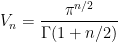
H is for hypersphere, which is the generalization of a circle or sphere into n-dimensional space. As a student, one of my favorite formulas was the one for the volume of a hypersphere in \mathbb{R}^n:

V_n = \displaystyle \frac{\pi^{n/2}}{\Gamma(1 + n/2)}

I is for into, a possible characteristic of a function f : A \to B.

J is for jump discontinuity, of the concepts that shouldn’t be brand-new to students at the start of a calculus class but often is.

Mathematics A to Z: Part 1

Last summer, Nebus Research had a fun series on the definitions of 26 different mathematical terms, one for each letter of the alphabet. Here are the words from A to E:

A is for ansatz, a uniquely mathematical bit of lingo.

B is for bijection, which I called a one-to-one correspondence when I was a student in the 1980s-1990s. This is a fundamental notion in real analysis and explains why there are exactly as many integers as there are rational numbers, even though the integers are a proper subset of the rational numbers.

C is for characteristic function, which only takes values of 0 and 1. This is similar to an indicator random variable in probability but is different than the characteristic equation encountered in differential equations.

D is for dual, a common notion in graph theory. See also the follow-up post referring to this article on Saving School Math.

E is for error, not in the sense of “a mistake,” but in the sense of the difference between a number and a partial sum of an infinite series whose sum is that number.

Wason Selection Task: Part 3

I recently read about a simple but clever logic puzzle, known as the “Wason selection task,” which is often claimed to be “the single most investigated experimental paradigm in the psychology of reasoning.” More than 90% of Wason’s subjects got the answer wrong when Wason first studied this problem back in the 1960s, and this result has been repeated time over time by psychologists ever since.

Here’s the puzzle: You are shown four different cards, showing a 5, an 8, a blue card, and a green card. You are told that each card has a number on one side and a color on the other side. You are asked to test the truth of the following statement:

If a card has an even number on one side, then its opposite side is blue.

Question: Which card (or cards) must you turn over to test the truth of this statement?

Interestingly, in the 1980s, a pair of psychologists slightly reworded the Wason selection puzzle in a form that’s logically equivalent, but this rewording caused a much higher rate of correct responses. Here was the rewording:

On this task imagine you are a police officer on duty. It is your job to make sure that people conform to certain rules. The cards in front of you have information about four people sitting at a table. On one side of the card is a person’s age and on the other side of the card is what the person is drinking. Here is a rule: “If a person is drinking beer, then the person must be over 19 years of age.” Select the card or cards that you definitely must turn over to determine whether or not the people are violating the rule.

Four cards are presented:

  • Drinking a beer
  • Drinking a Coke
  • 16 years of age
  • 22 years of age

In this experiment, 29 out of 40 respondents answered correctly. However, when presented with the same task using more abstract language, none of the 40 respondents answered correctly… even though the two puzzles are logically equivalent. Quoting from the above article:

Seventy-five percent of subjects nailed the puzzle when it was presented in this way—revealing what researchers now call a “content effect.” How you dress up the task, in other words, determines its difficulty, despite the fact that it involves the same basic challenge: to see if a rule—if P then Q—has been violated. But why should words matter when it’s the same logical structure that’s always underlying them?

This little study has harrowing implications for those of us that teach mathematical proofs and propositional logic. It’s very easy for people to get some logic questions correct but other logic questions incorrect, even if the puzzles look identical to the mathematician/logician who is posing the questions. Pedagogically, this means that it’s a good idea to use familiar contexts (like rules for underage drinking) to introduce propositional logic. But this comes with a warning, since students who answer questions arising from a familiar context correctly may not really understand propositional logic at all when the question is posed more abstract (like in a mathematical proof).


Wason Selection Task: Part 2

I recently read about a simple but clever logic puzzle, known as the “Wason selection task,” which is often claimed to be “the single most investigated experimental paradigm in the psychology of reasoning.”

Here’s the puzzle: You are shown four different cards, showing a 5, an 8, a blue card, and a green card. You are told that each card has a number on one side and a color on the other side. You are asked to test the truth of the following statement:

If a card has an even number on one side, then its opposite side is blue.

Question: Which card (or cards) must you turn over to test the truth of this statement?

The answer is: You must turn over the 8 card and the green card. The following video explains why:

Briefly:

  1. Clearly, you must turn over the 8 card. If the opposite side is not blue, then the proposition is false.
  2. Clearly, the 5 card is not helpful. The statement only tells us something if the card shows an even number.
  3. More subtly, the blue card is not helpful either. The statement claim is “If even, then blue,” not “If blue, then even.” This is the converse of the statement, and converses are not necessarily equivalent to the original statement.
  4. Finally, the contrapositive of “If even, then blue” is “If not blue, then not even.” Therefore, any card that is not blue (like the green one) should be turned over.

green line

If you got this wrong, you’re in good company. More than 90% of Wason’s subjects got the answer wrong when Wason first studied this problem back in the 1960s, and this result has been repeated time over time by psychologists ever since.

Speaking for myself, I must admit that I blew it too when I first came across this problem. In the haze of the early morning when I first read this article, I erroneously thought that the 8 card and the blue card had to be turned.


Wason Selection Task: Part 1

I recently read about a simple but clever logic puzzle, known as the “Wason selection task,” which is often claimed to be “the single most investigated experimental paradigm in the psychology of reasoning,” in the words of one textbook author.

Here’s the puzzle: You are shown four different cards, showing a 5, an 8, a blue card, and a green card. You are asked to test the truth of the following statement:

If a card has an even number on one side, then its opposite side is blue.

Question: Which card (or cards) must you turn over to test the truth of this statement?

I’ll start discussing the answer to this puzzle in tomorrow’s post. If you’re impatient, you can click through the interactive video above or else read the article where I first learned about this puzzle: http://m.nautil.us/blog/the-simple-logical-puzzle-that-shows-how-illogical-people-are (I got the opening sentence of this post from this article).

green_speech_bubble

io9: “I Fooled Millions Into Thinking Chocolate Helps Weight Loss. Here’s How.”

Peer-reviewed publications is the best way that we’ve figured out for vetting scientific experiments and disseminating scientific knowledge. But that doesn’t mean that the system can’t be abused, either consciously or unconsciously.

The eye-opening article http://io9.com/i-fooled-millions-into-thinking-chocolate-helps-weight-1707251800 describes how the author published flimsy data that any discerning statistician should have seen through and even managed to get his “results” spread in the popular press. Some money quotes:

Here’s a dirty little science secret: If you measure a large number of things about a small number of people, you are almost guaranteed to get a “statistically significant” result. Our study included 18 different measurements—weight, cholesterol, sodium, blood protein levels, sleep quality, well-being, etc.—from 15 people. (One subject was dropped.) That study design is a recipe for false positives.

Think of the measurements as lottery tickets. Each one has a small chance of paying off in the form of a “significant” result that we can spin a story around and sell to the media. The more tickets you buy, the more likely you are to win. We didn’t know exactly what would pan out—the headline could have been that chocolate improves sleep or lowers blood pressure—but we knew our chances of getting at least one “statistically significant” result were pretty good.

And:

With the paper out, it was time to make some noise. I called a friend of a friend who works in scientific PR. She walked me through some of the dirty tricks for grabbing headlines. It was eerie to hear the other side of something I experience every day.

The key is to exploit journalists’ incredible laziness. If you lay out the information just right, you can shape the story that emerges in the media almost like you were writing those stories yourself. In fact, that’s literally what you’re doing, since many reporters just copied and pasted our text.

And:

The only problem with the diet science beat is that it’s science. You have to know how to read a scientific paper—and actually bother to do it. For far too long, the people who cover this beat have treated it like gossip, echoing whatever they find in press releases. Hopefully our little experiment will make reporters and readers alike more skeptical.

If a study doesn’t even list how many people took part in it, or makes a bold diet claim that’s “statistically significant” but doesn’t say how big the effect size is, you should wonder why. But for the most part, we don’t. Which is a pity, because journalists are becoming the de facto peer review system. And when we fail, the world is awash in junk science.

The Extent and Consequences of P-Hacking in Science

A couple months ago, the open-access journal PLOS Biology (which is a reputable open-access journal, unlike many others) published this very interesting article about the abuse of hypothesis testing in the scientific literature: http://journals.plos.org/plosbiology/article?id=10.1371%2Fjournal.pbio.1002106

Here are some of my favorite quotes from near the end of the article:

The key to decreasing p-hacking is better education of researchers. Many practices that lead to p-hacking are still deemed acceptable. John et al. measured the prevalence of questionable research practices in psychology. They asked survey participants if they had ever engaged in a set of questionable research practices and, if so, whether they thought their actions were defensible on a scale of 0–2 (0 = no, 1 = possibly, 2 = yes). Over 50% of participants admitted to “failing to report all of a study’s dependent measures” and “deciding whether to collect more data after looking to see whether the results were significant,” and these practices received a mean defensibility rating greater than 1.5. This indicates that many researchers p-hack but do not appreciate the extent to which this is a form of scientific misconduct. Amazingly, some animal ethics boards even encourage or mandate the termination of research if a significant result is obtained during the study, which is a particularly egregious form of p-hacking (Anonymous reviewer, personal communication).

Eliminating p-hacking entirely is unlikely when career advancement is assessed by publication output, and publication decisions are affected by the p-value or other measures of statistical support for relationships. Even so, there are a number of steps that the research community and scientific publishers can take to decrease the occurrence of p-hacking.