I'm a Professor of Mathematics and a University Distinguished Teaching Professor at the University of North Texas. For eight years, I was co-director of Teach North Texas, UNT's program for preparing secondary teachers of mathematics and science.
This antiderivative has arguable the highest ratio of “really hard to compute” to “really easy to write”:
So far, I’ve shown that the denominator can be factored over the real numbers:
after finding the partial fractions decomposition.
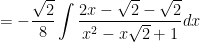
Let me start with the first of the two integrals. It’d be nice to use the substitution . However, , and so this substitution can’t be used cleanly. So, let me force the numerator to have this form, at least in part:
The substitution can now be applied to the first integral:
.
On the last line, I was able to remove the absolute value signs because is an irreducible quadratic and hence is never equal to zero for any real number .
Similarly, I’ll try to apply the substitution to the second integral:
The substitution can now be applied to the first integral:
.
So, thus far, I have shown that
I’ll consider the evaluation of the remaining two integrals in tomorrow’s post.
This antiderivative has arguable the highest ratio of “really hard to compute” to “really easy to write”:
So far, I’ve shown that the denominator can be factored over the real numbers:
,
so that the technique of partial fractions can be applied. Since both quadratics in the denominator are irreducible (and the degree of the numerator is less than the degree of the denominator), the partial fractions decomposition has the form
Clearing out the denominators, I get
or
or
Matching coefficients yields the following system of four equations in four unknowns:
Ordinarily, four-by-four systems of linear equations are somewhat painful to solve, but this system isn’t too bad. Since from the first equation, the third equation becomes
, or .
From the fourth equation, I can conclude that and . The second and third equations then become
,
or
,
.
Adding the two equations yields , so that and .
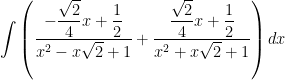
Therefore, the integral can be rewritten as
I’ll start evaluating this integral in tomorrow’s post.
This antiderivative has arguable the highest ratio of “really hard to compute” to “really easy to write”:
To compute this integral, I will use the technique of partial fractions. In yesterday’s post, I used De Moivre’s Theorem to factor the denominator over the complex plane, which then led to the factorization of the denominator over the real numbers.
In today’s post, I present an alternative way of factoring the denominator by completing the square. However, unlike the ordinary method of completing the square, I’ll do this by adding and subtracting the middle term and not the final term:
.
The quadratic formula can then be used to confirm that both of these quadratics have complex roots and hence are irreducible over the real numbers, and so I have thus factored the denominator over the real numbers:
.
and the technique of partial fractions can be applied.
There’s a theorem that says that any polynomial over the real numbers can be factored over the real numbers using linear terms and irreducible quadratic terms. However, as seen in this example, there’s no promise that the terms will have rational coefficients.
I’ll continue the calculation of this integral with tomorrow’s post.
This antiderivative has arguable the highest ratio of “really hard to compute” to “really easy to write”:
To compute this integral, I will use the technique of partial fractions. This requires factoring the denominator over the real numbers, which can be accomplished by finding the roots of the denominator. In other words, I need to solve
,
or
.
I switched to the letter since the roots will be complex. The four roots of this quartic equation can be found with De Moivre’s Theorem by writing
,
where is a real number, and
By De Moivre’s Theorem, I obtain
.
Matching terms, I obtain the two equations
and
or
and
or
and .
This yields the four solutions
Therefore, the denominator can be written as the following product of linear factors over the complex plane:
or
or
or
or
.
We have thus factored the denominator over the real numbers:
,
and the technique of partial fractions can be applied.
I’ll continue the calculation of this integral with tomorrow’s post.
This integral arguably has the highest ratio of “really hard to compute” to “really easy to write” of any indefinite integral, since it is merely a rational function without any powers with non-integer exponents, trigonometric functions, exponential functions, or logarithms. Furthermore, the numerator is a constant while the denominator has only two terms. It doesn’t look that hard.
But this integral is really hard to compute. Indeed, in my experience, this integral is often held as the gold standard for Calculus II (or AP Calculus) students who are learning the various techniques of integration. In this series, I will discuss the various methods that have to be employed to find this antiderivative.
I’ll begin this tomorrow. In the meantime, I’ll leave a thought bubble if you’d like to think about how to compute this integral.
From the video’s description: “Data scientist Cathy O’Neil provides a glimpse of the methods that Netflix, Google, and others apply to recommend or offer to users selections based on their apparent interests.” This is a non-intuitive but real application of linear algebra.
I’m doing something that I should have done a long time ago: collecting a series of posts into one single post. Recently, Math With Bad Drawings had a terrific series on how students try to avoid thinking in math class.
Part 1: Introduction: “In teaching math, I’ve come across a whole taxonomy of insidious strategies for avoiding thinking. Albeit for understandable reasons, kids employ an arsenal of time-tested ways to short-circuit the learning process, to jump to right answers and good test scores without putting in the cognitive heavy lifting. I hope to classify and illustrate these academic maladies: their symptoms, their root causes, and (with any luck) their cures.”
Part 2: Students’ natural desire to mindlessly plug numbers into a formula without conceptual understanding.
Part 3: The importance of both computational proficiency and conceptual understanding.
In my capstone class for future secondary math teachers, I ask my students to come up with ideas for engaging their students with different topics in the secondary mathematics curriculum. In other words, the point of the assignment was not to devise a full-blown lesson plan on this topic. Instead, I asked my students to think about three different ways of getting their students interested in the topic in the first place.
I plan to share some of the best of these ideas on this blog (after asking my students’ permission, of course).
This student submission comes from my former student Belle Duran. Her topic, from Geometry: deriving the Pythagorean theorem.
How can technology be used to effectively engage students with this topic?
Using the video in which the scarecrow from The Wizard of Oz “explains” the Pythagorean theorem, I can get the students to review what the definition of it is. Since the scarecrow’s definition was wrong, I can ask the students what was wrong with his phrasing (he said isosceles, when the Pythagorean theorem pertains to right triangles). Thus, I can ask why it only relates to right triangles, starting the proof for the Pythagorean theorem.
What interesting things can you say about the people who contributed to the discovery and/or the development of this topic?
While Pythagoras is an important figure in the development of mathematics, little is truly known about him since he was the leader of a half religious, half scientific cult-like society who followed a code of secrecy and often presented Pythagoras as a god-like figure. These Pythagoreans believed that “number rules the universe” and thus gave numerical values to many objects and ideas; these numerical values were endowed with mystical and spiritual qualities. Numbers were an obsession for these people, so much so that they put to death a member of the cult who founded the idea of irrational numbers through finding that if we take the legs of measure 1 of an isosceles right triangle, then the hypotenuse would be equal to sqrt(2). The most interesting of all, is the manner in which Pythagoras died. It all roots back to Pythagoras’ vegetarian diet. He had a strong belief in the transmigration of souls after death, so he obliged to become a vegetarian to avoid the chance of eating a relative or a friend. However, not only did he abstain from eating meat, but also beans since he believed that humans and beans were spawned from the same source, hence the human fetal shape of the bean. In a nutshell, he refused access to the Pythagorean Brotherhood to a wealthy man who grew vengeful and thus, unleashed a mob to go after the Brotherhood. Most of the members were killed, save for a few including Pythagoras (his followers created a human bridge to help him out of a burning building). He was meters ahead from the mob, and was about to run into safety when he froze, for before him stretched a vast bean field. Refusing to trample over a single bean, his pursuers caught up and immediately ended his life.
How has this topic appeared in the news?
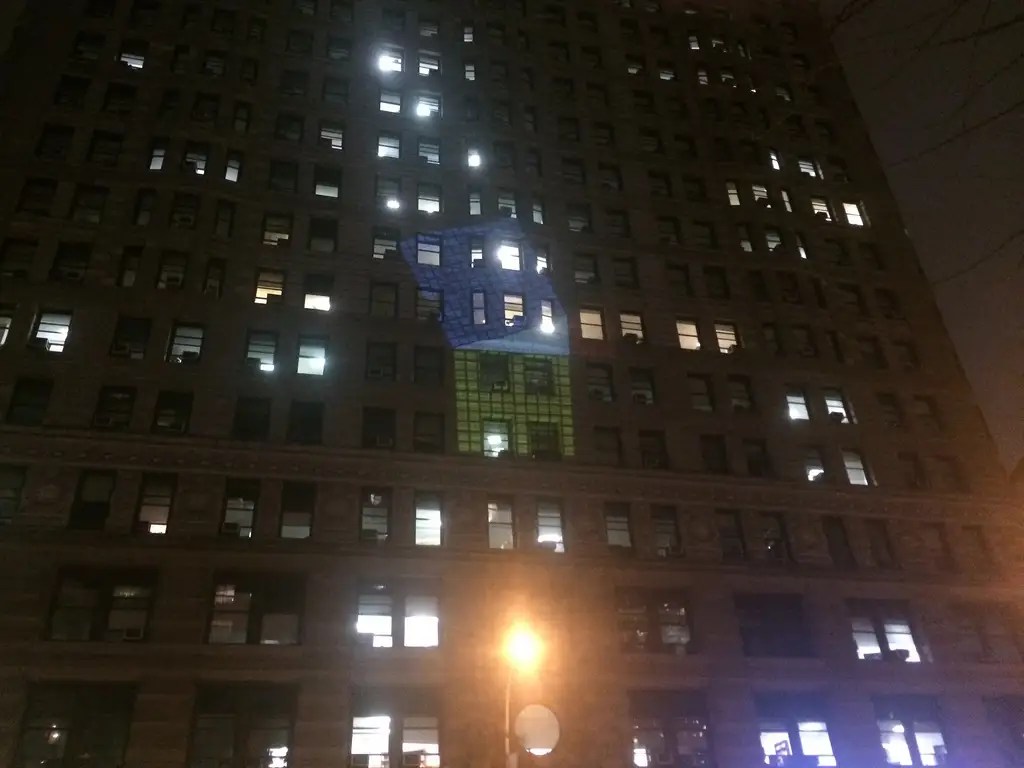
Dallas Cowboys coach, Jason Garrett recently made it mandatory for his players to know the Pythagorean theorem. He wants his players to understand that “’if you’re running straight from the line of scrimmage, six yards deep…it takes you a certain amount of time…If you’re doing it from ten yards inside and running to that same six yards, that’s the hypotenuse of the right triangle’” (NBC Sports). Also, recently the Museum of Mathematics (MoMath) and about 500 participants recently proved that New York’s iconic Flatiron building is indeed a right triangle. They measured the sides of the building by first handing out glow sticks for the participants to hold from end to end, then by counting while handing out the glow sticks, MoMath was able to estimate the length of the building in terms of glow sticks.
The lengths came out to be 75^2 + 180^2 = 38,025. After showing their Pythagorean relationship, MoMath projected geometric proofs on the side of the Flatiron building.
One of my colleagues placed the following problem on an exam for his Calculus II course…
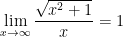
and was impressed by the variety of correct responses that he received. I thought it would be fun to discuss some of the different ways that this limit can be computed.
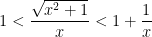
Method #5. Another geometric approach. The numbers and can be viewed as two sides of a right triangle with legs and and hypotenuse . Therefore, the length of the hypotenuse must be larger than the length of one leg but less than the sum of the lengths of the two legs. In other words,
,
or
.
Clearly and . Therefore, by the Sandwich Theorem, we can conclude that .
One of my colleagues placed the following problem on an exam for his Calculus II course…
and was impressed by the variety of correct responses that he received. I thought it would be fun to discuss some of the different ways that this limit can be computed.
Method #4. The geometric approach. The numbers and can be viewed as two sides of a right triangle with legs and and hypotenuse . So as gets larger and larger, the longer leg will get closer and closer in length to the length of the hypotenuse. Therefore, the ratio of the length of the hypotenuse to the length of the longer leg must be 1.

























 , or
, or  .
. and
and  . The second and third equations then become
 ,
, ,
, , so that
  and
and  .
.


 .
. ,
, .
. since the roots will be complex. The four roots of this quartic equation can be found with De Moivre’s Theorem by writing
 ,
, is a real number, and
 .
. and
and 
 and
and 
 .
.![z = 1 \left[ \cos \displaystyle \frac{\pi}{4} + i \sin \frac{\pi}{4} \right] = \displaystyle \frac{\sqrt{2}}{2} + i \frac{\sqrt{2}}{2}](https://s0.wp.com/latex.php?latex=z+%3D+1+%5Cleft%5B+%5Ccos+%5Cdisplaystyle+%5Cfrac%7B%5Cpi%7D%7B4%7D+%2B+i+%5Csin+%5Cfrac%7B%5Cpi%7D%7B4%7D+%5Cright%5D+%3D+%5Cdisplaystyle+%5Cfrac%7B%5Csqrt%7B2%7D%7D%7B2%7D+%2B+i+%5Cfrac%7B%5Csqrt%7B2%7D%7D%7B2%7D&bg=ffffff&fg=000000&s=0&c=20201002)
![z = 1 \left[ \cos \displaystyle \frac{3\pi}{4} + i \sin \frac{3\pi}{4} \right] = -\displaystyle \frac{\sqrt{2}}{2} + i \frac{\sqrt{2}}{2}](https://s0.wp.com/latex.php?latex=z+%3D+1+%5Cleft%5B+%5Ccos+%5Cdisplaystyle+%5Cfrac%7B3%5Cpi%7D%7B4%7D+%2B+i+%5Csin+%5Cfrac%7B3%5Cpi%7D%7B4%7D+%5Cright%5D+%3D+-%5Cdisplaystyle+%5Cfrac%7B%5Csqrt%7B2%7D%7D%7B2%7D+%2B+i+%5Cfrac%7B%5Csqrt%7B2%7D%7D%7B2%7D&bg=ffffff&fg=000000&s=0&c=20201002)
![z = 1 \left[ \cos \displaystyle \frac{5\pi}{4} + i \sin \frac{5\pi}{4} \right] = -\displaystyle \frac{\sqrt{2}}{2} - i \frac{\sqrt{2}}{2}](https://s0.wp.com/latex.php?latex=z+%3D+1+%5Cleft%5B+%5Ccos+%5Cdisplaystyle+%5Cfrac%7B5%5Cpi%7D%7B4%7D+%2B+i+%5Csin+%5Cfrac%7B5%5Cpi%7D%7B4%7D+%5Cright%5D+%3D+-%5Cdisplaystyle+%5Cfrac%7B%5Csqrt%7B2%7D%7D%7B2%7D+-+i+%5Cfrac%7B%5Csqrt%7B2%7D%7D%7B2%7D&bg=ffffff&fg=000000&s=0&c=20201002)
![z = 1 \left[ \cos \displaystyle \frac{7\pi}{4} + i \sin \frac{7\pi}{4} \right] = \displaystyle \frac{\sqrt{2}}{2} - i \frac{\sqrt{2}}{2}](https://s0.wp.com/latex.php?latex=z+%3D+1+%5Cleft%5B+%5Ccos+%5Cdisplaystyle+%5Cfrac%7B7%5Cpi%7D%7B4%7D+%2B+i+%5Csin+%5Cfrac%7B7%5Cpi%7D%7B4%7D+%5Cright%5D+%3D+%5Cdisplaystyle+%5Cfrac%7B%5Csqrt%7B2%7D%7D%7B2%7D+-+i+%5Cfrac%7B%5Csqrt%7B2%7D%7D%7B2%7D&bg=ffffff&fg=000000&s=0&c=20201002)
 can be written as the following product of linear factors over the complex plane:
![\displaystyle \left(x - \left[ \displaystyle \frac{\sqrt{2}}{2} + i \frac{\sqrt{2}}{2} \right] \right)\left(x - \left[ \displaystyle \frac{\sqrt{2}}{2} - i \frac{\sqrt{2}}{2} \right] \right) \left(x - \left[ -\displaystyle \frac{\sqrt{2}}{2} + i \frac{\sqrt{2}}{2} \right] \right) \left(x - \left[ - \displaystyle \frac{\sqrt{2}}{2} - i \frac{\sqrt{2}}{2} \right] \right)](https://s0.wp.com/latex.php?latex=%5Cdisplaystyle+%5Cleft%28x+-+%5Cleft%5B+%5Cdisplaystyle+%5Cfrac%7B%5Csqrt%7B2%7D%7D%7B2%7D+%2B+i+%5Cfrac%7B%5Csqrt%7B2%7D%7D%7B2%7D+%5Cright%5D+%5Cright%29%5Cleft%28x+-+%5Cleft%5B+%5Cdisplaystyle+%5Cfrac%7B%5Csqrt%7B2%7D%7D%7B2%7D+-+i+%5Cfrac%7B%5Csqrt%7B2%7D%7D%7B2%7D+%5Cright%5D+%5Cright%29+%5Cleft%28x+-+%5Cleft%5B+-%5Cdisplaystyle+%5Cfrac%7B%5Csqrt%7B2%7D%7D%7B2%7D+%2B+i+%5Cfrac%7B%5Csqrt%7B2%7D%7D%7B2%7D+%5Cright%5D+%5Cright%29+%5Cleft%28x+-+%5Cleft%5B+-+%5Cdisplaystyle+%5Cfrac%7B%5Csqrt%7B2%7D%7D%7B2%7D+-+i+%5Cfrac%7B%5Csqrt%7B2%7D%7D%7B2%7D+%5Cright%5D+%5Cright%29&bg=ffffff&fg=000000&s=0&c=20201002)
![\displaystyle \left(\left[x - \displaystyle \frac{\sqrt{2}}{2} \right] - i \frac{\sqrt{2}}{2} \right)\left( \left[ x - \displaystyle \frac{\sqrt{2}}{2} \right] + i \frac{\sqrt{2}}{2} \right) \left( \left[ x + \displaystyle \frac{\sqrt{2}}{2} \right] - i \frac{\sqrt{2}}{2} \right) \left( \left[ x + \displaystyle \frac{\sqrt{2}}{2} \right] + i \frac{\sqrt{2}}{2} \right)](https://s0.wp.com/latex.php?latex=%5Cdisplaystyle+%5Cleft%28%5Cleft%5Bx+-+%5Cdisplaystyle+%5Cfrac%7B%5Csqrt%7B2%7D%7D%7B2%7D+%5Cright%5D+-+i+%5Cfrac%7B%5Csqrt%7B2%7D%7D%7B2%7D+%5Cright%29%5Cleft%28+%5Cleft%5B+x+-+%5Cdisplaystyle+%5Cfrac%7B%5Csqrt%7B2%7D%7D%7B2%7D+%5Cright%5D+%2B+i+%5Cfrac%7B%5Csqrt%7B2%7D%7D%7B2%7D+%5Cright%29+%5Cleft%28+%5Cleft%5B+x+%2B+%5Cdisplaystyle+%5Cfrac%7B%5Csqrt%7B2%7D%7D%7B2%7D+%5Cright%5D+-+i+%5Cfrac%7B%5Csqrt%7B2%7D%7D%7B2%7D+%5Cright%29+%5Cleft%28+%5Cleft%5B+x+%2B+%5Cdisplaystyle+%5Cfrac%7B%5Csqrt%7B2%7D%7D%7B2%7D+%5Cright%5D+%2B+i+%5Cfrac%7B%5Csqrt%7B2%7D%7D%7B2%7D+%5Cright%29&bg=ffffff&fg=000000&s=0&c=20201002)
![\displaystyle \left(\left[x - \displaystyle \frac{\sqrt{2}}{2} \right]^2 - \left[ i \frac{\sqrt{2}}{2} \right]^2 \right) \left( \left[ x + \displaystyle \frac{\sqrt{2}}{2} \right]^2 - \left[i \frac{\sqrt{2}}{2} \right]^2 \right)](https://s0.wp.com/latex.php?latex=%5Cdisplaystyle+%5Cleft%28%5Cleft%5Bx+-+%5Cdisplaystyle+%5Cfrac%7B%5Csqrt%7B2%7D%7D%7B2%7D+%5Cright%5D%5E2+-+%5Cleft%5B+i+%5Cfrac%7B%5Csqrt%7B2%7D%7D%7B2%7D+%5Cright%5D%5E2+%5Cright%29+%5Cleft%28+%5Cleft%5B+x+%2B+%5Cdisplaystyle+%5Cfrac%7B%5Csqrt%7B2%7D%7D%7B2%7D+%5Cright%5D%5E2+-+%5Cleft%5Bi+%5Cfrac%7B%5Csqrt%7B2%7D%7D%7B2%7D+%5Cright%5D%5E2+%5Cright%29&bg=ffffff&fg=000000&s=0&c=20201002)

 .
.



 can be viewed as two sides of a right triangle with legs
  and
and  ,
, .
. and
and  . Therefore, by the Sandwich Theorem, we can conclude that
  .
. Mean Green Math