Another poorly written word problem (Part 4)

Textbooks have included the occasional awful problem ever since Pebbles Flintstone and Bamm-Bamm Rubble chiseled their homework on slate tablets while attending Bedrock Elementary. But even with the understanding that there have been children have been doing awful homework problems since the dawn of time (and long before the advent of the Common Core), this one is a doozy.

There’s no sense having a debate about standards for elementary mathematics if textbook publishers can’t write reasonable homework problems.

My reaction to this problem is pretty much echoed by the following post: http://www.patheos.com/blogs/friendlyatheist/2015/10/22/sometimes-estimating-is-better-than-getting-the-exact-answer/:

  1. Yes, this is an awful word problem. This should never have appeared in a math textbook or workbook. But if it appeared in a workbook, then it should never have been assigned by a teacher. And if it accidentally got assigned by a teacher, then the teacher should have extended some grace in the grading of the problem.
  2. Even with all that said, estimation has been in the elementary curriculum for decades and is not an invention of the Common Core. Furthermore, estimation is an important skill for students to acquire. From the above website:

Suppose you’re buying groceries. You have four items in your cart that cost $1.99, $4.93, $6.03, and $5.14.

If all you have is $20 in your wallet, is that enough to pay for the items?

I think that’s a very realistic question.

It would take you at least a little bit of time to add up those numbers individually and get an exact number. Would it answer your question? Absolutely. But you don’t need an exact answer.

The smarter thing to do would be to simply round the numbers. We should be saying to ourselves, “2 + 5 + 6 + 5 equals 18… throw in some tax… and I should still be under $20.”

Why is that better? Because the exact amount doesn’t really make a difference. You just need to be close enough.

I have deep and profound theological differences with the author of this post. But on this math issue, he’s right on the money (pardon the pun).


Guns on university campuses

Here in Texas, public universities are trying to figure out how they’re going to comply with a recently enacted state campus-carry law so that licensed handgun owners can bring their firearms to campus. A small sampling of local news articles and websites on this topic:

And in the midst of this debate, I found the opportunity for a mathematical wisecrack.

handgun

I’ve used this wisecrack in my probability class to great effect, as the joke pedagogically illustrates the important difference between P(A \mid B) and P(A \cap B).

green line

For what it’s worth, here’s the version of the joke as I first saw it (in the book Absolute Zero Gravity):

Then there was the statistician who hated to fly because he had nightmares about terrorists with bombs. Yes, he knew that it was a million to one chance, but that wasn’t good enough. So he took a lot of trains until he realized what he had to do.

Now, whenever he flies, he packs a bomb in his own suitcase. Hey, do you know what the odds are against an airplane carrying two bombs?

green line

Two final notes:

  1. For the humor-impaired, I’m not referring to all gun owners as idiots. The only people I’m calling idiots are me and those that would slaughter innocent people (and these two sets are disjoint).
  2. Though it’s certainly an important issue, I have no interest in debating the wisdom of the campus-carry law on this blog. Rather, the point of this post was using current events to memorably illustrate mathematical ideas.

Math autobiography

I recently read a very interesting opinion piece: asking students to write a math autobiography as the first assignment of the semester. I may try this out in a future semester. From the opinion piece:

Want to know one of my favorite assignments that I have ever given my students? Want to know learn a lot of useful information about your students in a short amount of time?

I know it sounds too good to be true, but this one simple assignment could change how you teach your classes and how well you know your audience…

Math Autobiography

Purpose of the Assignment 
As your instructor, I want to get to know you as a person and as a student of mathematics. This will help me better meet your needs. It also helps our department as we work to improve our services to students.

Content 
Your autobiography should address the four sections listed below. I’ve listed some questions to help guide you, but please don’t just go through and answer each question separately. The questions are just to help get you thinking. Remember the purpose of the paper. Write about the things that will give me a picture of you. The key to writing a good piece is to give lots of detail…

Section 1: Introduction

  • How would you describe yourself?
  • Where are you from? How did you decide to attend Fort Lewis?
  • What is your educational background? Did you just graduate from high school? Have you been out of school for a few years? If so, what have you been doing since then?
  • General interests: favorite subjects in school, favorite activities or hobbies.

Section 2: Experience with Math

  • What math classes have you taken and when?
  • What have your experiences in math classes been like?
  • How do you feel about math?
  • In what ways have you used math outside of school?

Section 3: Learning Styles and Habits (specifically for math)

  •  Do you learn best from reading, listening or doing?
  • Do you prefer to work alone or in groups?
  • What do you do when you get “stuck”?
  • Do you ask for help? From whom?
  • Describe some of your study habits. For example: Do you take notes? Are they helpful? Are you organized? Do you procrastinate? Do you read the text?

Section 4: The Future

  • What are your expectations for this course?
  • What are your responsibilities as a student in this course? What do you expect from your instructor?
  • What are your educational and life goals?
  • How does this course fit into your educational goals?

The author’s conclusions:

It was fantastic! Students took it way more seriously than I could have imagined. Some wrote pages and all wrote enough to get to know them. It made me realize that we don’t give our students opportunities to share their math baggage/backgrounds/etc. with us often enough. Students shared everything from horror stories about being shamed in math courses to their excitement about math. Some let you know what they have heard about your class and even fears they may have such as a fear of presenting or working with others.

An NFL player was just accepted to the math PhD program at MIT

I really enjoyed writing this post.

John Urschel is an amazingly talented young man that I’ve profiled before on this blog. Not only is he an offensive lineman for the Baltimore Ravens, but he’s also an accomplished young mathematician who was just accepted into the doctorate program at the Massachusetts Institute of Technology. From the news article:

The 6’3”, 305-pound offensive lineman will begin a PhD in mathematics at the Massachusetts Institute of Technology this year. The Hulk-like math geek, who graduated from Penn State with a 4.0 grade point average, will study spectral graph theory, numerical linear algebra, and machine learning.

In 2015, Urschel played in the NFL playoffs for the Ravens while simultaneously (pdf) working on a paper on graph eigenfunctions. (What have you done lately?) The paper, entitled, “A Cascadic Multigrid Algorithm for Computing the Fielder Vector of Graph Laplacians,” is available online.


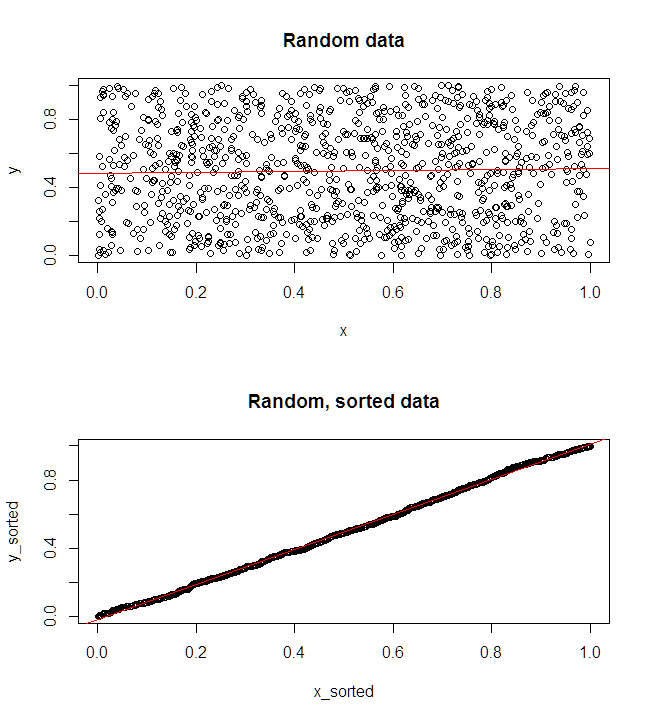
What Happens if the Explanatory and Response Variables Are Sorted Independently?

From the category “I Can’t Believe What I Just Read,” the following question was posed to a question-and-answer statistics board last month:

Suppose we have data set (X_i,Y_i) with n points. We want to perform a linear regression, but first we sort the X_i values and the Y_i values independently of each other, forming data set (X_i,Y_j). Is there any meaningful interpretation of the regression on the new data set? Does this have a name?
I imagine this is a silly question so I apologize, I’m not formally trained in stats. In my mind this completely destroys our data and the regression is meaningless. But my manager says he gets “better regressions most of the time” when he does this (here “better” means more predictive). I have a feeling he is deceiving himself.

The answers were priceless:

Your intuition is correct: the independently sorted data have no reliable meaning because the inputs and outputs are being randomly mapped to one another rather than what the observed relationship was.

There is a (good) chance that the regression on the sorted data will look nice, but it is meaningless in context.

And:

If you want to convince your boss, you can show what is happening with simulated, random, independent x,y data. With R:

And:

This technique is actually amazing. I’m finding all sorts of relationships that I never suspected. For instance, I would have not have suspected that the numbers that show up in Powerball lottery, which it is CLAIMED are random, actually are highly correlated with the opening price of Apple stock on the same day! Folks, I think we’re about to cash in big time. 🙂

The sad end of the story, from the original poster:

Thank you for all of your nice and patient examples. I showed him the examples by @RUser4512 and @gung and he remains staunch. He’s becoming irritated and I’m becoming exhausted. I feel crestfallen. I want my work to mean something. I will probably begin looking for other jobs soon.

The Unsuccessful Self-Treatment of a Case of “Writer’s Block”

In 1974, Dennis Upper published his wry and classic intellectual treatise entitled The Unsuccessful Self-Treatment of a Case of “Writer’s Block” in the Journal of Applied Behavior Analysis. If you’ve never seen this before, trust me, you want to see this: http://www.ncbi.nlm.nih.gov/pmc/articles/PMC1311997/pdf/jaba00061-0143a.pdf

Postscript: In 2007, several authors were able to replicate this work in their paper A Multisite Cross-Cultural Replication of Upper’s (1974) Unsuccessful Self-Treatment of Writer’s Block: http://www.ncbi.nlm.nih.gov/pmc/articles/PMC2078566/pdf/jaba-40-04-773.pdf

High-pointing a football?

Today is one of the high points of the American sports calendar: the AFC and NFC championship games to determine who plays in the Super Bowl.

A major pet peeve of mine while watching sports on TV: football announcers who “explain” that a receiver made a great reception because “he caught the ball at its highest point.”

Ignoring the effects of air resistance, the trajectory of a thrown football is parabolic, and the ball is the essentially the same height above the ground when it is either thrown or caught. (Yes, there might be a difference of at most three feet, but that’s negligible compared to the distance that a football is typically thrown.) Therefore, a football reaches the highest point of its trajectory approximately halfway between the quarterback and the receiver.

And anyone who can catch the ball that far above the ground should be immediately tested for steroids.