
Courtesy of http://mathwithbaddrawings.com/2015/09/23/what-does-probability-mean-in-your-profession/:


See the whole thing at http://mathwithbaddrawings.com/2015/09/23/what-does-probability-mean-in-your-profession/.
I’m doing something that I should have done a long time ago: collecting a series of posts into one single post. The following links comprised my short series on a couple of easily stated but remarkably difficult geometry problems.
Part 1: The world’s second hardest easy geometry problem.
Part 2: The world’s hardest easy geometry problem.
I’m not a big fan of science fiction, but I know enough to know that Isaac Asimov was one of the great science fiction novelists of the 20th century. The following was written by him in the October 1980 issue of The Magazine of Fantasy and Science Fiction and was reprinted in his book Counting the Eons, which was published in 1983. (I’m now holding the battered and torn pages of my copy of this book; I devoured Asimov’s musings on mathematics and science when I was young.)
Robotics has become a sufficiently well development technology to warrant articles and books on its history and I have watched this in amazement, and in some disbelief, because I invented it.
No, not the technology, the word.
In October 1941, I wrote a robot story entitled “Runaround,” first published in the March 1942 issue of Astounding Science Fiction, in which I recited, for the first time, my Three Laws of Robotics. Here they are:
- A robot must not injure a human being or, through inaction, allow a human being to come to harm.
- A robot must obey the orders give it by human beings except where those orders would conflict with the First Law.
- A robot must protect its own existence, except where such protection would conflict with the First or Second Laws.
Clearly, the order in which the Three Laws of Robotics matters. Shuffling the order leads to 

Source: http://www.xkcd.com/1613/
I recently read a very interesting article on FiveThirtyEight.com regarding men’s and women’s tennis that reminded me of the following standard problem in probability.
Player X and Player Y play a series of at most
games, and a winner is declared when either Player X or Player Y wins at least
games. Suppose that the chance that Player X wins is
, and suppose that the outcomes of the games are independent. Find the probability that Player Y wins if (a)
, (b)
.
The easiest way to solve this is to assume that all




Adding the first two probabilities, the chance that Player Y wins is 
Similarly, for part (b),





Adding the first three probabilities, the chance that Player Y wins is 
The graphs of 


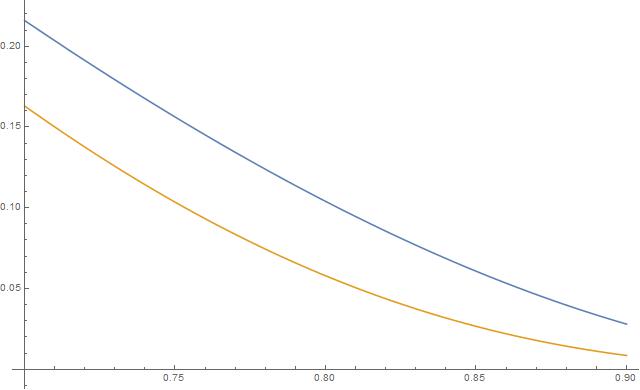 Remarkably, this above curve has been observed in real-life sports: namely, women’s tennis (which plays best 2 sets out of 3 — marked WTA below) and men’s tennis (which plays best 3 sets out of 5 in Grand Slams — marked ATP below). The chart indicates that when two men’s players ranked 20 places apart play each other in Grand Slams, an upset occurs about 13% of the time. However, the upset percentage is only 5% in women’s tennis. (This approximately matches the above curve near

However, in tennis tournaments that are not Grand Slams, men’s tennis players also play a matches with a maximum of 3 sets. In those tournaments, the chances of an upset are approximately equal in both men’s tennis and women’s tennis.

However, since the casual tennis fan (like me) only tunes into the Grand Slams but not other tennis matches, this fact is not widely known — which gives the misleading impression that top women’s tennis players are not as tough, skilled, etc. as men’s tennis players.
The FiveThirtyEight article argues that top women’s tennis players don’t make it to the latter stages of Grand Slam tournaments than top men’s players because of the two tournaments are held under these different rules, and that women’s tennis would be better served if their matches were also played in a best-3-out-of-5 format.
This is the T-shirt for the student civil engineering club at the University of Texas at Arlington. (ASCE stands for the American Society of Civil Engineers.)

It’s 2016, which means it’s another election year. Here’s a very nice article from the last campaign cycle about the bipartisan abuse of statistics to mislead: http://www.washingtonpost.com/blogs/the-fix/wp/2014/10/30/graphs-can-be-made-to-show-anything-campaign-ads-edition/?tid=sm_fb
Here’s an article on cheating that I read recently: http://alumni.stanford.edu/get/page/magazine/article/?article_id=80757
A couple of quotes:
It was once a common schoolyard taunt, delivered with a snarling, singsong cadence: “Cheaters never PROSper! Cheaters never PROSper!” The perp, having been caught in the act of copying from a neighbor’s paper, would reflexively hiss: “I am not a cheater!”
A rash of cheating scandals at leading universities has again aimed a spotlight on the issue and renewed interest in understanding what motivates people to flout the rules. Researchers have found that even excellent students can be tempted to cheat when certain conditions line up. When we’re feeling tired or overwhelmed; when the likelihood of getting away with it is high; and when there is a perception that others are cheating, too, it can be easy to rationalize taking the low road.
Monin says two conditions clearly can motivate cheating among high-achieving students: first, the perception that “everybody else is cheating, so it can’t be that bad;” second, the worry that “I’ll fall behind unless I cheat.” (The same reasoning was used to explain steroid use by baseball players and blood doping by professional cyclists.) The psychological underpinnings of cheating are important, but administrators, researchers and ethicists are trying to understand whether other factors—technology, parenting styles and pressure-cooker environments on campuses—are driving more cheating today.
And:
Duke University researcher Dan Ariely is a professor of behavioral economics who wrote the 2012 book The (Honest) Truth About Dishonesty. Ariely notes that for many years the dominant school of thought about cheating followed the theories of Nobel Prize-winning economist Gary Becker. Becker argued that people rationally analyze their decisions, weigh the pros and cons, assess the risks and penalties, and land on a choice that produces the best outcome for the lowest cost.
Ariely decided to test that. He created experiments involving math problems in which subjects were tempted by greater or lesser rewards, and higher and lower chances of getting caught, and in which the behavior of others around them informed their mindset. Based on his results in one experiment, 70 percent were tempted to cheat at least a little. But it turns out the value of the reward plays a lesser role than Becker would have predicted. Instead, people seemed to calculate the largest benefit they could get for a transgression that would still allow them to tell themselves they weren’t a cheater. “Essentially, we cheat up to the level that allows us to retain our self-image as reasonably honest individuals,” Ariely says.
I recommend reading the whole article.
Years ago, when I first taught Precalculus at the college level, I was starting a section on trigonometry by reminding my students of the acronym SOHCAHTOA for keeping the trig functions straight:


At this point, one of my students volunteered that a previous math teacher had taught her an acrostic to keep these straight: Some Old Hippie Caught Another Hippie Tripping On Acid.
Needless to say, I’ve been passing this pearl of wisdom on to my students ever since.
Errors in textbooks happened when Pebbles Flintstone and Bamm-Bamm Rubble attended Flintstone Elementary, and they still happen on occasion today. But even with that historical perspective, this howler is a doozy.
This was sent to me by a former student of mine. It appears in the chapter study guide for Section 2.1 of Glencoe’s Algebra 2 textbook (published in 2014), presumably as an enrichment activity for students learning about the definitions of “one to one functions” and “onto functions.”
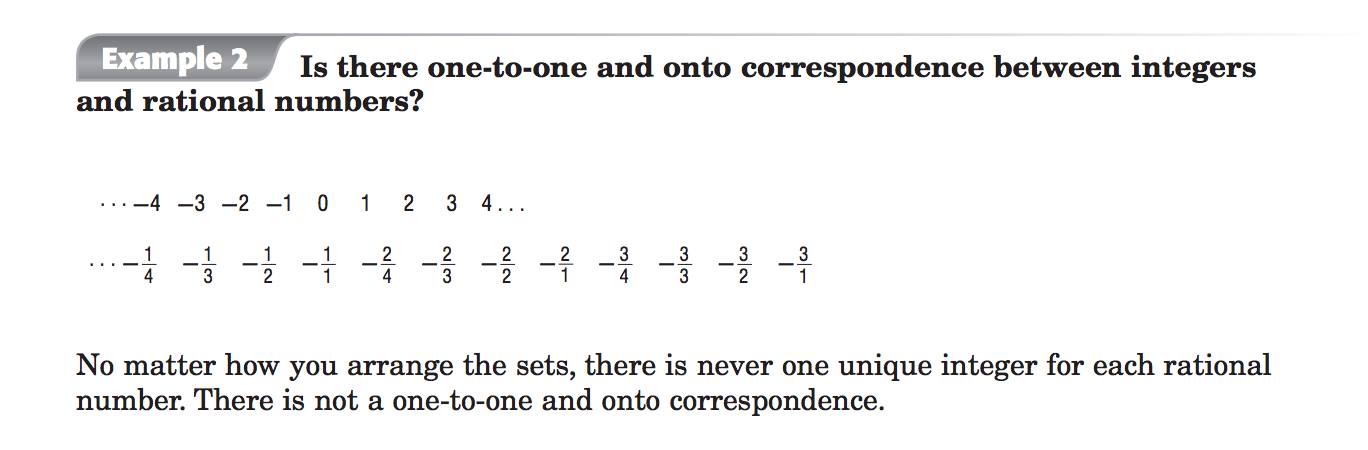 Just how bad is this mistake?
 is most definitely a countable set, and so there is a one-to-one and onto correspondence between integers and rational numbers. See https://proofwiki.org/wiki/Rational_Numbers_are_Countably_Infinite or http://www.homeschoolmath.net/teaching/rational-numbers-countable.php for details. and
  . and
. and  . If the authors had double-checked this proof in any reputable book, they should have also been able to double-check that their Example 2 was completely false.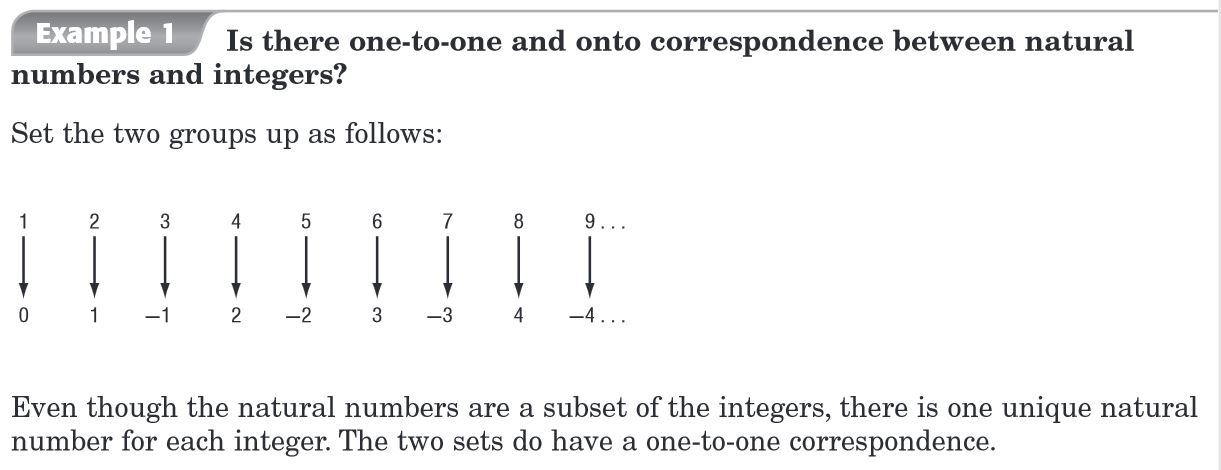

The full chapter study guide can be found here (it’s on the last page): http://nseuntj.weebly.com/uploads/1/8/2/0/18201983/2.1relations_and_functions.pdf
Reactions can be found here: https://www.reddit.com/r/math/comments/3k1qe6/this_is_in_a_high_school_math_textbook_in_texas/
Reference to this can be seen on page 10 of the teacher’s manual here: http://msastete.com/yahoo_site_admin1/assets/docs/Chpte2-1.25882808.pdf
 Mean Green Math