Engaging students: Graphing Sine and Cosine Functions

In my capstone class for future secondary math teachers, I ask my students to come up with ideas for engaging their students with different topics in the secondary mathematics curriculum. In other words, the point of the assignment was not to devise a full-blown lesson plan on this topic. Instead, I asked my students to think about three different ways of getting their students interested in the topic in the first place.

I plan to share some of the best of these ideas on this blog (after asking my students’ permission, of course).

This student submission comes from my former student Emma Sivado. Her topic, from Precalculus: graphing sine and cosine functions.

green line

D.1: What interesting things can you say about the people who contributed to the discovery and/or the development of this topic?

First, I would pose the question “how did the Egyptians build the pyramids without calculators without measuring tapes and without the advanced mathematics we have today?” After a short discussion I would ask them if we want to build a pyramid that is 250 meters high and the base is 360 meters long how long would we need to make the hypotenuse? Already knowing the Pythagorean Theorem the students would be able to answer the question. Then, I would tell them that historians have found Egyptian scribes asking questions such as these in order to build the pyramids, and systems of ropes with knots were used to measure lengths. These relationships in right triangles created the sine and cosine functions we know today. Sine and cosine date back to 1900 BC where they were used to calculate angles in order to track the motion of the planets and stars. However, the definition of sine and cosine in terms of right triangles was not recorded until 1596 AD by Copernicus.

http://www.math.ucdenver.edu/~jloats/Student%20pdfs/40_Trigonometry_Trenkamp.pdf


green line

A.2: How could you as a teacher create an activity or project that involves your topic?

I found a great activity that encompasses all of the aspects of graphing sine and cosine on the University of Arizona website. Depending on how transformations in the linear and quadratic functions were introduced, this activity could follow the same pattern; allowing the students to explore the ideas themselves and having them put the content into their own words. The activity begins by giving an example of a bug walking on an upright loop. The instructor asks the students what the graph would look like of the bug’s distance from the ground vs. time. I would probably use a different, more concrete example because there are plenty of things the students know that go around in circles. The best example I think is a Ferris wheel. So after the students are able to tell you what the graph would look like you relate that to the unit circle and how the sine and cosine functions follow the same pattern of going around the circle counterclockwise. Next, you let the students plot points from the unit circle onto the Cartesian plane showing them that their prediction was correct; the sine and cosine functions make a wave. Now that they have drawn the parent function you let them explore the functions f(x) = asinx or f(x)= acosx, then f(x) = sin(bx) or f(x) = cos(bx), then finally f(x) = sin(x+c) or f(x) = cos(x+c) to let them discover how a, b, and c change the amplitude, period, frequency, and starting point of the graphs.

This is a great activity because the students use multiple examples to see how a, b, and c affect the parent graph of sine and cosine. The activity promotes inquiry based learning and will help deepen the understanding of the graphs of sine and cosine.

http://ime.math.arizona.edu/g-teams/Profiles/JC/Graphing_Sine_and_Cosine_2013.pdf


green line

E.1: How can technology (YouTube, Khan Academy [khanacademy.org], Vi Hart, Geometers Sketchpad, graphing calculators, etc.) be used to effectively engage students with this topic? Note: It’s not enough to say “such-and-such is a great website”; you need to explain in some detail why it’s a great website.

Math can be seen in many forms of art from music to painting. I remember one of my favorite activities from math in high school was creating pictures with sine and cosine functions. We were able to draw flowers, clovers, and hearts simply with only the sine and cosine functions. After the students understand the parent function you can give them an exploration activity on their graphing calculator where they plug in various sine and cosine functions to draw flowers, clovers, and hearts. After that challenge the students to draw their own picture using the patterns they see from the examples. These same ideas can be used in computer graphics and animation to draw similar figures, and a lot of students are interested in computers and especially video games so this should be a fun activity for them.
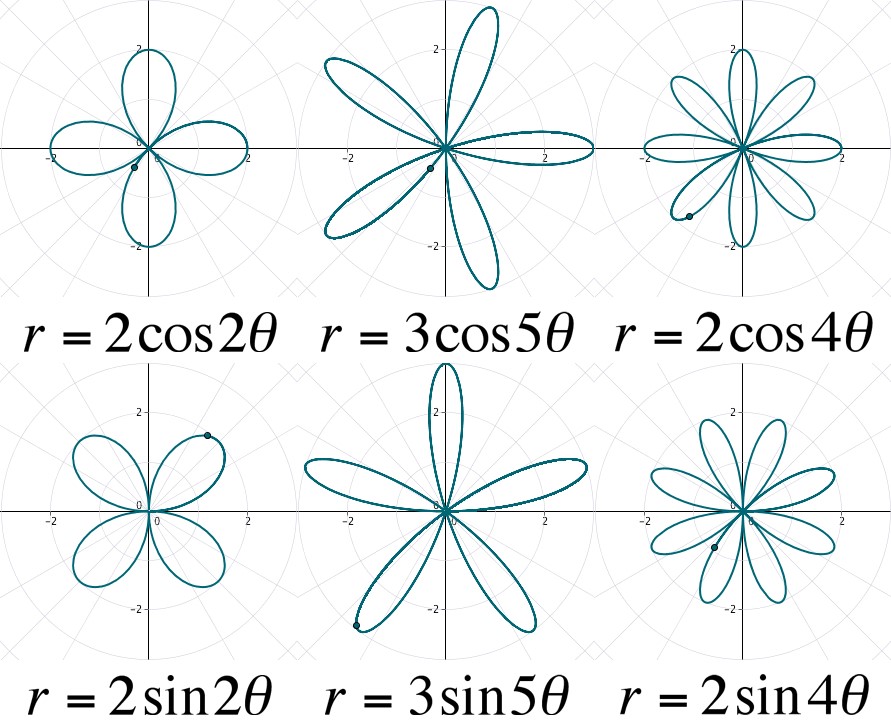
clovers

ftp://arts.ucsc.edu/pub/ems/DANM%20220-2012/Drawing%20with%20trig.pdf

Engaging students: Using radians to measure angles instead of degrees

In my capstone class for future secondary math teachers, I ask my students to come up with ideas for engaging their students with different topics in the secondary mathematics curriculum. In other words, the point of the assignment was not to devise a full-blown lesson plan on this topic. Instead, I asked my students to think about three different ways of getting their students interested in the topic in the first place.

I plan to share some of the best of these ideas on this blog (after asking my students’ permission, of course).

This student submission comes from my former student A’Lyssa Rodriguez. Her topic, from Precalculus: using radians to measure angles instead of degrees

green line

D1. How did people’s conception of this topic change over time?

Babylonians came up with the degree system. For their number system they liked to use the number 60 and multiples thereof. Therefore they decided on the number 360 and each number represented a degree in a circle. This number was completely arbitrary and was simply a matter of preference by the Babylonians. Although this makes handling circles and angles seem easier, due to it being an arbitrary number, it makes degrees unnatural. So the deeper concepts in math needed a more natural number. Radians are that more natural measurement we needed. Using the length of the radius of any circle and wrapping around the outside of that circle, one can see that it almost completely goes around the entire circle 6 times. To make up for what is left we multiply the radius by 2pi. Thus the equation for the circumference of a circle is C = 2 πr. This is the reason and the change over time for the use of radians instead of degrees.


green line


C2. How has this topic appeared in high culture (art, classical music, theatre, etc.)?
Pure tones are found in music. Regardless of other musical properties such as amplitude or the time relation to other sound waves (phase), these tones will have a consistent sinusoidal sound wave. The sine function used to measure these waves use radians. Although degrees are technically possible, this function is most accurate when using radians. According to Mathematics and Music: Composition, Perception, and Performance by James S. Walker and Gary W. Don, the formula that can be used to determine the oscillation for a tuning fork is y= Asin(θ) where θ is measured in radians and is equal to 2 πvt+ θ0 and θ0 is the initial value of θ when t=0. So y = Asin(2 πvt+ π/2).

green line

B2. How does this topic extend what your students should have learned in previous courses?

In previous courses, students use degrees to measure angles and to refer to circles. Even activities outside of the classroom, such as snowboarding, use degrees. This was easiest and best for learning purposes, up until this point that is. Now that trigonometric functions will be introduced, the circle will be studied more in depth, and more real life situations will be given, it is necessary to use radians instead of degrees. The calculations will become more accurate in some cases, some even easier, and it is essential to use a more natural number. This topic merely adds on to what the students already know about angles but also makes them think about it in a different way. One way their previous knowledge of degrees will be extended is by learning to convert from degrees to radians and back again.


Engaging students: Finding the domain and range of a function

In my capstone class for future secondary math teachers, I ask my students to come up with ideas for engaging their students with different topics in the secondary mathematics curriculum. In other words, the point of the assignment was not to devise a full-blown lesson plan on this topic. Instead, I asked my students to think about three different ways of getting their students interested in the topic in the first place.

I plan to share some of the best of these ideas on this blog (after asking my students’ permission, of course).

This student submission comes from my former student Esmeralda Sheran. Her topic, from Precalculus: finding the domain and range of a function.

green line

I found that Free Math Help and Khan Academy are both interactive websites that help students learn how to find domain and range of functions. If I were to have a lesson on how to find domain and range of functions I would have my students use the Free Math Help website to explore the concept of domain and range. Using the Free Math Help website a student can input any type of function that they come up with to see what the graph looks like, the steps of how to find the domain/range, and how the domain and range correspond with the graph. I could choose to have students come up with their own functions and they could experiment with expression that are not functions just so they can share some findings they came up on their own. Conversely I could make handouts with a variety of functions both continuous and discrete, expression that are not functions so that I could manage their learning in a way that they can see different graphs and their corresponding domain and ranges. Also I could give them a series of functions with different translations based off of one main parent function.

Then using Khan Academy website I could perform an active elaborate in which the students see a graph and then must give the corresponding domain and range intervals. I can walk around to each student to see what they have recorded and ask them to provide a justification for their answer or explain what properties the graph has that gives the domain and range they come up with. However I chose to structure the activities the students will be able to observe and discuss the changes in the domain and range interactively by using either Khan Academy or Free Math Help.


green line

How can this topic be used in your students’ future courses in mathematics or science?

Knowing how to find domain is fundamental to most any mathematical course proceeding and not excluding pre-calculus. Once students are able to understand how to find the domain and range of a function they are able to learn deeper concepts used in calculus, discrete mathematics, and real analysis. Once in calculus students are expected to use domain and range in order to complete derivative problems specifically pertaining to finding critical points like the maximum/minimum and to describe the function as it changes from interval to interval. Understanding domain and range is also important when students must contrive and solve a definite integral from analyzing a graph or data. Then in discrete mathematics students must apply what they have learned from domain and range in the past to understand what preimage and codomain means and how they relate to the domain and how they differ from range. Apart from the regular mathematic courses, physics, differential equations and similar course also have applications of derivatives and integrals that require previous knowledge on how to find the domain and range of a function.


green line

How could you as a teacher create an activity or project that involves your topic?

  • I would have the students create maps such as the ones from The Emperor’s New Groove using colored pencils and paper provided in class.
  • The instructions for the activity would be:
  • Leave an inch of blank space on the bottom of the page and the left edge.
  • Then create your own chase scene
    • Using two different characters
    • Make sure your chase can pass the vertical line test.
  • Then with rulers use the centimeter side to mark your x and y axis
  • Now you must find the length and height of each of your chase scenes
    • instead of writing 7 cm long; 5 cm high use interval notation [2,9];[1,5]

This activity will help students connect domain and range to being the span of the function’s graph and the possible input and output values. It will be engaging because a kid’s movie is tied into the activity. Also the students can work independently and creatively, which is something different than what they are used to doing in the average classroom. After this activity we could move on to a more in depth discussion of the domain of discrete and discontinuous functions.

References:


The Emperor’s New Groove – Disney Movie


Free Math Help interactive website

http://www.freemathhelp.com/domain-range.html

Khan Academy interactive website

https://www.khanacademy.org/math/algebra/algebra-functions/domain-and-range/e/domain_and_range_0.5

Difference of Two Powers (Part 5)

In this series of posts, I’ve explored ways that students can discover the formula for the difference of two squares and the difference of two cubes:

x^2 - y^2 = (x-y) (x+y)

x^3 - y^3 = (x-y)(x^2 + xy + y^2).

If students have understood the origins of these two formulas, then it’s not much of a stretch for students to guess the formula for x^4 -y^4. A geometric derivation requires four-dimensional visualization which is beyond of what can be reasonably expected of high school students. Still, students can look at the above two formula and guess that x-y is a factor of x^4-y^4, and that the second factor would contain x^3 and y^3:

x^4 - y^4 = (x-y)(x^3 + \hbox{~~~something~~~} + y^3).

From this point forward, it’s a matter of either using long division to find the quotient of x^4-y^4 or else just guessing (and confirming) the nature of the \hbox{something}.

Once students recognize that the answer is

x^4 - y^4 = (x-y)(x^3 + x^2 y + x y^2 + y^3),

then the factorings of x^5 - y^5, x^6 - y^6, etc. become obvious.

Difference of Two Cubes (Part 4)

Here’s the formula for the difference of two cubes:

x^3 - y^3 = (x-y)(x^2 + xy + y^2)

The formula isn’t terribly complicated; however, the factoring on the right-hand side is hardly the first thing that a student would guess if only given the left-hand side to simplify. The formula of course can be confirmed by multiplying out the right-hand side, but that’s really cheating. It’d be nice to have a way for students to develop the right-hand side, as opposed to merely confirming that the right-hand side is correct.

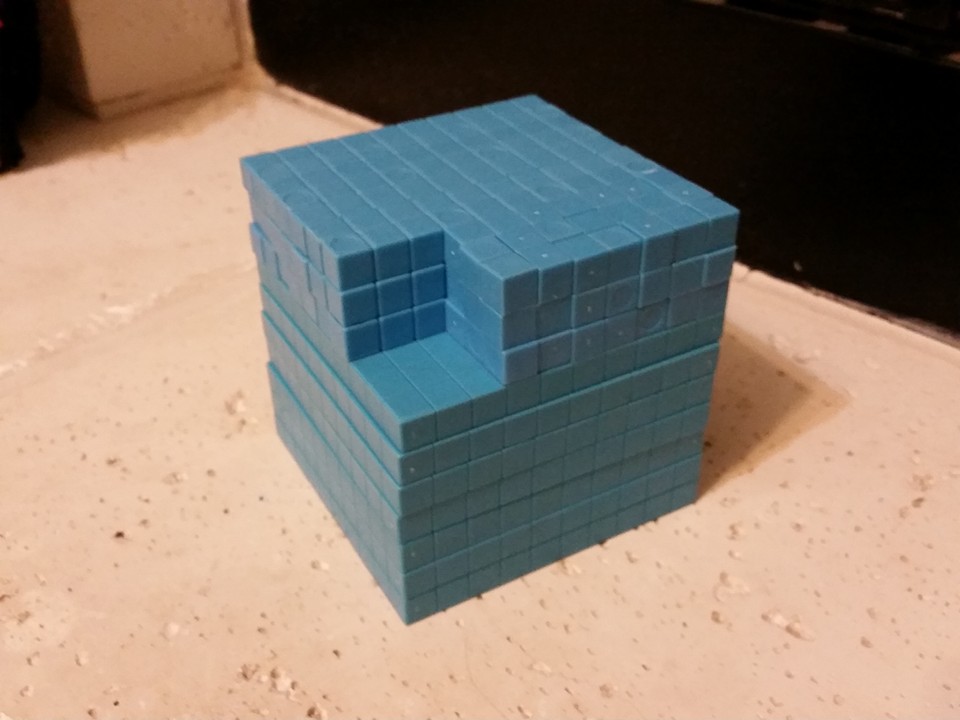
To this end, I suggest using base-10 blocks, a common manipulative found in elementary classrooms. The figure below shows a 10×10 cube with a 3×3 cube removed.

difference of two cubes

A (hopefully interesting) challenge for students would be how to build this figure only using the materials found in a typical base-10 kit, and also building it with as few pieces as possible. I think that most high school students, after some thought, can solve this puzzle by using 7 flats (for the bottom 7 layers), 21 rods, and 63 units. This of course provides the correct answer, as

7 \times 100 + 21 \times 10 + 63 \times 1 = 963 = 10^3 - 3^3.

After finding the correct answer, students should give this picture some deeper thought. If we let x = 10 and y = 3, then

7 \times 100 = (x-y) x^2.

This makes sense on physical grounds: the volume of the “base” of 7 layers is 7 \times 10, and the 7 came from the fact that the top 3 layers are incomplete.

Likewise, the 21 rods can be thought of as

21 \times 10 = 7 \times 3 \times 10 = (x-y) y x.

Again, this makes sense just looking at the picture, as the 21 rods makes a solid that is 3 units high (y), 10 units long (x), and 7 units wide (x-y).

Finally, the 63 units can be thought of as

63 = 7 \times 3 \times 3 = (x-y) y^2.

Indeed, these 63 units form a solid with a square base of side 3 and a length of 7.

Adding them together, we find

7 \times 100 + 21 \times 10 + 63 \times 1 = (x-y) x^2 + (x-y) xy + (x-y) y^2 = (x-y) (x^2 + xy+ y^2),

which is indeed the formula for the difference of two cubes. Now that students have discovered the formula for themselves, the formula can then be confirmed using the distributive law.

green line

As a postscript, it should be possible to use two different colors of base-10 blocks (to represent positive and negative numbers) so that students can derive the formula

x^3 + y^3 = (x+y)(x^2 - xy + y^2).

However, I don’t personally own two different colored base 10 kits, so I haven’t had time to think through how to do this.


Difference of Two Cubes (Part 3)

In my experience, students who have reached the level of calculus or higher have completely mastered the formula for the difference of two squares:

x^2 -y^2 = (x-y)(x+y).

However, these same students almost never know that there even is a formula for factoring the difference of two cubes x^3 -y^3, and it’s a rare day that I have a student who can actually immediately recall the formula correctly. I suppose that this formula is either never taught in Algebra II or (more likely) students immediately forget the formula after it’s been taught since there’s little opportunity for reinforcing this formula in more advanced courses in mathematics.

I recently came across an interesting pedagogical challenge: Is there an easy way, using commonly used classroom supplies, for teachers to guide students to explore and discover the formula for the difference of two cubes in the same way that they can discover the formula for the difference of two squares? (The cheap way is for students to just multiply out the factored expression to get x^3 -y^3, but that’s cheating since they shouldn’t know what the answer is in advance.)

I came up with a way to do this, and I’ll present it in tomorrow’s post. For now, I’ll leave a thought bubble for anyone who’d like to think about it between now and then.

green_speech_bubble

Difference of Two Squares (Part 2)

In yesterday’s post, I discussed a numerical way for students in Algebra I to guess for themselves the formula for the difference of two squares.

There is a also well-known geometric way of deriving this formula (from http://proofsfromthebook.com/2013/03/20/representing-the-sum-and-difference-of-two-squares/)

The idea is that a square of side b is cut from a corner of a square of side a. By cutting the remaining figure in two and rearranging the pieces, a rectangle with side lengths of a+b and a-b can be formed, thus proving that a^2 - b^2 = (a+b)(a-b).

Again, this is a simple construction that only requires paper, scissors, and a little guidance from the teacher so that students can discover this formula for themselves.

Difference of Two Squares (Part 1)

In Algebra I, we drill into student’s heads the formula for the difference of two squares:

x^2 - y^2 = (x-y)(x+y)

While this formula can be confirmed by just multiplying out the right-hand side, innovative teachers can try to get students to do some exploration to guess the formula for themselves. For example, teachers can use some cleverly chosen multiplication problems:

9 \times 11 = 99

19 \times 21 = 399

29 \times 31 = 899

39 \times 41 = 1599

Students should be able to recognize the pattern (perhaps with a little prompting):

9 \times 11 = 99 = 100 - 1

19 \times 21 = 399 = 400 - 1

29 \times 31 = 899 = 900 - 1

39 \times 41 = 1599 = 1600 - 1

Students should hopefully recognize the perfect squares:

9 \times 11 = 99 = 10^2 - 1

19 \times 21 = 399 = 20^2 - 1

29 \times 31 = 899 = 30^2 - 1

39 \times 41 = 1599 = 40^2 - 1,

so that they can guess the answer to something like 59 \times 61 without pulling out their calculators.

green lineContinuing the exploration, students can use a calculator to find

8 \times 12 = 96

18 \times 22 = 396

28 \times 32 = 896

38 \times 42 = 1596

Students should be able to recognize the pattern:

8 \times 12 = 10^2 - 4

18 \times 22 = 20^2 - 4

28 \times 32 = 30^2 - 4

38 \times 42 = 40^2 -4,

and perhaps they can even see the next step:

8 \times 12 = 10^2 - 2^2

18 \times 22 = 20^2 - 2^2

28 \times 32 = 30^2 - 2^2

38 \times 42 = 40^2 -2^2.

From this point, it’s a straightforward jump to

(10-2) \times (10+2) = 10^2 - 2^2

(20-2) \times (20+2) = 20^2 - 2^2

(30-2) \times (30+2) = 30^2 - 2^2

(40-2) \times (40+2) = 40^2 -2^2,

leading students to guess that (x-y)(x+y) = x^2 -y^2.