
The following problem appeared in Volume 53, Issue 4 (2022) of The College Mathematics Journal.
Define, for every non-negative integer
, the
.
Consider the sequence of complex polynomials in
defined by
for every non-negative integer
, where
. It is clear that
has degree
and thus has the representation
,
where each
is a positive integer. Prove that
for
.
This problem appeared in the same issue as the probability problem considered in the previous two posts. Looking back, I think that the confidence that I gained by solving that problem gave me the persistence to solve this problem as well.
My first thought when reading this problem was something like “This involves sums, polynomials, and binomial coefficients. And since the sequence is recursively defined, it’s probably going to involve a proof by mathematical induction. I can do this.”
My second thought was to use Mathematica to develop my own intuition and to confirm that the claimed pattern actually worked for the first few values of
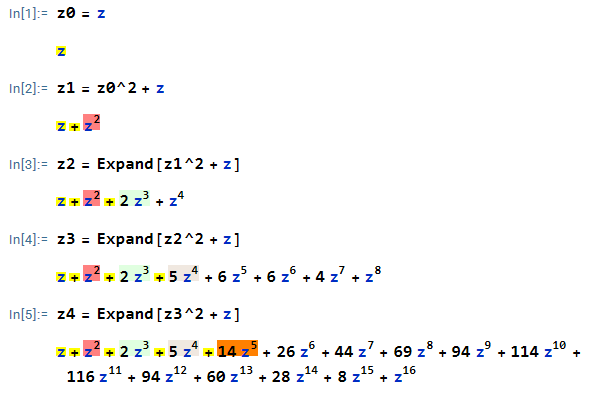
As claimed in the statement of the problem, each 


and the problem claims that the coefficient of

Confident that the pattern actually worked, all that remained was pushing through the proof by induction.
We proceed by induction on 

Although not necessary, I’ll add for good measure that

and


This next calculation illustrates what’s coming later. In the previous calculation, the coefficient of 

This is accomplished by examining all pairs, one from the left product and one from the right product, so that the exponent works out to be

For the inductive step, we assume that, for some 

Our goal is to show that 

For 


For 


The last step used a recursive relationship for the Catalan numbers that I vaguely recalled but absolutely had to look up to complete the proof.
 Mean Green Math
One thought on “Solving Problems Submitted to MAA Journals (Part 3)”