My Favorite One-Liners: Part 100

In this series, I’m compiling some of the quips and one-liners that I’ll use with my students to hopefully make my lessons more memorable for them.

Today’s quip is one that I’ll use surprisingly often:

If you ever meet a mathematician at a bar, ask him or her, “What is your favorite application of the Cauchy-Schwartz inequality?”

The point is that the Cauchy-Schwartz inequality arises surprisingly often in the undergraduate mathematics curriculum, and so I make a point to highlight it when I use it. For example, off the top of my head:

1. In trigonometry, the Cauchy-Schwartz inequality states that

|{\bf u} \cdot {\bf v}| \le \; \parallel \!\! {\bf u} \!\! \parallel \cdot \parallel \!\! {\bf v} \!\! \parallel

for all vectors {\bf u} and {\bf v}. Consequently,

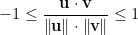
-1 \le \displaystyle \frac{ {\bf u} \cdot {\bf v} } {\parallel \!\! {\bf u} \!\! \parallel \cdot \parallel \!\! {\bf v} \!\! \parallel} \le 1,

which means that the angle

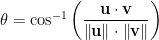
\theta = \cos^{-1} \left( \displaystyle \frac{ {\bf u} \cdot {\bf v} } {\parallel \!\! {\bf u} \!\! \parallel \cdot \parallel \!\! {\bf v} \!\! \parallel} \right)

is defined. This is the measure of the angle between the two vectors {\bf u} and {\bf v}.

2. In probability and statistics, the standard deviation of a random variable X is defined as

\hbox{SD}(X) = \sqrt{E(X^2) - [E(X)]^2}.

The Cauchy-Schwartz inequality assures that the quantity under the square root is nonnegative, so that the standard deviation is actually defined. Also, the Cauchy-Schwartz inequality can be used to show that \hbox{SD}(X) = 0 implies that X is a constant almost surely.

3. Also in probability and statistics, the correlation between two random variables X and Y must satisfy

-1 \le \hbox{Corr}(X,Y) \le 1.

Furthermore, if \hbox{Corr}(X,Y)=1, then Y= aX +b for some constants a and b, where a > 0. On the other hand, if \hbox{Corr}(X,Y)=-1, if \hbox{Corr}(X,Y)=1, then Y= aX +b for some constants a and b, where a < 0.

Since I’m a mathematician, I guess my favorite application of the Cauchy-Schwartz inequality appears in my first professional article, where the inequality was used to confirm some new bounds that I derived with my graduate adviser.

My Favorite One-Liners: Part 99

In this series, I’m compiling some of the quips and one-liners that I’ll use with my students to hopefully make my lessons more memorable for them.

Today’s quip is a light-hearted one-liner that I’ll use to lighten the mood when in the middle of a complex calculation, like the following limit problem from calculus:

Let f(x) = 11-4x. Find \delta so that |f(x) - 3| < \epsilon whenever $|x-2| < \delta$.

The solution of this problem requires isolating x in the above inequality:

|(11-4x) - 3| < \epsilon

|8-4x| < \epsilon

-\epsilon < 8 - 4x < \epsilon

-8-\epsilon < -4x < -8 + \epsilon

At this point, the next step is dividing by -4. So, I’ll ask my class,

When we divide by -4, what happens to the crocodiles?

This usually gets the desired laugh out of the middle-school rule about how the insatiable “crocodiles” of an inequality always point to the larger quantity, leading to the next step:

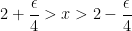
2 + \displaystyle \frac{\epsilon}{4} > x > 2 - \displaystyle \frac{\epsilon}{4},

so that

\delta = \min \left( \left[ 2 + \displaystyle \frac{\epsilon}{4} \right] - 2, 2 - \left[2 - \displaystyle \frac{\epsilon}{4} \right] \right) = \displaystyle \frac{\epsilon}{4}.

Formally completing the proof requires starting with |x-2| < \displaystyle \frac{\epsilon}{4} and ending with |f(x) - 3| < \epsilon.

My Favorite One-Liners: Part 97

In this series, I’m compiling some of the quips and one-liners that I’ll use with my students to hopefully make my lessons more memorable for them.

I’ll save this tongue-in-cheek one-liner for the wonderful occasions when my students collectively ace an exam and they’re extremely happy after I’ve returned the tests:

I learned my lesson; clearly, I need to make the next test harder.


My Favorite One-Liners: Part 96

In this series, I’m compiling some of the quips and one-liners that I’ll use with my students to hopefully make my lessons more memorable for them.

When assigning homework or a take-home project, my students may ask what the rules are for collaborating with their peers. As a general rule, I want my students to talk to each other and to collaborate on homework, even if that opens the possibility that some student may directly copy their answers from somebody else. (I figure that if any student abuses collaboration, they will get appropriately punished when they take in-class exams.) So, when students ask about rules for collaborating, I tell them:

To quote the great philosopher, “You go talk to your friends, talk to my friends, talk to me.”

My Favorite One-Liners: Part 95

In this series, I’m compiling some of the quips and one-liners that I’ll use with my students to hopefully make my lessons more memorable for them.

Today’s quip is one that I’ll use in a statistics class when we find an extraordinarily small P-value. For example:

There is a social theory that states that people tend to postpone their deaths until after some meaningful event… birthdays, anniversaries, the World Series.

In 1978, social scientists investigated obituaries that appeared in a Salt Lake City newspaper. Among the 747 obituaries examined, 60 of the deaths occurred in the three-month period preceding their birth month. However, if the day of death is independent of birthday, we would expect that 25% of these deaths would occur in this three-month period.

Does this study provide statistically significant evidence to support this theory? Use \alpha=0.01.

It turns out, using a one-tailed hypothesis test for proportions, that the test statistics is z = -10.71 and the P-value is about 4.5 \times 10^{-27}. After the computations, I’ll then discuss what the numbers mean.

I’ll begin by asking, “Is the null hypothesis [that the proportion of deaths really is 25%] possible?” The correct answer is, “Yes, it’s possible.” Even extraordinarily small P-values do not prove that the null hypothesis is impossible. To emphasize the point, I’ll say:

After all, I found a woman who agreed to marry me. So extremely unlikely events are still possible.

Once the laughter dies down, I’ll ask the second question, “Is the null hypothesis plausible?” Of course, the answer is no, and so we reject the null hypothesis in favor of the alternative.


My Favorite One-Liners: Part 94

In this series, I’m compiling some of the quips and one-liners that I’ll use with my students to hopefully make my lessons more memorable for them. Today’s edition isn’t a one-liner, but it’s still one of my favorites.

When constructing a mathematical model, sometimes certain simplifying assumptions have to be made… and sometimes these simplifications can be less than realistic. If a student complains about the unreasonableness of the simplifications, I’ll share the following story (taken from the book Absolute Zero Gravity).

Once upon a time, a group of investors decided that horse-racing could be made to pay on a scientific basis. So, they hired a team of biologists, a team of physicists, and a team of mathematicians to spend a year studying the question. At the end of the year, all three teams announced complete solutions. The investors decided to celebrate with a gala dinner where all three plans could be unveiled.

The mathematicians had the thickest report, so the chief mathematician was asked to give the first talk: “Ladies and gentlemen, you have nothing to worry about. Without describing the many details of
our proof, we can guarantee a solution to the problem you gave us — it turns out that every race is won by a least one horse. But we have been able to go beyond even this, and can show that the solution is unique: every race is won by no more than one horse!”

The biologists, who had spent the most money, went next. They were also able to show that the investors had nothing to worry about. By using the latest technology of genetic engineering, the biologists could easily set up a breeding program to produce an unbeatable racehorse, at a cost well below a million a year, in about two hundred years.

Now the investors’ hopes were riding on the physicists. The chief physicist also began by assuring them that their troubles were over. “We have perfected a method for predicting with 96 percent certainty the winner of any given race. The method is based on a very few simplifying assumptions. First, let each horse be a perfect rolling sphere… “

My Favorite One-Liners: Part 93

In this series, I’m compiling some of the quips and one-liners that I’ll use with my students to hopefully make my lessons more memorable for them.

This is a wisecrack that I’ll use in my probability/statistics classes to clarify the difference between P(A \cap B) and P(A \mid B):

Even though the odds of me being shot by some idiot wielding a gun while I teach my class are probably a million to one, I’ve decided, in light of Texas’  campus-carry law, to get my concealed handgun license and carry my own gun to class. This is for my own safety and protection; after all, the odds of *two* idiots carrying a gun to my class must be absolutely microscopic.

See also my previous post for more of the background for this wisecrack.


My Favorite One-Liners: Part 92

In this series, I’m compiling some of the quips and one-liners that I’ll use with my students to hopefully make my lessons more memorable for them.

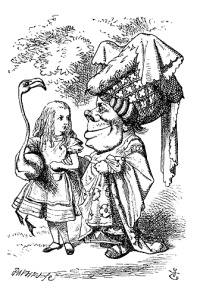
This is one of my favorite quote from Alice in Wonderland that I’ll use whenever discussing the difference between the ring axioms (integers are closed under addition, subtraction, and multiplication, but not division) and the field axioms (closed under division except for division by zero):

‘I only took the regular course [in school,’ said the Mock Turtle.]

‘What was that?’ inquired Alice.

‘Reeling and Writhing, of course, to begin with,’ the Mock Turtle replied; ‘and then the different branches of Arithmetic — Ambition, Distraction, Uglification, and Derision.’

My Favorite One-Liners: Part 91

In this series, I’m compiling some of the quips and one-liners that I’ll use with my students to hopefully make my lessons more memorable for them.

Everyone once in a while, a student might make a careless mistake  — or just choose an incorrect course of action — that changes what was supposed to be a simple problem into an incredibly difficult problem. For example, here’s a problem that might arise in Calculus I:

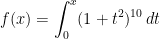
Find f'(x) if f(x) = \displaystyle \int_0^x (1+t^2)^{10} \, dt

The easy way to do this problem, requiring about 15 seconds to complete, is to use the Fundamental Theorem of Calculus. The hard way is by multiplying out (1+t^2)^{10} — preferably using Pascal’s triangle — taking the integral term-by-term, and then taking the derivative of the result. Naturally, a student who doesn’t see the easy way of doing the problem might get incredibly frustrated by the laborious calculations.

So here’s the advice that I give my students to trying to discourage them from following such rabbit trails:

If you find yourself stuck on what seems to be an incredibly difficult problem, you should ask yourself, “Just how evil do I think my professor is?”