Inverse Functions: Arccosine and Dot Products (Part 22)

Here’s a straightforward application of arccosine, that, as far as I can tell, isn’t taught too often in Precalculus and is not part of the Common Core standards for vectors and matrices.

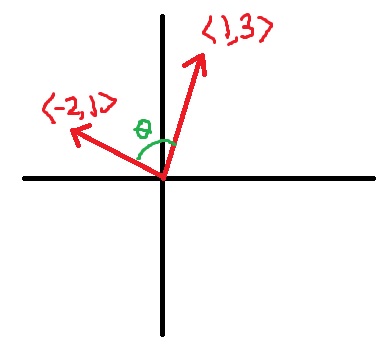
Find the angle between the vectors \langle 1,3 \rangle and \langle -2,1 \rangle.

dotproductThis problem is equivalent to finding the angle between the lines y = 3x and y = -x/2. The angle \theta is not drawn in standard position, which makes measurement of the angle initial daunting.

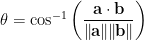
Fortunately, there is the straightforward formula for the angle between two vectors {\bf a} and {\bf b}:

\theta = \cos^{-1} \left( \displaystyle \frac{ {\bf a} \cdot {\bf b} }{ \parallel \!\! {\bf a} \!\! \parallel \parallel \!\! {\bf b} \!\! \parallel } \right)

We recall that {\bf a} \cdot {\bf b} is the dot product (or inner product) of the two vectors {\bf a} and {\bf b}, while \parallel \!\! {\bf a} \!\! \parallel = \sqrt{ {\bf a} \cdot {\bf a} } is the norm (or length) of the vector {\bf a}.

 For this particular example,

\theta = \cos^{-1} \left( \displaystyle \frac{\langle 1,3 \rangle \cdot \langle -2,1 \rangle }{ \parallel \!\!\langle 1,3 \rangle \!\! \parallel \parallel \!\!\langle -2,1 \rangle \!\! \parallel } \right)

\theta = \cos^{-1} \left( \displaystyle \frac{ (1)(-2) + (3)(1) }{ \sqrt{ (1)^2 + (3)^2} \sqrt{ (-2)^2 + 1^2 }} \right)

\theta = \cos^{-1} \displaystyle \frac{1}{\sqrt{50}}

\theta \approx 81.87^\circ

In the next post, we’ll discuss why this actually works. And then we’ll consider how the same problem can be solved more directly using arctangent.

One thought on “Inverse Functions: Arccosine and Dot Products (Part 22)

Leave a comment

This site uses Akismet to reduce spam. Learn how your comment data is processed.