
In this series of posts, I consider how two different definitions of the number 
- Algebra II/Precalculus: If
dollars are invested at interest rate
for
years with continuous compound interest, then the amount of money after
.
- Calculus: The number
from
to
is equal to
, so that

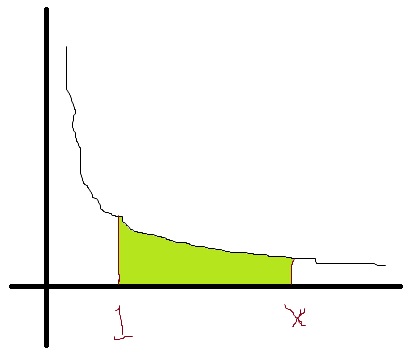
These two definitions appear to be very, very different. One deals with making money. The other deals with the area under a hyperbola. Amazingly, these two definitions are related to each other. In this series of posts, I’ll discuss the connection between the two.
I should say at the outset that the second definition is usually considered the true definition of

In yesterday’s post, I presented an informal derivation of the continuous compound interest formula 
What does it mean for something to compound continuously? In a nutshell, the rate at which the money increases should be proportional to the amount currently present. In other words, 


for some constant of proportionality





(Technically, a better solution would use an integrating factor [see also MathWorld], but I find that the above derivation is much more convincing to students who are a few semesters removed from a formal course in differential equations.) When presenting this in class, I’ll sometimes lazily write 


To solve for the missing constant 


Replacing 
 Mean Green Math
2 thoughts on “Different definitions of e (Part 6): Continuous compound interest”