
And the end of every semester, instructors are often asked “What do I need on the final to make a ___ in the course?”, where the desired course grade is given. (I’ve never done a survey, but A appears to be the most desired course grade, followed by C, D, and B.) Here’s the do-it-yourself algorithm that I tell my students, in which the final counts for 20% of the course average.
Let
be the grade on the final exam, and let
be the up-to-date course average prior to the final. Then the course average is equal to
.
Somehow, students don’t seem comforted by this simple algebra.
 More seriously, here’s a practical tip for students to determine what they need on the final to get a certain grade (hat tip to my friend Jeff Cagle for this idea). It’s based on the following principle:
If the average of
is
, then the average of
is
. In other words, if you add a constant to a list of values, then the average changes by that constant.
As an application of this idea, let’s try to guess the average of 


So here’s a typical student question: “If my average right now is an 


Seen another way, we’re solving the algebra problem

Let me solve this in an unorthodox way:


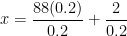

This last line matches the solution found in the previous paragraph, 
 Mean Green Math