
Yes, I definitely have had days like this. (This clip comes from the PhD Movie, from the creator of PhD Comics.)
Month: October 2013
Georgia Tech halftime show: A tribute to math
For the 2013 football season, the Georgia Tech marching band has a new halftime show called “Math.” Enjoy.
Engaging students: Parabolas
In my capstone class for future secondary math teachers, I ask my students to come up with ideas for engaging their students with different topics in the secondary mathematics curriculum. In other words, the point of the assignment was not to devise a full-blown lesson plan on this topic. Instead, I asked my students to think about three different ways of getting their students interested in the topic in the first place.
I plan to share some of the best of these ideas on this blog (after asking my students’ permission, of course).
This student submission comes from my former student Claire McMahon. Her topic, from Precalculus: parabolas.

The parabola took a long time to get to us and took a few thinkers to really get the idea down. This website that I found really nailed the dates and also simplified the rational that led up to the parabola as we know it today. The history of the parabola is as follows:
The parabola was explored by Menaechmus (380 BC to 320 BC), who was a pupil of Plato and Eudoxus. He was trying to duplicate the cube by finding the side of the cube that has an area double the cube. Instead, Menaechmus solved it by finding the intersection of the two parabolas x2=y and y2=2x. Euclid (325 BC to 265 BC) wrote about the parabola. Apollonius (262 BC to 190 BC) named the parabola. Pappus (290 to 350) considered the focus and directrix of the parabola. Pascal (1623 to 1662) considered the parabola as a projection of a circle. Galileo (1564 to 1642) showed that projectiles falling under uniform gravity follow parabolic paths. Gregory (1638 to 1675) and Newton (1643 to 1727) considered the properties of a parabola.
This really got me to thinking what it really took to figure out the derivation of the formula and even for the graph of the parabola. I find it interesting that the idea had to travel through seven genius minds to come to all of the properties that the parabola holds to this day.
This same website led me to another use of the parabola, other than to describe a projectile’s path. The use of suspension bridges relies heavily on a parabolic model. Other parabolic models would include the satellite dishes and even all types of lights. Have you ever thought that every single place that light bulb reflects is a reflection off a point from the focus to the parabola to create your beam of light!! Pretty cool!! So you might ask why do I need to know anything about parabolas? There is your answer; it’s used in everyday life. Here are a couple of examples from the website that I found interesting:
One of the “real world” applications of parabolas involves the concept of a 3D parabolic reflector in which a parabola is revolved about its axis (the line segment joining the vertex and focus). The shape of car headlights, mirrors in reflecting telescopes, and television and radio antennae (such as the one below) all utilize this property.
Antenna of a Radio Telescope
All incoming rays parallel to the axis of the parabola are reflected through the focus.
Flashlights & Headlights
In terms of a car headlight, this property is used to reflect the light rays emanating from the focus of the parabola (where the actual light bulb is located) in parallel rays.
Here are the specs on the suspension bridge:
Hold up a chain by both ends and you’ll get a curve. What kind of curve is it? You might say it is a parabola – Galileo Galili believed it was a parabola. Yet, Galileo was wrong!!!! That curve is NOT a parabola. It is a catenary.It makes sense that you would think that the curved chain is a parabola. Both the catenary and the parabola have similar properties. Both curves have a single low point. They both have a vertical line of symmetry, they at least appear to be continuous and differentiable throughout, and the slope is steeper as we move away from the low point, but it never becomes vertical.So, how is the curve of the cable in a suspension bridge a parabola? When the structure is being built and the main cables are attached to the towers, the curve is a catenary. But when the cables are attached to the deck with hangers, it is no longer a catenary. The curve of the cables become the curve of a parabola. Unlike the catenary, which is curving under its own weight, the parabola is curving not just under its own weight, but also curving from holding up the weight of the deck. The cable of a suspension bridge is under tension from holding up the bridge.Therefore, the cables of a suspension bridge is a parabola, because the weight of the deck is equally distributed on the curve.
I never really knew that there was a difference between the two and now I know that there are certain properties that made it down through the ages that hold true today. This was a very enlightening subject matter.
Website used: http://www.carondelet.pvt.k12.ca.us/Family/Math/03210/page2.htm
Area of a triangle: Pick’s theorem (Part 8)
The following is one of my all-time favorite paragraphs to ever appear in a professional mathematical journal.
Some years ago, the Northwest Mathematics Conference was held in Eugene, Oregon. To add a bit of local flavor, a forester was included on the program, and those who attended his session were introduced to a variety of nice examples which illustrated the important role that mathematics plays in the forest industry. One of his problems was concerned with the calculation of the area inside a polygonal region drawn to scale from field data obtained for a stand of timber by a timber cruiser. The standard method is to overlay a scale drawing with a transparency on which a square dot pattern is printed. Except for a factor dependent on the relative sizes of the drawing and the square grid, the area inside the polygon is computed by counting all of the dots fully inside the polygon, and then adding half of the number of dots which fall on the bounding edges of the polygon. Although the speaker was not aware that he was essentially using Pick’s formula, I was delighted to see that one of my favorite mathematical results was not only beautiful, but even useful.
D. DeTemple, cited in Branko Grunbaum and G. C. Shephard, “Pick’s Theorem,” American Mathematical Monthly, Vol. 100, pp. 150-161 (February 1993).
Suppose that the vertices of a triangle are 


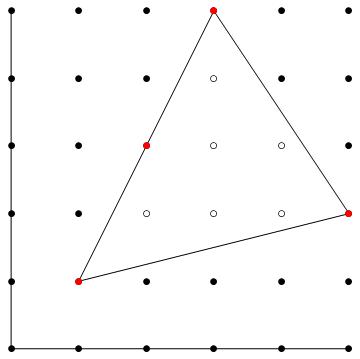 Because the vertices of the triangle have integer coordinates, Pick’s Theorem offers an exceedingly simple way of finding the area of this triangle.
- There are
points (marked white) that are inside the triangle.
- There are
points (marked red) that are on the boundary of the triangle, including the three corners.
- Therefore, the area is
.
You can confirm this area by drawing the rectangle with corners at 


Amazingly, this theorem is true for any polygonal figure — not just triangles — whose vertices have integer coordinates.
A decent classroom activity so that students can discover Pick’s theorem for themselves has been published by the National Council of Teachers of Mathematics. I modified this activity to teach my daughter and her friends last summer, so I say from first-hand experience that fourth-graders can use inductive reasoning to guess Pick’s theorem.
Additional references:
Area of a triangle: Vertices (Part 7)
Suppose that the vertices of a triangle are 


At first blush, this doesn’t fall under any of the categories of SSS, SAS, or ASA. And we certainly aren’t given a base 

Fortunately, there’s another way to find the area of a triangle that directly uses the coordinates of the triangle. It turns out that the area of the triangle is equal to the absolute value of

Notice that the first two columns contain the coordinates of the three vertices, while the third column is just padded with 

In other words, direct use of the vertices is, in this case, a lot easier than the standard SSS, SAS, or ASA formulas.
A (perhaps) surprising consequence of this formula is that the area of any triangle with integer coordinates must either be an integer or else a half-integer. We’ll see this again when we consider Pick’s theorem in tomorrow’s post.
There is another way to solve this problem by considering the three vertices as points in 


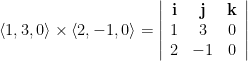

So the length of the cross-product is clearly 

The above technique works for any triangle in 


Furthermore, determinants may be used to find the volume of a tetrahedron in 


One-third of the absolute value of the determinant of these three vectors will be the volume of the tetrahedron.
This post has revolved around one central idea: a determinant represents an area or a volume. While this particular post has primarily concerned triangles and tetrahedra, I should also mention that determinants are similarly used (without the factors of 

This central idea is also the basis behind an important technique taught in multivariable calculus: integration in polar coordinates and in spherical coordinates.
In two dimensions, the formulas for conversion from polar to rectangular coordinates are


Therefore, using the Jacobian, the “infinitesimal area element” used for integrating is



Similarly, using a 

References:
http://www.purplemath.com/modules/detprobs.htm
http://mathworld.wolfram.com/Parallelogram.html
http://en.wikipedia.org/wiki/Parallelogram#Area_formulas
Area of a triangle: Incenter (Part 6)
 Source: http://mathworld.wolfram.com/Incircle.html
The incenter 

This incircle provides a different way of finding the area of 


Similarly,
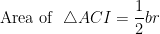
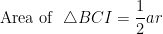
Since the area of

or

where 
This also permits the computation of

Equating these two expressions for the area of

For much more about the inradius and incircle, I’ll refer to the MathWorld website.
Area of a triangle: SSS (Part 5)

In yesterday’s post, we discussed how the area 

This can be used as the starting point for the derivation of Heron’s formula, which determines the area of a triangle using SSS (i.e., only the three sides). I won’t give the full derivation in this post — there’s no point in me retyping the details — but will refer to the Wikipedia page and the MathWorld page for the details. However, I will give the big ideas behind the derivation.
1. We begin by recalling that 



2. From the Law of Cosines, we know that

or
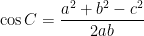
3. Substituting, we see that
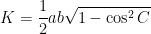

4. This last expression only contains the side lengths

where 
A final note: If you actually are able to start with Step 3 and end with Heron’s formula on your own — without consulting a textbook or the Internet if you get stuck — feel free to cry out “More power!” and grunt like Tim “The Toolman” Taylor:
Area of a triangle: SAS, ASA, and the Law of Sines (Part 4)
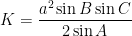
The typical way students remember the area
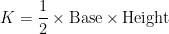
However, there are other formulas for the area of a triangle which can be helpful if the height is not immediately known.
Case 1: SAS. Suppose that two sides and the angle between the sides — say, 
If 


Therefore,
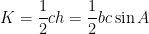
Using the same picture, one can also show that
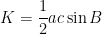
Also, with a different but similar picture, one can show that
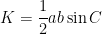
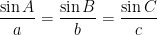
An important consequence of the SAS area formula is the Law of Sines. Since all three formulas must give the same area

Multiplying by 
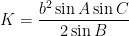
Case 2: ASA. Now suppose that we are given the measures of two angles and the length of the side in between them — say, angles 


From the SAS formula and the Law of Sines, we have

Combining these, we find

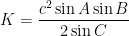
By similar reasoning, we can also find that
Volume of pyramids, cones, and spheres (Part 3)
I’m in the middle of a series of posts concerning the area of a triangle. Today, however, I want to take a one-post detour using yesterday’s post as a springboard. In yesterday’s post, we discussed a two-dimensional version of Cavalieri’s principle. From Wikipedia:
Suppose two regions in a plane are included between two parallel lines in that plane. If every line parallel to these two lines intersects both regions in line segments of equal length, then the two regions have equal areas.
In other words, if I have any kind of shape that has cross-sections that match those of the triangles above, then the shape has the same area as the triangles. Geometrically, we can think of each triangle a bunch of line segments joined together. So while the positioning of the line segments affects the shape of the region, the positioning does not affect the area of the region.
There is also a three-dimensional statement of Cavalieri’s principle, and this three-dimensional version is much more important than the above two-dimensional version. From MathWorld:
If, in two solids of equal altitude, the sections made by planes parallel to and at the same distance from their respective bases are always equal, then the volumes of the two solids are equal.
Pedagogically, I would recommend introducing Cavalieri’s principle with two-dimensional figures like those from yesterday’s post since cross-sections in triangles are much easier for students to visualize than cross-sections in three-dimensional regions.
This three-dimensional version of Cavalieri’s principle is needed to prove — without calculus — the volume formulas commonly taught in geometry class. Based on my interactions with students, they are commonly taught without proof, as my college students can use these formulas but have no recollection of ever seeing any kind of justification for why they are true. When I teach calculus, I show my students that the volume of a sphere can be found by integration using the volume of a solid of revolution:
![V = \displaystyle \int_{-R}^R \pi \left[ \sqrt{R^2 - x^2} \right]^2 \, dx = \frac{4}{3} \pi R^3](https://s0.wp.com/latex.php?latex=V+%3D+%5Cdisplaystyle+%5Cint_%7B-R%7D%5ER+%5Cpi+%5Cleft%5B+%5Csqrt%7BR%5E2+-+x%5E2%7D+%5Cright%5D%5E2+%5C%2C+dx+%3D+%5Cfrac%7B4%7D%7B3%7D+%5Cpi+R%5E3&bg=ffffff&fg=000000&s=0&c=20201002)
Without fail, my students (1) already know this formula from Geometry but (2) do not recall ever being taught why this formula is correct. Curious students also wonder (3) how the volume of a sphere (or a pyramid or a cone) can be obtained only using geometric concepts and without using calculus.
For the sake of brevity, I only give the logical flow for how these volumes can be derived for students without using calculus. I’ll refer to this excellent site for more details about each step.
- Using a simple foldable manipulative (see also this site), students can see that
for a certain pyramid — called a yangma — with a square base and a height that is equal to the base length.
- Enlarging the yangma will not change the ratio of the volume of the pyramid to the volume of the prism.
- Cavalieri’s principle then shows that
- Cavalieri’s principle then shows that
- Finally, a clever use of Cavalieri’s principle — comparing a sphere to a cylinder with a cone-shaped region removed — can be used to show that the volume of a sphere is
.
I note in closing that there are other ways for students to discover these formulas, like filling an empty pyramid with rice, pouring into an empty prism of equal base and height, and repeating until the prism is filled.
Area of a triangle: Equal cross-sections (Part 2)
Let’s take a second look at the familiar formula for the area of a triangle, 
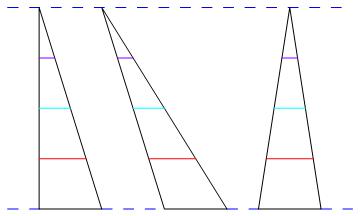 The picture above shows three different triangles: one right, one obtuse, and one acute. The three triangles have bases of equal length and also have the same height. Therefore, even though the triangles have different shapes (i.e., they’re not congruent), they have the same height.
Let’s take a second look at these three triangles. In each triangle, I’ve drawn in three “cross-section” line segments which are parallel to the base. Notice that corresponding cross-sections have equal length. In other words, the red line segments have the same length, the light-blue line segments have the same length, and the purple line segments have the same length.
Why is this true? There are two ways of thinking about this (for the sake of brevity, I won’t write out the details).
- Algebraically, the length of the cross-section increases linearly as they descend from the top vertex to the bottom base. This linear increase does not depend upon the shape of the triangle. Since the three triangles have bases of equal length, the cross-sections have to have the same length.
- Geometrically, the length of the cross-sections can be found with similar triangles, comparing the big original triangle to the smaller triangle that has a cross-section as its base. Again, the scale factor between the similar triangles depends only on the height of the smaller triangle and not on the shape of the original triangle. So the cross-sections have to have the same length.
So, since the three triangles share the same height and base length, the three triangles have the same area, and the corresponding cross-sections have the same length.
The reverse principle is also true. This is called Cavalieri’s principle. From Wikipedia:
Suppose two regions in a plane are included between two parallel lines in that plane. If every line parallel to these two lines intersects both regions in line segments of equal length, then the two regions have equal areas.
In other words, if I have any kind of shape that has cross-sections that match those of the triangles above, then the shape has the same area as the triangles. Geometrically, we can think of each triangle a bunch of line segments joined together. So while the positioning of the line segments affects the shape of the region, the positioning does not affect the area of the region.
For example, here are three non-triangular regions whose cross-sections match those of the above triangles. The region on the right is especially complex since it has a curvy hole in the middle, so that the cross-sections shown are actually two distinct line segments. Nevertheless, we can say with confidence that, by Cavalieri’s principle, the area of each region matches those of the triangles above.
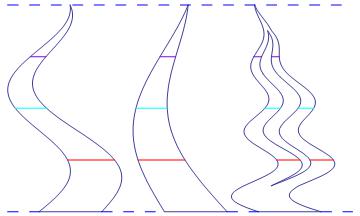
Though we wouldn’t expect geometry students to make this connection, Cavalieri’s principle may be viewed as a geometric version of integral calculus. In calculus, we teach that the area between the curves 

![A = \displaystyle \int_{y_1}^{y_2} [F(y) - f(y)] \, dy = \displaystyle \int_{y_1}^{y_2} d(y) \, dy](https://s0.wp.com/latex.php?latex=A+%3D+%5Cdisplaystyle+%5Cint_%7By_1%7D%5E%7By_2%7D+%5BF%28y%29+-+f%28y%29%5D+%5C%2C+dy+%3D+%5Cdisplaystyle+%5Cint_%7By_1%7D%5E%7By_2%7D+d%28y%29+%5C%2C+dy&bg=ffffff&fg=000000&s=0&c=20201002)
where $d(y) = F(y) – f(y)$ is the difference in the two curves. In the above formula, I chose integration with respect to 

 Mean Green Math