
In my capstone class for future secondary math teachers, I ask my students to come up with ideas for engaging their students with different topics in the secondary mathematics curriculum. In other words, the point of the assignment was not to devise a full-blown lesson plan on this topic. Instead, I asked my students to think about three different ways of getting their students interested in the topic in the first place.
I plan to share some of the best of these ideas on this blog (after asking my students’ permission, of course).
This student submission comes from my former student Roderick Motes. His topic, from Algebra II: polynomials and non-linear functions.

How can this topic be used in your students future math and science courses?
Polynomials are used extensively throughout math and science, and nonlinear functions have a place in math, science, and even business.
Consider a problem that is fundamental in both physics and calculus. How can we effectively model motion? To talk about motion we have to have a basic understanding of linear functions (these model constant acceleration problems well,) but we also need an understanding of polynomials if we are to gain a real appreciation for how acceleration is related to position; even the simplest kinematic problems will often require us to deal with polynomials.
Within business consider investing money at a bank. Your returns on investments made aren’t linear, they’re a function of the total amount you have at any given moment. The basic formula:

has a very funny setup, that is actually related in rather interesting ways to some fundamental concepts you will discuss in courses that have nonlinear functions as a topic.

The website http://zebu.uoregon.edu/~probs/mech.html has a great deal of physics problems, most of which are not novel, that demonstrate the need for nonlinear functions even within basic mechanics.
How does this topic extend what your students have learned in previous courses?
Linear change is often among the first topics we discuss in algebra. We use the same concept in geometry when talking about slope. It’s very easy to see applications of this. Weight as a function of a person’s height, and the very accessible choice of which cell phone plan is best for your family both use linear functions to model the real world.
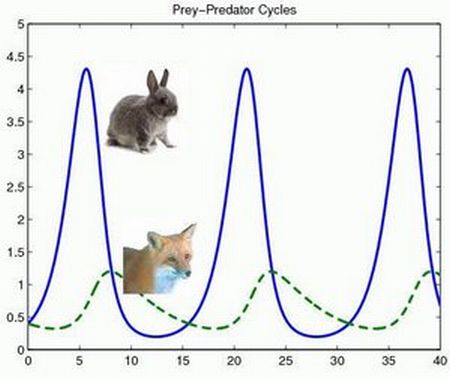
But, as discussed above, what happens when things don’t quite work out in a linear fashion? Animal populations in the wild are bound by some particularly interesting equations. Bacterial growth is modeled by exponential increase. Motion in physics is generally described with polynomials of degree at least two. Supply and Demand, while easy to understand as linear functions, are rarely so easily described in the real world.
At a more basic level nonlinear functions are tied to concepts of multiplication, division, and graphs. All of these are concepts students should be familiar with by late primary school. We describe multiplication, in one way, as repeated addition. So what happens when we repeat multiplication? Exponentiation. Exponents are at the heart of the study of nonlinear equations. Questions like this which students may have thought at some point or another are finally discussed and implemented within the context of nonlinear equations.
How can technology be used to effectively engage students?
Technology and modeling of functions go hand in hand, and any topic you can think of can be approached using technology.
To grab student attention you might discuss this wonderful Vi Hart video
The video discusses how frequency and pitch are related, and you’ll notice that sound is simply sine waves (a type of nonlinear function!) You can discuss this idea with students who are particularly engaged by music, and discuss how mathematics and nonlinear functions can, as Ms. Hart points out in the video, be used to explain why cultures so different still developed similar musical structures.
For students who are more into computers and programming you might be able to capture their attention with game design. As outlined at http://www.ehow.com/how-does_5296037_math-involved-designing-video-games.html, math and physics are used in the creation of physics engines like the Source Engine, or the Quake Engine for video games. To effectively model real situations you have to be able to understand nonlinear equations and be able to create convincing models for the computer to display. At my high school the computer science teacher was trying to make a great push to have computer science students and math students’ team up to actually create interesting things, while learning new material in an engaging way. Depending on your school, this could be an interesting approach that is also multidisciplinary.
 Mean Green Math
Great analysis. Your writing skill is outstanding and I think that, you are a great teacher.