
On my TI-83 plus emulator, I input the following in the statistical command 2-SampTInt:
x1 = 51.71
s1 = 0.79
n1 = 10
x2 = 136.14
s2 = 3.59
n2 = 10
C-Level: .95
Pooled: No
The calculator returns 9.896 degrees of freedom; it should be more like 12 degrees of freedom according to Welch’s formula (which is also implemented with T.TEST in Microsoft Excel).
I’m assuming the TI has some non-standard way of computing the number of degrees of freedom, but I haven’t the faintest idea what it could be. What’s odd is that the number of degrees of freedom appears to be computed with Welch’s formula when using the parallel command 2-SampTTest.
Day: June 23, 2013
Bumper sticker
For what it’s worth, I also have this bumper sticker on my office door.

Medical trials
This is a great and highly readable layman’s article about something that I wish I was more proficient in: the use of statistics to validate (or invalidate) medical trials.
Assessing private schools
Here’s a pet peeve that probably only bothers me: I get disturbed when a private school partially assesses the quality of its academic program by comparing the SAT scores of its graduates to either national or state averages. The children who attend private schools are those who’d be expected to do well on the SAT in the first place: they come from families able to afford a private education, and (sadly) SAT scores are highly correlated with family income. The table below shows the average SAT scores in 2009-10 based on family income and is taken from the above link.
| Family income | Critical Reading | Math | Writing |
|---|---|---|---|
| All students | 501 | 516 | 492 | Less than $20,000 | 437 | 460 | 432 |
| $20,000, but less than $40,000 | 465 | 479 | 455 |
| $40,000, but less than $60,000 | 490 | 500 | 478 |
| $60,000, but less than $80,000 | 504 | 514 | 492 |
| $80,000, but less than $100,000 | 518 | 529 | 505 |
| $100,000, but less than $120,000 | 528 | 541 | 518 |
| $120,000, but less than $140,000 | 533 | 546 | 523 |
| $140,000, but less than $160,000 | 540 | 554 | 531 |
| $160,000, but less than $200,000 | 547 | 561 | 540 |
| More than $200,000 | 568 | 586 | 567 |
Note that students who comes from families earning between $60,000-80,000 are at about the average for the country.
Based on this chart, my personal opinion is that private schools of average academic quality should produce graduates that score, on each of the three sections, about 35 or 40 points higher than the rest of the country. However, for very exclusive and expensive private schools, the difference should be 50 or even 60 points on each section.
NB: These comments are strictly limited to this one assessment of the academic programs of private schools. There are other assessments of academic quality besides the SAT, and there are plenty of nonacademic reasons for parents to choose a private education if they have the means to do so.
How not to give a presentation
I doodled this list during a particularly grueling workshop presentation:
HOW NOT TO CONDUCT A TRAINING WORKSHOP
- Assume your audience consists entirely of peer reviewers judging the suitability of your presentation for publication.
- Make sure that every facet and angle of the theoretical and philosophical underpinnings of your presentation are covered.
- Present a thoroughly detailed and annotated literature review of all prior results.
- Design all PowerPoint slides in 10-point font or less.
- Present all quantitative results in at least two different useless graphical formats, courtesy of the fun charts that Microsoft Excel will let you make.
- Create multiple acronyms and use them aggressively.
- Devote the most amount of time to the most difficult topics and processes that only a select few will be asked to perform.
- Name-drop the top brass.
- Demonstrate complicated software without providing notes for the audience’s future reference.
- Emphasize how much the new process costs, so that everyone fully comprehends how importance it is that the new process doesn’t fail.
Dissertations
I first saw this gem in the delightful book Absolute Zero Gravity: Science Quotes, Jokes and Anecdotes.

A little rabbit was sitting in a field, scribbling on a pad of paper, when a fox came along. “What are you doing, little rabbit?”
“I’m working on my dissertation,” said the rabbit.
“Really?” said the fox. “And what is your topic?”
“Oh, the topic doesn’t matter,” said the rabbit.
“No, tell me,” begged the fox.
“If you must know,” said the rabbit, “I’m advancing a theory that rabbits can eat many quite large animals – including, for instance, foxes.”
“Surely you have no experimental evidence for that,” scoffed the fox.
“Yes, I do,” said the rabbit, “and if you’d like to step inside this cave for a moment I’ll be glad to show you.” So the fox followed the rabbit into the cave. About half an hour passed. Then the rabbit came back out, brushing a tuft of fox fur off his chin, and began once more to scribble on his pad of paper.
News spreads quickly in the forest, and it wasn’t long before a curious wolf came along. “I hear you’re writing a thesis, little rabbit,” said the wolf.
“Yes,” said the rabbit, scribbling away.
“And the topic?” asked the wolf.
“Not that it matters, but I’m presenting some evidence that rabbits can eat larger animals – including, for example, wolves.” The wolf howled with laughter. “I see you don’t believe me,” said the rabbit. “Perhaps you would like to step inside this cave and see my experimental apparatus.”
Licking her chops, the wolf followed the rabbit into the cave. About half an hour passed before the rabbit came out of the cave with his pad of paper, munching on what looked like the end of a long gray tail.
Then along came a big brown bear. “What’s this I hear about your thesis topic?” he demanded.
“I can’t imagine why you all keep pestering me about my topic,” said the rabbit irritably. “As if the topic made any difference at all.”
The bear sniggered behind his paw. “Something about rabbits eating bigger animals was what I heard – and apparatus inside the cave.”
“That’s right,” snapped the rabbit, putting down his pencil. “And if you want to see it I’ll gladly show you.” Into the cave they went, and a half hour later the rabbit came out again picking his teeth with a big bear claw.
By now all the animals in the forest were getting nervous about the rabbit’s project, and a little mouse was elected to sneak up and peek into the cave when the rabbit’s back was turned. There she discovered that the mystery of the rabbit’s thesis had not only a solution but also a moral. The mystery’s solution is that the cave contained an enormous lion. And the moral is that your thesis topic really doesn’t matter – as long as you have the right thesis advisor.
Multiple choice
I had a good chuckle at the following photo.
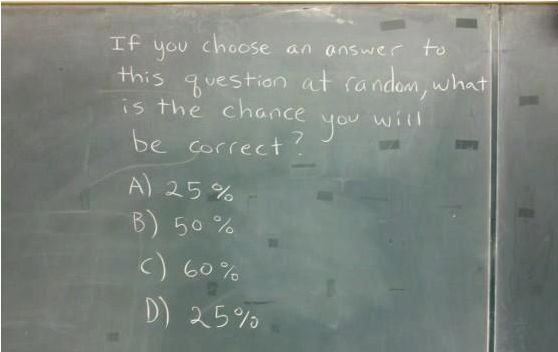
Here’s a thought bubble if you’d like to think about it before I reveal the answer.

You’d think that, since there are four possible answers, that you should answer 25%. However, there are two choices for 25%, so the chance of picking 25% as your answer is 2/4, or 50%. But there’s only one way to answer 50%, so the answer should be 1/4, or 25%. To quote “The King and I,” et cetera, et cetera, et cetera.
The correct answer, of course, is adding a fifth option: E) 20%.
Transition from high school to college
One of my (perhaps unsolvable) professional concerns is the large number of students who ace high school but flounder once hitting the higher academic expectations in college. This particular article was written by a student from Washington, DC, but it really could’ve come from anywhere.
A major contributing cause (though not the only one) is that the high-stakes tests that high school students take at the end of the year does not even come close to measuring college readiness. If I could wave my magic wand, I would assess the effectiveness of high schools not only with high-staking testing but also with graduates’ GPA in core classes during their freshman year of college.
Math emporium
It took some convincing, but I’m now a supporter of this novel way of using technology to teach lower-level mathematics courses at the collegiate level. The results speak for themselves.
Typographical error (perhaps)
Here’s a great typo that I saw on a paper submitted by one of my former students who aspires to be a secondary math teacher. Instead of writing “engaging one’s students,” she accidentally wrote “encaging one’s students.”
 Mean Green Math