The following problem appeared in Volume 96, Issue 3 (2023) of Mathematics Magazine.
Evaluate the following sums in closed form:
and
.
When I first read this problem, I immediately noticed that
is a Taylor polynomial of and
is a Taylor polynomial of . In other words, the given expressions are the sums of the tail-sums of the Taylor series for and .
As usual when stumped, I used technology to guide me. Here’s the graph of the first sum, adding the first 50 terms.
I immediately notice that the function oscillates, which makes me suspect that the answer involves either or . I also notice that the sizes of oscillations increase as increases, so that the answer should have the form or , where is an increasing function. I also notice that the graph is symmetric about the origin, so that the function is even. I also notice that the graph passes through the origin.
So, taking all of that in, one of my first guesses was , which is satisfies all of the above criteria.
That’s not it, but it’s not far off. The oscillations of my guess in orange are too big and they’re inverted from the actual graph in blue. After some guessing, I eventually landed on .
That was a very good sign… the two graphs were pretty much on top of each other. That’s not a proof that is the answer, of course, but it’s certainly a good indicator.
I didn’t have the same luck with the other sum; I could graph it but wasn’t able to just guess what the curve could be.
At long last, we have reached the end of this series of posts.
The derivation is elementary; I’m confident that I could have understood this derivation had I seen it when I was in high school. That said, the word “elementary” in mathematics can be a bit loaded — this means that it is based on simple ideas that are perhaps used in a profound and surprising way. Perhaps my favorite quote along these lines was this understated gem from the book Three Pearls of Number Theory after the conclusion of a very complicated proof in Chapter 1:
You see how complicated an entirely elementary construction can sometimes be. And yet this is not an extreme case; in the next chapter you will encounter just as elementary a construction which is considerably more complicated.
Here are the elementary ideas from calculus, precalculus, and high school physics that were used in this series:
Physics
Conservation of angular momentum
Newton’s Second Law
Newton’s Law of Gravitation
Precalculus
Completing the square
Quadratic formula
Factoring polynomials
Complex roots of polynomials
Bounds on and
Period of and
Zeroes of and
Trigonometric identities (Pythagorean, sum and difference, double-angle)
Conic sections
Graphing in polar coordinates
Two-dimensional vectors
Dot products of two-dimensional vectors (especially perpendicular vectors)
Euler’s equation
Calculus
The Chain Rule
Derivatives of and
Linearizations of , , and near (or, more generally, their Taylor series approximations)
Derivative of
Solving initial-value problems
Integration by substitution
While these ideas from calculus are elementary, they were certainly used in clever and unusual ways throughout the derivation.
I should add that although the derivation was elementary, certain parts of the derivation could be made easier by appealing to standard concepts from differential equations.
One more thought. While this series of post was inspired by a calculation that appeared in an undergraduate physics textbook, I had thought that this series might be worthy of publication in a mathematical journal as an historical example of an important problem that can be solved by elementary tools. Unfortunately for me, Hieu D. Nguyen’s terrific article Rearing Its Ugly Head: The Cosmological Constant and Newton’s Greatest Blunder in The American Mathematical Monthly is already in the record.
In this series, I’m discussing how ideas from calculus and precalculus (with a touch of differential equations) can predict the precession in Mercury’s orbit and thus confirm Einstein’s theory of general relativity. The origins of this series came from a class project that I assigned to my Differential Equations students maybe 20 years ago.
In this series, we found an approximate solution to the governing initial-value problem
,
where , , , is the gravitational constant of the universe, is the mass of the planet, is the mass of the Sun, is the constant angular momentum of the planet, is the eccentricity of the orbit, and is the speed of light.
We used the following steps to find an approximate solution.
Step 0. Ignore the general-relativity contribution and solve the simpler initial-value problem
,
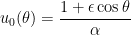
which is a zeroth-order approximation to the real initial-value problem. We found that the solution of this differential equation is
,
which is the equation of an ellipse in polar coordinates.
Step 1. Solve the initial-value problem
,
which partially incorporates the term due to general relativity. This is a first-order approximation to the real differential equation. After much effort, we found that the solution of this initial-value problem is
.
For large values of , this is accurately approximated as:
,
which can be further approximated as
.
From this expression, the precession in a planet’s orbit due to general relativity can be calculated.
Roughly 20 years ago, I presented this application of differential equations at the annual meeting of the Texas Section of the Mathematical Association of America. After the talk, a member of the audience asked what would happen if we did this procedure yet again to find a second-order approximation. In other words, I was asked to consider…
Step 2. Solve the initial-value problem
.
It stands to reason that the answer should be an even more accurate approximation to the true solution .
I didn’t have an immediate answer for this question, but I can answer it now. Letting Mathematica do the work, here’s the answer:
Yes, it’s a mess. The term in red is , while the term in yellow is the next largest term in . Both of these appear in the answer to .
The term in green is the next largest term in , with the highest power of in the numerator and the highest power of in the denominator. In other words,
.
How does this compare to our previous approximation of
?
Well, to a second-order Taylor approximation, it’s the same! Let
.
Expanding about and treated as a constant, we find
.
Substituting yields the above approximation for .
Said another way, proceeding to a second-order approximation merely provides additional confirmation for the precession of a planet’s orbit.
Just for the fun of it, I also used Mathematica to find the solution of Step 3:
Step 2. Solve the initial-value problem
.
I won’t copy-and-paste the solution from Mathematica; unsurpisingly, it’s really long. I will say that, unsurprisingly, the leading terms are
.
I said “unsurprisingly” because this matches the third-order Taylor polynomial of our precession expression. I don’t have time to attempt it, but surely there’s a theorem to be proven here based on this computational evidence.
In this series, I’m discussing how ideas from calculus and precalculus (with a touch of differential equations) can predict the precession in Mercury’s orbit and thus confirm Einstein’s theory of general relativity. The origins of this series came from a class project that I assigned to my Differential Equations students maybe 20 years ago.
We have shown that under general relativity, the motion of a planet around the Sun precesses by
,
where is the semi-major axis of the planet’s orbit, is the orbit’s eccentricity, is the gravitational constant of the universe, is the mass of the Sun, and is the speed of light.
Notice that for to be as observable as possible, we’d like to be as small as possible and to be as large as possible. By a fortunate coincidence, the orbit of Mercury — the closest planet to the sun — has the most elliptical orbit of the eight planets.
Here are the values of the constants for Mercury’s orbit in the SI system:
The last constant, , is the time for Mercury to complete one orbit. This isn’t in the SI system, but using Earth years as the unit of time will prove useful later in this calculation.
Using these numbers, and recalling that , we find that
.
Notice that all of the units cancel out perfectly; this bit of dimensional analysis is a useful check against careless mistakes.
Again, the units of are in radians per Mercury orbit, or radians per 0.2408 years. We now convert this to arc seconds per century:
.
This indeed matches the observed precession in Mercury’s orbit, thus confirming Einstein’s theory of relativity.
This same computation can be made for other planets. For Venus, we have the new values of , , and . Repeating this calculation, we predict the precession in Venus’s orbit to be 8.65” per century. Einstein made this prediction in 1915, when the telescopes of the time were not good enough to measure the precession in Venus’s orbit. This only happened in 1960, 45 years later and 5 years after Einstein died. Not surprisingly, the precession in Venus’s orbit also agrees with general relativity.
In this series, I’m discussing how ideas from calculus and precalculus (with a touch of differential equations) can predict the precession in Mercury’s orbit and thus confirm Einstein’s theory of general relativity. The origins of this series came from a class project that I assigned to my Differential Equations students maybe 20 years ago.
We have shown that the motion of a planet around the Sun, expressed in polar coordinates with the Sun at the origin, under general relativity is
,
where , , is the semi-major axis of the planet’s orbit, is the orbit’s eccentricity, , is the gravitational constant of the universe, is the mass of the planet, is the mass of the Sun, is the planet’s perihelion, is the constant angular momentum of the planet, and is the speed of light.
The above function is maximized (i.e., the distance from the Sun is minimized) when is as large as possible. This occurs when is a multiple of .
Said another way, the planet is at its closest point to the Sun when . One orbit later, the planet returns to its closest point to the Sun when
We now use the approximation
;
this can be demonstrated by linearization, Taylor series, or using the first two terms of the geometric series . With this approximation, the closest approach to the Sun in the next orbit occurs when
,
which is coterminal with the angle
.
Substituting and , we see that the amount of precession per orbit is
.
The units of are radians per orbit. In the next post, we will use Mercury’s data to find in seconds of arc per century.
In this series, I’m discussing how ideas from calculus and precalculus (with a touch of differential equations) can predict the precession in Mercury’s orbit and thus confirm Einstein’s theory of general relativity. The origins of this series came from a class project that I assigned to my Differential Equations students maybe 20 years ago.
We have shown that the motion of a planet around the Sun, expressed in polar coordinates with the Sun at the origin, under general relativity is
,
where , , , , is the gravitational constant of the universe, is the mass of the planet, is the mass of the Sun, is the planet’s perihelion, is the constant angular momentum of the planet, and is the speed of light.
We notice that the orbit of a planet under general relativity looks very, very similar to the orbit under Newtonian physics:
,
so that
.
As we’ve seen, this describes an elliptical orbit, normally expressed in rectangular coordinates as
,
with semimajor axis along the axis. In particular, for an elliptical orbit, the planet’s closest approach to the Sun occurs at :
,
and the planet’s further distance from the Sun occurs at :
.
Therefore, the length of the major axis of the ellipse is the sum of these two distances:
.
Said another way, . This is a far more convenient formula for computing than , as the values of (the semi-major axis) and (the eccentricity of the orbit) are more accessible than the angular momentum of the planet’s orbit.
In the next post, we finally compute the precession of the orbit.
In this series, I’m discussing how ideas from calculus and precalculus (with a touch of differential equations) can predict the precession in Mercury’s orbit and thus confirm Einstein’s theory of general relativity. The origins of this series came from a class project that I assigned to my Differential Equations students maybe 20 years ago.
We have shown that the motion of a planet around the Sun, expressed in polar coordinates with the Sun at the origin, under general relativity is
,
where , , , is the gravitational constant of the universe, is the mass of the planet, is the mass of the Sun, is the constant angular momentum of the planet, and is the speed of light.
We will now simplify this expression, using the facts that is very small and is quite large, so that is very small indeed. We will use the two approximations
;
these approximations can be obtained by linearization or else using the first term of the Taylor series expansions of and about .
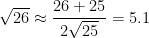
I recently came across the following computational trick: to estimate , use
,
where is the closest perfect square to . For example,
.
I had not seen this trick before — at least stated in these terms — and I’m definitely not a fan of computational tricks without an explanation. In this case, the approximation is a straightforward consequence of a technique we teach in calculus. If , then , so that . Since , the equation of the tangent line to at is
.
The key observation is that, for , the graph of will be very close indeed to the graph of . In Calculus I, this is sometimes called the linearization of at . In Calculus II, we observe that these are the first two terms in the Taylor series expansion of about .
For the problem at hand, if , then
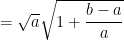
if is close to zero. Therefore, if is a perfect square close to so that the relative difference is small, then
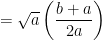
.
One more thought: All of the above might be a bit much to swallow for a talented but young student who has not yet learned calculus. So here’s another heuristic explanation that does not require calculus: if , then the geometric mean will be approximately equal to the arithmetic mean . That is,
Some time ago, I posted a series on the lecture that I’ll give to student to remind them about Taylor series. I won’t repost the whole thing here, but the basic ideas are inductively motivating the concept by starting with a polynomial and then reinforcing the concept with both numerical calculation and comparison of graphs.
After giving this lecture recently, one of my students told me about this terrific video on Taylor series that does much of the same things, with the added bonus of engaging animations. I recommend this highly.
My latest article on mathematics education, titled “Developing Intuition for Logarithms,” was published this month in the “My Favorite Lesson” section of the September 2018 issue of the journal Mathematics Teacher. This is a lesson that I taught for years to my Precalculus students, and I teach it currently to math majors who are aspiring high school teachers. Per copyright law, I can’t reproduce the article here, though the gist of the article appeared in an earlier blog post from five years ago.
Rather than repeat the article here, I thought I would write about some extra thoughts on developing intuition for logarithms that, due to space limitations, I was not able to include in the published article.
While some common (i.e., base-10) logarithms work out evenly, like , most do not. Here is the typical output when a scientific calculator computes a logarithm:
To a student first learning logarithms, the answer is just an apparently random jumble of digits; indeed, it can proven that the answer is irrational. With a little prompting, a teacher can get his/her students wondering about how people 50 years ago could have figured this out without a calculator. This leads to a natural pedagogical question:
Can good Algebra II students, using only the tools at their disposal, understand how decimal expansions of base-10 logarithms could have been found before computers were invented?
Students who know calculus, of course, can do these computations since
a standard topic in second-semester calculus, can be used to calculate for values of close to 1. However, a calculation using a power series is probably inaccessible to bright Algebra II students, no matter how precocious they are. (Besides, in real life, calculators don’t actually use Taylor series to perform these calculations; see the article CORDIC: How Hand Calculators Calculate, which appeared in College Mathematics Journal, for more details.)
In this series, I’ll discuss a technique that Algebra II students can use to find the decimal expansions of base-10 logarithms to surprisingly high precision using only tools that they’ve learned in Algebra II. This technique won’t be very efficient, but it should be completely accessible to students who are learning about base-10 logarithms for the first time. All that will be required are the Laws of Logarithms and a standard scientific calculator. A little bit of patience can yield the first few decimal places. And either a lot of patience, a teacher who knows how to use Wolfram Alpha appropriately, or a spreadsheet that I wrote can be used to obtain the decimal approximations of logarithms up to the digits displayed on a scientific calculator.

.


 and
and 
 near
near  (or, more generally, their Taylor series approximations)
 substitution
![u''(\theta) + u(\theta) = \displaystyle \frac{1}{\alpha} + \delta [u(\theta)]^2](https://s0.wp.com/latex.php?latex=u%27%27%28%5Ctheta%29+%2B+u%28%5Ctheta%29+%3D+%5Cdisplaystyle+%5Cfrac%7B1%7D%7B%5Calpha%7D+%2B+%5Cdelta+%5Bu%28%5Ctheta%29%5D%5E2&bg=ffffff&fg=000000&s=0&c=20201002)

 ,
, ,
,  ,
,  ,
,  is the gravitational constant of the universe,
  is the mass of the planet,
  is the mass of the Sun,
  is the constant angular momentum of the planet,
  is the eccentricity of the orbit, and
  is the speed of light.

 ,
, ,
,![u_1''(\theta) + u_1(\theta) = \displaystyle \frac{1}{\alpha} + \delta [u_0(\theta)]^2](https://s0.wp.com/latex.php?latex=u_1%27%27%28%5Ctheta%29+%2B+u_1%28%5Ctheta%29+%3D+%5Cdisplaystyle+%5Cfrac%7B1%7D%7B%5Calpha%7D+%2B+%5Cdelta+%5Bu_0%28%5Ctheta%29%5D%5E2&bg=ffffff&fg=000000&s=0&c=20201002)

 ,
, .
. , this is accurately approximated as:
 ,
,![u_1(\theta) \approx \displaystyle \frac{1}{\alpha} \left[ 1 + \epsilon \cos \left( \theta - \frac{\delta \theta}{\alpha} \right) \right]](https://s0.wp.com/latex.php?latex=u_1%28%5Ctheta%29+%5Capprox+%5Cdisplaystyle+%5Cfrac%7B1%7D%7B%5Calpha%7D+%5Cleft%5B+1+%2B+%5Cepsilon+%5Ccos+%5Cleft%28+%5Ctheta+-+%5Cfrac%7B%5Cdelta+%5Ctheta%7D%7B%5Calpha%7D+%5Cright%29+%5Cright%5D&bg=ffffff&fg=000000&s=0&c=20201002) .
.
![u_2''(\theta) + u_2(\theta) = \displaystyle \frac{1}{\alpha} + \delta [u_1(\theta)]^2](https://s0.wp.com/latex.php?latex=u_2%27%27%28%5Ctheta%29+%2B+u_2%28%5Ctheta%29+%3D+%5Cdisplaystyle+%5Cfrac%7B1%7D%7B%5Calpha%7D+%2B+%5Cdelta+%5Bu_1%28%5Ctheta%29%5D%5E2&bg=ffffff&fg=000000&s=0&c=20201002)

 .
. .
.
 , while the term in yellow is the next largest term in
  . Both of these appear in the answer to
  .
. 
 in the denominator. In other words,
 .
.![u(\theta) \approx \displaystyle \frac{1}{\alpha} \left[ 1 + \epsilon \cos \left( \theta - \frac{\delta \theta}{\alpha} \right) \right]](https://s0.wp.com/latex.php?latex=u%28%5Ctheta%29+%5Capprox+%5Cdisplaystyle+%5Cfrac%7B1%7D%7B%5Calpha%7D+%5Cleft%5B+1+%2B+%5Cepsilon+%5Ccos+%5Cleft%28+%5Ctheta+-+%5Cfrac%7B%5Cdelta+%5Ctheta%7D%7B%5Calpha%7D+%5Cright%29+%5Cright%5D&bg=ffffff&fg=000000&s=0&c=20201002) ?
? ![f(x) = \displaystyle \frac{1}{\alpha} \left[ 1 + \epsilon \cos \left( \theta - x \right) \right]](https://s0.wp.com/latex.php?latex=f%28x%29+%3D+%5Cdisplaystyle+%5Cfrac%7B1%7D%7B%5Calpha%7D+%5Cleft%5B+1+%2B+%5Cepsilon+%5Ccos+%5Cleft%28+%5Ctheta+-+x+%5Cright%29+%5Cright%5D&bg=ffffff&fg=000000&s=0&c=20201002) .
. and treated
 ![f(x) \approx f(0) + f'(0) x + \displaystyle \frac{f''(0)}{2} x^2 = \displaystyle \frac{1}{\alpha} \left[ 1 + \epsilon \cos \left( \theta\right) \right] + \frac{\epsilon}{\alpha} x \sin \theta - \frac{\epsilon}{2\alpha} x^2 \cos \theta](https://s0.wp.com/latex.php?latex=f%28x%29+%5Capprox+f%280%29+%2B+f%27%280%29+x+%2B+%5Cdisplaystyle+%5Cfrac%7Bf%27%27%280%29%7D%7B2%7D+x%5E2+%3D+%5Cdisplaystyle+%5Cfrac%7B1%7D%7B%5Calpha%7D+%5Cleft%5B+1+%2B+%5Cepsilon+%5Ccos+%5Cleft%28+%5Ctheta%5Cright%29+%5Cright%5D+%2B+%5Cfrac%7B%5Cepsilon%7D%7B%5Calpha%7D+x+%5Csin+%5Ctheta+-+%5Cfrac%7B%5Cepsilon%7D%7B2%5Calpha%7D+x%5E2+%5Ccos+%5Ctheta&bg=ffffff&fg=000000&s=0&c=20201002) .
. yields the above approximation for
 ![u_3''(\theta) + u_3(\theta) = \displaystyle \frac{1}{\alpha} + \delta [u_2(\theta)]^2](https://s0.wp.com/latex.php?latex=u_3%27%27%28%5Ctheta%29+%2B+u_3%28%5Ctheta%29+%3D+%5Cdisplaystyle+%5Cfrac%7B1%7D%7B%5Calpha%7D+%2B+%5Cdelta+%5Bu_2%28%5Ctheta%29%5D%5E2&bg=ffffff&fg=000000&s=0&c=20201002)

 .
. .
. ,
, is the semi-major axis of the planet’s orbit,
  to be as observable as possible, we’d like


 , is the time for Mercury to complete one orbit. This isn’t in the SI system, but using Earth years as the unit of time will prove useful later in this calculation.
 , we find that
 .
.
 .
. ,
,  , and
, and  . Repeating this calculation, we predict the precession in Venus’s orbit to be 8.65” per century. Einstein made this prediction in 1915, when the telescopes of the time were not good enough to measure the precession in Venus’s orbit. This only happened in 1960, 45 years later and 5 years after Einstein died. Not surprisingly, the precession in Venus’s orbit also agrees with general relativity.
 with the Sun at the origin, under general relativity is
 ![u(\theta) \approx \displaystyle \frac{1}{\alpha} \left[ 1 + \epsilon \cos \left( \theta - \frac{\delta \theta}{\alpha} \right) \right]](https://s0.wp.com/latex.php?latex=u%28%5Ctheta%29+%5Capprox++%5Cdisplaystyle+%5Cfrac%7B1%7D%7B%5Calpha%7D+%5Cleft%5B+1+%2B+%5Cepsilon+%5Ccos+%5Cleft%28+%5Ctheta+-+%5Cfrac%7B%5Cdelta+%5Ctheta%7D%7B%5Calpha%7D+%5Cright%29+%5Cright%5D&bg=ffffff&fg=000000&s=0&c=20201002) ,
, ,
,  is the planet’s perihelion,
  is minimized) when
  is as large as possible. This occurs when
  is a multiple of
  .
. . One orbit later, the planet returns to its closest point to the Sun when


 ;
; . With this approximation, the closest approach to the Sun in the next orbit occurs when
 ,
, .
. .
. ,
, ![u(\theta) \approx \displaystyle \frac{1}{\alpha} \left[ 1 + \epsilon \cos \theta \right]](https://s0.wp.com/latex.php?latex=u%28%5Ctheta%29+%5Capprox++%5Cdisplaystyle+%5Cfrac%7B1%7D%7B%5Calpha%7D+%5Cleft%5B+1+%2B+%5Cepsilon+%5Ccos+%5Ctheta+%5Cright%5D&bg=ffffff&fg=000000&s=0&c=20201002) ,
, .
. ,
, axis. In particular, for an elliptical orbit, the planet’s closest approach to the Sun occurs at
  ,
, :
: .
. of the major axis of the ellipse is the sum of these two distances:


 .
. , as the values of
  with the Sun at the origin, under general relativity is
  ,
, is very small and
  is very small indeed. We will use the two approximations
 ;
; .
.![= \displaystyle \frac{1}{\alpha} \left[1 + \epsilon \cos \theta + \frac{ \delta\epsilon}{\alpha} \theta \sin \theta \right]](https://s0.wp.com/latex.php?latex=%3D++%5Cdisplaystyle+%5Cfrac%7B1%7D%7B%5Calpha%7D+%5Cleft%5B1+%2B+%5Cepsilon+%5Ccos+%5Ctheta+%2B+%5Cfrac%7B+%5Cdelta%5Cepsilon%7D%7B%5Calpha%7D+%5Ctheta+%5Csin+%5Ctheta+%5Cright%5D&bg=ffffff&fg=000000&s=0&c=20201002)
![= \displaystyle \frac{1}{\alpha} \left[1 + \epsilon \left(\cos \theta + \frac{ \delta}{\alpha} \theta \sin \theta \right) \right]](https://s0.wp.com/latex.php?latex=%3D++%5Cdisplaystyle+%5Cfrac%7B1%7D%7B%5Calpha%7D+%5Cleft%5B1+%2B+%5Cepsilon+%5Cleft%28%5Ccos+%5Ctheta+%2B+%5Cfrac%7B+%5Cdelta%7D%7B%5Calpha%7D+%5Ctheta+%5Csin+%5Ctheta+%5Cright%29+%5Cright%5D&bg=ffffff&fg=000000&s=0&c=20201002)
![= \displaystyle \frac{1}{\alpha} \left[1 + \epsilon \left(\cos \theta \cdot 1 + \sin \theta \cdot \frac{ \delta \theta}{\alpha} \right) \right]](https://s0.wp.com/latex.php?latex=%3D++%5Cdisplaystyle+%5Cfrac%7B1%7D%7B%5Calpha%7D+%5Cleft%5B1+%2B+%5Cepsilon+%5Cleft%28%5Ccos+%5Ctheta+%5Ccdot+1+%2B+%5Csin+%5Ctheta+%5Ccdot+%5Cfrac%7B+%5Cdelta+%5Ctheta%7D%7B%5Calpha%7D++%5Cright%29+%5Cright%5D&bg=ffffff&fg=000000&s=0&c=20201002)
![\approx \displaystyle \frac{1}{\alpha} \left[1 + \epsilon \left(\cos \theta \cdot \cos \frac{\delta \theta}{\alpha} + \sin \theta \cdot \sin \frac{ \delta \theta}{\alpha} \right) \right]](https://s0.wp.com/latex.php?latex=%5Capprox++%5Cdisplaystyle+%5Cfrac%7B1%7D%7B%5Calpha%7D+%5Cleft%5B1+%2B+%5Cepsilon+%5Cleft%28%5Ccos+%5Ctheta+%5Ccdot+%5Ccos+%5Cfrac%7B%5Cdelta+%5Ctheta%7D%7B%5Calpha%7D+%2B+%5Csin+%5Ctheta+%5Ccdot+%5Csin+%5Cfrac%7B+%5Cdelta+%5Ctheta%7D%7B%5Calpha%7D++%5Cright%29+%5Cright%5D&bg=ffffff&fg=000000&s=0&c=20201002)
![\approx \displaystyle \frac{1}{\alpha} \left[1 + \epsilon \cos \left( \theta - \frac{\delta \theta}{\alpha} \right) \right]](https://s0.wp.com/latex.php?latex=%5Capprox++%5Cdisplaystyle+%5Cfrac%7B1%7D%7B%5Calpha%7D+%5Cleft%5B1+%2B+%5Cepsilon+%5Ccos+%5Cleft%28+%5Ctheta+-+%5Cfrac%7B%5Cdelta+%5Ctheta%7D%7B%5Calpha%7D++%5Cright%29+%5Cright%5D&bg=ffffff&fg=000000&s=0&c=20201002) .
. , use
, use ,
, . For example,
 .
. , then
  , so that
  . Since
  , the equation of the tangent line to
  at
at  .
. will be very close indeed to the graph of
  at
at  . In Calculus II, we observe that these are the first two terms in the
  .
. , then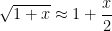
 is close to zero. Therefore, if
  is small, then


 .
. , then the geometric mean
  will be approximately equal to the arithmetic mean
  . That is,
 ,
, .
. , most do not. Here is the typical output when a scientific calculator computes a logarithm:
 ,
, ,
, for values of
  Mean Green Math