At long last, we have reached the end of this series of posts.
The derivation is elementary; I’m confident that I could have understood this derivation had I seen it when I was in high school. That said, the word “elementary” in mathematics can be a bit loaded — this means that it is based on simple ideas that are perhaps used in a profound and surprising way. Perhaps my favorite quote along these lines was this understated gem from the book Three Pearls of Number Theory after the conclusion of a very complicated proof in Chapter 1:
You see how complicated an entirely elementary construction can sometimes be. And yet this is not an extreme case; in the next chapter you will encounter just as elementary a construction which is considerably more complicated.
Here are the elementary ideas from calculus, precalculus, and high school physics that were used in this series:
Physics
Conservation of angular momentum
Newton’s Second Law
Newton’s Law of Gravitation
Precalculus
Completing the square
Quadratic formula
Factoring polynomials
Complex roots of polynomials
Bounds on and
Period of and
Zeroes of and
Trigonometric identities (Pythagorean, sum and difference, double-angle)
Conic sections
Graphing in polar coordinates
Two-dimensional vectors
Dot products of two-dimensional vectors (especially perpendicular vectors)
Euler’s equation
Calculus
The Chain Rule
Derivatives of and
Linearizations of , , and near (or, more generally, their Taylor series approximations)
Derivative of
Solving initial-value problems
Integration by substitution
While these ideas from calculus are elementary, they were certainly used in clever and unusual ways throughout the derivation.
I should add that although the derivation was elementary, certain parts of the derivation could be made easier by appealing to standard concepts from differential equations.
One more thought. While this series of post was inspired by a calculation that appeared in an undergraduate physics textbook, I had thought that this series might be worthy of publication in a mathematical journal as an historical example of an important problem that can be solved by elementary tools. Unfortunately for me, Hieu D. Nguyen’s terrific article Rearing Its Ugly Head: The Cosmological Constant and Newton’s Greatest Blunder in The American Mathematical Monthly is already in the record.
In this series, I’m discussing how ideas from calculus and precalculus (with a touch of differential equations) can predict the precession in Mercury’s orbit and thus confirm Einstein’s theory of general relativity. The origins of this series came from a class project that I assigned to my Differential Equations students maybe 20 years ago.
We have shown that the motion of a planet around the Sun, expressed in polar coordinates with the Sun at the origin, under general relativity is
,
where , , , is the gravitational constant of the universe, is the mass of the planet, is the mass of the Sun, is the constant angular momentum of the planet, and is the speed of light.
We will now simplify this expression, using the facts that is very small and is quite large, so that is very small indeed. We will use the two approximations
;
these approximations can be obtained by linearization or else using the first term of the Taylor series expansions of and about .
In my capstone class for future secondary math teachers, I ask my students to come up with ideas for engaging their students with different topics in the secondary mathematics curriculum. In other words, the point of the assignment was not to devise a full-blown lesson plan on this topic. Instead, I asked my students to think about three different ways of getting their students interested in the topic in the first place.
I plan to share some of the best of these ideas on this blog (after asking my students’ permission, of course).
This student submission comes from my former student Morgan Mayfield. His topic, from Precalculus: deriving the double angle formulas for sine, cosine, and tangent.
How could you as a teacher create an activity or project that involves your topic?
I want to provide some variety for opportunities to make this an engaging opportunity for Precalculus students and some Calculus students. Here are my three thoughts:
IDEA 1:
For precalculus students in a regular or advanced class, have them derive this formula in groups. After students are familiar with the Pythagorean identities and with angle sum identities, group students and ask them to derive a formula for double angles Sin(2θ), Cos(2θ), Tan(2θ). Let them struggle a bit, and if needed give them some hints such as useful formulas and ways to represent multiplication so that it looks like other operations. From here, encourage students to simplify when they can and challenge students to find the other formulas of Cos(2θ). Ask students to speculate instances when each formula for Cos(2θ) would be advantageous. This gives students confidence in their own abilities and show how math is interconnected and not just a bunch of trivial formulas.
Lastly, to challenge students, have them come up with an alternative way to prove Tan(2θ), notably Sin(2θ)/Cos(2θ). This would make an appropriate activity for students while having them continue practicing proving trigonometric identities.
IDEA 2:
This next idea should be implemented for an advanced Precal class, and only when there is some time to spare. Euler was an intelligent man and left us with the Euler’s Formula: . Have Precalculus students suspend their questions about where it comes from and what it is used for. This is not something they would use in their class. Reassure them that for what they will do, all they need to understand is imaginary numbers, multiplying imaginary numbers, and laws of exponents. Have them plug in x = A + B and simplify the right-hand side of the equation so that we get: where and are two real numbers. The goal here is to get . All the steps to get to this point is Algebra, nothing out of their grasp. Now, the next part is to really get their brains going about what meaning we can make of this. If they are struggling, have them think about the implications of two imaginary numbers being equal; the coefficient of the real parts and imaginary parts must be equal to each other. Lastly, ask them if these equations seem familiar, where are they from, and what are they called…the angle sum formulas. From here, this can lead into what if x=2A? Students will either brute force the formula again, and others will realize x = A + A and plug it in to the equation they just derived and simplify. This idea is a 2-in-1 steal for the angle sum formulas and double angle formulas. It’s biggest downside is this is for Sin(2θ) and Cos(2θ).IDEA 3:
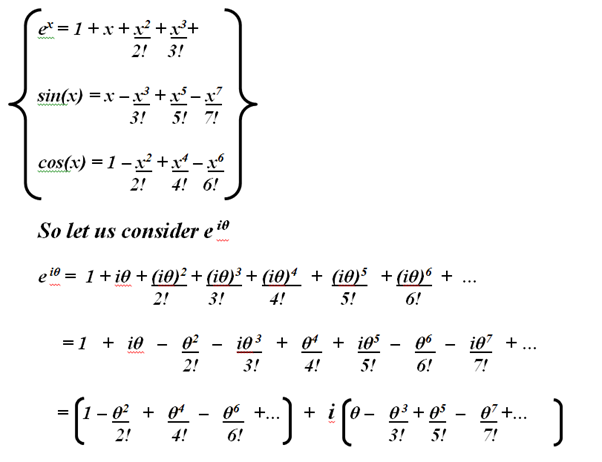
Take IDEA 2, and put it in a Calculus 2 class. Everything that the precalculus class remains, but now have the paired students prove the Euler’s Formula using Taylor Series. Guide them through using the Taylor Series to figure out a Taylor Series representation of , , and . Then ask students to find an expanded Taylor Series of to 12 terms with ellipses, no need to evaluate each term, just the precise term. Give hints such as and to consider and other similar cases. Lastly, ask students to separate the extended series in a way that mimics using ellipses to shows the series goes to infinity. What they should find is something like this:
Look familiar? Well it is the addition of two Taylor Series that represent Sin(x) and Cos(x). This is the last connection students need to make. Give hints to look through their notes to see why the “a” and “b” in the imaginary number look so familiar. This, is just one way to prove Euler’s Formula, then you can continue with IDEA 2 until your students prove the angle sum formulas and double angle formulas.
How does this topic extend what your students should have learned in previous courses?
Students in Texas will typically be exposed to the Pythagorean Theorem in 8th grade. At this stage, students use to find a missing side length. Students may also be exposed to Pythagorean triples at this stage. Then at the Geometry level or in a Trigonometry section, students will be exposed to the Pythagorean Identity. The Identity is . I think that this is not fair for students to just learn this identity without connecting it to the Pythagorean Theorem. I think it would be a nice challenge student to solve for this identity by using a right triangle with hypotenuse c so that Sin (θ) = b/c and cos (θ) = a/c, one could then show either and thus or one could show (using the Pythagorean theorem).
From here, students learn about the angle addition and subtraction formulas in Precalculus. This is all that they need to derive the double angle formulas.
This would be a good challenge exercise for students to do in pairs. Sin(2θ) = Sin(θ + θ), Cos(2 θ) = Cos(θ + θ), Tan(2θ) = Tan(θ + θ). Now we can apply the angle sum formula where both angles are equal:
Sin(2θ) = sin(θ)cos(θ) + cos(θ)sin(θ) = 2sin(θ)cos(θ)
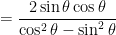
Cos(2θ) = cos(θ)cos(θ) – sin(θ)sin(θ) = (We use a Pythagorean Identity here)
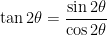
Tan(2θ) =
Bonus challenge, use Sin(2θ) and Cos(2θ) to get Tan(2θ). Well, if , then
The derivations are straight forward, and I believe that many students get off the hook by not being exposed to deriving many trigonometric identities and taking them as facts. This is in the grasp of an average 10th to 12th grader.
What are the contributions of various cultures to this topic?
I have included four links that talk about the history of Trigonometry. It seemed that ancient societies would need to know about the Pythagorean Identities and the angles sum formulas to know the double angle formulas. Here is our problem, it’s hard to know who “did it first?” and when “did they know it?”. Mathematical proofs and history were not kept as neatly written record but as oral traditions, entertainment, hobbies, and professions. The truth is that from my reading, many cultures understood the double angle formula to some extent independently of each other, even if there was no formal proof or record of it. Looking back at my answer to B2, it seems that the double angle formula is almost like a corollary to knowing the angle sum formulas, and thus to understand one could imply knowledge of the other. Perhaps, it was just not deemed important to put the double angle formula into a category of its own. Many of the people who figured out these identities were doing it because they were astronomers, navigators, or carpenters (construction). Triangles and circles are very important to these professions. Knowledge of the angle sum formula was known in Ancient China, Ancient India, Egypt, Greece (originally in the form of broken chords theorem by Archimedes), and the wider “Medieval Islamic World”. Do note that that Egypt, Greece, and the Medieval Islamic World were heavily intertwined as being on the east side of the Mediterranean and being important centers of knowledge (i.e. Library of Alexandria.) Here is the thing, their knowledge was not always demonstrated in the same way as we know it today. Some cultures did have functions similar to the modern trigonometric functions today, and an Indian mathematician, Mādhava of Sangamagrāma, figured out the Taylor Series approximations of those functions in the 1400’s. Greece and China for example relayed heavily on displaying knowledge of trigonometry in ideas of the length of lines (rods) as manifestations of variables and numbers. Ancient peoples didn’t have calculators, and they may have defined trigonometric functions in a way that would be correct such as the “law of sines” or a “Taylor series”, but still relied on physical “sine tables” to find a numerical representation of sine to n numbers after the decimal point. How we think of Geometry and Trigonometry today may have come from Descartes’ invention of the Cartesian plane as a convenient way to bridge Algebra and Geometry.
References:
https://www.mathpages.com/home/kmath205/kmath205.htmhttps://en.wikipedia.org/wiki/History_of_trigonometryhttps://www.ima.umn.edu/press-room/mumford-and-pythagoras-theorem
In my capstone class for future secondary math teachers, I ask my students to come up with ideas for engaging their students with different topics in the secondary mathematics curriculum. In other words, the point of the assignment was not to devise a full-blown lesson plan on this topic. Instead, I asked my students to think about three different ways of getting their students interested in the topic in the first place.
I plan to share some of the best of these ideas on this blog (after asking my students’ permission, of course).
This student submission comes from my former student Daniel Adkins. His topic, from Precalculus: deriving the double angle formulas for sine, cosine, and tangent.
How does this topic extend what your students should have already learned?
A major factor that simplifies deriving the double angle formulas is recalling the trigonometric identities that help students “skip steps.” This is true especially for the Sum formulas, so a brief review of these formulas in any fashion would help students possibly derive the equations on their own in some cases. Listed below are the formulas that can lead directly to the double angle formulas.
A list of the formulas that students can benefit from recalling:
Sum Formulas:
sin(a+b) = sin(a)cos(b) + cos(a)sin(b)
cos(a+b) = cos(a)cos(b) – sin(a)sin(b)
tan(a+b) = [tan(a) +tan(b)] / [1-tan(a)tan(b)]
Pythagorean Identity:
Sin2 (a) + Cos2(a) = 1
This leads to the next topic, an activity for students to attempt the equation on their own.
How could you as a teacher create an activity or project that involves your topic?
I’m a firm believer that the more often a student can learn something of their own accord, the better off they are. Providing the skeletal structure of the proofs for the double angle formulas of sine, cosine, and tangent might be enough to help students reach the formulas themselves. The major benefit of this is that, even though these are simple proofs, they have a lot of variance on how they may be presented to students and how “hands on” the activity can be.
I have an example worksheet demonstrating this with the first two double angle formulas attached below. This is in extremely hands on format that can be given to students with the formulas needed in the top right corner and the general position where these should be inserted. If needed the instructor could take this a step further and have the different Pythagorean Identities already listed out (I.e. Cos2(a) = 1 – Sin2(a), Sin2(a) = 1 – Cos2(a)) to emphasize that different formats could be needed. This is an extreme that wouldn’t take students any time to reach the conclusions desired. Of course a lot of this information could be dropped to increase the effort needed to reach the conclusion.
A major benefit with this also is that even though they’re simple, students will still feel extremely rewarded from succeeding on this paper on their own, and thus would be more intrinsically motivated towards learning trig identities.
How can Technology be used to effectively engage students with this topic?
When it comes to technology in the classroom, I tend to lean more on the careful side. I know me as a person/instructor, and I know I can get carried away and make a mess of things because there was so much excitement over a new toy to play with. I also know that the technology can often detract from the actual math itself, but when it comes to trigonometry, and basically any form of geometric mathematics, it’s absolutely necessary to have a visual aid, and this is where technology excels.
The Wolfram Company has provided hundreds of widgets for this exact purpose, and below, you’ll find one attached that demonstrates that sin(2a) appears to be equal to its identity 2cos(a)sin(a). This is clearly not a rigorous proof, but it will help students visualize how these formulas interact with each other and how they may be similar. The fact that it isn’t rigorous may even convince students to try to debunk it. If you can make a student just irritated enough that they spend a few minutes trying to find a way to show you that you’re wrong, then you’ve done your job in that you’ve convinced them to try mathematics for a purpose.
After all, at the end of the day, it doesn’t matter how you begin your classroom, or how you engage your students, what matters is that they are engaged, and are willing to learn.
In this series, I’m compiling some of the quips and one-liners that I’ll use with my students to hopefully make my lessons more memorable for them.
Sometimes, I’ll expect students to learn and master operations that cancel. For example, in Precalculus, I want my students to know the sum-to-product trigonometric identities
,
,
,
.
These can be helpful for solving trigonometric equations. For example, to solve , we have
for integers .
However, I also want my students to know the product-to-sum trigonometric identities
,
,
.
These are useful when computing certain definite integrals (especially related to Fourier series). For example, if are both integers, then
.
This integral and other similar integrals are necessary to find the formula for the coefficients in a Fourier series.
In other words, sometimes I’ll want my students to convert a product into a sum. Other times, I’ll want my students to convert a sum into a product.
To help this sink in, I’ll tell my students, “To quote the great philosopher: Sometimes you gotta know when to hold ’em, know when to fold them.”
However, when I made this joke recently, a student innocently asked, “What great philosopher said that?” I turned the question back to my class, but not one of my class of millennials knew the answer. One person came close with his answer of “Willie” — wrong answer but correct genre and time frame. (Somebody else answered Socrates.)
So that my students actually learn something important in my class, here’s the cultural reference:
This antiderivative has arguable the highest ratio of “really hard to compute” to “really easy to write”:
As we’ve seen in this series, the answer is
It turns out that this can be simplified somewhat as long as and . I’ll use the trig identity
When I apply this trig identity for and , I obtain
.
So we can conclude that
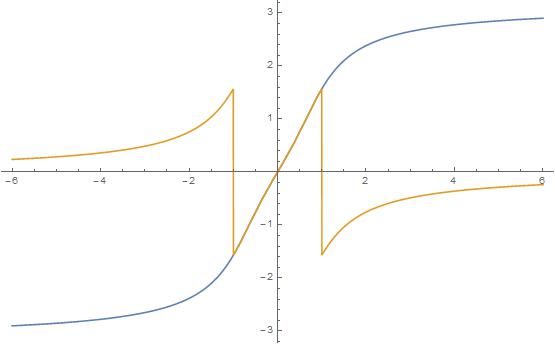
for some integer that depends on . The is important, as a cursory look reveals that and have different graphs. (The vertical lines in the orange graph indicate where the right-hand side is undefined when or .
The two graphs coincide when but differ otherwise. However, it appears that the two graphs differ by a constant. Indeed, if I subtract from the orange graph if and add to the orange graph if , then they match:
So, evidently
if ,
if ,
if .
So as long as and , this constant , , or can be absorbed into the constant :
.
However, a picture may be persuasive but is not a proof, and there are some subtle issues with this simplification. I’ll discuss these further details in tomorrow’s post.
Some husbands try to impress their wives by lifting extremely heavy objects or other extraordinary feats of physical prowess.
That will never happen in the Quintanilla household in a million years.
But she was impressed that I broke an impasse in her research and resolved a discrepancy between Mathematica 4 and Mathematica 8 by finding the following integral by hand in less than an hour:
In this series, I’ll explore different ways of evaluating this integral.I begin by adjusting the range of integration:
,
where
,
,
.
I’ll begin with and apply the substitution , or . Then , and the endpoints change from to . Therefore,
.
Next, we use the periodic property for both sine and cosine — and — to rewrite as
.
Changing the dummy variable from back to , we have
.
Therefore, we can combined into a single integral:
Next, we work on the middle integral . We use the substitution , or , so that . Then the interval of integration changes from to , so that
.
Next, we use the trigonometric identities
,
,
so that the last integral becomes
On the line above, I again replaced the dummy variable of integration from to . We see that , and so
I’ll continue with the evaluation of this integral in tomorrow’s post.
In a recent class with my future secondary math teachers, we had a fascinating discussion concerning how a teacher should respond to the following question from a student:
Is it ever possible to prove a statement or theorem by proving a special case of the statement or theorem?
Usually, the answer is no. In this series of posts, we’ve seen that a conjecture could be true for the first 40 cases or even the first cases yet not always be true. We’ve also explored the computational evidence for various unsolved problems in mathematics, noting that even this very strong computational evidence, by itself, does not provide a proof for all possible cases.
However, there are plenty of examples in mathematics where it is possible to prove a theorem by first proving a special case of the theorem. For the remainder of this series, I’d like to list, in no particular order, some common theorems used in secondary mathematics which are typically proved by first proving a special case.
However, we see that what I’ve called Lemma 3, often called a cofunction identity, can be considered a special case of Theorem 2. However, this is not circular logic since the cofunction identities can be proven without appealing to Theorems 1 and 2.
We’ve seen in this series that blinding using the arcsine function on a calculator is insufficient for finding all solutions of an equation like . In today’s post, I discuss one of the first places that this becomes practically important: solving the ambiguous case of solving a triangle given two sides and an nonincluded angle.
A note on notation: when solving for the parts of , will be the length of the side opposite , will be the length of the side opposite , and will be the length of the side opposite angle . Also will be the measure of , will be measure of , and will be the measure of . Modern textbooks tend not to use , , and for these kinds of problems, for which I have only one response:
Why does an SSA triangle produce an ambiguous case (unlike the SAS, SSS, or ASA cases)? Here’s a possible problem that has exactly one solution:
Solve if , , and .
A student new to the Law of Sines might naively start solving the problem by drawing something like this:
Of course, that’s an inaccurate picture that isn’t drawn to scale. A more accurate picture would look like this:
Notice that the red circle intersects the dashed black line at exactly one point. Therefore, we know that there will be exactly one solution for this case. We also note that the circle would have intersected the black dashed line had the dashed line been extended to the left. This will become algebraically clear in the solution below.
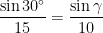
Of course, students should not be expected to make a picture this accurately when doing homework. Fortunately, this impossibility naturally falls out of the equation when using the Law of Sines:
At this point, the natural inclination of a student is to pop out the calculator and find .
This is incorrect logic that, as we’ll see tomorrow, nevertheless leads to the correct conclusion. This is incorrect logic because there are two angles between and with a sine of . There is one solution in the first quadrant (the unique answer specified by arcsine), and there is another answer in the second quadrant — which is between and and hence not a permissible value of arcsine. Let me demonstrate this in three different ways.
First, let’s look at the graph of (where, for convenience, the units of the axis are in degrees). This graph intersects the line in two different places between and . This does not violate the way that arcsine was defined — arcsine was defined using the restricted domain , or in degrees.
Second, let’s look at drawing angles in standard position. The angle in the second quadrant is clearly the reflection of the angle in the first quadrant through the axis.
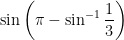
Third, let’s use a trigonometric identity to calculate :
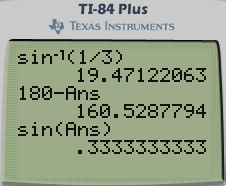
Fourth, and perhaps most convincingly for modern students (to my great frustration), let’s use a calculator:
All this to say, blinding computing uses incorrect logic when solving this problem.
Tomorrow, we’ll examine what happens when we try to solve the triangle using these two different solutions for .
In this series of posts, I explore properties of complex numbers that explain some surprising answers to exponential and logarithmic problems using a calculator (see video at the bottom of this post). These posts form the basis for a sequence of lectures given to my future secondary teachers.
To begin, we recall that the trigonometric form of a complex number is
where and , with in the appropriate quadrant. As noted before, this is analogous to converting from rectangular coordinates to polar coordinates.
There’s a shorthand notation for the right-hand side () that I’ll justify later in this series.
Why is this important? When students first learn to multiply complex numbers like and , they are taught to just distribute (or, using the nomenclature that I don’t like, FOIL it out):
.
The trigonometric form of a complex number permits a geometric interpretation of multiplication, given in the following theorem.
Theorem..
Proof. As above, we distribute (except for the and terms):
.
When actually doing this in class, the big conceptual jump for students is the last step. So I make a big song-and-dance routine out of this:
Cosine of the first times cosine of the second minus sine of the first times sine of the second… where have I seen this before?
The idea is for my students to search deep into their mathematical memories until they recall the appropriate trig identity.
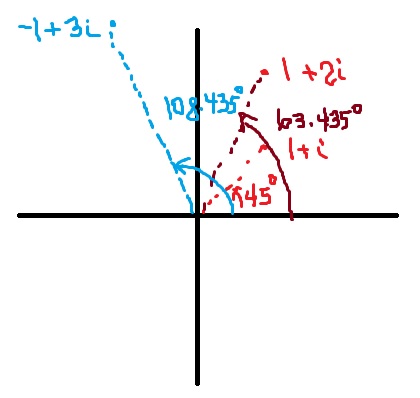
For the original multiplication problem, we see that
Therefore, the product of $1+i$ and $1+2i$ will be a distance of $\sqrt{2} \cdot \sqrt{5} = \sqrt{10}$ from the origin, and the angle from the positive real axis will be . Indeed,
.
For completeness, here’s the movie that I use to engage my students when I begin this sequence of lectures.

and
,
, and
near
(or, more generally, their Taylor series approximations)
substitution


 with the Sun at the origin, under general relativity is
  ,
, ,
,  ,
,  ,
,  is the gravitational constant of the universe,
  is the mass of the planet,
  is the mass of the Sun,
  is the constant angular momentum of the planet, and
  is the speed of light.
 is very small and
  is quite large, so that
  is very small indeed. We will use the two approximations
 ;
; .
.  .
. :
:![= \displaystyle \frac{1}{\alpha} \left[1 + \epsilon \cos \theta + \frac{ \delta\epsilon}{\alpha} \theta \sin \theta \right]](https://s0.wp.com/latex.php?latex=%3D++%5Cdisplaystyle+%5Cfrac%7B1%7D%7B%5Calpha%7D+%5Cleft%5B1+%2B+%5Cepsilon+%5Ccos+%5Ctheta+%2B+%5Cfrac%7B+%5Cdelta%5Cepsilon%7D%7B%5Calpha%7D+%5Ctheta+%5Csin+%5Ctheta+%5Cright%5D&bg=ffffff&fg=000000&s=0&c=20201002)
![= \displaystyle \frac{1}{\alpha} \left[1 + \epsilon \left(\cos \theta + \frac{ \delta}{\alpha} \theta \sin \theta \right) \right]](https://s0.wp.com/latex.php?latex=%3D++%5Cdisplaystyle+%5Cfrac%7B1%7D%7B%5Calpha%7D+%5Cleft%5B1+%2B+%5Cepsilon+%5Cleft%28%5Ccos+%5Ctheta+%2B+%5Cfrac%7B+%5Cdelta%7D%7B%5Calpha%7D+%5Ctheta+%5Csin+%5Ctheta+%5Cright%29+%5Cright%5D&bg=ffffff&fg=000000&s=0&c=20201002)
![= \displaystyle \frac{1}{\alpha} \left[1 + \epsilon \left(\cos \theta \cdot 1 + \sin \theta \cdot \frac{ \delta \theta}{\alpha} \right) \right]](https://s0.wp.com/latex.php?latex=%3D++%5Cdisplaystyle+%5Cfrac%7B1%7D%7B%5Calpha%7D+%5Cleft%5B1+%2B+%5Cepsilon+%5Cleft%28%5Ccos+%5Ctheta+%5Ccdot+1+%2B+%5Csin+%5Ctheta+%5Ccdot+%5Cfrac%7B+%5Cdelta+%5Ctheta%7D%7B%5Calpha%7D++%5Cright%29+%5Cright%5D&bg=ffffff&fg=000000&s=0&c=20201002)
![\approx \displaystyle \frac{1}{\alpha} \left[1 + \epsilon \left(\cos \theta \cdot \cos \frac{\delta \theta}{\alpha} + \sin \theta \cdot \sin \frac{ \delta \theta}{\alpha} \right) \right]](https://s0.wp.com/latex.php?latex=%5Capprox++%5Cdisplaystyle+%5Cfrac%7B1%7D%7B%5Calpha%7D+%5Cleft%5B1+%2B+%5Cepsilon+%5Cleft%28%5Ccos+%5Ctheta+%5Ccdot+%5Ccos+%5Cfrac%7B%5Cdelta+%5Ctheta%7D%7B%5Calpha%7D+%2B+%5Csin+%5Ctheta+%5Ccdot+%5Csin+%5Cfrac%7B+%5Cdelta+%5Ctheta%7D%7B%5Calpha%7D++%5Cright%29+%5Cright%5D&bg=ffffff&fg=000000&s=0&c=20201002)
![\approx \displaystyle \frac{1}{\alpha} \left[1 + \epsilon \cos \left( \theta - \frac{\delta \theta}{\alpha} \right) \right]](https://s0.wp.com/latex.php?latex=%5Capprox++%5Cdisplaystyle+%5Cfrac%7B1%7D%7B%5Calpha%7D+%5Cleft%5B1+%2B+%5Cepsilon+%5Ccos+%5Cleft%28+%5Ctheta+-+%5Cfrac%7B%5Cdelta+%5Ctheta%7D%7B%5Calpha%7D++%5Cright%29+%5Cright%5D&bg=ffffff&fg=000000&s=0&c=20201002) .
. . Have Precalculus students suspend their questions about where it comes from and what it is used for. This is not something they would use in their class. Reassure them that for what they will do, all they need to understand is imaginary numbers, multiplying imaginary numbers, and laws of exponents. Have them plug in x = A + B and simplify the right-hand side of the equation so that we get:
  where
where  and
and  are two real numbers. The goal here is to get
  . All the steps to get to this point is Algebra, nothing out of their grasp. Now, the next part is to really get their brains going about what meaning we can make of this. If they are struggling, have them think about the implications of two imaginary numbers being equal; the coefficient of the real parts and imaginary parts must be equal to each other. Lastly, ask them if these equations seem familiar, where are they from, and what are they called…the angle sum formulas. From here, this can lead into what if x=2A? Students will either brute force the formula again, and others will realize x = A + A and plug it in to the equation they just derived and simplify. This idea is a 2-in-1 steal for the angle sum formulas and double angle formulas. It’s biggest downside is this is for Sin(2θ) and Cos(2θ).
IDEA 3:
Take IDEA 2, and put it in a Calculus 2 class. Everything that the precalculus class remains, but now have the paired students prove the Euler’s Formula using Taylor Series. Guide them through using the Taylor Series to figure out a Taylor Series representation of
. All the steps to get to this point is Algebra, nothing out of their grasp. Now, the next part is to really get their brains going about what meaning we can make of this. If they are struggling, have them think about the implications of two imaginary numbers being equal; the coefficient of the real parts and imaginary parts must be equal to each other. Lastly, ask them if these equations seem familiar, where are they from, and what are they called…the angle sum formulas. From here, this can lead into what if x=2A? Students will either brute force the formula again, and others will realize x = A + A and plug it in to the equation they just derived and simplify. This idea is a 2-in-1 steal for the angle sum formulas and double angle formulas. It’s biggest downside is this is for Sin(2θ) and Cos(2θ).
IDEA 3:
Take IDEA 2, and put it in a Calculus 2 class. Everything that the precalculus class remains, but now have the paired students prove the Euler’s Formula using Taylor Series. Guide them through using the Taylor Series to figure out a Taylor Series representation of  , and
, and  . Then ask students to find an expanded Taylor Series of to 12 terms with ellipses, no need to evaluate each term, just the precise term. Give hints such as
  and to consider
  and other similar cases. Lastly, ask students to separate the extended series in a way that mimics
  using ellipses to shows the series goes to infinity. What they should find is something like this:
 to find a missing side length. Students may also be exposed to Pythagorean triples at this stage. Then at the Geometry level or in a Trigonometry section, students will be exposed to the Pythagorean Identity. The Identity is
  . I think that this is not fair for students to just learn this identity without connecting it to the Pythagorean Theorem. I think it would be a nice challenge student to solve for this identity by using a right triangle with hypotenuse c so that Sin (θ) = b/c and cos (θ) = a/c, one could then show either
  and thus
  or one could show
  (using the Pythagorean theorem).
From here, students learn about the angle addition and subtraction formulas in Precalculus. This is all that they need to derive the double angle formulas.
(using the Pythagorean theorem).
From here, students learn about the angle addition and subtraction formulas in Precalculus. This is all that they need to derive the double angle formulas.






 Bonus challenge, use Sin(2θ) and Cos(2θ) to get Tan(2θ). Well, if
  , then


 ,
, ,
, ,
, .
. , we have


 for integers
  .
.![\cos x \cos y = \displaystyle \frac{1}{2} [\cos(x+y) + \cos(x-y) ]](https://s0.wp.com/latex.php?latex=%5Ccos+x+%5Ccos+y+%3D+%5Cdisplaystyle+%5Cfrac%7B1%7D%7B2%7D+%5B%5Ccos%28x%2By%29+%2B+%5Ccos%28x-y%29+%5D&bg=ffffff&fg=000000&s=0&c=20201002) ,
,![\sin x \sin y = \displaystyle \frac{1}{2} [\cos(x-y) - \cos(x+y) ]](https://s0.wp.com/latex.php?latex=%5Csin+x+%5Csin+y+%3D+%5Cdisplaystyle+%5Cfrac%7B1%7D%7B2%7D+%5B%5Ccos%28x-y%29+-+%5Ccos%28x%2By%29+%5D&bg=ffffff&fg=000000&s=0&c=20201002) ,
,![\sin x \cos y = \displaystyle \frac{1}{2} [\sin(x+y) + \sin(x-y) ]](https://s0.wp.com/latex.php?latex=%5Csin+x+%5Ccos+y+%3D+%5Cdisplaystyle+%5Cfrac%7B1%7D%7B2%7D+%5B%5Csin%28x%2By%29+%2B+%5Csin%28x-y%29+%5D&bg=ffffff&fg=000000&s=0&c=20201002) .
. are both integers, then
![\displaystyle \int_0^{2\pi} \cos mx \cos nx \, dx = \displaystyle \int_0^{2\pi} \frac{1}{2} \left[\cos([m+n]x) + \cos([m-n])x) \right] \, dx](https://s0.wp.com/latex.php?latex=%5Cdisplaystyle+%5Cint_0%5E%7B2%5Cpi%7D+%5Ccos+mx+%5Ccos+nx+%5C%2C+dx+%3D+%5Cdisplaystyle+%5Cint_0%5E%7B2%5Cpi%7D+%5Cfrac%7B1%7D%7B2%7D+%5Cleft%5B%5Ccos%28%5Bm%2Bn%5Dx%29+%2B+%5Ccos%28%5Bm-n%5D%29x%29+%5Cright%5D+%5C%2C+dx&bg=ffffff&fg=000000&s=0&c=20201002)
![= \left[ \displaystyle \frac{\sin([m+n]x)}{2(m+n)} + \frac{\sin([m-n]x)}{2(m-n)} \right]^{2\pi}_0](https://s0.wp.com/latex.php?latex=%3D+%5Cleft%5B+%5Cdisplaystyle+%5Cfrac%7B%5Csin%28%5Bm%2Bn%5Dx%29%7D%7B2%28m%2Bn%29%7D+%2B%C2%A0+%5Cfrac%7B%5Csin%28%5Bm-n%5Dx%29%7D%7B2%28m-n%29%7D+%5Cright%5D%5E%7B2%5Cpi%7D_0&bg=ffffff&fg=000000&s=0&c=20201002)
![= \displaystyle \frac{\sin(2[m+n]\pi) - \sin 0}{2(m+n)} + \frac{\sin(2[m-n]\pi) - \sin 0}{2(m-n)}](https://s0.wp.com/latex.php?latex=%3D+%5Cdisplaystyle+%5Cfrac%7B%5Csin%282%5Bm%2Bn%5D%5Cpi%29+-+%5Csin+0%7D%7B2%28m%2Bn%29%7D+%2B%C2%A0+%5Cfrac%7B%5Csin%282%5Bm-n%5D%5Cpi%29+-+%5Csin+0%7D%7B2%28m-n%29%7D&bg=ffffff&fg=000000&s=0&c=20201002) .
.


 and
and  . I’ll use the trig identity
 and
and  , I obtain
![\tan \left[ \tan^{-1} ( x\sqrt{2} - 1 ) + \tan^{-1}( x \sqrt{2} + 1) \right] = \displaystyle \frac{x \sqrt{2} - 1 + x \sqrt{2} + 1}{1 - (x\sqrt{2} - 1)(x\sqrt{2} + 1)}](https://s0.wp.com/latex.php?latex=%5Ctan+%5Cleft%5B+%5Ctan%5E%7B-1%7D+%28+x%5Csqrt%7B2%7D+-+1+%29+%2B+%5Ctan%5E%7B-1%7D%28+x+%5Csqrt%7B2%7D+%2B+1%29+%5Cright%5D+%3D+%5Cdisplaystyle+%5Cfrac%7Bx+%5Csqrt%7B2%7D+-+1+%2B+x+%5Csqrt%7B2%7D+%2B+1%7D%7B1+-+%28x%5Csqrt%7B2%7D+-+1%29%28x%5Csqrt%7B2%7D+%2B+1%29%7D&bg=ffffff&fg=000000&s=0&c=20201002)


 .
.
 . The
. The  is important, as a cursory look reveals that
  and
and  have different graphs. (The vertical lines in the orange graph indicate where the right-hand side is undefined when
  or
or  .
.
 but differ otherwise. However, it appears that the two graphs differ by a constant. Indeed, if I subtract
  from the orange graph if
  and add
  , then they match: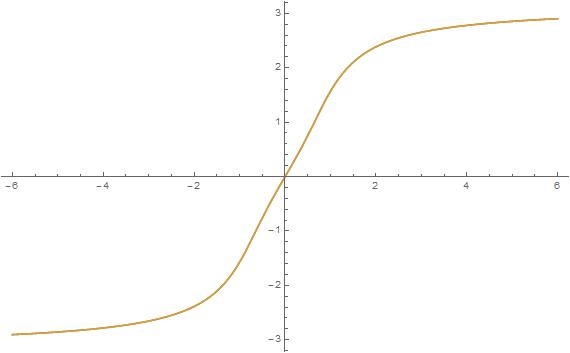
 if
if  if
if  if
if  .
. ,
,  , or
, or  :
: .
.
 ,
, ,
, ,
, .
. and apply the substitution
  , or
, or  . Then
  , and the endpoints change from
  to
to  . Therefore,
 .
. and
and  — to rewrite
  .
. back to
  .
. into a single integral:


 . We use the substitution
  , or
, or  , so that
  to
to  , so that
 .
. ,
, ,
,


 , and so

 cases yet not always be true. We’ve also explored the computational evidence for various unsolved problems in mathematics, noting that even this very strong computational evidence, by itself, does not provide a proof for all possible cases.


![\sin(\alpha + \beta) = \cos(\pi/2 - [\alpha + \beta])](https://s0.wp.com/latex.php?latex=%5Csin%28%5Calpha+%2B+%5Cbeta%29+%3D+%5Ccos%28%5Cpi%2F2+-+%5B%5Calpha+%2B+%5Cbeta%5D%29&bg=ffffff&fg=000000&s=0&c=20201002) by Lemma 4
by Lemma 4![= \cos([\pi/2 - \alpha] - \beta)](https://s0.wp.com/latex.php?latex=%3D+%5Ccos%28%5B%5Cpi%2F2+-+%5Calpha%5D+-+%5Cbeta%29&bg=ffffff&fg=000000&s=0&c=20201002)
 by Lemma 1
 by Lemmas 3 and 4.
![\sin(\alpha - \beta) = \cos(\pi/2 - [\alpha - \beta])](https://s0.wp.com/latex.php?latex=%5Csin%28%5Calpha+-+%5Cbeta%29+%3D+%5Ccos%28%5Cpi%2F2+-+%5B%5Calpha+-+%5Cbeta%5D%29&bg=ffffff&fg=000000&s=0&c=20201002) by Lemma 4
by Lemma 4![= \cos([\pi/2 - \alpha] + \beta)](https://s0.wp.com/latex.php?latex=%3D+%5Ccos%28%5B%5Cpi%2F2+-+%5Calpha%5D+%2B+%5Cbeta%29&bg=ffffff&fg=000000&s=0&c=20201002)
 by Lemma 2
 by Lemmas 3 and 4.
 . In today’s post, I discuss one of the first places that this becomes practically important: solving the ambiguous case of solving a triangle given two sides and an nonincluded angle.
 ,
,  ,
,  , and
, and  will be measure of
  will be the measure of
  . Modern textbooks tend not to use
 ,
,  , and
, and  .
.




 .
.
 and
and  with a sine of
  . There is one solution in the first quadrant (the unique answer specified by arcsine), and there is another answer in the second quadrant — which is between
  and
and  (where, for convenience, the units of the
  axis are in degrees). This graph intersects the line
  in two different places between
 ![[-\pi/2,\pi/2]](https://s0.wp.com/latex.php?latex=%5B-%5Cpi%2F2%2C%5Cpi%2F2%5D&bg=ffffff&fg=000000&s=0&c=20201002) , or
, or ![[-90^\circ, 90^\circ]](https://s0.wp.com/latex.php?latex=%5B-90%5E%5Ccirc%2C+90%5E%5Ccirc%5D&bg=ffffff&fg=000000&s=0&c=20201002) in degrees.
in degrees.
 axis.
axis.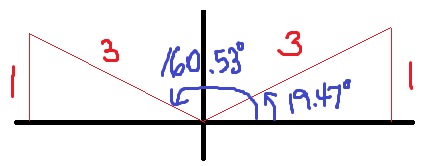
 :
:


 is
is
 and
and  , with
  in the appropriate quadrant. As noted before, this is analogous to converting from rectangular coordinates to polar coordinates.
 ) that I’ll justify later in this series.
 and
and  , they are taught to just distribute (or, using the nomenclature that I don’t like, FOIL it out):
 .
.![\left[ r_1 (\cos \theta_1 + i \sin \theta_1) \right] \cdot \left[ r_2 (\cos \theta_2 + i \sin \theta_2) \right] = r_1 r_2 (\cos [\theta_1+\theta_2] + i \sin [\theta_1+\theta_2])](https://s0.wp.com/latex.php?latex=%5Cleft%5B+r_1+%28%5Ccos+%5Ctheta_1+%2B+i+%5Csin+%5Ctheta_1%29+%5Cright%5D+%5Ccdot+%5Cleft%5B+r_2+%28%5Ccos+%5Ctheta_2+%2B+i+%5Csin+%5Ctheta_2%29+%5Cright%5D+%3D+r_1+r_2+%28%5Ccos+%5B%5Ctheta_1%2B%5Ctheta_2%5D+%2B+i+%5Csin+%5B%5Ctheta_1%2B%5Ctheta_2%5D%29&bg=ffffff&fg=000000&s=0&c=20201002) .
. and
and  terms):
![\left[ r_1 (\cos \theta_1 + i \sin \theta_1) \right] \cdot \left[ r_2 (\cos \theta_2 + i \sin \theta_2) \right]](https://s0.wp.com/latex.php?latex=%5Cleft%5B+r_1+%28%5Ccos+%5Ctheta_1+%2B+i+%5Csin+%5Ctheta_1%29+%5Cright%5D+%5Ccdot+%5Cleft%5B+r_2+%28%5Ccos+%5Ctheta_2+%2B+i+%5Csin+%5Ctheta_2%29+%5Cright%5D+&bg=ffffff&fg=000000&s=0&c=20201002)

![= r_1 r_2 (\cos \theta_1 \cos \theta_2 - \sin \theta_1 \sin \theta_2 + i[ \sin \theta_1 \cos \theta_2 + \cos \theta_1 \sin \theta_2])](https://s0.wp.com/latex.php?latex=%3D+r_1+r_2+%28%5Ccos+%5Ctheta_1+%5Ccos+%5Ctheta_2+-+%5Csin+%5Ctheta_1+%5Csin+%5Ctheta_2+%2B+i%5B+%5Csin+%5Ctheta_1+%5Ccos+%5Ctheta_2+%2B+%5Ccos+%5Ctheta_1+%5Csin+%5Ctheta_2%5D%29&bg=ffffff&fg=000000&s=0&c=20201002)
![= r_1 r_2 (\cos [\theta_1+\theta_2] + i \sin [\theta_1+\theta_2])](https://s0.wp.com/latex.php?latex=%3D+r_1+r_2+%28%5Ccos+%5B%5Ctheta_1%2B%5Ctheta_2%5D+%2B+i+%5Csin+%5B%5Ctheta_1%2B%5Ctheta_2%5D%29&bg=ffffff&fg=000000&s=0&c=20201002) .
.
![1 + 2i = \sqrt{5} \left( \cos[\tan^{-1} 2] + i \sin[\tan^{-1} 2] \right) \approx \sqrt{5} \left( \cos 63.435^\circ + i \sin 63.435^\circ \right)](https://s0.wp.com/latex.php?latex=1+%2B+2i+%3D+%5Csqrt%7B5%7D+%5Cleft%28+%5Ccos%5B%5Ctan%5E%7B-1%7D+2%5D+%2B+i+%5Csin%5B%5Ctan%5E%7B-1%7D+2%5D+%5Cright%29+%5Capprox+%5Csqrt%7B5%7D+%5Cleft%28+%5Ccos+63.435%5E%5Ccirc+%2B+i+%5Csin+63.435%5E%5Ccirc+%5Cright%29&bg=ffffff&fg=000000&s=0&c=20201002)
 . Indeed,
 .
.
 Mean Green Math