
One of my guilty pleasures in the 1990s, when I was far too old to be watching children’s cartoons, was the fantastic show “Pinky and the Brain.” In the clip below, the Brain tells a scary campfire story. (Well, it’s about math, and what’s scarier than math?)
Tag: sine
The antiderivative of 1/(x^4+1): Part 2
This antiderivative has arguable the highest ratio of “really hard to compute” to “really easy to write”:

To compute this integral, I will use the technique of partial fractions. This requires factoring the denominator over the real numbers, which can be accomplished by finding the roots of the denominator. In other words, I need to solve

or

I switched to the letter 

where 

By De Moivre’s Theorem, I obtain

Matching terms, I obtain the two equations


or


or

This yields the four solutions
![z = 1 \left[ \cos \displaystyle \frac{\pi}{4} + i \sin \frac{\pi}{4} \right] = \displaystyle \frac{\sqrt{2}}{2} + i \frac{\sqrt{2}}{2}](https://s0.wp.com/latex.php?latex=z+%3D+1+%5Cleft%5B+%5Ccos+%5Cdisplaystyle+%5Cfrac%7B%5Cpi%7D%7B4%7D+%2B+i+%5Csin+%5Cfrac%7B%5Cpi%7D%7B4%7D+%5Cright%5D+%3D+%5Cdisplaystyle+%5Cfrac%7B%5Csqrt%7B2%7D%7D%7B2%7D+%2B+i+%5Cfrac%7B%5Csqrt%7B2%7D%7D%7B2%7D&bg=ffffff&fg=000000&s=0&c=20201002)
![z = 1 \left[ \cos \displaystyle \frac{3\pi}{4} + i \sin \frac{3\pi}{4} \right] = -\displaystyle \frac{\sqrt{2}}{2} + i \frac{\sqrt{2}}{2}](https://s0.wp.com/latex.php?latex=z+%3D+1+%5Cleft%5B+%5Ccos+%5Cdisplaystyle+%5Cfrac%7B3%5Cpi%7D%7B4%7D+%2B+i+%5Csin+%5Cfrac%7B3%5Cpi%7D%7B4%7D+%5Cright%5D+%3D+-%5Cdisplaystyle+%5Cfrac%7B%5Csqrt%7B2%7D%7D%7B2%7D+%2B+i+%5Cfrac%7B%5Csqrt%7B2%7D%7D%7B2%7D&bg=ffffff&fg=000000&s=0&c=20201002)
![z = 1 \left[ \cos \displaystyle \frac{5\pi}{4} + i \sin \frac{5\pi}{4} \right] = -\displaystyle \frac{\sqrt{2}}{2} - i \frac{\sqrt{2}}{2}](https://s0.wp.com/latex.php?latex=z+%3D+1+%5Cleft%5B+%5Ccos+%5Cdisplaystyle+%5Cfrac%7B5%5Cpi%7D%7B4%7D+%2B+i+%5Csin+%5Cfrac%7B5%5Cpi%7D%7B4%7D+%5Cright%5D+%3D+-%5Cdisplaystyle+%5Cfrac%7B%5Csqrt%7B2%7D%7D%7B2%7D+-+i+%5Cfrac%7B%5Csqrt%7B2%7D%7D%7B2%7D&bg=ffffff&fg=000000&s=0&c=20201002)
![z = 1 \left[ \cos \displaystyle \frac{7\pi}{4} + i \sin \frac{7\pi}{4} \right] = \displaystyle \frac{\sqrt{2}}{2} - i \frac{\sqrt{2}}{2}](https://s0.wp.com/latex.php?latex=z+%3D+1+%5Cleft%5B+%5Ccos+%5Cdisplaystyle+%5Cfrac%7B7%5Cpi%7D%7B4%7D+%2B+i+%5Csin+%5Cfrac%7B7%5Cpi%7D%7B4%7D+%5Cright%5D+%3D+%5Cdisplaystyle+%5Cfrac%7B%5Csqrt%7B2%7D%7D%7B2%7D+-+i+%5Cfrac%7B%5Csqrt%7B2%7D%7D%7B2%7D&bg=ffffff&fg=000000&s=0&c=20201002)
Therefore, the denominator 
![\displaystyle \left(x - \left[ \displaystyle \frac{\sqrt{2}}{2} + i \frac{\sqrt{2}}{2} \right] \right)\left(x - \left[ \displaystyle \frac{\sqrt{2}}{2} - i \frac{\sqrt{2}}{2} \right] \right) \left(x - \left[ -\displaystyle \frac{\sqrt{2}}{2} + i \frac{\sqrt{2}}{2} \right] \right) \left(x - \left[ - \displaystyle \frac{\sqrt{2}}{2} - i \frac{\sqrt{2}}{2} \right] \right)](https://s0.wp.com/latex.php?latex=%5Cdisplaystyle+%5Cleft%28x+-+%5Cleft%5B+%5Cdisplaystyle+%5Cfrac%7B%5Csqrt%7B2%7D%7D%7B2%7D+%2B+i+%5Cfrac%7B%5Csqrt%7B2%7D%7D%7B2%7D+%5Cright%5D+%5Cright%29%5Cleft%28x+-+%5Cleft%5B+%5Cdisplaystyle+%5Cfrac%7B%5Csqrt%7B2%7D%7D%7B2%7D+-+i+%5Cfrac%7B%5Csqrt%7B2%7D%7D%7B2%7D+%5Cright%5D+%5Cright%29+%5Cleft%28x+-+%5Cleft%5B+-%5Cdisplaystyle+%5Cfrac%7B%5Csqrt%7B2%7D%7D%7B2%7D+%2B+i+%5Cfrac%7B%5Csqrt%7B2%7D%7D%7B2%7D+%5Cright%5D+%5Cright%29+%5Cleft%28x+-+%5Cleft%5B+-+%5Cdisplaystyle+%5Cfrac%7B%5Csqrt%7B2%7D%7D%7B2%7D+-+i+%5Cfrac%7B%5Csqrt%7B2%7D%7D%7B2%7D+%5Cright%5D+%5Cright%29&bg=ffffff&fg=000000&s=0&c=20201002)
or
![\displaystyle \left(\left[x - \displaystyle \frac{\sqrt{2}}{2} \right] - i \frac{\sqrt{2}}{2} \right)\left( \left[ x - \displaystyle \frac{\sqrt{2}}{2} \right] + i \frac{\sqrt{2}}{2} \right) \left( \left[ x + \displaystyle \frac{\sqrt{2}}{2} \right] - i \frac{\sqrt{2}}{2} \right) \left( \left[ x + \displaystyle \frac{\sqrt{2}}{2} \right] + i \frac{\sqrt{2}}{2} \right)](https://s0.wp.com/latex.php?latex=%5Cdisplaystyle+%5Cleft%28%5Cleft%5Bx+-+%5Cdisplaystyle+%5Cfrac%7B%5Csqrt%7B2%7D%7D%7B2%7D+%5Cright%5D+-+i+%5Cfrac%7B%5Csqrt%7B2%7D%7D%7B2%7D+%5Cright%29%5Cleft%28+%5Cleft%5B+x+-+%5Cdisplaystyle+%5Cfrac%7B%5Csqrt%7B2%7D%7D%7B2%7D+%5Cright%5D+%2B+i+%5Cfrac%7B%5Csqrt%7B2%7D%7D%7B2%7D+%5Cright%29+%5Cleft%28+%5Cleft%5B+x+%2B+%5Cdisplaystyle+%5Cfrac%7B%5Csqrt%7B2%7D%7D%7B2%7D+%5Cright%5D+-+i+%5Cfrac%7B%5Csqrt%7B2%7D%7D%7B2%7D+%5Cright%29+%5Cleft%28+%5Cleft%5B+x+%2B+%5Cdisplaystyle+%5Cfrac%7B%5Csqrt%7B2%7D%7D%7B2%7D+%5Cright%5D+%2B+i+%5Cfrac%7B%5Csqrt%7B2%7D%7D%7B2%7D+%5Cright%29&bg=ffffff&fg=000000&s=0&c=20201002)
or
![\displaystyle \left(\left[x - \displaystyle \frac{\sqrt{2}}{2} \right]^2 - \left[ i \frac{\sqrt{2}}{2} \right]^2 \right) \left( \left[ x + \displaystyle \frac{\sqrt{2}}{2} \right]^2 - \left[i \frac{\sqrt{2}}{2} \right]^2 \right)](https://s0.wp.com/latex.php?latex=%5Cdisplaystyle+%5Cleft%28%5Cleft%5Bx+-+%5Cdisplaystyle+%5Cfrac%7B%5Csqrt%7B2%7D%7D%7B2%7D+%5Cright%5D%5E2+-+%5Cleft%5B+i+%5Cfrac%7B%5Csqrt%7B2%7D%7D%7B2%7D+%5Cright%5D%5E2+%5Cright%29+%5Cleft%28+%5Cleft%5B+x+%2B+%5Cdisplaystyle+%5Cfrac%7B%5Csqrt%7B2%7D%7D%7B2%7D+%5Cright%5D%5E2+-+%5Cleft%5Bi+%5Cfrac%7B%5Csqrt%7B2%7D%7D%7B2%7D+%5Cright%5D%5E2+%5Cright%29&bg=ffffff&fg=000000&s=0&c=20201002)
or

or

We have thus factored the denominator over the real numbers:

and the technique of partial fractions can be applied.
I’ll continue the calculation of this integral with tomorrow’s post.
Different ways of solving a contest problem (Part 3)
The following problem appeared on the American High School Mathematics Examination (now called the AMC 12) in 1988:
If
, what is
?
When I presented this problem to a group of students, I was pleasantly surprised by the amount of creativity shown when solving this problem.
Yesterday, I presented a solution using a Pythagorean identity, but I was unable to be certain if the final answer was a positive or negative without drawing a picture. Here’s a third solution that also use a Pythagorean trig identity but avoids this difficulty. Again, I begin by squaring both sides.





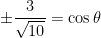
Yesterday, I used the Pythagorean identity again to find 


Unlike the example yesterday, the signs of 


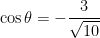

If they’re both positive, then

and if they’re both negative, then

Either way, the answer must be 
This is definitely superior to the solution provided in yesterday’s post, as there’s absolutely no doubt that the product
Different ways of solving a contest problem (Part 2)
The following problem appeared on the American High School Mathematics Examination (now called the AMC 12) in 1988:
If
When I presented this problem to a group of students, I was pleasantly surprised by the amount of creativity shown when solving this problem.
Yesterday, I presented a solution using triangles. Here’s a second solution that I received: begin by squaring both sides and using a Pythagorean trig identity.
We use the Pythagorean identity again to find
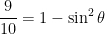

Therefore, we know that

so the answer is either 
 For a contest problem, the above logic makes perfect sense. However, the last step definitely plays to the fact that this was a multiple-choice problem, and the concluding step would not have been possible had
Different ways of solving a contest problem (Part 1)
The following problem appeared on the American High School Mathematics Examination (now called the AMC 12) in 1988:
If
When I presented this problem to a group of students, I was pleasantly surprised by the amount of creativity shown when solving this problem.
Here’s the first solution that I received: draw the appropriate triangles for the angle 

Therefore, the angle

In Quadrant I,

In Quadrant III, 

Either way, we can be certain that 
How I Impressed My Wife: Part 5h
Earlier in this series, I gave three different methods of showing that

Using the fact that  is independent of
  , I’ll now give a fourth method.
 Since is independent of , I can substitute any convenient value of that I want without changing the value of . As shown in previous posts, substituting
  yields the following simplification:
is independent of , I’ll now give a fourth method.Since is independent of , I can substitute any convenient value of that I want without changing the value of . As shown in previous posts, substituting yields the following simplification:



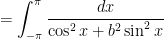

The four roots of the denominator satisfy

So far, I’ve handled the cases 


Factoring the denominator is a bit more complicated if

However, unlike the cases 


Therefore, the four complex roots of the denominator satisfy 


where 

I’ll begin with solving

Matching the real and imaginary parts, we see that


This completely matches the form of the double-angle trig identities


and so the problem reduces to solving
where $\sin \phi = |b|$ and $\cos \phi = \sqrt{1-b^2}$. By De Moivre’s Theorem, I can conclude that the two solutions of this equation are

or

I could re-run this argument to solve 


Therefore, I can factor the denominator as follows:
![u^4 + (4 b^2 - 2) u^2 + 1 = (u - [\sqrt{1-b^2} + i|b|])(u - [\sqrt{1-b^2} - i|b|])](https://s0.wp.com/latex.php?latex=u%5E4+%2B+%284+b%5E2+-+2%29+u%5E2+%2B+1+%3D+%28u+-+%5B%5Csqrt%7B1-b%5E2%7D+%2B+i%7Cb%7C%5D%29%28u+-+%5B%5Csqrt%7B1-b%5E2%7D+-+i%7Cb%7C%5D%29&bg=ffffff&fg=000000&s=0&c=20201002)
![\qquad \times (u - [-\sqrt{1-b^2} + i|b|])(u - [-\sqrt{1-b^2} + i|b|])](https://s0.wp.com/latex.php?latex=%5Cqquad+%5Ctimes+%28u+-+%5B-%5Csqrt%7B1-b%5E2%7D+%2B+i%7Cb%7C%5D%29%28u+-+%5B-%5Csqrt%7B1-b%5E2%7D+%2B+i%7Cb%7C%5D%29&bg=ffffff&fg=000000&s=0&c=20201002)
![= (u - \sqrt{1-b^2} - i|b|)(u - \sqrt{1-b^2} + i|b])](https://s0.wp.com/latex.php?latex=%3D+%28u+-+%5Csqrt%7B1-b%5E2%7D+-+i%7Cb%7C%29%28u+-+%5Csqrt%7B1-b%5E2%7D+%2B+i%7Cb%5D%29&bg=ffffff&fg=000000&s=0&c=20201002)

![= ([u - \sqrt{1-b^2}]^2 +b^2)([u + \sqrt{1-b^2}]^2 +b^2)](https://s0.wp.com/latex.php?latex=%3D+%28%5Bu+-+%5Csqrt%7B1-b%5E2%7D%5D%5E2+%2Bb%5E2%29%28%5Bu+%2B+%5Csqrt%7B1-b%5E2%7D%5D%5E2+%2Bb%5E2%29&bg=ffffff&fg=000000&s=0&c=20201002)
To double-check my work, I can directly multiply this product:
![([u - \sqrt{1-b^2}]^2 +b^2)([u + \sqrt{1-b^2}]^2 +b^2)](https://s0.wp.com/latex.php?latex=%28%5Bu+-+%5Csqrt%7B1-b%5E2%7D%5D%5E2+%2Bb%5E2%29%28%5Bu+%2B+%5Csqrt%7B1-b%5E2%7D%5D%5E2+%2Bb%5E2%29&bg=ffffff&fg=000000&s=0&c=20201002)

![= ([u^2 +1] - 2u\sqrt{1-b^2})([u^2+1] + 2u\sqrt{1-b^2})](https://s0.wp.com/latex.php?latex=%3D+%28%5Bu%5E2+%2B1%5D+-+2u%5Csqrt%7B1-b%5E2%7D%29%28%5Bu%5E2%2B1%5D+%2B+2u%5Csqrt%7B1-b%5E2%7D%29&bg=ffffff&fg=000000&s=0&c=20201002)
![= [u^2+1]^2 - [2u\sqrt{1-b^2}]^2](https://s0.wp.com/latex.php?latex=%3D+%5Bu%5E2%2B1%5D%5E2+-+%5B2u%5Csqrt%7B1-b%5E2%7D%5D%5E2&bg=ffffff&fg=000000&s=0&c=20201002)

![= u^4 + u^2 (2 - 4[1-b^2]) + 1](https://s0.wp.com/latex.php?latex=%3D+u%5E4+%2B+u%5E2+%282+-+4%5B1-b%5E2%5D%29+%2B+1&bg=ffffff&fg=000000&s=0&c=20201002)

So, at last, I can rewrite the integral
![Q = \displaystyle \int_{-\infty}^{\infty} \frac{ 2(1+u^2) du}{ ([u - \sqrt{1-b^2}]^2 +b^2)([u + \sqrt{1-b^2}]^2 +b^2)}](https://s0.wp.com/latex.php?latex=Q+%3D+%5Cdisplaystyle+%5Cint_%7B-%5Cinfty%7D%5E%7B%5Cinfty%7D+%5Cfrac%7B+2%281%2Bu%5E2%29+du%7D%7B+%28%5Bu+-+%5Csqrt%7B1-b%5E2%7D%5D%5E2+%2Bb%5E2%29%28%5Bu+%2B+%5Csqrt%7B1-b%5E2%7D%5D%5E2+%2Bb%5E2%29%7D&bg=ffffff&fg=000000&s=0&c=20201002)
I’ll continue with this fourth evaluation of the integral, continuing the case
How I Impressed My Wife: Part 4b
Previously in this series, I have used two different techniques to show that
Originally, my wife had asked me to compute this integral by hand because Mathematica 4 and Mathematica 8 gave different answers. At the time, I eventually obtained the solution by multiplying the top and bottom of the integrand by  and then employing the substitution
  (after using trig identities to adjust the limits of integration).
and then employing the substitution (after using trig identities to adjust the limits of integration).But this wasn’t the only method I tried. Indeed, I tried two or three different methods before deciding they were too messy and trying something different. So, for the rest of this series, I’d like to explore different ways that the above integral can be computed.
Let me backtrack to a point in the middle of the previous solution:

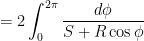
where 


Earlier in this series, I used the magic substitution 

so that the integral
![\cos \phi = \displaystyle \frac{1}{2} \left[z + \displaystyle \frac{1}{z} \right]](https://s0.wp.com/latex.php?latex=%5Ccos+%5Cphi+%3D+%5Cdisplaystyle+%5Cfrac%7B1%7D%7B2%7D+%5Cleft%5Bz+%2B+%5Cdisplaystyle+%5Cfrac%7B1%7D%7Bz%7D+%5Cright%5D&bg=ffffff&fg=000000&s=0&c=20201002)
and

Employing this substitution, the region of integration changes from 

![Q = 2 \displaystyle \oint_C \frac{\displaystyle -\frac{i}{z} dz}{S + \displaystyle \frac{R}{2} \left[z + \displaystyle \frac{1}{z} \right]}](https://s0.wp.com/latex.php?latex=Q+%3D+2+%5Cdisplaystyle+%5Coint_C+%5Cfrac%7B%5Cdisplaystyle+-%5Cfrac%7Bi%7D%7Bz%7D+dz%7D%7BS+%2B+%5Cdisplaystyle+%5Cfrac%7BR%7D%7B2%7D+%5Cleft%5Bz+%2B+%5Cdisplaystyle+%5Cfrac%7B1%7D%7Bz%7D+%5Cright%5D%7D&bg=ffffff&fg=000000&s=0&c=20201002)


While this looks integral in the complex plane looks a lot more complicated than a regular integral, it’s actually a lot easier to compute using residues. I’ll discuss the computation of this contour integral in tomorrow’s post.
How I Impressed My Wife: Part 3c
Previously in this series, I showed that
My wife had asked me to compute this integral by hand because Mathematica 4 and Mathematica 8 gave different answers. At the time, I eventually obtained the solution by multiplying the top and bottom of the integrand by and then employing the substitution (after using trig identities to adjust the limits of integration).
and then employing the substitution (after using trig identities to adjust the limits of integration).But this wasn’t the only method I tried. Indeed, I tried two or three different methods before deciding they were too messy and trying something different. So, for the rest of this series, I’d like to explore different ways that the above integral can be computed.
So far, I have shown that

To simplify the denominator even further, I will combine the two trigonometric terms in the denominator; this is possible because the argument of both the sine and cosine functions are the same. To this end, notice that
![2 a \sin \theta + (1 - a^2 - b^2) \cos \theta = R \displaystyle \left[ \frac{2a}{R} \sin \theta + \frac{1-a^2-b^2}{R} \cos \theta \right]](https://s0.wp.com/latex.php?latex=2+a+%5Csin+%5Ctheta+%2B+%281+-+a%5E2+-+b%5E2%29+%5Ccos+%5Ctheta+%3D+R+%5Cdisplaystyle+%5Cleft%5B+%5Cfrac%7B2a%7D%7BR%7D+%5Csin+%5Ctheta+%2B+%5Cfrac%7B1-a%5E2-b%5E2%7D%7BR%7D+%5Ccos+%5Ctheta+%5Cright%5D&bg=ffffff&fg=000000&s=0&c=20201002)
where
Next, let


With this substitution, we find that
![2 a \sin \theta + (1 - a^2 - b^2) \cos \theta = R [\cos \theta \cos \alpha + \sin \theta \sin \alpha]](https://s0.wp.com/latex.php?latex=2+a+%5Csin+%5Ctheta+%2B+%281+-+a%5E2+-+b%5E2%29+%5Ccos+%5Ctheta+%3D+R+%5B%5Ccos+%5Ctheta+%5Ccos+%5Calpha+%2B+%5Csin+%5Ctheta+%5Csin+%5Calpha%5D&bg=ffffff&fg=000000&s=0&c=20201002)

Therefore, the integral
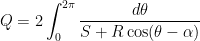
where
I’ll continue this different method of evaluating this integral in tomorrow’s post.
How I Impressed My Wife: Part 3b
Previously in this series, I showed that
My wife had asked me to compute this integral by hand because Mathematica 4 and Mathematica 8 gave different answers. At the time, I eventually obtained the solution by multiplying the top and bottom of the integrand by and then employing the substitution (after using trig identities to adjust the limits of integration).
and then employing the substitution (after using trig identities to adjust the limits of integration).But this wasn’t the only method I tried. Indeed, I tried two or three different methods before deciding they were too messy and trying something different. So, for the rest of this series, I’d like to explore different ways that the above integral can be computed.
So far, I have shown that
We now employ the substitution 


Next, I’ll divide write 


For 



Next, I use the periodic property for both sine and cosine — 


Except for the dummy variable

I’ll continue this different method of evaluating this integral in tomorrow’s post.
How I Impressed My Wife: Part 3a
Previously in this series, I showed that
My wife had asked me to compute this integral by hand because Mathematica 4 and Mathematica 8 gave different answers. At the time, I eventually obtained the solution by multiplying the top and bottom of the integrand by and then employing the substitution (after using trig identities to adjust the limits of integration).
and then employing the substitution (after using trig identities to adjust the limits of integration).But this wasn’t the only method I tried. Indeed, I tried two or three different methods before deciding they were too messy and trying something different. So, for the rest of this series, I’d like to explore different ways that the above integral can be computed.
For this next technique, I begin by using the trigonometric identities

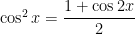

Using these identities, we obtain

In this way, the exponents have been removed from the denominator, thus making the integrand somewhat less complicated.
I’ll continue this different method of evaluating this integral in tomorrow’s post.
 Mean Green Math