In this series, I’m compiling some of the quips and one-liners that I’ll use with my students to hopefully make my lessons more memorable for them.
Today’s quip is a light-hearted one-liner that I’ll use to lighten the mood when in the middle of a complex calculation, like the following limit problem from calculus:
Let . Find so that whenever $|x-2| < \delta$.
The solution of this problem requires isolating in the above inequality:
At this point, the next step is dividing by . So, I’ll ask my class,
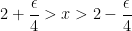
When we divide by , what happens to the crocodiles?
This usually gets the desired laugh out of the middle-school rule about how the insatiable “crocodiles” of an inequality always point to the larger quantity, leading to the next step:
,
so that
.
Formally completing the proof requires starting with and ending with .
In this series, I’m compiling some of the quips and one-liners that I’ll use with my students to hopefully make my lessons more memorable for them.
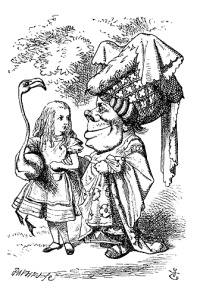
This is one of my favorite quote from Alice in Wonderland that I’ll use whenever discussing the difference between the ring axioms (integers are closed under addition, subtraction, and multiplication, but not division) and the field axioms (closed under division except for division by zero):
‘I only took the regular course [in school,’ said the Mock Turtle.]
‘What was that?’ inquired Alice.
‘Reeling and Writhing, of course, to begin with,’ the Mock Turtle replied; ‘and then the different branches of Arithmetic — Ambition, Distraction, Uglification, and Derision.’
In this series, I’m compiling some of the quips and one-liners that I’ll use with my students to hopefully make my lessons more memorable for them.
When I was a student, I heard the story (probably apocryphal) about the mathematician who wrote up a mathematical paper that was hundreds of pages long and gave it to the departmental administrative assistant to type. (This story took place many years ago before the advent of office computers, and so typewriters were the standard for professional communication.) The mathematician had written “iff” as the standard abbreviation for “if and only if” since typewriters did not have a button for the symbol.
Well, so the story goes, the administrative assistant saw all of these “iff”s, muttered to herself about how mathematicians don’t know how to spell, and replaced every “iff” in the paper with “if”.
And so the mathematician had to carefully pore through this huge paper, carefully checking if the word “if” should be “if” or “iff”.
I have no idea if this story is true or not, but it makes a great story to tell students.
In this series, I’m compiling some of the quips and one-liners that I’ll use with my students to hopefully make my lessons more memorable for them.
Sometimes, I’ll deliberately show something wrong to my students, and their job is to figure out how it went wrong. For example, I might show my students the classic “proof” that :
After coming to the conclusion, as my students are staring at this very unanticipated result, I’ll smile with my best used-car salesman smile and say “Trust me,” just like in the old Joe Isuzu commercials.
Of course, the joke is that my students shouldn’t trust me, and they should figure out exactly what happened.
In this series, I’m compiling some of the quips and one-liners that I’ll use with my students to hopefully make my lessons more memorable for them.
Suppose that my students need to prove a theorem like “Let be an integer. Then is odd if and only if is odd.” I’ll ask my students, “What is the structure of this proof?”
The key is the phrase “if and only if”. So this theorem requires two proofs:
Assume that is odd, and show that is odd.
Assume that is odd, and show that is odd.
I call this a blue-light special: Two for the price of one. Then we get down to the business of proving both directions of the theorem.
I’ll also use the phrase “blue-light special” to refer to the conclusion of the conjugate root theorem: if a polynomial with real coefficients has a complex root , then is also a root. It’s a blue-light special: two for the price of one.
In this series, I’m compiling some of the quips and one-liners that I’ll use with my students to hopefully make my lessons more memorable for them.
Sometimes it’s pretty easy for students to push through a proof from beginning to end. For example, in my experience, math majors have little trouble with each step of the proof of the following theorem.
Theorem. If , then .
Proof. Let , where , and let , where . Then
For other theorems, it’s not so easy for students to start with the left-hand side and end with the right-hand side. For example:
Theorem. If , then .
Proof. Let , where , and let , where . Then
.
A sharp math major can then provide the next few steps of the proof from here; however, it’s not uncommon for a student new to proofs to get stuck at this point. Inevitably, somebody asks if we can do the same thing to the right-hand side to get the same thing. I’ll say, “Sure, let’s try it”:
.
I call working with both the left and right sides to end up at the same spot the Diamond Rio approach to proofs: “I’ll start walking your way; you start walking mine; we meet in the middle ‘neath that old Georgia pine.” Not surprisingly, labeling this with a catchy country song helps the idea stick in my students’ heads.
Though not the most elegant presentation, this is logically correct because the steps for the right-hand side can be reversed and appended to the steps for the left-hand side:
Proof (more elegant). Let , where , and let , where . Then
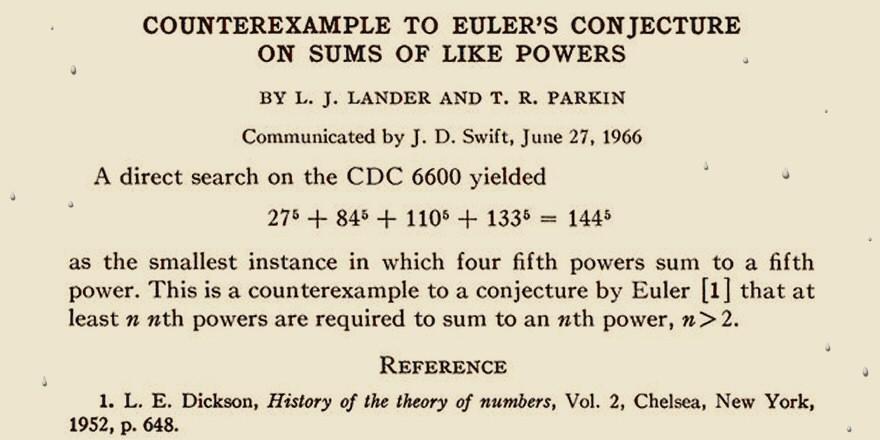
Euler’s conjecture, a theory proposed by Leonhard Euler in 1769, hung in there for 200 years. Then L.J. Lander and T.R. Parkin came along in 1966, and debunked the conjecture in two swift sentences. Their article — which is now open access and can be downloaded here — appeared in the Bulletin of the American Mathematical Society.
Sometimes it’s pretty easy for students to push through a proof from beginning to end. For example, in my experience, math majors have little trouble with each step of the proof of the following theorem.
Theorem. If , then .
Proof. Let , where , and let , where . Then
For other theorems, it’s not so easy for students to start with the left-hand side and end with the right-hand side. For example:
Theorem. If , then .
Proof. Let , where , and let , where . Then
.
A sharp math major can then provide the next few steps of the proof from here; however, it’s not uncommon for a student new to proofs to get stuck at this point. Inevitably, somebody asks if we can do the same thing to the right-hand side to get the same thing. I’ll say, “Sure, let’s try it”:
.
I call working with both the left and right sides to end up at the same spot the Diamond Rio approach to proofs: “I’ll start walking your way; you start walking mine; we meet in the middle ‘neath that old Georgia pine.” Not surprisingly, labeling this with a catchy country song helps the idea stick in my students’ heads.
Though not the most elegant presentation, this is logically correct because the steps for the right-hand side can be reversed and appended to the steps for the left-hand side:
Proof (more elegant). Let , where , and let , where . Then

. Find
so that
whenever $|x-2| < \delta$.




![\delta = \min \left( \left[ 2 + \displaystyle \frac{\epsilon}{4} \right] - 2, 2 - \left[2 - \displaystyle \frac{\epsilon}{4} \right] \right) = \displaystyle \frac{\epsilon}{4}](https://s0.wp.com/latex.php?latex=%5Cdelta+%3D+%5Cmin+%5Cleft%28+%5Cleft%5B+2+%2B+%5Cdisplaystyle+%5Cfrac%7B%5Cepsilon%7D%7B4%7D+%5Cright%5D+-+2%2C+2+-+%5Cleft%5B2+-+%5Cdisplaystyle+%5Cfrac%7B%5Cepsilon%7D%7B4%7D+%5Cright%5D+%5Cright%29+%3D+%5Cdisplaystyle+%5Cfrac%7B%5Cepsilon%7D%7B4%7D&bg=ffffff&fg=000000&s=0&c=20201002)

 symbol.
 :
:


 be an integer. Then
  is odd.” I’ll ask my students, “What is the structure of this proof?”
 with real coefficients has a complex root
  , then
  is also a root. It’s a blue-light special: two for the price of one.
 , then
  .
. , where
  , and let
  , where
  . Then


 .
.



 .
.



 .
.

 Mean Green Math