In this series, I’m compiling some of the quips and one-liners that I’ll use with my students to hopefully make my lessons more memorable for them.
In differential equations, we teach our students that to solve a homogeneous differential equation with constant coefficients, such as
,
the first step is to construct the characteristic equation
by essentially replacing with , with , and so on. Standard techniques from Algebra II/Precalculus, like the rational root test and synthetic division, are then used to find the roots of this polynomial; in this case, the roots are and . Therefore, switching back to the realm of differential equations, the general solution of the differential equation is
.
As , this general solution blows up (unless, by some miracle, ). The last two terms decay to 0, but the first term dominates.
The moral of the story is: if any of the roots have a positive real part, then the solution will blow up to or . On the other hand, if all of the roots have a negative real part, then the solution will decay to 0 as .
This sets up the following awful math pun, which I first saw in the book Absolute Zero Gravity:
An Aeroflot plan en route to Warsaw ran into heavy turbulence and was in danger of crashing. In desparation, the pilot got on the intercom and asked, “Would everyone with a Polish passport please move to the left side of the aircraft.” The passengers changed seats, and the turbulence ended. Why? The pilot achieved stability by putting all the Poles in the left half-plane.
In this series, I’m compiling some of the quips and one-liners that I’ll use with my students to hopefully make my lessons more memorable for them.
Here’s a problem that hypothetically could appear in Algebra II or Precalculus:
Find the solutions of .
While there is a formula for solving quartic equations, it’s extremely long and hence is not typically taught to high school students. Instead, the techniques that are typically taught are the Rational Root Test and (sometimes, depending on the textbook) Descartes’ Rule of Signs. The Rational Root Test constructs a list of possible rational roots (in this case ) to test… usually with synthetic division to accomplish this as quickly as possible.
The only problem is that there’s no guarantee that any of these possible rational roots will actually work. Indeed, for this particular example, none of them work because all of the solutions are complex ( and ). So the Rational Root Test is of no help for this example — and students have to somehow try to find the complex roots.
So here’s the wisecrack that I use. This wisecrack really only works in Texas and other states in which the state legislature has seen the wisdom of allowing anyone to bring a handgun to class:
What do you do if a problem like this appears on the test? [Murmurs and various suggestions]
Shoot the professor. [Nervous laughter]
It’s OK; campus carry is now in effect. [Full-throated laughter.]
In this series, I’m compiling some of the quips and one-liners that I’ll use with my students to hopefully make my lessons more memorable for them.
Often I’ll cover a topic in class that students really should have learned in a previous class but just didn’t. For example, in my experience, a significant fraction of my senior math majors have significant gaps in their backgrounds from Precalculus:
About a third have no memory of ever learning the Rational Root Test.
About a third have no memory of ever learning synthetic division.
About half have no memory of ever learning Descartes’ Rule of Signs.
Almost none have learned the Conjugate Root Theorem.
Often, these students will feel somewhat crestfallen about these gaps in their background knowledge… they’re about to graduate from college with a degree in mathematics and are now discovering that they’re missing some pretty basic things that they really should have learned in high school. And I don’t want them to feel crestfallen. Certainly, these gaps need to be addressed, but I don’t want them to feel discouraged.
Hence one of my favorite motivational one-liners:
It’s not your fault if you don’t know what you’ve never been taught.
I think this strikes the appropriate balance between acknowledging that there’s a gap that needs to be addressed and assuring the students that I don’t think they’re stupid for having this gap.
In this series, I’m compiling some of the quips and one-liners that I’ll use with my students to hopefully make my lessons more memorable for them. Today’s post is certainly not a one-liner but instead is my pseudohistory for how the roots of polynomials were found.
When I teach Algebra II or Precalculus (or train my future high school teachers to teach these subjects), we eventually land on the Rational Root Test and Descartes’ Rule of Signs as an aid for finding the roots of cubic equations or higher. Before I get too deep into this subject, however, I like to give a 10-15 minute pseudohistory about the discovery of how polynomial equations can be solved. Historians of mathematics will certain take issue with some of this “history.” However, the main purpose of the story is not complete accuracy but engaging students with the history of mathematics. I think the story I tell engages students while remaining reasonably accurate… and I always refer students to various resources if they want to get the real history.
To begin, I write down the easiest two equations to solve (in all cases, :
and
These are pretty easy to solve, with solutions well known to students:
and
In other words, there are formulas that you can just stick in the coefficients and get the answer out without thinking too hard. Sure, there are alternate ways of solving for that could be easier, like factoring, but the worst-case scenario is just plugging into the formula.
These formulas were known to Babylonian mathematicians around 2000 B.C. (When I teach this in class, I write the date, and all other dates and discoverers, next to the equations for dramatic pedagogical effect.) Though not written in these modern terms, basically every ancient culture on the globe that did mathematics had some version of these formulas: for example, the ancient Egyptians, Greeks, Chinese, and Mayans.
Naturally, this leads to a simple question: is there a formula for the cubic:
Is there some formula that we can just plug , , , and to just get the answer? The answer is, Yes, there is a formula. But it’s nasty. The formula was not discovered until 1535 A.D., and it was discovered by a man named Tartaglia. During the 1500s, the study of mathematics was less about the dispassionate pursuit of truth and more about exercising machismo. One mathematician would challenge another: “Here’s my cubic equation; I bet you can’t solve it. Nyah-nyah-nyah-nyah-nyah.” Then the second mathematician would solve it and challenge the first: “Here’s my cubic equation; I bet you can’t solve it. Nyah-nyah-nyah-nyah-nyah.” And so on. Well, Tartaglia came up with a formula that would solve every cubic equation. By plugging in , , , and , you get the answer out.
Tartaglia’s discovery was arguably the first triumph of the European Renaissance. The solution of the cubic was perhaps the first thing known to European mathematicians in the Middle Ages that was unknown to the ancient Greeks.
In 1535, Tartaglia was a relatively unknown mathematician, and so he told a more famous mathematician, Cardano, about his formula. Cardano told Tartaglia, why yes, that is very interesting, and then published the formula under his own name, taking credit without mention of Tartaglia. To this day, the formula is called Cardano’s formula.
So there is a formula. But it would take an entire chalkboard to write down the formula. That’s why we typically don’t make students learn this formula in high school; it’s out there, but it’s simply too complicated to expect students to memorize and use.
This leads to the next natural question: what about quartic equations?
The solution of the quartic was discovered less than five years later by an Italian mathematician named Ferrari. Ferrari found out that there is a formula that you can just plug in , , , , and , turn the crank, and get the answers out. Writing out this formula would take two chalkboards. So there is a formula, but it’s also very, very complicated.
Of course, Ferrari had some famous descendants in the automotive industry.
So now we move onto my favorite equation, the quintic. (If you don’t understand why it’s my favorite, think about my last name.)
After solving the cubic and quartic in rapid succession, surely there should also be a formula for the quintic. So they tried, and they tried, and they tried, and they got nowhere fast. Finally, the problem was solved nearly 300 years later, in 1832 (for the sake telling a good story, I don’t mention Abel) by a French kid named Evariste Galois. Galois showed that there is no formula. That takes some real moxie. There is no formula. No matter how hard you try, you will not find a formula that can work for every quintic. Sure, there are some quintics that can be solved, like . But there is no formula that will work for every single quintic.
Galois made this discovery when he was 19 years old… in other words, approximately the same age as my students. In fact, we know when wrote down his discovery, because it happened the night before he died. You see, he was living in France in 1832. What was going on in France in 1832? I ask my class, have they seen Les Miserables?
France was torn upside-down in 1832 in the aftermath of the French Revolution, and young Galois got into a heated argument with someone over politics; Galois was a republican, while the other guy was a royalist. More importantly, both men were competing for the hand of the same young woman. So they decided to settle their differences like honorable Frenchmen, with a duel. So Galois wrote up his mathematical notes one night, and the next day, he fought the duel, he lost the duel, and he died.
Thus giving complete and total proof that tremendous mathematical genius does not prevent somebody from being a complete idiot.
For the present, there are formulas for cubic and quartic equations, but they’re long and impractical. And for quintic equations and higher, there is no formula. So that’s why we teach these indirect methods like the Rational Root Test and Descartes’ Rule of Signs, as they give tools to use to guess at the roots of higher-order polynomials without using something like the quadratic formula.
In this series, I’m compiling some of the quips and one-liners that I’ll use with my students to hopefully make my lessons more memorable for them.
One of the techniques commonly taught in Algebra II or Precalculus is the Rational Root Test, which is a way of making a list of candidates of rational numbers that might (emphasis, might) be roots of the polynomial. This is a commonly taught method for finding the roots of polynomials whose degree is higher than 3. (Other techniques that are typically taught to students are Descartes’ Rule of Signs and (less commonly) the Upper and Lower Bound Rules.) For example, for the polynomial .
The factors of the constant term are and , and so the numerator of any rational root must be one of these numbers.
The factors of the leading coefficient are and , and so the denominator of any rational root must be one of these numbers.
In conclusion, if there’s a rational root, then it’s and . In other words, we have a list of 16 possible rational roots. Not all of them will be roots, of course, since the cubic polynomial only has at most three distinct roots. Also, there’s no guarantee that any of them will be roots. The only way to find out if any of them work is by testing them, usually using synthetic division.
So, after a practice problem or two, I’ll ask my students,
What guarantee do you have that at least one of the possible rational roots will actually work?
After letting them think for a few seconds, I give them the answer:
The benevolence of your instructor.
In other words, there is no guarantee that any of the possible rational roots will actually work, except that the instructor (or author of the textbook) has rigged things so that it happens.
In this series, I’m compiling some of the quips and one-liners that I’ll use with my students to hopefully make my lessons more memorable for them.
Suppose that my students need to prove a theorem like “Let be an integer. Then is odd if and only if is odd.” I’ll ask my students, “What is the structure of this proof?”
The key is the phrase “if and only if”. So this theorem requires two proofs:
Assume that is odd, and show that is odd.
Assume that is odd, and show that is odd.
I call this a blue-light special: Two for the price of one. Then we get down to the business of proving both directions of the theorem.
I’ll also use the phrase “blue-light special” to refer to the conclusion of the conjugate root theorem: if a polynomial with real coefficients has a complex root , then is also a root. It’s a blue-light special: two for the price of one.
In this series, I’m compiling some of the quips and one-liners that I’ll use with my students to hopefully make my lessons more memorable for them. Today’s story is a continuation of yesterday’s post. I call today’s one-liner “Method #1… Method #2.”
Every once in a while, I want my students to figure out that there’s a clever way to do a problem that will save them a lot of time, and they need to think of it.
For example, in Algebra II, Precalculus, or Probability, I might introduce the binomial coefficients to my students, show them the formula for computing them and how they’re related to combinatorics and to Pascal’s triangle, and then ask them to compute . We write down
So this fraction needs to be simplified. So I’ll dramatically announce:
Method #1: Multiply out the top and the bottom.
This produces the desired groans from my students. If possible, then I list other available but undesirable ways of solving the problem.
Method #2: Figure out the 100th row of Pascal’s triangle.
Method #3: List out all of the ways of getting 3 successes in 100 trials.
All of this gets the point across: there’s got to be an easier way to do this. So, finally, I’ll get to what I really want my students to do:
Method #4: Write , and cancel.
The point of this bit of showman’s patter is to get my students to think about what they should do next as opposed to blindly embarking in a laborious calculation.
As another example, consider the following problem from Algebra II/Precalculus: “Show that is a factor of .”
As I’m writing down the problem on the board, someone will usually call out nervously, “Are you sure you mean ?” Yes, I’m sure.
“So,” I announce, “how are we going to solve the problem?”
Method #1: Use synthetic division.
Then I’ll make a point of what it would take to write down the procedure of synthetic division for this polynomial of degree 78.
Method #2: (As my students anticipate the real way of doing the problem) Use long division.
Understanding laughter ensures. Eventually, I tell my students — or, sometimes, my students will tell me:
In this series, I’m compiling some of the quips and one-liners that I’ll use with my students to hopefully make my lessons more memorable for them. This is a quip that I’ll use when a theoretical calculation can be easily confirmed with a calculator. Today’s post is less of a one-liner than a story.
When I teach Algebra II or Precalculus (or train my future high school teachers to teach these subjects), we eventually land on the Rational Root Test and Descartes’ Rule of Signs as an aid for finding the roots of cubic equations or higher. Before I get too deep into this subject, however, I like to give a 10-15 minute pseudohistory about the discovery of how polynomial equations can be solved. Historians of mathematics will certain take issue with some of this “history.” However, the main purpose of the story is not complete accuracy but engaging students with the history of mathematics. I think the story I tell engages students while remaining reasonably accurate… and I always refer students to various resources if they want to get the real history.
To begin, I write down the easiest two equations to solve (in all cases, :
and
These are pretty easy to solve, with solutions well known to students:
and
In other words, there are formulas that you can just stick in the coefficients and get the answer out without thinking too hard. Sure, there are alternate ways of solving for that could be easier, like factoring, but the worst-case scenario is just plugging into the formula.
These formulas were known to Babylonian mathematicians around 2000 B.C. (When I teach this in class, I write the date, and all other dates and discoverers, next to the equations for dramatic pedagogical effect.) Though not written in these modern terms, basically every ancient culture on the globe that did mathematics had some version of these formulas: for example, the ancient Egyptians, Greeks, Chinese, and Mayans.
Naturally, this leads to a simple question: is there a formula for the cubic:
Is there some formula that we can just plug , , , and to just get the answer? The answer is, Yes, there is a formula. But it’s nasty. The formula was not discovered until 1535 A.D., and it was discovered by a man named Tartaglia. During the 1500s, the study of mathematics was less about the dispassionate pursuit of truth and more about exercising machismo. One mathematician would challenge another: “Here’s my cubic equation; I bet you can’t solve it. Nyah-nyah-nyah-nyah-nyah.” Then the second mathematician would solve it and challenge the first: “Here’s my cubic equation; I bet you can’t solve it. Nyah-nyah-nyah-nyah-nyah.” And so on. Well, Tartaglia came up with a formula that would solve every cubic equation. By plugging in , , , and , you get the answer out.
Tartaglia’s discovery was arguably the first triumph of the European Renaissance. The solution of the cubic was perhaps the first thing known to European mathematicians in the Middle Ages that was unknown to the ancient Greeks.
In 1535, Tartaglia was a relatively unknown mathematician, and so he told a more famous mathematician, Cardano, about his formula. Cardano told Tartaglia, why yes, that is very interesting, and then published the formula under his own name, taking credit without mention of Tartaglia. To this day, the formula is called Cardano’s formula.
So there is a formula. But it would take an entire chalkboard to write down the formula. That’s why we typically don’t make students learn this formula in high school; it’s out there, but it’s simply too complicated to expect students to memorize and use.
This leads to the next natural question: what about quartic equations?
The solution of the quartic was discovered less than five years later by an Italian mathematician named Ferrari. Ferrari found out that there is a formula that you can just plug in , , , , and , turn the crank, and get the answers out. Writing out this formula would take two chalkboards. So there is a formula, but it’s also very, very complicated.
Of course, Ferrari had some famous descendants in the automotive industry.
So now we move onto my favorite equation, the quintic. (If you don’t understand why it’s my favorite, think about my last name.)
After solving the cubic and quartic in rapid succession, surely there should also be a formula for the quintic. So they tried, and they tried, and they tried, and they got nowhere fast. Finally, the problem was solved nearly 300 years later, in 1832 (for the sake telling a good story, I don’t mention Abel) by a French kid named Evariste Galois. Galois showed that there is no formula. That takes some real moxie. There is no formula. No matter how hard you try, you will not find a formula that can work for every quintic. Sure, there are some quintics that can be solved, like . But there is no formula that will work for every single quintic.
Galois made this discovery when he was 19 years old… in other words, approximately the same age as my students. In fact, we know when wrote down his discovery, because it happened the night before he died. You see, he was living in France in 1832. What was going on in France in 1832? I ask my class, have they seen Les Miserables?
France was torn upside-down in 1832 in the aftermath of the French Revolution, and young Galois got into a heated argument with someone over politics; Galois was a republican, while the other guy was a royalist. More importantly, both men were competing for the hand of the same young woman. So they decided to settle their differences like honorable Frenchmen, with a duel. So Galois wrote up his mathematical notes one night, and the next day, he fought the duel, he lost the duel, and he died.
Which bring me to the conclusion of this story: we have complete and total proof that tremendous mathematical genius does not prevent somebody from being a complete idiot.
For the present, there are formulas for cubic and quartic equations, but they’re long and impractical. And for quintic equations and higher, there is no formula. So that’s why we teach these indirect methods like the Rational Root Test and Descartes’ Rule of Signs, as they give tools to use to guess at the roots of higher-order polynomials without using something like the quadratic formula.
In my capstone class for future secondary math teachers, I ask my students to come up with ideas for engaging their students with different topics in the secondary mathematics curriculum. In other words, the point of the assignment was not to devise a full-blown lesson plan on this topic. Instead, I asked my students to think about three different ways of getting their students interested in the topic in the first place.
I plan to share some of the best of these ideas on this blog (after asking my students’ permission, of course).
This student submission again comes from my former student Sarah Asmar. Her topic, from Algebra/Precalculus: dividing polynomials.
How could you as a teacher create an activity or project that involves your topic?
Many high school students are introduced to Polynomials in Algebra I. They are taught how to factor and to even graph Polynomials. In Algebra II, students are asked to add, subtract, multiply and divide Polynomials. Dividing Polynomials is challenging for many students because they are not only dividing numbers, but now they have added letters to the mix. There are two ways to divide Polynomials: Long Division and Synthetic Division. Since this is a topic that most students find difficult to grasp, I would split the students into groups of about 3 or 4 and provide each group with Algebra tiles. I would then provide each group with an index card with a specific Polynomial for them to divide. The index card will have a dividend and divisor for the students to use in order for them to create find the answer using the Algebra tiles. First, they will need to create a frame. Then, the dividend should be formed inside the frame while the divisor is formed on the left hand side outside of the frame. The answer will be shown with the tiles on the top line outside the frame. I will do an example with them first and then have them do the problem provided on their index card with their group. This activity will provide the students with a visual representation on how dividing polynomials would look like in order for it to be easier for them on paper.
How can this topic be used in your students’ future courses in mathematics or science?
Students are introduced to dividing Polynomials in Algebra II. Most would never like to see this topic again, but unfortunately that is not the case. Dividing Polynomials is revisited in a Pre-Calculus class. However, it is taught at a much deeper level. Students are required to divide using long and synthetic division. Synthetic division is taught as a short cut for dividing Polynomials, but it doesn’t always work and students would have to divide using long division. Synthetic substitution is taught as well to find the solution of the Polynomial given. Synthetic substitution is as easy as just plugging in the given number for the variable provided in the Polynomial. Dividing Polynomials is also used in Binomial Expansion in Pre-Calculus. Along with all of these topics in Pre-Calculus, dividing Polynomials appears in all future basic Math courses such as Calculus. A real life example that uses Polynomials is aerospace science. These equations are used for object in motion, projectiles and air resistance.
How can technology be used to effectively engage students with this topic?
I was searching the Internet and I came across this video. I thought that this video would be an amazing tool to help the students understand how to divide polynomials without me just lecturing to them. It is sung to the tune of “We Are Young” which is a very popular song in the pop music culture. Using something like this would show a visual representation, but it will also drill the steps in their head. Our brains can easily remember songs even after listening to a song just once. The fact that dividing polynomials is put into a song makes it more likely for a student to remember the steps they need to take in order to perform the indicated operation.
In my capstone class for future secondary math teachers, I ask my students to come up with ideas for engaging their students with different topics in the secondary mathematics curriculum. In other words, the point of the assignment was not to devise a full-blown lesson plan on this topic. Instead, I asked my students to think about three different ways of getting their students interested in the topic in the first place.
I plan to share some of the best of these ideas on this blog (after asking my students’ permission, of course).
This student submission comes from my former student Jessica Martinez. Her topic, from Algebra II: polynomials and non-linear functions.
How can technology (YouTube, Khan Academy [khanacademy.org], Vi Hart, Geometers Sketchpad, graphing calculators, etc.) be used to effectively engage students with this topic?
There is a Ted Talk video showing the math behind professional basketball player Michael Jordan’s hang time. The video connects a popular sport and player with mathematics by using quadratic equations to explain how MJ stays in the air as long as he does. You can see that the video is aimed at a younger audience since it’s done with cartoon animation, and it’s fairly easy to follow along as it explains the math. The video explains how they derived the formula for MJ’s jump shot by using his initial velocity and the force of gravity along with the variable of time. It also provides a great visual representation of how jumping into the air resembles a parabola of a quadratic function when they place MJ jumping against a graph. The video shows how applicable quadratics are by explaining that the roots of the parabola of MJ’s jump shot are the spots where he jumps and where he lands again. We could also calculate the maximum height of MJ’s jump by finding the vertex of the parabola and I could modify the equation as a problem for my students to solve. For example, we could look up the world record for highest jump and I could ask my students to calculate what the initial velocity would be for that person to get the highest jump using MJ’s hang time.
How could you as a teacher create an activity or project that involves your topic?
As a student, the first couple of times I looked at the graphs of polynomials I always thought, “Huh, those kind of look like rollercoasters”. I did some researching and I found a project where students are asked to use polynomials to analyze and design rollercoasters. As a teacher, I could introduce this project with a short video or advertisement of a popular theme park (like Six Flags) to get their interest and show some of the cool rollercoasters in action. Then I would have the students answer word problems about rollercoasters and their polynomial functions to find the local max/min of the coasters, where the function is increasing/decreasing (riding down or up on the rollercoaster), and what type of function best models certain parts of the coaster (quadratic, cubic or quartic). After my students have worked some polynomial function problems, I would have them pair up or work in groups to design their own rollercoaster using polynomials. I would also like to collaborate with a physics teacher as well; by using physics, my students could test the equations of their coasters with velocity, force and acceleration and see if they are realistic or not (and they could also see how this topic extends to other courses).
What interesting (i.e., uncontrived) word problems using this topic can your students do now?
Whenever a new infectious disease begins to spread rapidly (like Ebola or the Zika virus), there is coverage of the spread all over the news, making this topic highly relevant for my students. The spread of infectious disease can be modeled through non-linear functions such as exponential functions. I could create multiple word problems about the Ebola outbreak in Africa; for example, I could have my students pretend that scientists have developed a vaccine for the Ebola virus but now the problem is distributing the vaccine to all of the infected people. I would have my students pretend they were a disease control team trying to race against the spread of this disease in order to vaccinate the people before it was too late. By using actual date on reported cases in a specific country in Africa (like Liberia or Sierra Leone), my students could find the exponential function that best represents their data. They could then use that function to estimate the time it would take for all of the population in their country to be infected and compare that to the rate and time it would take to distribute all of the vaccines to the people (making estimates based on research of the country and how it has handled disease spread in the past). Since actual data won’t always match precisely with a mathematical function, I would have my students discuss what other variables and factors could affect their calculations as well.
TEDEd. (2015, June 04). The math behind Michael Jordan’s legendary hang time – Andy Peterson and Zack Patterson. Retrieved September 23, 2016, from https://www.youtube.com/watch?v=sDbmcPnzwy4





 .
. ) to test… usually with synthetic division to accomplish this as quickly as possible.
 and
and  ). So the Rational Root Test is of no help for this example — and students have to somehow try to find the complex roots.
 :
: and
and 
 and
and 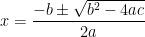
 that could be easier, like factoring, but the worst-case scenario is just plugging into the formula.
 ,
,  ,
,  , and
, and  to just get the answer? The answer is, Yes, there is a formula. But it’s nasty. The formula was not discovered until 1535 A.D., and it was discovered by a man named
 , turn the crank, and get the answers out. Writing out this formula would take two chalkboards. So there is a formula, but it’s also very, very complicated.
 . But there is no formula that will work for every single quintic.
 .
. and
and  , and so the numerator of any rational root must be one of these numbers.
 and
and  , and so the denominator of any rational root must be one of these numbers.
 and
and  . In other words, we have a list of 16 possible rational roots. Not all of them will be roots, of course, since the cubic polynomial only has at most three distinct roots. Also, there’s no guarantee that any of them will be roots. The only way to find out if any of them work is by testing them, usually using
  be an integer. Then
  is odd.” I’ll ask my students, “What is the structure of this proof?”
 with real coefficients has a complex root
  , then
  is also a root. It’s a blue-light special: two for the price of one.
 . We write down
 , and cancel.
 is a factor of
  .”
.” ?” Yes, I’m sure.
 .
. Mean Green Math