Confirming Einstein’s Theory of General Relativity With Calculus, Part 9: Pedagogical Thoughts

At long last, we have reached the end of this series of posts.

The derivation is elementary; I’m confident that I could have understood this derivation had I seen it when I was in high school. That said, the word “elementary” in mathematics can be a bit loaded — this means that it is based on simple ideas that are perhaps used in a profound and surprising way. Perhaps my favorite quote along these lines was this understated gem from the book Three Pearls of Number Theory after the conclusion of a very complicated proof in Chapter 1:

You see how complicated an entirely elementary construction can sometimes be. And yet this is not an extreme case; in the next chapter you will encounter just as elementary a construction which is considerably more complicated.

Here are the elementary ideas from calculus, precalculus, and high school physics that were used in this series:

  • Physics
    • Conservation of angular momentum
    • Newton’s Second Law
    • Newton’s Law of Gravitation
  • Precalculus
    • Completing the square
    • Quadratic formula
    • Factoring polynomials
    • Complex roots of polynomials
    • Bounds on \cos \theta and \sin \theta
    • Period of \cos \theta and \sin \theta
    • Zeroes of \cos \theta and \sin \theta
    • Trigonometric identities (Pythagorean, sum and difference, double-angle)
    • Conic sections
    • Graphing in polar coordinates
    • Two-dimensional vectors
    • Dot products of two-dimensional vectors (especially perpendicular vectors)
    • Euler’s equation
  • Calculus
    • The Chain Rule
    • Derivatives of \cos \theta and \sin \theta
    • Linearizations of \cos x, \sin x, and 1/(1-x) near x \approx 0 (or, more generally, their Taylor series approximations)
    • Derivative of e^x
    • Solving initial-value problems
    • Integration by u-substitution

While these ideas from calculus are elementary, they were certainly used in clever and unusual ways throughout the derivation.

I should add that although the derivation was elementary, certain parts of the derivation could be made easier by appealing to standard concepts from differential equations.

One more thought. While this series of post was inspired by a calculation that appeared in an undergraduate physics textbook, I had thought that this series might be worthy of publication in a mathematical journal as an historical example of an important problem that can be solved by elementary tools. Unfortunately for me, Hieu D. Nguyen’s terrific article Rearing Its Ugly Head: The Cosmological Constant and Newton’s Greatest Blunder in The American Mathematical Monthly is already in the record.

Confirming Einstein’s Theory of General Relativity With Calculus, Part 7e: Computing Precession

In this series, I’m discussing how ideas from calculus and precalculus (with a touch of differential equations) can predict the precession in Mercury’s orbit and thus confirm Einstein’s theory of general relativity. The origins of this series came from a class project that I assigned to my Differential Equations students maybe 20 years ago.

We have shown that under general relativity, the motion of a planet around the Sun precesses by

\phi = \displaystyle \frac{6\pi GM}{ac^2 (1-\epsilon^2)} \qquad \hbox{radians per orbit},

where a is the semi-major axis of the planet’s orbit, \epsilon is the orbit’s eccentricity, G is the gravitational constant of the universe, M is the mass of the Sun, and c is the speed of light.

Notice that for \phi to be as observable as possible, we’d like a to be as small as possible and \epsilon to be as large as possible. By a fortunate coincidence, the orbit of Mercury — the closest planet to the sun — has the most elliptical orbit of the eight planets.

Here are the values of the constants for Mercury’s orbit in the SI system:

  • G = 6.6726 \times 10^{-11} \qquad \hbox{N-m}^2/\hbox{kg}^2
  • M = 1.9929 \times 10^{30} \qquad \hbox{kg}
  • a = 5.7871 \times 10^{10} \qquad \hbox{m}
  • c = 2.9979 \times 10^{8} \qquad \hbox{m/s}
  • \epsilon = 0.2056
  • T = 0.2408 \qquad \hbox{years}

The last constant, T, is the time for Mercury to complete one orbit. This isn’t in the SI system, but using Earth years as the unit of time will prove useful later in this calculation.

Using these numbers, and recalling that 1 ~ \hbox{N} = 1 ~ \hbox{kg-m/s}^2, we find that

\phi = \displaystyle \frac{6\pi \times 6.6726 \times 10^{-11} ~ \hbox{m}^3/(\hbox{kg-s}^2) \times 1.9929 \times 10^{30} ~ \hbox{kg}}{5.7871 \times 10^{10} ~ \hbox{m} \times (2.9979 \times 10^{8} ~ \hbox{m/s})^2 \times (1-(0.2408)^2)} \approx 5.03 \times 10^{-7}.

Notice that all of the units cancel out perfectly; this bit of dimensional analysis is a useful check against careless mistakes.

Again, the units of \phi are in radians per Mercury orbit, or radians per 0.2408 years. We now convert this to arc seconds per century:

\phi \approx 5.03 \times 10^{-7} \displaystyle \frac{\hbox{radians}}{\hbox{0.2408 years}} \times \frac{180 ~\hbox{degrees}}{\pi ~ \hbox{radians}} \times \frac{3600 ~ \hbox{arc seconds}}{1 ~ \hbox{degree}} \times \frac{100 ~ \hbox{years}}{1 ~ \hbox{century}}

\phi = 43.1 \displaystyle \frac{\hbox{arc seconds}}{\hbox{century}}.

This indeed matches the observed precession in Mercury’s orbit, thus confirming Einstein’s theory of relativity.

This same computation can be made for other planets. For Venus, we have the new values of a = 1.0813 \times 10^{11} ~ \hbox{m}, \epsilon = 0.0068, and T = 0.6152 ~ \hbox{years}. Repeating this calculation, we predict the precession in Venus’s orbit to be 8.65” per century. Einstein made this prediction in 1915, when the telescopes of the time were not good enough to measure the precession in Venus’s orbit. This only happened in 1960, 45 years later and 5 years after Einstein died. Not surprisingly, the precession in Venus’s orbit also agrees with general relativity.

Confirming Einstein’s Theory of General Relativity With Calculus, Part 7d: Predicting Precession IV

In this series, I’m discussing how ideas from calculus and precalculus (with a touch of differential equations) can predict the precession in Mercury’s orbit and thus confirm Einstein’s theory of general relativity. The origins of this series came from a class project that I assigned to my Differential Equations students maybe 20 years ago.

We have shown that the motion of a planet around the Sun, expressed in polar coordinates (r,theta) with the Sun at the origin, under general relativity is

u(\theta) \approx  \displaystyle \frac{1}{\alpha} \left[ 1 + \epsilon \cos \left( \theta - \frac{\delta \theta}{\alpha} \right) \right],

where u = \displaystyle \frac{1}{r}, \alpha = a(1-\epsilon^2), a is the semi-major axis of the planet’s orbit, \epsilon is the orbit’s eccentricity, \delta = \displaystyle \frac{3GM}{c^2}, G is the gravitational constant of the universe, m is the mass of the planet, M is the mass of the Sun, P is the planet’s perihelion, \ell is the constant angular momentum of the planet, and c is the speed of light.

The above function u(\theta) is maximized (i.e., the distance from the Sun r(\theta) is minimized) when \displaystyle \cos \left( \theta - \frac{\delta \theta}{\alpha} \right) is as large as possible. This occurs when \theta - \displaystyle \frac{\delta \theta}{\alpha} is a multiple of 2\pi.

Said another way, the planet is at its closest point to the Sun when \theta = 0. One orbit later, the planet returns to its closest point to the Sun when

\theta - \displaystyle \frac{\delta \theta}{\alpha} = 2\pi

\theta \displaystyle\left(1 - \frac{\delta}{\alpha} \right) = 2\pi

\theta = 2\pi \displaystyle\frac{1}{1 - (\delta/\alpha)}

We now use the approximation

\displaystyle \frac{1}{1-x} \approx 1 + x \qquad \hbox{if} \qquad x \approx 0;

this can be demonstrated by linearization, Taylor series, or using the first two terms of the geometric series 1 + x + x^2 + x^3 + \dots. With this approximation, the closest approach to the Sun in the next orbit occurs when

\theta = 2\pi \displaystyle\left(1 + \frac{\delta}{\alpha} \right) = 2\pi + \frac{2\pi \delta}{\alpha},

which is coterminal with the angle

\phi = \displaystyle \frac{2\pi \delta}{\alpha}.

Substituting \alpha = a(1-\epsilon^2) and \delta = \displaystyle \frac{3GM}{c^2}, we see that the amount of precession per orbit is

\phi = \displaystyle 2 \pi \frac{3GM}{c^2} \frac{1}{a(1-\epsilon^2)} = \frac{6\pi G M}{ac^2(1-\epsilon^2)}.

The units of \phi are radians per orbit. In the next post, we will use Mercury’s data to find \phi in seconds of arc per century.

Confirming Einstein’s Theory of General Relativity With Calculus, Part 7c: Predicting Precession III

In this series, I’m discussing how ideas from calculus and precalculus (with a touch of differential equations) can predict the precession in Mercury’s orbit and thus confirm Einstein’s theory of general relativity. The origins of this series came from a class project that I assigned to my Differential Equations students maybe 20 years ago.

We have shown that the motion of a planet around the Sun, expressed in polar coordinates (r,theta) with the Sun at the origin, under general relativity is

u(\theta) \approx  \displaystyle \frac{1}{\alpha} \left[ 1 + \epsilon \cos \left( \theta - \frac{\delta \theta}{\alpha} \right) \right],

where u = \displaystyle \frac{1}{r}, \displaystyle \frac{1}{\alpha} = \frac{GMm^2}{\ell^2}, \epsilon = \displaystyle \frac{\alpha - P}{P}, \delta = \displaystyle \frac{3GM}{c^2}, G is the gravitational constant of the universe, m is the mass of the planet, M is the mass of the Sun, P is the planet’s perihelion, \ell is the constant angular momentum of the planet, and c is the speed of light.

We notice that the orbit of a planet under general relativity looks very, very similar to the orbit under Newtonian physics:

u(\theta) \approx  \displaystyle \frac{1}{\alpha} \left[ 1 + \epsilon \cos \theta \right],

so that

r(\theta) = \displaystyle \frac{\alpha}{1 + \epsilon \cos \theta}.

As we’ve seen, this describes an elliptical orbit, normally expressed in rectangular coordinates as

\displaystyle \frac{(x-h)^2}{a^2} + \frac{y^2}{b^2} = 1,

with semimajor axis along the x-axis. In particular, for an elliptical orbit, the planet’s closest approach to the Sun occurs at \theta = 0:

r(0) = \displaystyle \frac{\alpha}{1 + \epsilon \cos 0} = \frac{\alpha}{1 + \epsilon},

and the planet’s further distance from the Sun occurs at \theta = \pi:

r(\pi) = \displaystyle \frac{\alpha}{1 + \epsilon \cos \pi} = \frac{\alpha}{1 - \epsilon}.

Therefore, the length 2a of the major axis of the ellipse is the sum of these two distances:

2a =  \displaystyle \frac{\alpha}{1 + \epsilon} +  \frac{\alpha}{1 - \epsilon}

2a = \displaystyle \frac{\alpha(1-\epsilon) + \alpha(1+\epsilon)}{(1 + \epsilon)(1 - \epsilon)}

2a= \displaystyle \frac{2\alpha}{1  - \epsilon^2}

a =  \displaystyle \frac{\alpha}{1  - \epsilon^2}.

Said another way, \alpha = a(1-\epsilon^2). This is a far more convenient formula for computing \alpha than \alpha = \displaystyle \frac{\ell^2}{GMm^2}, as the values of a (the semi-major axis) and \epsilon (the eccentricity of the orbit) are more accessible than the angular momentum \ell of the planet’s orbit.

In the next post, we finally compute the precession of the orbit.

Confirming Einstein’s Theory of General Relativity With Calculus, Part 4c: Newton’s Second Law and Newton’s Law of Gravitation

In this series, I’m discussing how ideas from calculus and precalculus (with a touch of differential equations) can predict the precession in Mercury’s orbit and thus confirm Einstein’s theory of general relativity. The origins of this series came from a class project that I assigned to my Differential Equations students maybe 20 years ago.

In this post, following from the previous two posts, we will show that if the motion of a planet around the Sun is expressed in polar coordinates (r,\theta), with the Sun at the origin, then under Newtonian mechanics (i.e., without general relativity) the motion of the planet follows the differential equation

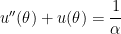
u''(\theta) + u(\theta) = \displaystyle \frac{1}{\alpha},

where u = 1/r and \alpha is a certain constant. Deriving this governing differential equation will require some principles from physics. If you’d rather skip the physics and get to the mathematics, we’ll get to solving this differential equations in the next post.

From Newton’s second law, the gravitational force on the planet as it orbits the Sun satisfies

{\bf F} = m{\bf a},

where the force {\bf F} and the acceleration {\bf a} are vectors. When written in polar coordinates, this becomes

{\bf F} = m \displaystyle \left[ \frac{d^2r}{dt^2} - r \left( \frac{d\theta}{dt} \right)^2 \right] {\bf u}_r + m \left(r \frac{d^2 \theta}{d t^2} + 2 \frac{dr}{dt} \frac{d\theta}{dt} \right) {\bf u}_\theta,

where {\bf u}_r is a unit vector pointing away from the origin and {\bf u}_\theta is a unit vector perpendicular to {\bf u}_r that points in the direction of increasing \theta.

Furthermore, from Newton’s Law of Gravitation, if the Sun is located at the origin, then the gravitational force on the planet is

{\bf F} = \displaystyle -\frac{GMm}{r^2} {\bf u}_r,

where M is the mass of the sun, m is the mass of the planet, and G is the gravitational constant of the universe (which is a constant, no matter what Q from Star Trek: The Next Generation says).

Since these are the same force, the {\bf u}_r components must be the same. (Also, the {\bf u}_\theta component must be zero, but we won’t need to use that fact.) Therefore,

m \displaystyle \left[ \frac{d^2r}{dt^2} - r \left( \frac{d\theta}{dt} \right)^2 \right] = \displaystyle -\frac{GMm}{r^2},

or

\displaystyle  \frac{d^2r}{dt^2} - r \left( \frac{d\theta}{dt} \right)^2 = \displaystyle -\frac{GM}{r^2}.

In a previous post, we showed that

\displaystyle \frac{d\theta}{dt} = \frac{\ell}{mr^2},

where \ell is a constant, and

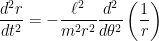
\displaystyle \frac{d^2r}{dt^2} = - \frac{\ell^2}{m^2 r^2} \frac{d^2}{d\theta^2} \left( \frac{1}{r} \right).

Substituting, we find

\displaystyle  - \frac{\ell^2}{m^2 r^2} \frac{d^2}{d\theta^2} \left( \frac{1}{r} \right) - r \left( \frac{\ell}{mr^2} \right)^2  = \displaystyle -\frac{GM}{r^2}

\displaystyle  \frac{\ell^2}{m^2 r^2} \frac{d^2}{d\theta^2} \left( \frac{1}{r} \right) + r \left( \frac{\ell^2}{m^2 r^4} \right)  = \displaystyle \frac{GM}{r^2}

\displaystyle  \frac{\ell^2}{m^2 r^2} \frac{d^2}{d\theta^2} \left( \frac{1}{r} \right) +\frac{\ell^2}{m^2 r^3}  = \displaystyle \frac{GM}{r^2}

\displaystyle  \frac{\ell^2}{m^2 r^2} \left[ \frac{d^2}{d\theta^2} \left( \frac{1}{r} \right) + \frac{1}{r} \right]  = \displaystyle \frac{GM}{r^2}

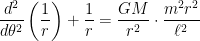
\displaystyle  \frac{d^2}{d\theta^2} \left( \frac{1}{r} \right) + \frac{1}{r} = \displaystyle \frac{GM}{r^2} \cdot \frac{m^2 r^2}{\ell^2}

\displaystyle  \frac{d^2}{d\theta^2} \left( \frac{1}{r} \right) + \frac{1}{r} = \displaystyle \frac{GMm^2}{\ell^2}.

So, substituting u = 1/r and \alpha = \displaystyle \frac{\ell^2}{GMm^2}, we finally obtain the governing equation

\displaystyle  \frac{d^2 u}{d\theta^2}  + u = \displaystyle \frac{1}{\alpha}.

This is the governing differential equation of planetary motion under Newtonian mechanics. For now, it’s not obvious why we chose \displaystyle \frac{1}{\alpha} as the constant on the right-hand side instead of just \alpha, but the reason for this choice will become apparent in future posts.

In the next few posts, we use differential equations (or, if you’d prefer, just calculus) to show that Newtonian mechanics predicts that planets orbit the Sun in ellipses.

Confirming Einstein’s Theory of General Relativity With Calculus, Part 4b: Acceleration in Polar Coordinates

In this series, I’m discussing how ideas from calculus and precalculus (with a touch of differential equations) can predict the precession in Mercury’s orbit and thus confirm Einstein’s theory of general relativity. The origins of this series came from a class project that I assigned to my Differential Equations students maybe 20 years ago.

In this part of the series, we will show that if the motion of a planet around the Sun is expressed in polar coordinates (r,\theta), with the Sun at the origin, then under Newtonian mechanics (i.e., without general relativity) the motion of the planet follows the differential equation

u''(\theta) + u(\theta) = \displaystyle \frac{1}{\alpha},

where u = 1/r and \alpha is a certain constant. Deriving this governing differential equation will require some principles from physics. If you’d rather skip the physics and get to the mathematics, we’ll get to solving this differential equations in the next post.

Part of the derivation of this governing differential equation will involve Newton’s Second Law

{\bf F} = m {\bf a},

where m is the mass of the planet and the force {\bf F} and the acceleration a are vectors. In usual rectangular coordinates, the acceleration vector would be expressed as

{\bf a} = x''(t) {\bf i} + y''(t) {\bf j},

where the components of the acceleration in the x- and y-directors are x''(t) and y''(t), and the unit vectors {\bf i} and {\bf j} are perpendicular, pointing in the positive x and positive y directions.

Unfortunately, our problem involves polar coordinates, and rewriting the acceleration vector in polar coordinates, instead of rectangular coordinates, is going to take some work.

Suppose that the position of the planet is (r,\theta) in polar coordinates, so that the position in rectangular coordinates is {\bf r} = (r\cos \theta, r \sin \theta). This may be rewritten as

{\bf r} = r \cos \theta {\bf i} + r \sin \theta {\bf j} = r ( \cos \theta {\bf i} + \sin \theta {\bf j}) = r {\bf u}_r,

where

{\bf u}_r = \cos \theta {\bf i} + \sin \theta {\bf j}

is a unit vector that points away from the origin. We see that this is a unit vector since

\parallel {\bf u}_r \parallel = {\bf u}_r \cdot {\bf u}_r = \cos^2 \theta + \sin^2 \theta =1.

We also define

{\bf u}_\theta = -\sin \theta {\bf i} + \cos \theta {\bf j}

to be a unit vector that is perpendicular to {\bf u}_r; it turns out that {\bf u}_\theta points in the direction of increasing \theta. To see that {\bf u}_r and {\bf u}_\theta are perpendicular, we observe

{\bf u}_r \cdot {\bf u}_\theta = -\sin \theta \cos \theta + \sin \theta \cos \theta = 0.

Computing the velocity and acceleration vectors in polar coordinates will have a twist that’s not experienced with rectangular coordinates since both {\bf u}_r and {\bf u}_\theta are functions of \theta. Indeed, we have

\displaystyle \frac{d{\bf u}_r}{d\theta} =  \frac{d \cos \theta}{d\theta} {\bf i} + \frac{d\sin \theta}{d\theta} {\bf j} = -\sin \theta {\bf i} + \cos \theta {\bf j} = {\bf u}_\theta.

Furthermore,

\displaystyle \frac{d{\bf u}_\theta}{d\theta} =  -\frac{d \sin \theta}{d\theta} {\bf i} + \frac{d\cos \theta}{d\theta} {\bf j} = -\cos \theta {\bf i} - \sin \theta {\bf j} = -{\bf u}_r.

These two equations will be needed in the derivation below.

We are now in position to express the velocity and acceleration of the orbiting planet in polar coordinates. Clearly, the position of the planet is r {\bf u}_r, or a distance r from the origin in the direction of {\bf u}_r. Therefore, by the Product Rule, the velocity of the planet is

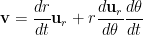
{\bf v} = \displaystyle \frac{d}{dt} (r {\bf u}_r) = \displaystyle \frac{dr}{dt} {\bf u}_r + r \frac{d {\bf u}_r}{dt}

We now apply the Chain Rule to the second term:

{\bf v} = \displaystyle \frac{dr}{dt} {\bf u}_r + r \frac{d {\bf u}_r}{d\theta} \frac{d\theta}{dt}

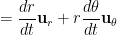
= \displaystyle \frac{dr}{dt} {\bf u}_r + r \frac{d\theta}{dt} {\bf u}_\theta.

Differentiating a second time with respect to time, and again using the Chain Rule, we find

{\bf a} = \displaystyle \frac{d {\bf v}}{dt} = \displaystyle \frac{d^2r}{dt^2} {\bf u}_r + \frac{dr}{dt} \frac{d{\bf u}_r}{dt} + \frac{dr}{dt} \frac{d\theta}{dt} {\bf u}_\theta + r \frac{d^2\theta}{dt^2} {\bf u}_\theta + r \frac{d\theta}{dt} \frac{d{\bf u}_\theta}{dt}

= \displaystyle \frac{d^2r}{dt^2} {\bf u}_r + \frac{dr}{dt} \frac{d{\bf u}_r}{d\theta} \frac{d\theta}{dt} + \frac{dr}{dt} \frac{d\theta}{dt} {\bf u}_\theta + r \frac{d^2\theta}{dt^2} {\bf u}_\theta +  r \frac{d\theta}{dt} \frac{d{\bf u}_\theta}{d\theta} \frac{d\theta}{dt}

= \displaystyle \frac{d^2r}{dt^2} {\bf u}_r + \frac{dr}{dt} \frac{d\theta}{dt} {\bf u}_\theta  + \frac{dr}{dt} \frac{d\theta}{dt} {\bf u}_\theta + r \frac{d^2\theta}{dt^2} {\bf u}_\theta -  r \left(\frac{d\theta}{dt} \right)^2 {\bf u}_r

= \displaystyle \left[ \frac{d^2r}{dt^2} -  r \left(\frac{d\theta}{dt} \right)^2 \right] {\bf u}_r + \left[ 2\frac{dr}{dt} \frac{d\theta}{dt} + r \frac{d^2\theta}{dt^2} \right] {\bf u}_\theta.

This will be needed in the next post, when we use both Newton’s Second Law and Newton’s Law of Gravitation, expressed in polar coordinates.

Confirming Einstein’s Theory of General Relativity With Calculus, Part 4a: Angular Momentum

In this series, I’m discussing how ideas from calculus and precalculus (with a touch of differential equations) can predict the precession in Mercury’s orbit and thus confirm Einstein’s theory of general relativity. The origins of this series came from a class project that I assigned to my Differential Equations students maybe 20 years ago.

In this part of the series, we will show that if the motion of a planet around the Sun is expressed in polar coordinates (r,\theta), with the Sun at the origin, then under Newtonian mechanics (i.e., without general relativity) the motion of the planet follows the differential equation

u''(\theta) + u(\theta) = \displaystyle \frac{1}{\alpha},

where u = 1/r and \alpha is a certain constant. Deriving this governing differential equation will require some principles from physics. If you’d rather skip the physics and get to the mathematics, we’ll get to solving this differential equations in a few posts.

One principle from physics that we’ll need is the Law of Conservation of Angular Momentum. Mathematically, this is expressed by

mr^2 \displaystyle \frac{d\theta}{dt} = \ell,

where \ell is a constant. Of course, this can be written as

\displaystyle \frac{d\theta}{dt} = \displaystyle \frac{\ell}{mr^2};

this will be used a couple times in the derivation below.

As we’ll soon see, we will need to express the second derivative \displaystyle \frac{d^2 r}{d t^2} in a form that depends only on \theta. To do this, we use the Chain Rule to obtain

r' = \displaystyle \frac{dr}{dt}

= \displaystyle \frac{dr}{d\theta} \cdot \frac{d\theta}{dt}

= \displaystyle \frac{\ell}{mr^2} \frac{dr}{d\theta}

= \displaystyle - \frac{\ell}{m} \frac{d}{d\theta} \left( \frac{1}{r} \right).

This last step used the Chain Rule in reverse:

\displaystyle \frac{d}{d\theta} \left( \frac{1}{r} \right) = \frac{d}{dr} \left( \frac{1}{r} \right) \cdot \frac{dr}{dt} = -\frac{1}{r^2} \cdot \frac{dr}{dt}.

To examine the second derivative \displaystyle \frac{d^2 r}{d t^2}, we again use the Chain Rule:

\displaystyle \frac{d^2 r}{d t^2} = \displaystyle \frac{dr'}{dt}

= \displaystyle \frac{dr'}{d\theta} \cdot \frac{d\theta}{dt}

= \displaystyle \frac{\ell}{mr^2} \frac{dr'}{d\theta}

= \displaystyle \frac{\ell}{mr^2} \frac{d}{d\theta} \left[ \frac{dr}{dt} \right]

= \displaystyle \frac{\ell}{mr^2} \frac{d}{d\theta} \left[ - \frac{\ell}{m} \frac{d}{d\theta} \left( \frac{1}{r} \right) \right]

= \displaystyle - \frac{\ell^2}{m^2r^2} \frac{d}{d\theta} \left[ \frac{d}{d\theta} \left( \frac{1}{r} \right) \right]

= \displaystyle - \frac{\ell^2}{m^2r^2} \frac{d^2}{d\theta^2}  \left( \frac{1}{r} \right) .

While far from obvious now, this will be needed when we rewrite Newton’s Second Law in polar coordinates.

Confirming Einstein’s Theory of General Relativity With Calculus, Part 2d: Hyperbolas and Polar Coordinates

In this series, I’m discussing how ideas from calculus and precalculus (with a touch of differential equations) can predict the precession in Mercury’s orbit and thus confirm Einstein’s theory of general relativity. The origins of this series came from a class project that I assigned to my Differential Equations students maybe 20 years ago.

In a previous post, we showed that the polar equation

r = \displaystyle \frac{a}{1 + e \cos \theta}

is equivalent to the rectangular equation

\displaystyle \frac{\left(x + \displaystyle \frac{\alpha e}{1-e^2} \right)^2}{\displaystyle \frac{\alpha^2}{(1-e^2)^2}} + \frac{y^2}{\displaystyle \frac{\alpha^2}{1-e^2}} = 1

as long as e \ne 0. Furthermore, if 0 < e < 1, then this represents an ellipse with eccentricity e whose major axis lies on the x-axis, with one focus located at the origin.

While not directly related to our discussion of precession, it turns out that this equation represents a hyperbola if e > 1. Under this assumption, 1-e^2 < 0 and e^2-1>0, so let me rewrite the previous equation in terms of e^2-1:

\displaystyle \frac{\left(x - \displaystyle \frac{\alpha e}{e^2-1} \right)^2}{\displaystyle \frac{\alpha^2}{(e^2-1)^2}} - \frac{y^2}{\displaystyle \frac{\alpha^2}{e^2-1}} = 1

This matches the form of a left-right hyperbola

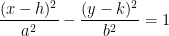
\displaystyle \frac{(x-h)^2}{a^2} - \frac{(y-k)^2}{b^2} = 1,

where the center of the hyperbola is located at

(h,k) = \displaystyle \left(  \frac{\alpha e}{e^2-1} , 0 \right)

Also, for a hyperbola, the distance c from the center to the foci satisfies

c^2 = a^2 + b^2,

so that

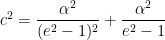
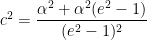
c^2 = \displaystyle \frac{\alpha^2}{(e^2-1)^2} + \displaystyle \frac{\alpha^2}{e^2-1}

c^2 = \displaystyle \frac{\alpha^2 + \alpha^2 (e^2 - 1)}{(e^2-1)^2}

c^2 = \displaystyle \frac{\alpha^2 e^2}{(e^2-1)^2}

c = \displaystyle \frac{\alpha e}{e^2-1}

The two foci are located a distance c to the left of the right of the center. Since it happened to happen that c = h, this means that the origin is, once again, one of the foci of the hyperbola.

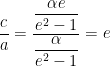
Furthermore, the eccentricity c/a of the hyperbola is easily computed as

\displaystyle \frac{c}{a} = \frac{ \displaystyle \frac{\alpha e}{e^2-1} }{ \displaystyle \frac{\alpha}{e^2-1}} = e,

so that, once again, the well-chosen parameter e is the eccentricity.

Confirming Einstein’s Theory of General Relativity With Calculus, Part 2c: Circles, Parabolas, and Polar Coordinates

In this series, I’m discussing how ideas from calculus and precalculus (with a touch of differential equations) can predict the precession in Mercury’s orbit and thus confirm Einstein’s theory of general relativity. The origins of this series came from a class project that I assigned to my Differential Equations students maybe 20 years ago.

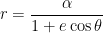
In the previous post, we showed that the polar equation

r = \displaystyle \frac{\alpha}{1 + e \cos \theta}

converts to

x^2 (1-e^2) + 2 \alpha e x + y^2 = \alpha^2

in rectangular coordinates. Furthermore, if 0 < e < 1, then this represents an ellipse with eccentricity e whose semi-major axis lies along the x-axis with one focus at the origin.

It turns out that, for different non-negative values of e, the same polar equation represents different conic sections. These are not particularly relevant for our study of precession, but I’m including this anyway in this series as a small tangential discussion.

Let’s take a look at the easy case of e = 0. With this substitution, the equation in rectangular coordinates simplifies to

x^2 + y^2 = \alpha^2.

Of course, this is the equation of a circle that is centered at the origin with radius \alpha.

The other easy case is e = 1, so that 1-e^2 = 0. Then the equation in rectangular coordinates simplifies to

2 \alpha x + y^2 = \alpha^2

y^2 = -2\alpha x + \alpha^2

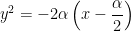
y^2 = -2 \alpha \displaystyle  \left( x - \frac{\alpha}{2} \right)

y^2 = -4 \cdot \displaystyle \frac{\alpha}{2}  \left( x - \frac{\alpha}{2} \right)

This matches the form of a parabola that opens to the left with a horizontal axis of symmetry:

(y-k)^2 = -4 p (x-h).

In this case, the vertex of the parabola is located at

(h,k) = \displaystyle \left( \frac{\alpha}{2} , 0 \right),

while the focus of the parabola is located a distance p = \displaystyle \frac{\alpha}{2} to the left of the vertex. In other words, the origin is the focus of the parabola. (For what it’s worth, the directrix of the parabola would be the vertical line y = \alpha, located p to the right of the vertex.)

Confirming Einstein’s Theory of General Relativity With Calculus, Part 2b: Ellipses and Polar Coordinates

In this series, I’m discussing how ideas from calculus and precalculus (with a touch of differential equations) can predict the precession in Mercury’s orbit and thus confirm Einstein’s theory of general relativity. The origins of this series came from a class project that I assigned to my Differential Equations students maybe 20 years ago.

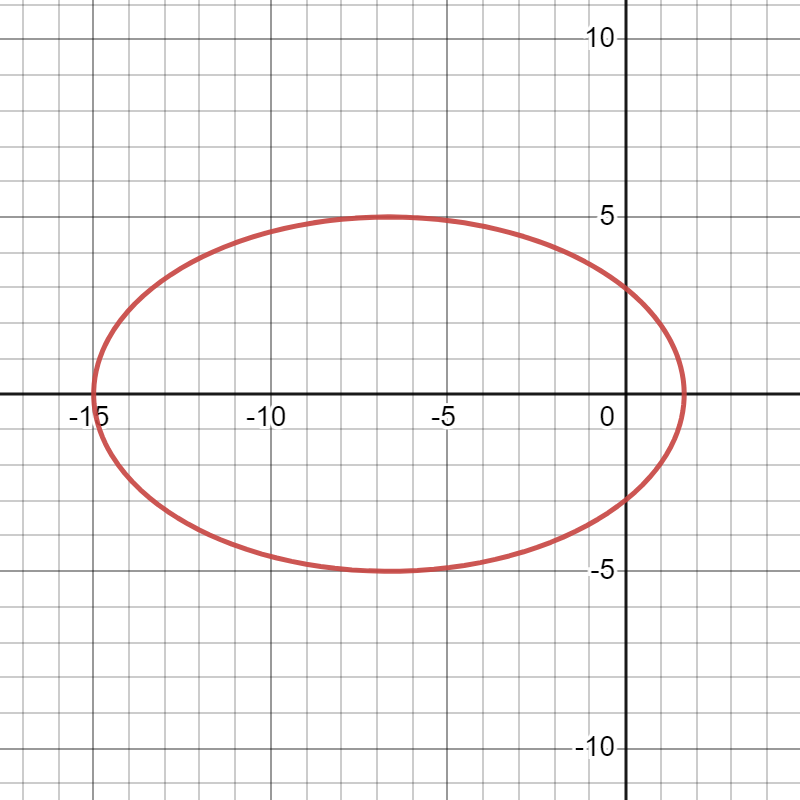
As part of our derivation, we’ll need to use the fact that, in polar coordinates, the graph of

r = \displaystyle \frac{\alpha}{1 + e \cos \theta}

turns out to be an ellipse if 0 < e < 1, with the origin at one focus.

We now prove this. Clearing the denominator, we obtain

r + re \cos \theta = \alpha.

Switching to rectangular coordinates, this becomes

\sqrt{x^2 + y^2} + e x = \alpha

\sqrt{x^2 + y^2} = \alpha - ex

x^2 + y^2 = (\alpha - ex)^2

x^2 + y^2 = \alpha^2 - 2\alpha ex + e^2 x^2

x^2 (1-e^2) + 2 \alpha e x + y^2 = \alpha^2

(1-e^2)\left(x^2 + 2 \displaystyle \frac{\alpha e}{1-e^2} x \right) + y^2 = \alpha^2

(1-e^2)\left(x^2 + 2 \displaystyle \frac{\alpha e}{1-e^2} x + \frac{\alpha^2 e^2}{(1-e^2)^2} \right) + y^2 = \alpha^2 + \displaystyle \frac{\alpha^2e^2}{1-e^2}

(1-e^2) \left(x + \displaystyle \frac{\alpha e}{1-e^2} \right)^2 + y^2 = \displaystyle \frac{\alpha^2(1-e^2)+\alpha^2 e^2}{1-e^2}

(1-e^2) \left(x + \displaystyle \frac{\alpha e}{1-e^2} \right)^2 + y^2 = \displaystyle \frac{\alpha^2}{1-e^2}

\displaystyle \frac{(1-e^2)^2}{\alpha^2} \left(x + \displaystyle \frac{\alpha e}{1-e^2} \right)^2 + \frac{1-e^2}{\alpha^2} y^2 = 1

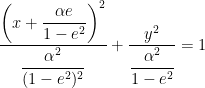
\displaystyle \frac{\left(x + \displaystyle \frac{\alpha e}{1-e^2} \right)^2}{\displaystyle \frac{\alpha^2}{(1-e^2)^2}} + \frac{y^2}{\displaystyle \frac{\alpha^2}{1-e^2}} = 1

Since we assumed that 0 < e < 1, we have 0 < 1 - e^2 < 1 so that

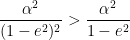
\displaystyle \frac{\alpha^2}{(1-e^2)^2} > \displaystyle \frac{\alpha^2}{1-e^2}.

Therefore, this matches the usual form of an ellipse in rectangular coordinates

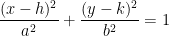
\displaystyle \frac{(x-h)^2}{a^2} + \frac{(y-k)^2}{b^2} = 1,

where the center of the ellipse is located at

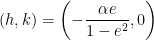
(h,k) = \displaystyle \left( -\displaystyle \frac{\alpha e}{1-e^2}, 0 \right),

the semi-major axis is horizontal with length

a = \displaystyle \frac{\alpha}{1-e^2},

and the semi-minor axis is vertical with length

b = \displaystyle \frac{\alpha}{\sqrt{1-e^2}}.

Furthermore, the distance c of the foci from the center of the ellipse satisfies the equation

b^2 + c^2 = a^2,

so that

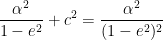
\displaystyle \frac{\alpha^2}{1-e^2} + c^2 = \displaystyle \frac{\alpha^2}{(1-e^2)^2}

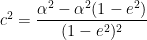
c^2 = \displaystyle \frac{\alpha^2}{(1-e^2)^2} - \displaystyle \frac{\alpha^2}{1-e^2}

c^2 = \displaystyle \frac{\alpha^2 - \alpha^2(1-e^2)}{(1-e^2)^2}

c^2 = \displaystyle \frac{\alpha^2 e^2}{(1-e^2)^2}

c = \displaystyle \frac{\alpha e}{1-e^2}

From this, we derive two nice properties of the ellipse. First, looking back on previous work, we see that c = -h. Therefore, since the foci of the ellipse are distance c away from the center along the major axis, we conclude that one focus of the ellipse is located at (-h+c,0), or (0,0). That is, the origin is one focus of the ellipse. (For the little it’s worth, the other focus is located at (-2h,0).

Second, the eccentricity of the ellipse is defined to be the ratio c/a. This is now easily computed:

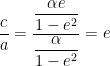
\displaystyle \frac{c}{a} = \displaystyle \frac{\displaystyle \frac{\alpha e}{1-e^2}}{\displaystyle \frac{\alpha}{1-e^2}} = e.

In other words, the letter e was well-chosen to represent the eccentricity of the ellipse.

For what it’s worth, here’s an alternate derivation of the formulas for a and b. For this ellipse, the planet’s closest approach to the Sun occurs at \theta = 0:

r(0) = \displaystyle \frac{\alpha}{1 + e \cos 0} = \frac{\alpha}{1 + e},

and the planet’s further distance from the Sun occurs at \theta = \pi:

r(\pi) = \displaystyle \frac{\alpha}{1 + e \cos \pi} = \frac{\alpha}{1 - e}.

Therefore, the length 2a of the major axis of the ellipse is the sum of these two distances:

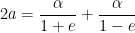
2a =  \displaystyle \frac{\alpha}{1 + e} +  \frac{\alpha}{1 - e}

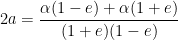
2a = \displaystyle \frac{\alpha(1-e) + \alpha(1+e)}{(1 + e)(1 -e)}

2a= \displaystyle \frac{2\alpha}{1  - e^2}

a =  \displaystyle \frac{\alpha}{1  - e^2}.

Since c = a\epsilon, we can also compute b:

b^2 = a^2 - c^2

b^2 = a^2 - a^2 e^2

b^2 = a^2 ( 1-e^2)

b^2 = \displaystyle \frac{\alpha^2}{(1  - e^2)^2} (1-e^2)

b^2 = \displaystyle \frac{\alpha^2}{1  - e^2}

b =  \displaystyle \frac{\alpha}{\sqrt{1  - e^2}}