Today is one of the high points of the American sports calendar: the AFC and NFC championship games to determine who plays in the Super Bowl.
A major pet peeve of mine while watching sports on TV: football announcers who “explain” that a receiver made a great reception because “he caught the ball at its highest point.”
Ignoring the effects of air resistance, the trajectory of a thrown football is parabolic, and the ball is the essentially the same height above the ground when it is either thrown or caught. (Yes, there might be a difference of at most three feet, but that’s negligible compared to the distance that a football is typically thrown.) Therefore, a football reaches the highest point of its trajectory approximately halfway between the quarterback and the receiver.
And anyone who can catch the ball that far above the ground should be immediately tested for steroids.
In my capstone class for future secondary math teachers, I ask my students to come up with ideas for engaging their students with different topics in the secondary mathematics curriculum. In other words, the point of the assignment was not to devise a full-blown lesson plan on this topic. Instead, I asked my students to think about three different ways of getting their students interested in the topic in the first place.
I plan to share some of the best of these ideas on this blog (after asking my students’ permission, of course).
This student submission again comes from my former student Tiffany Wilhoit. Her topic, from Algebra: graphing parabolas.
How did people’s conception of this topic change over time?
The parabola has been around for a long time! Menaechmus (380 BC-320 BC) was likely the first person to have found the parabola. Therefore, the parabola has been around since the ancient Greek times. However, it wasn’t until around a century later that Apollonius gave the parabola its name. Pappus (290-350) is the mathematician who discovered the focus and directrix of the parabola, and their given relation. One of the most famous mathematicians to contribute to the study of parabolas was Galileo. He determined that objects falling due to gravity fall in parabolic pathways, since gravity has a constant acceleration. Later, in the 17th century, many mathematicians studied properties of the parabola. Gregory and Newton discovered that parabolas cause rays of light to meet at a focus. While Newton opted out of using parabolic mirrors for his first telescope, most modern reflecting telescopes use them. Mathematicians have been studying parabolas for thousands of years, and have discovered many interesting properties of the parabola.
How could you as a teacher create an activity or project that involves your topic?
A fun activity to set up for your students will include several boxes and balls, for a smaller set up, you can use solo cups and ping pong balls. Divide the class into groups, and give each group a set of boxes and balls. First, have the students set up a tower(s) with the boxes. The students will now attempt to knock the boxes down using the balls. The students can map out the parabolic curve showing the path they want to take. By changing the distance from the student throwing the ball and the boxes, the students will be able to see how the curve changes. If students have the tendency to throw the ball straight instead of in the shape of a parabola, have a member of the group stand between the thrower and the boxes. This will force the ball to be thrown over the student’s head, resulting in the parabolic curve. The students can also see what happens to the curve depending on where the student stands between the thrower and boxes. In order for the students to make a positive parabolic curve, have them throw the ball underhanded. This activity will engage the students by getting them involved and active, plus they will have some fun too! (To start off with, you can show the video from part E1, since the students are playing a real life version of Angry Birds!)
How can technology be used to effectively engage students with this topic?
A great video to show students before studying parabolas can be found on YouTube:
The video uses the popular game Angry Birds to introduce parabolic graphs. First, the video shows the bird flying a parabolic path, but the bird misses the pig. The video goes on to explain why the pig can’t be hit. It does a good job of explaining what a parabola is, why the first parabolic curve would not allow the bird to hit the pig, and how to change the curve to line up the path of the bird to the pig. This video would be interesting to the students, because a majority of the class (if not all) will know the game, and most have played the game! The video goes even further by encouraging students to look for parabolas in their lives. It even gives other examples such as arches and basketball. This will get the students thinking about parabolas outside of the classroom. (This video would be perfect to show before the students try their own version of Angry Birds discussed in part A2)
In my capstone class for future secondary math teachers, I ask my students to come up with ideas for engaging their students with different topics in the secondary mathematics curriculum. In other words, the point of the assignment was not to devise a full-blown lesson plan on this topic. Instead, I asked my students to think about three different ways of getting their students interested in the topic in the first place.
I plan to share some of the best of these ideas on this blog (after asking my students’ permission, of course).
This student submission comes from my former student Banner Tuerck. His topic, from Precalculus: finding the equation of a parabola from the focus and directrix.
An interesting way to present the mathematics behind parabolas and their focus points is through the applications it has in science present in our everyday lives. http://spacemath.gsfc.nasa.gov/IRAD/IRAD-4.pdf
The above link includes a great engagement activity for students to do as a group activity. The first exercise presented involves the students in the design of a parabolic dish after observing the properties of a satellite dish with a radio receiver (located at the focus). Once the students have completed the design of the parabolic dish the instructor could then use the second half of the pdf from the link as an elaboration activity. The instructor could either keep the students in the groups or have them work the problems individually. Nevertheless, the second activity would be for the students to work problems one and two, which deal with aiding a bird watcher and a hobbiest in determining the focus points in order to design their parabolically shaped tools. The last problems are excellent real world examples of why one would need to know and apply the mathematics for parabolas. This will encourage students to view everyday objects with a more mathematical respect.
The understanding of the relationship between the focus point and the directrix of a standard parabola is fundamental when students extend their mathematical and science education in post-secondary courses. For example, when students reach multivariable calculus they will graph and study the properties of conic sections on a three dimensional scale. With respect to this topic the students can apply their preexisting knowledge of two-dimensional parabolas to the paraboloids presented in this course. Furthermore, if students from a pre-calculus high school course were to not keep with the theoretical study of mathematics they could benefit greatly from this topic in careers such as architecture, art, or graphic design.
As an instructor of a pre-calculus course one has many technological resources to use in order to construct an elaborate lesson on the directrix and focus of a parabola. For example, modern graphing calculators allow instructors to link their calculator to a projector and show the entire class various parabolas in order to further visualize the changing distances to these specific points. Furthermore, I believe a unique homework assignment would be for students to graph given quadratic equations with an online resource such as http://www.wolframalpha.com/. This assignment would also be a great review of how to apply the distance formula. I recommend having the students check that the points on the parabola are equidistant apart from the focus and the directrix they have already found after graphing and computing. Another idea is requesting (for full credit of the assignment) the students use the following link: https://www.khanacademy.org/math/algebra2/conics_precalc/parabolas_precalc/v/parabola-focus-and-directrix-1
to facilitate their understanding of the definition of a parabola as well as the importance of the focus point and directrix line. This is a way to involve technology while simultaneously ensuring that students review key aspects of the lesson after it was given by the instructor during class time.
In my capstone class for future secondary math teachers, I ask my students to come up with ideas for engaging their students with different topics in the secondary mathematics curriculum. In other words, the point of the assignment was not to devise a full-blown lesson plan on this topic. Instead, I asked my students to think about three different ways of getting their students interested in the topic in the first place.
I plan to share some of the best of these ideas on this blog (after asking my students’ permission, of course).
This student submission comes from my former student Christine Gines. Her topic, from Precalculus: finding the equation of a parabola from the focus and directrix.
How can technology be used to effectively engage students with this topic?
Beginning the class with a short clip involving a certain topic is a great way to start and engage a classroom for several reasons. First of all, videos can achieve things that a teacher can’t in a limited classroom. Also, videos save preparation time for the teacher and students just like watching videos in general! Youtube.com is, if not the, one of the largest video sharing websites. You can find videos on just about any topic and for this reason, I recommend it.
On youtube I found a great introductory video parabola involving the focus of a parabola. This video does a fantastic job of engaging viewers by demonstrating the effects of concentrated sunlight by melting metal, stone, and setting wood on fire. Not only does this video grasp students’ attention, but it also raises a sense of curiosity by not explaining what is happening. After watching, students will ideally be eager to find answers at which point the teacher could introduce the topic and let students explore their questions.
How could you as a teacher create an activity or project that involves your topic?
Deriving the equation of a parabola may seem like a procedural concept, but it doesn’t have to be. The following activity is an example of how you can let students explore this concept visually and kinesthetically.
The only materials you will need are wax paper and pencils for each student. The instructions are as follows:
Draw a line about 2cm above the edge of the wax paper.
Fix a point above the line
Draw several point on the fixed line
Fold each point on the line so that it touches the fixed point above the line
This is what the activity should look like:
This activity lets students explore the relationship between the directrix and the focus. A good follow-up to this activity is a peer-to-peer discussion of why a parabola was created. Ask them questions like, “Where is the vertex of this parabola in relation to the line and fixed point?” or “Can you find a relationship between this activity and the video that melted stone?” The activity benefits all types of learners and challenges students to find a deeper understanding, rather than simply following algebraic steps
How did people’s conception of this topic change over time?
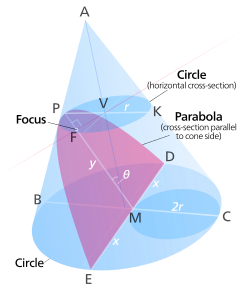
The discovery of the conics section can be traced back to Ancient Greece, when Menaechmus (pupil of Eudoxus and tutor of Alexander the Great) was puzzled with mathematical problem of doubling a cube. While attempting to solve this problem, Menaechmus discovered the conics section. This happened around 360-350 B.C. He was also the first to demonstrate that parabolas can be obtained by cutting a cone in a plane that was not parallel to the base, like so:
Parabolas at this time were only a mathematical concept to be studied and not put to use in the real world. It wasn’t until Pappus came along and discovered the focus and directrix property, that parabolas were noticed for their practical use. This discovery led to many applications of parabolas. Just a few examples include telescopes, satellites, microphones, and even bridges.
In my capstone class for future secondary math teachers, I ask my students to come up with ideas for engaging their students with different topics in the secondary mathematics curriculum. In other words, the point of the assignment was not to devise a full-blown lesson plan on this topic. Instead, I asked my students to think about three different ways of getting their students interested in the topic in the first place.
I plan to share some of the best of these ideas on this blog (after asking my students’ permission, of course).
This student submission comes from my former student Claire McMahon. Her topic, from Precalculus: parabolas.
The parabola took a long time to get to us and took a few thinkers to really get the idea down. This website that I found really nailed the dates and also simplified the rational that led up to the parabola as we know it today. The history of the parabola is as follows:
The parabola was explored by Menaechmus (380 BC to 320 BC), who was a pupil of Plato and Eudoxus. He was trying to duplicate the cube by finding the side of the cube that has an area double the cube. Instead, Menaechmus solved it by finding the intersection of the two parabolas x2=y and y2=2x. Euclid (325 BC to 265 BC) wrote about the parabola. Apollonius (262 BC to 190 BC) named the parabola. Pappus (290 to 350) considered the focus and directrix of the parabola. Pascal (1623 to 1662) considered the parabola as a projection of a circle. Galileo (1564 to 1642) showed that projectiles falling under uniform gravity follow parabolic paths. Gregory (1638 to 1675) and Newton (1643 to 1727) considered the properties of a parabola.
This really got me to thinking what it really took to figure out the derivation of the formula and even for the graph of the parabola. I find it interesting that the idea had to travel through seven genius minds to come to all of the properties that the parabola holds to this day.
This same website led me to another use of the parabola, other than to describe a projectile’s path. The use of suspension bridges relies heavily on a parabolic model. Other parabolic models would include the satellite dishes and even all types of lights. Have you ever thought that every single place that light bulb reflects is a reflection off a point from the focus to the parabola to create your beam of light!! Pretty cool!! So you might ask why do I need to know anything about parabolas? There is your answer; it’s used in everyday life. Here are a couple of examples from the website that I found interesting:
One of the “real world” applications of parabolas involves the concept of a 3D parabolic reflector in which a parabola is revolved about its axis (the line segment joining the vertex and focus). The shape of car headlights, mirrors in reflecting telescopes, and television and radio antennae (such as the one below) all utilize this property.
Antenna of a Radio Telescope
All incoming rays parallel to the axis of the parabola are reflected through the focus.
Flashlights & Headlights
In terms of a car headlight, this property is used to reflect the light rays emanating from the focus of the parabola (where the actual light bulb is located) in parallel rays.
Here are the specs on the suspension bridge:
Hold up a chain by both ends and you’ll get a curve. What kind of curve is it? You might say it is a parabola – Galileo Galili believed it was a parabola. Yet, Galileo was wrong!!!! That curve is NOT a parabola. It is a catenary.It makes sense that you would think that the curved chain is a parabola. Both the catenary and the parabola have similar properties. Both curves have a single low point. They both have a vertical line of symmetry, they at least appear to be continuous and differentiable throughout, and the slope is steeper as we move away from the low point, but it never becomes vertical.So, how is the curve of the cable in a suspension bridge a parabola? When the structure is being built and the main cables are attached to the towers, the curve is a catenary. But when the cables are attached to the deck with hangers, it is no longer a catenary. The curve of the cables become the curve of a parabola. Unlike the catenary, which is curving under its own weight, the parabola is curving not just under its own weight, but also curving from holding up the weight of the deck. The cable of a suspension bridge is under tension from holding up the bridge.Therefore, the cables of a suspension bridge is a parabola, because the weight of the deck is equally distributed on the curve.
I never really knew that there was a difference between the two and now I know that there are certain properties that made it down through the ages that hold true today. This was a very enlightening subject matter.


 Mean Green Math